Looking for a Shorter Overview?
AI Summary
Key Moments
Timing review requests for best response
Ask for reviews only after customers have had enough time to experience the product or service.Choosing the right communication channel
Use SMS for quick responses, email for detailed asks, and in-app prompts for immediate engagement.Ensuring compliance with FTC rules
Avoid fake reviews and disclose incentives clearly to follow recent FTC regulations.Building sustainable review collection workflows
Create simple, event-triggered sequences with frequency limits to keep reviews coming consistently.You've got a happy customer, the work is done, and now comes the awkward part. Do you ask for a review right away, wait a few days, or let it happen naturally and hope they remember?
That moment matters more than most businesses think. People don't ignore review requests because they hate the brand, they ignore them when the ask arrives at the wrong time, in the wrong channel, or with too much pressure attached.
Why Asking for Reviews Matters More Than Ever
A customer finishes the job, the package lands on the porch, or the software trial goes live. A review request hits their inbox before they've even had time to judge the experience, and what should feel like a helpful nudge suddenly feels pushy. That's the tension that arises when they're asking for reviews.
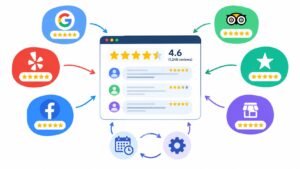
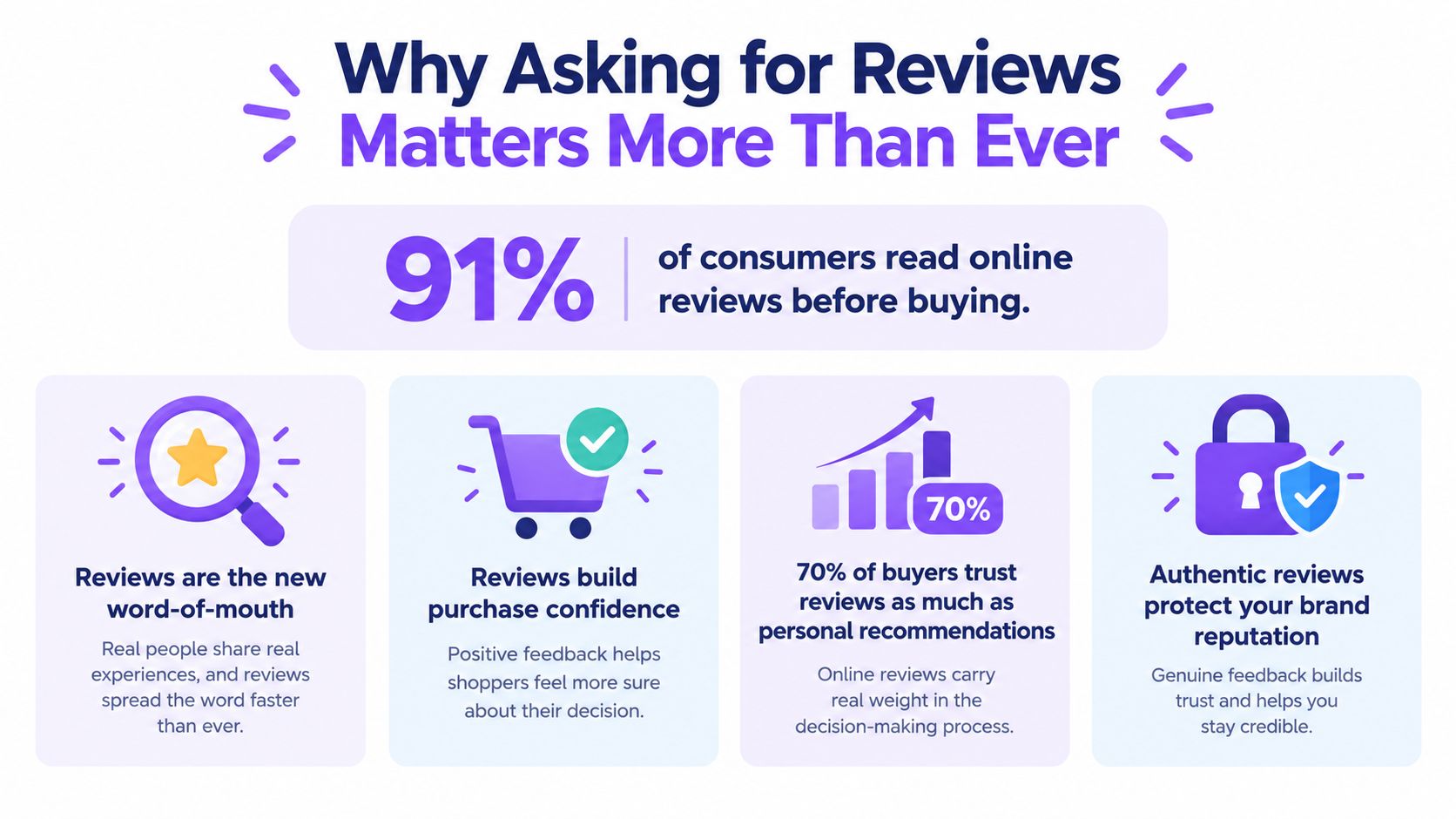
The stakes are higher now because shoppers lean on reviews before they buy. A 2016 Pew Research Center survey found that 82% of U.S. adults read online customer ratings or reviews before buying something for the first time, and 40% said they always or almost always do so. The same study found 46% of Americans felt reviews help consumers feel confident about purchases, while broader OECD-cited evidence says around 70% of consumers across 23 countries consider ratings and reviews important or very important to transactions, which makes review requests a trust-building task, not a vanity task. Those figures are summarized in the linked reference from the Pew-related discussion: Pew Research Center survey discussion.
Reviews now carry more weight than a branded claim
The old habit was to wait for organic praise. That works eventually, but it leaves trust to chance. Requested reviews tend to show up in the same buying window where shoppers are comparing options, which is exactly when social proof has the most impact.
Practical rule: if the review arrives after the experience has become clear in the customer's mind, it feels relevant. If it arrives before that, it feels like a chore.
There's another reason to be deliberate. ReviewTrackers reported that reviews generated from review requests averaged 4.34 stars out of 5, compared with 3.89 stars for unprompted reviews. The same review-tracking source also notes that 54% of consumers trust online reviews first, ahead of friends and family at 24%, company claims at 18%, and influencers or media at 2% each, with 77% saying reviews are mostly trustworthy. That makes the ask itself part of your brand's credibility engine. ReviewTrackers customer reviews stats
Freshness changes how buyers filter
Recent review behavior is tighter than it used to be. BrightLocal reports that in 2026, 41% of consumers “always” read reviews when browsing businesses, up from 29% the prior year, and it notes a sharper rise in people only considering businesses with 4.5+ stars. That means stale review profiles can feel less convincing even when the underlying service is solid, so the timing of each request matters as much as the wording. BrightLocal local consumer review survey
The takeaway is simple. Review volume, recency, and tone all affect whether a future buyer trusts you enough to convert. Asking at the right moment isn't a side task anymore, it's part of the sales process.
When to Ask for Reviews Without Hurting Response Rates
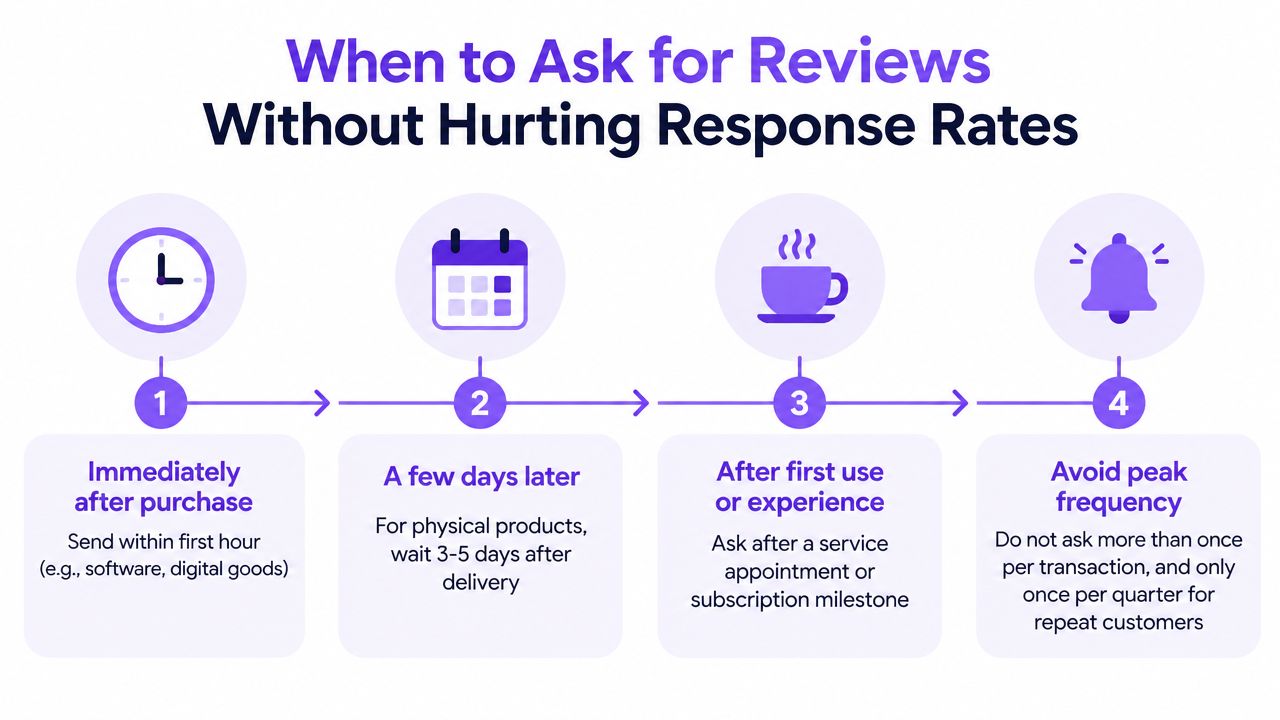
Timing is where most review programs either pick up momentum or stall. A request sent too early can interrupt the customer's reflection window, while one sent too late arrives after the positive feeling has already faded. The right move depends on the type of transaction, not on a generic “send it soon” rule.
The clearest pattern is that more immediate is not always more effective. A large independent review-solicitation study found that solicitations sent within 24 hours of a transaction were less effective than no request at all, while requests sent 9 or 14 days later performed better. It also showed a non-linear response curve, with 1-day prompts producing 6% review rates versus 12% in the no-prompt control, while 9-day and 14-day prompts recovered to 3% and 2% respectively. The study's practical lesson is that customers often need time to process the experience before they're ready to write about it. When is the right time to ask for customer reviews
Match the ask to the journey type
Fast-consumption services can justify a near-term prompt because the customer has already felt the result. Durable goods, subscriptions, and multi-step services usually need more breathing room, because the buyer has to use the product, live with the outcome, or see the full service cycle before they can give a useful review.
A simple way to think about it:
- Immediate or near-immediate asks: useful for software, digital goods, and completed service calls where the value is obvious fast.
- Delayed asks: better for delivered physical products, longer implementations, and anything the customer needs to experience first.
- Milestone-based asks: useful after the first session, first outcome, or first replenishment, when the customer can judge quality without guessing.
Ask after the experience has had time to become a memory, not while it's still just a transaction.
Avoid frequency that turns into fatigue
The other mistake is not timing alone, it's repetition. Asking too often makes the brand feel needy, and repeat customers start to tune out every message if they see the same ask after every order. A clean cadence keeps trust intact.
For repeat buyers, the practical guardrail is to space requests so they feel tied to meaningful moments, not every touchpoint. If you want a simple way to sanity-check timing by order type and customer rhythm, use the review velocity calculator before launching a sequence.
When in doubt, ask after satisfaction has formed, not when momentum is merely convenient for your team. The strongest review programs are paced around the customer's experience, not the sender's calendar.
Choosing the Right Channel for Your Review Requests
Channel choice changes the shape of the response. A great message sent in the wrong place often underperforms a decent message sent where the customer already pays attention. Email, SMS, and in-app prompts each play a different role, and they shouldn't be treated as interchangeable.
One benchmark report observed SMS review requests at 42% response versus 9% for email, with response rates falling as elapsed time increases from 0 to 2 hours at 42%, to 24 to 48 hours at 11%, and 48+ hours at 6%. A separate benchmark set reported email open rates of only 15% to 25% for testimonial or review requests, while completion rates improved by 30% to 50% when messages were sent within 24 hours of a positive interaction. The practical read is obvious, fast mobile-native prompts win the moment, while email works better as a lower-pressure follow-up than as the only channel. SMS review requests outperform email benchmark
Compare the channels side by side
| Channel | Response Rate | Best Send Window | Ideal Use Case |
|---|---|---|---|
| SMS | 42% in the benchmark report | 0 to 2 hours after completion | Immediate post-service asks, appointment follow-ups, quick-turn transactions |
| 9% in the benchmark report | Within 24 hours, then as fallback | Longer-form requests, customers who prefer a written message, second-touch follow-up | |
| In-app | Not cited in the verified data | Right after a completed action or milestone | Product-led flows, software activation, task completion, success moments |
The table makes the trade-off plain. SMS gives you speed, email gives you room to explain, and in-app prompts fit naturally when the customer is already inside the product.
Build a short sequence, not a single blast
The strongest workflow is event-triggered, not batch-driven. Send the first ask through the channel most aligned with the moment, then use a second channel only if the customer doesn't respond. That sequence keeps the request visible without making it feel repetitive.
Best practice: one fast prompt, one softer follow-up, then stop. If the customer hasn't responded, more pressure usually creates less goodwill.
If your team needs a practical starting point for SMS structure and timing, the review request SMS tool can help draft a mobile-first version without making the message bloated.
A delayed email blast sent to everyone at once is usually the weakest option. It asks people to remember an experience long after the feeling has cooled, and by that point the window for useful feedback has already narrowed.
Messaging Templates That Make Saying Yes Easy
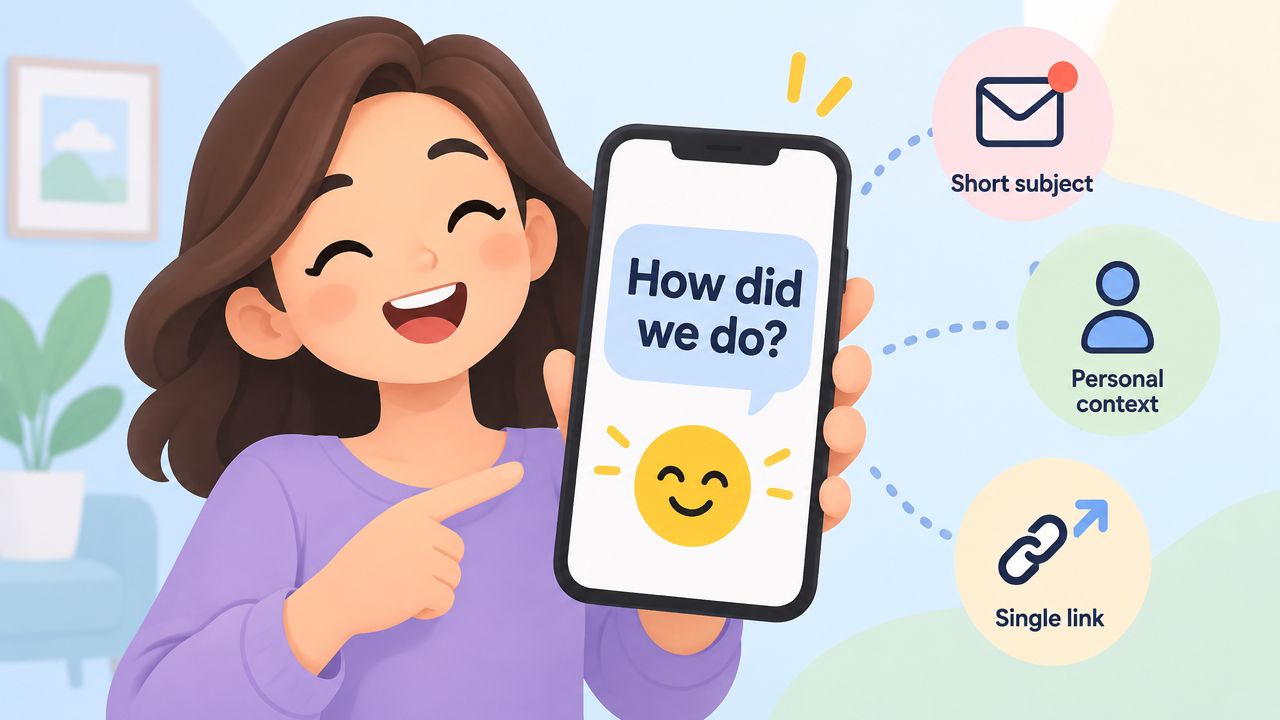
Strong review requests don't sound like marketing copy. They sound like a quick, human follow-up from someone who remembers the transaction and respects the customer's time. The best ones do four things at once, they're short, specific, low-pressure, and easy to act on.
The structure matters more than clever phrasing. Use a brief subject line or opening, mention the actual service or product, ask for one clear action, and make the link impossible to miss. That approach works because it reduces the effort of deciding what to do next.
Keep the ask specific and light
For email, the subject line should look like a normal follow-up, not a campaign. For SMS, the first line has to carry the whole message because there's no room for fluff. In-app prompts work best when they appear after a success moment, not before.
A usable email frame looks like this:
- Opening: thank the customer by name and reference the completed job, purchase, or support resolution.
- Ask: invite them to leave a quick review if they've got a minute.
- Link: include one direct path to the review form, not multiple options.
- Tone: keep it appreciative, not entitled.
A simple SMS version can be even tighter:
- Greeting: mention the completed service or delivered order.
- Request: ask if they'd be willing to share feedback.
- Action: add a single link.
- Close: thank them without overselling the impact.
Use wording that feels earned, not scripted
If the customer just got a problem solved, the message should acknowledge that. If they received a product, mention the item rather than a vague “recent purchase.” If the experience was support-led, connect the request to the service interaction instead of pretending it was a generic brand touchpoint.
For more practical phrasing ideas, the collection of proven review request examples for eCommerce is a useful reference point because it shows how the ask changes across delivery, product use, and follow-up timing. Use those patterns as structure, not as filler to copy verbatim.
You can also use the review request generator to draft a first pass, then edit out anything that sounds overly polished. The best requests still sound like they came from a real person who handled the account.
Incentives and Compliance Rules You Must Follow
A lot of businesses assume that giving something away will solve the review problem. That's risky thinking. Incentives can increase participation, but they can also destroy trust fast if they cross into fake, selective, or undisclosed review territory.
The FTC tightened the rules here. Its final rule on consumer reviews and testimonials was announced on August 14, 2024 and took effect on October 21, 2024. The rule specifically prohibits fake or false consumer reviews, including AI-generated fake reviews and reviews from people without real experience with the business or product, and it allows courts to impose civil penalties for knowing violations. FTC final rule announcement
The compliance line is narrower than many teams think
The FTC rule also restricts insider reviews. Company insiders must disclose their material connection to the business, and the rule bars insiders from soliciting reviews from family members. Businesses also can't ask employees to solicit reviews from their families. Alston summary of the FTC final rule
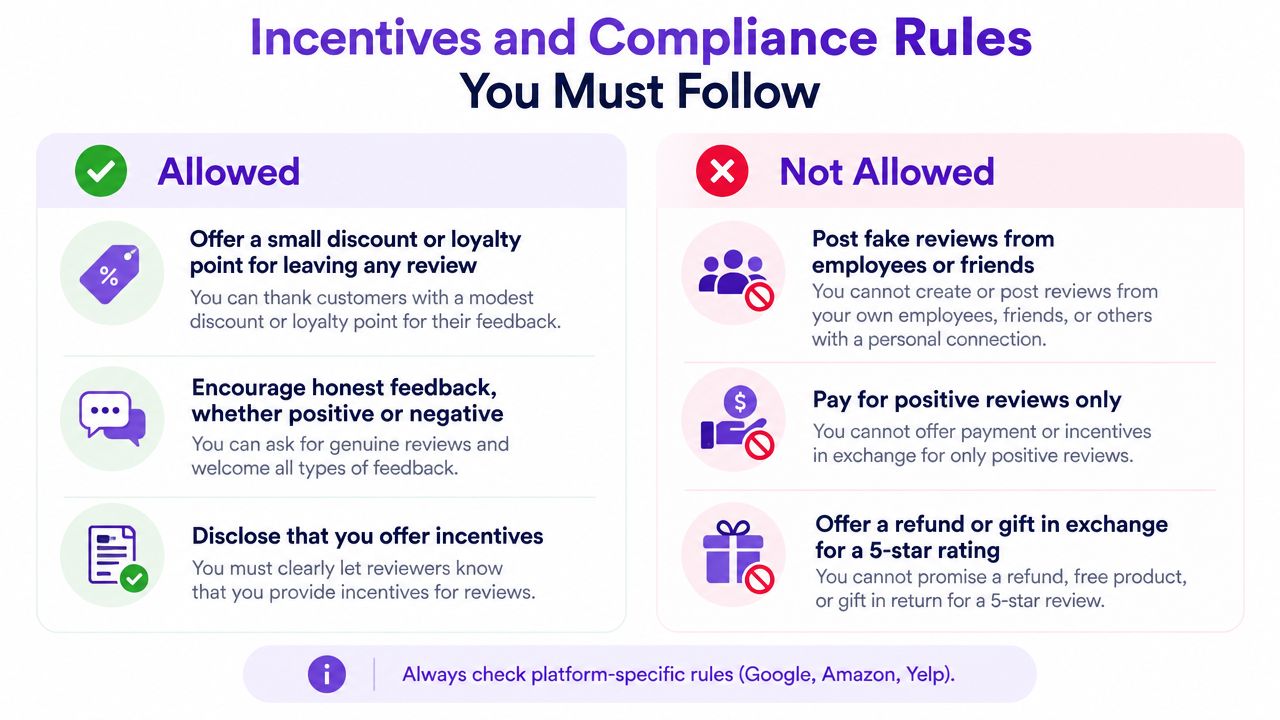
That means a few common shortcuts are off-limits. Paying for positive reviews, manufacturing praise from staff, or nudging only happy customers into posting without disclosure all create legal and reputational risk.
Safe alternatives still exist
You can still encourage honest feedback. You can still ask for a review after a service or purchase. You can still offer a non-contingent incentive if your platform and disclosure practices allow it, as long as the ask isn't tied to a positive rating only.
A clean compliance checklist looks like this:
- Ask for honest feedback only.
- Disclose any incentive clearly.
- Never request a five-star rating in exchange for anything.
- Don't use fake or experience-free reviewers.
- Check the platform rules before you launch.
The temptation is to push for more volume by lowering friction in the wrong places. That usually backfires. A smaller set of authentic reviews is worth far more than a profile that looks padded or manipulated.
Building a Repeatable System That Keeps Reviews Coming
Review collection works best when it runs like a workflow, not a mood. The team should know when the ask fires, which channel carries it, how often the same customer can be asked again, and where the resulting reviews get stored or displayed. If that sounds operational, it is, because the businesses that stay consistent usually remove manual chasing from the process.
For teams that want a broader automation mindset, marketing workflow automation strategies is a helpful reference for thinking about triggers, handoffs, and follow-up logic beyond just review asks. The same thinking applies here, set the trigger, choose the channel, define the fallback, and stop after the sequence is done.
Keep the workflow simple enough to maintain
Start with the event that matters most, delivery confirmed, appointment completed, issue resolved, or first product milestone reached. Then attach one request, not a barrage of messages. If the customer doesn't respond, mark the record and let the sequence end cleanly.
A practical system usually includes:
- Trigger logic: one request tied to a real customer moment.
- Channel routing: SMS first for speed, email as fallback, in-app where the product experience is already active.
- Frequency limits: no repeated nagging after the first ask for that transaction.
- Display layer: a central place to organize and reuse the best reviews on site.
Measure what matters, then tighten the loop
The numbers worth watching are simple. Look at response by channel, timing by transaction type, and whether the message feels relevant enough to earn a reply. If one segment keeps underperforming, the issue is usually timing, wording, or channel fit, not the customer's willingness to respond.
Bragly is one option for collecting, organizing, and displaying reviews in one place, with no-code widgets, source aggregation, tagging, and analytics that help keep social proof current across a site. That kind of setup removes the busywork of manual placement and makes fresh testimonials easier to keep visible.
The point isn't to ask more often. It's to ask well, at the right moment, and then make the results easy to reuse. Once that workflow is in place, review collection stops being a one-off campaign and becomes part of how the business keeps proving itself.
If you want to turn review requests into a repeatable system instead of another task on your to-do list, visit Bragly to collect, manage, and display customer reviews in one place. It gives you a practical way to keep fresh social proof visible without chasing every testimonial by hand.