

Looking for a Shorter Overview?
AI Summary
Key Moments
Meaning of Five-Star Reviews
Five-star ratings serve as trust cues only when backed by credible, detailed customer feedback.Historical Context of Star Ratings
The five-star system originated in travel publishing and evolved across industries, carrying different cultural meanings.Risks of Perfect Ratings
A flawless five-star average risks suspicion and mistrust if it lacks visible criticism or context.Ethical Review Collection Practices
Complying with FTC and platform rules requires honest, sentiment-neutral requests and retention of negative feedback.A perfect 5 star review can hurt conversion if it looks too clean. Buyers don't just read the score, they read the pattern, and they get suspicious when every signal screams perfection. The businesses that win treat five stars as proof, not polish, and they show enough texture for people to believe what they're seeing.
What a 5 Star Review Really Signals to Buyers
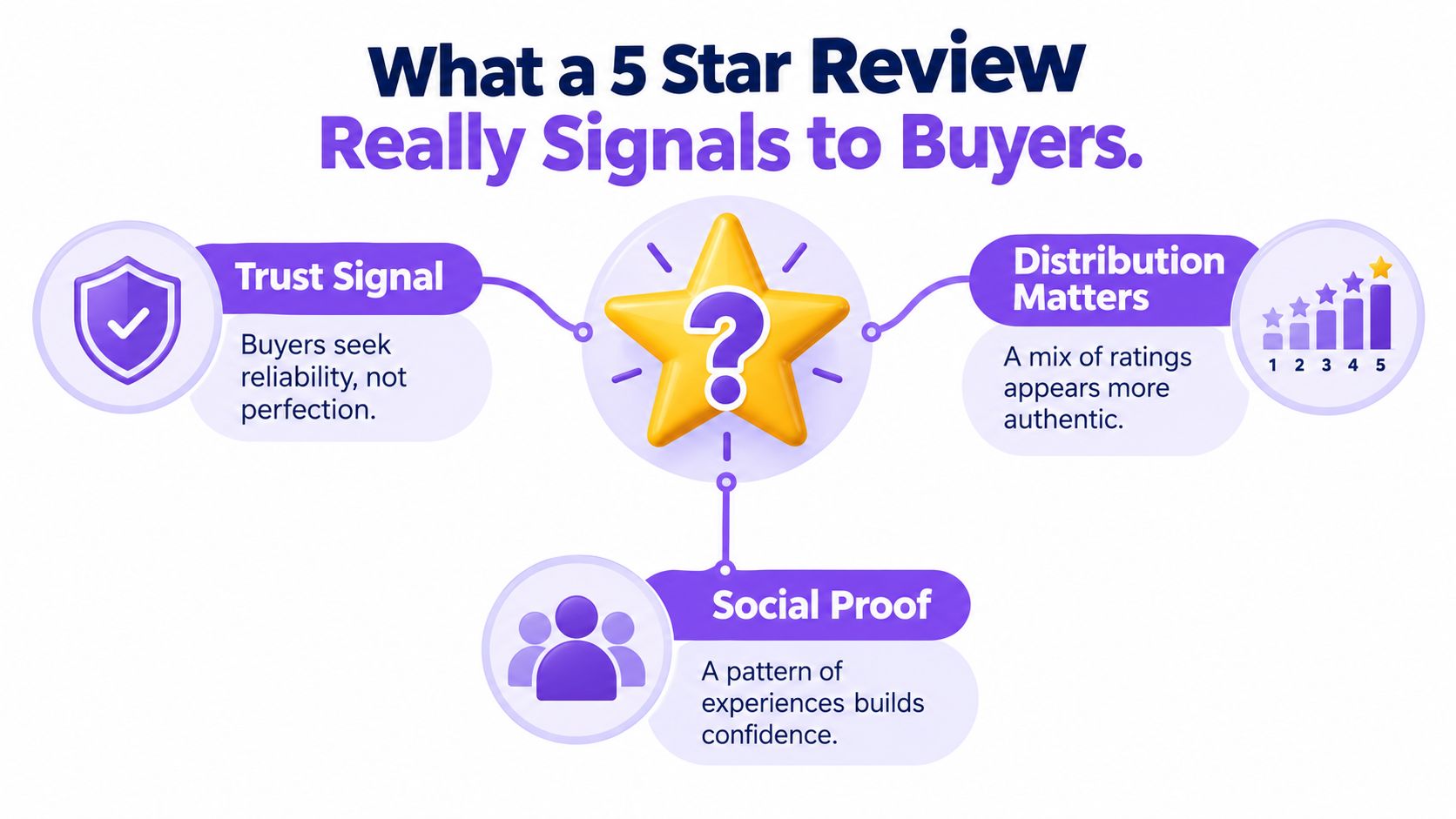
A 5 star review is not a finish line. It's a trust cue, and trust cues only work when they sit inside a believable pattern of customer experience.
Buyers read the pattern, not the badge
A single glowing review rarely closes the sale on its own. What changes behavior is the distribution behind the average, the number of reviews supporting it, and whether the comments sound specific enough to be real. A perfect score with thin evidence can look staged, while a slightly lower score with detailed feedback often feels more credible.


That's why I tell founders to stop chasing “perfect” and start chasing legible trust. Buyers want to see that other people had the same problem, bought the same product, and got a result they can understand. They're not looking for a trophy, they're looking for reassurance.
Practical rule: Use five stars to signal confidence, not to hide every rough edge.
The same score can also mean different things across platforms and markets. In some contexts, four stars reads like praise. In others, five stars is treated as merely acceptable. That mismatch is one reason review strategy breaks when teams copy a widget from one site to another without thinking about audience expectations.
If you want a broader perspective on how imported testimonials behave across platforms, the discussion in Global Pet Sitter review imports is a useful reference point.
What turns a review into persuasion
A review converts when it does three things at once. It proves someone used the product, it shows the outcome in plain language, and it gives the reader a reason to believe the experience could repeat for them. That's why a review with detail beats a blank five-star badge almost every time.
The most persuasive reviews usually include a specific product, a concrete result, or a named interaction with support. They don't need to be long. They need to sound lived in. The more the reader can map the review onto their own situation, the more the score matters.
Where the Five Star Rating Came From
The star rating system is older than many realize. Its history matters because it explains why users bring different expectations to the same rating label.
From travel marks to platform defaults
The convention traces back to early nineteenth-century travel publishing. In 1820, British travel writer Mariana Starke used repeated exclamation marks in a guidebook to mark places and attractions considered especially noteworthy, and that symbolic marking gradually evolved into star-based rankings. A formal one-to-five-star hospitality system is commonly traced to the Automobile Association in 1912, when stars were used to rate hotel amenities. That framework then spread across travel, restaurants, films, television, theatre, and consumer products because it compresses a complex experience into a fast, readable ordinal scale.
That compression is exactly why the format stuck. A buyer can scan a star score much faster than a paragraph, but the trade-off is ambiguity. The symbol says “quality,” yet people still disagree about what quality means.
Why digital platforms reshaped the meaning
Online marketplaces later pushed the format into daily use at massive scale. In the late 1990s, eBay moved from positive, neutral, and negative feedback toward the five-star structure now common across digital services. That shift also exposed a problem that still shows up today. Users often treat four stars as criticism and five stars as just acceptable, which means the same label can carry very different meaning from one platform to another.
The lesson is simple. A five-star rating is not a universal language. It's a shorthand that only works when the surrounding context teaches buyers how to read it.
The Numbers Behind 5 Star Review Conversions
A perfect average is a poor conversion target on its own. Review volume, visibility, and your position relative to buyer expectations deserve equal attention. Prioritize a profile that gives shoppers enough evidence to make a decision, then measure whether that evidence helps them buy.
What the data says about volume and score
Treat average rating and review volume as separate signals. The average summarizes satisfaction; the count shows how much feedback sits behind that summary. Chasing perfection can backfire when it leaves you celebrating a score supported by only a thin trail of reviews. Build enough visible feedback for shoppers to assess the experience beyond the headline rating.
For example, I'd rather show a business at 4.6 with dozens of specific reviews than build a sales page around 5.0 with sparse feedback. That's a display recommendation, not a promise that one score will always convert better. The details still have to support the purchase: what customers bought, how they used it, and whether it met their expectations.
Give buyers something concrete to evaluate.
| Signal | What to evaluate | Business implication |
|---|---|---|
| Average rating | The score alongside the feedback supporting it | Set a credible target rather than making perfection the goal |
| Review volume | Whether shoppers have enough experiences to compare | Collect feedback consistently and make the count visible |
| Price sensitivity | How much reassurance the purchase requires | Put relevant customer experiences near higher-commitment buying decisions |
Use a star rating calculator to translate raw reviews into the displayed average. Run realistic scenarios before setting collection targets. A larger review base requires more new feedback to move the score, so a target should reflect the reviews you already have.
Thresholds change behavior fast
Buyer expectations make small rating changes worth monitoring. If your score sits near a threshold customers use to shortlist businesses, track it alongside review freshness. A healthy historical average still leaves questions about the experience customers receive today.
Treat your rating like a live commercial asset. Ask recent customers for honest feedback, keep collection consistent, and refresh the reviews featured on buying pages. Display five-star feedback with the overall score and review count beside it. Choose comments that answer purchase questions, and keep their context intact. Your strongest praise should help buyers assess the offer without making the display look airbrushed.
When a Perfect Rating Starts to Hurt
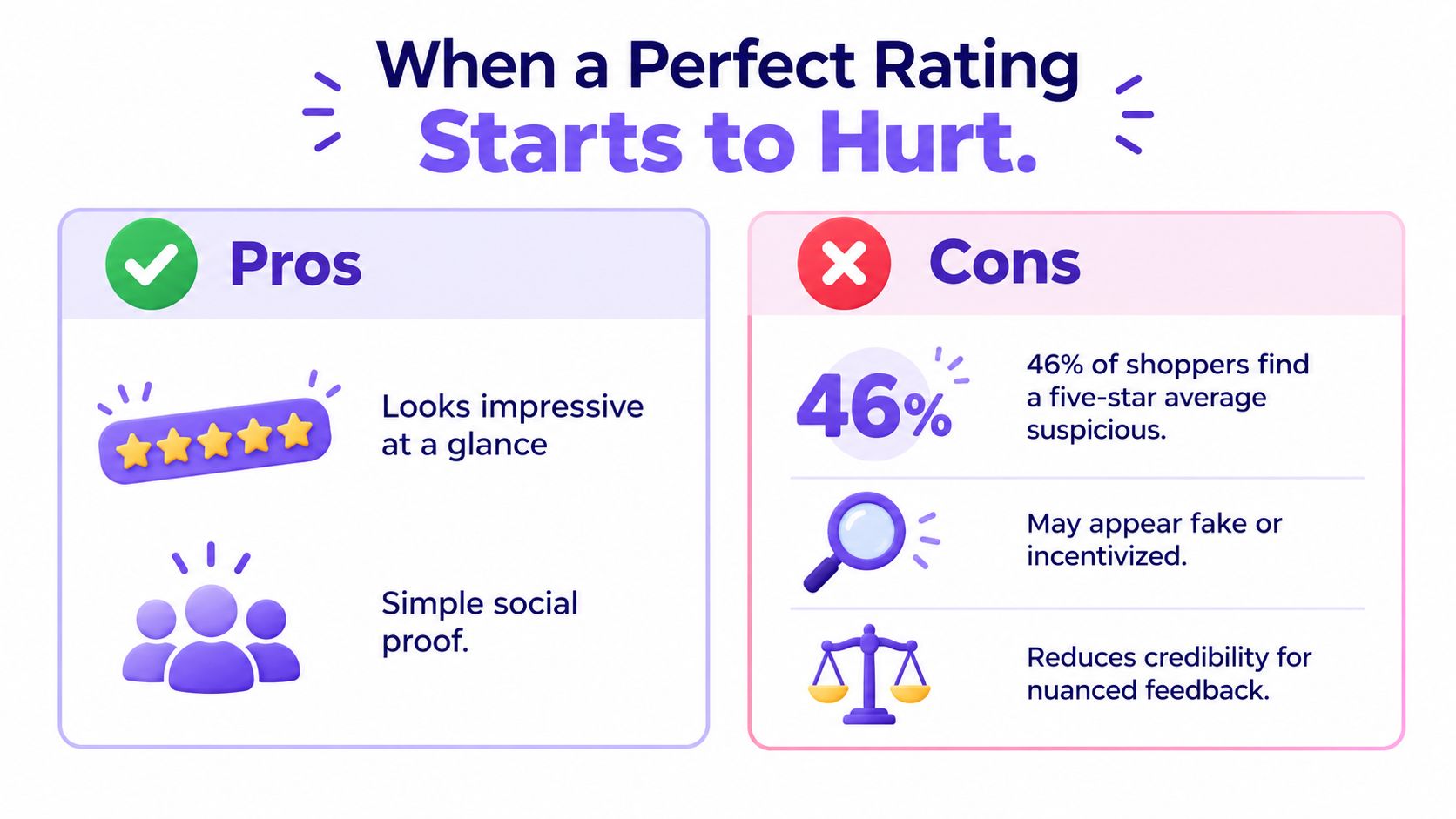
A flawless rating can make your business harder to trust. Chasing perfection by removing criticism creates a polished display that gives buyers fewer reasons to believe the praise.
Suspicion rises when everything is perfect
A five-star average needs context. A handful of enthusiastic reviews and a long history of uniformly glowing feedback invite different questions. As the review stream grows, buyers have more language and experiences to compare. If every customer sounds equally delighted, the display can start to look curated.
Don't make buyers guess what you removed.
Treat skepticism as a display problem you can address. Let readers inspect the feedback behind the score, including complaints and qualified praise. A review that explains who the product suits, or where the service fell short, gives shoppers something concrete to evaluate. Generic enthusiasm offers less help.
What a healthy distribution looks like
Keep genuine criticism visible and respond without defensiveness. Include source labels and verified-purchase signals where available, so readers can judge the context of each review. Never imply verification you cannot support.
A perfect score can be a liability if the rest of the page looks sterile.
When featuring five-star feedback, choose reviews that describe different experiences rather than repeating the same compliment. Preserve caveats within those reviews. If a customer loved the result but mentioned a delay, keep both parts.
Leave the wider review stream accessible from the featured praise. The goal is a display buyers can inspect, with enough texture to understand both the strengths and the trade-offs of buying from you.
FTC and Platform Rules You Cannot Ignore
If you're collecting reviews at scale, compliance is part of the strategy. Ignore it, and the risk isn't just reputational.
The FTC rule changed the baseline
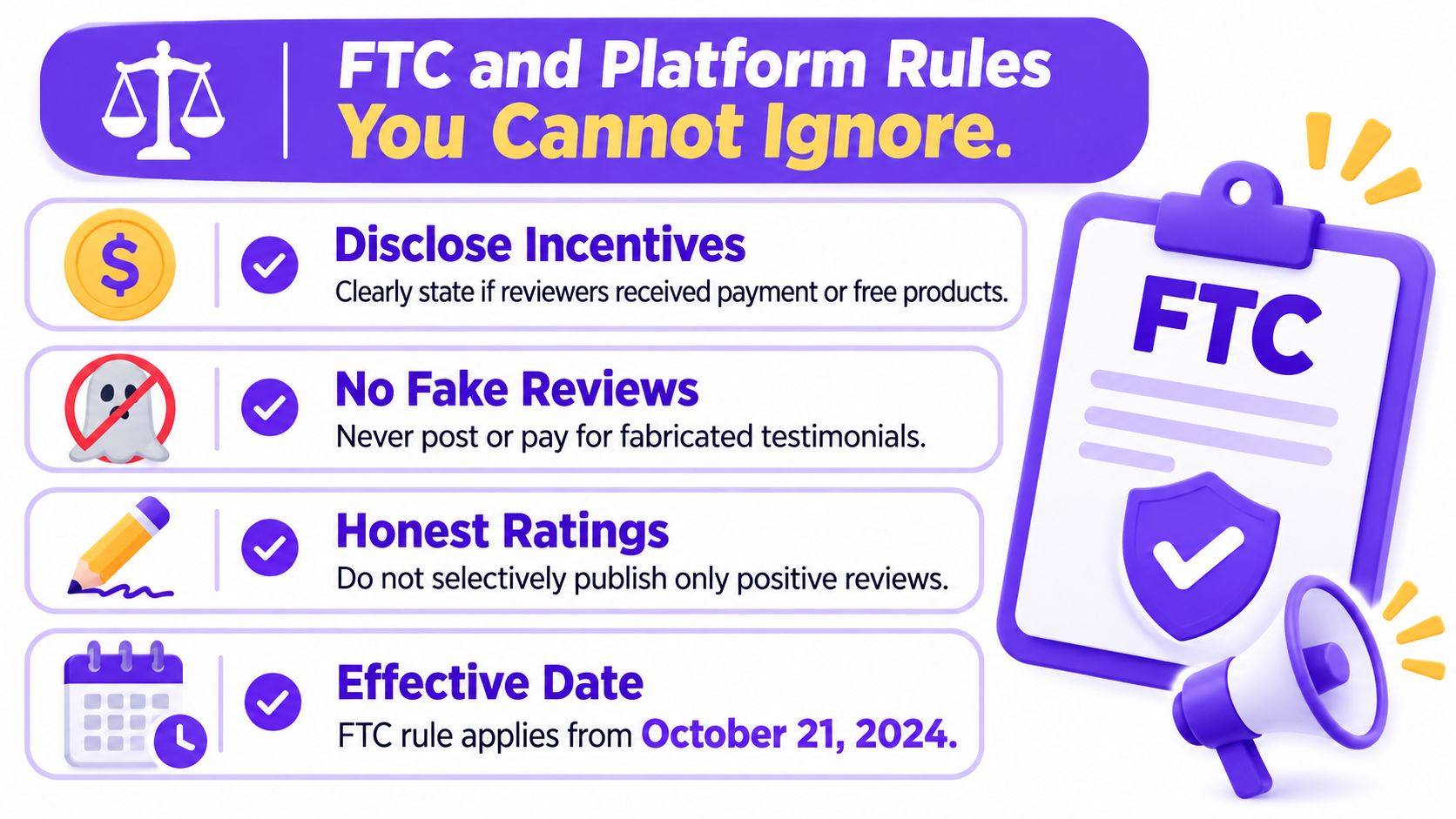
The U.S. Federal Trade Commission's Consumer Reviews and Testimonials Rule took effect on October 21, 2024. It prohibits businesses from creating, selling, purchasing, or knowingly disseminating fake reviews, including reviews generated by artificial intelligence, written by nonexistent people, or posted by people who didn't use the product or service. It also addresses fake testimonials, undisclosed insider reviews, review suppression, and company-controlled review sites that pretend to be independent.
That means review authenticity isn't a nice-to-have anymore. It's a compliance issue, and knowing violations can lead to civil penalties.
What Google will not tolerate
Google Maps treats paid or incentivized reviews as prohibited fake engagement. Its policy bans reviews or ratings exchanged for money, discounts, free goods, or services, and it also bans content posted from multiple accounts or solicited without a genuine customer experience. Businesses also can't selectively ask for positive reviews, discourage negative ones, or offer incentives for customers to revise or remove bad feedback. Violations can lead to restrictions ranging from temporary ineligibility to receive new reviews to unpublishing existing reviews for a defined period.
If you want a quick way to spot risky practices before they spread, a fake review checker is worth using on any review program you're auditing.
The safest operating rules
Use a sentiment-neutral ask. Disclose incentives clearly if you offer them. Keep negative feedback in the system instead of filtering it out. Never publish only the good responses if doing so creates a misleading picture. Those four habits keep you inside the rules and out of the worst review-gating mistakes.
An Ethical Playbook for Earning More 5 Star Reviews
The best way to earn more five-star feedback is to ask at the right moment, through the right channel, without steering the answer. Founders who get this right build a system, not a one-off campaign.
Ask when value is fresh
Timing matters more than polish. Ask after delivery, after setup, after a repair, or after the customer has used the product enough to judge it. That's when the experience is vivid and the review is easier to write. If you ask too early, you get vague praise. If you ask too late, you lose momentum.
Use the channel that matches the relationship. Email works when the transaction is complete. SMS works when the customer already expects quick communication. In-app prompts work when the user has just hit a meaningful milestone. A first-party form gives you a controlled place to collect the response, tag it, and route it where it belongs.
If you want a concrete example of automated timing after service work, review requests after a repair show how a post-job prompt can fit into a normal workflow without turning into a hard sell.
Organize the feedback before you publish it
The fastest way to make reviews useful is to tag them by product, location, and customer segment. That way, the right five stars appear on the right page instead of getting dumped into one generic stream. A support review belongs near support proof. A location review belongs on the local page. A product-specific testimonial belongs where the purchase decision happens.
That's where a centralized system starts to earn its keep. Bragly, for example, centralizes review collection and display, supports tagging, and keeps imported reviews synced so the widget doesn't drift out of date. The point isn't software for its own sake. The point is reducing manual cleanup so the proof stays current.
Rule of thumb: If a review can't be sorted, it can't be used well.
Volume still matters, but depth beats perfection in the widget. A page with a healthy spread of detailed testimonials usually outperforms a wall of identical praise, because the mix feels lived in. As the library grows, auto-sync keeps the proof current and stops old praise from doing work that newer feedback should be doing instead.
Do this this week
- Send three requests immediately. One to a recent buyer, one to a long-time customer, and one to someone who used your support team.
- Add one tagging rule. Sort every new review by product, location, or segment before it's published.
- Refresh one widget. Replace stale testimonials with the newest credible feedback you have.
Sample Responses That Turn Five Stars Into Loyalty
Most brands waste the response. They say thanks and stop. That's a missed retention moment.
| Situation | Weak Response | Strong Response |
|---|---|---|
| Vague praise | “Thanks for the review!” | “Thanks, Maya, glad the setup was smooth. We built that onboarding flow to cut friction, and we're testing a follow-up guide for advanced tips next month.” |
| Team member named | “Appreciate it!” | “Thanks for calling out Sam. He'll love hearing that, and your note is a good reminder that fast handoffs matter as much as product quality.” |
| Feature praise | “We're happy you liked it.” | “We're glad the reporting tool helped. That's the feature we've been improving most, and we'd love to include you in the next beta.” |
A strong response does four things. It thanks the customer by name, references a specific detail from the review, adds one new piece of information, and invites a next step. That next step can be a referral, a beta, or just another touchpoint that keeps the relationship warm.
Use the same structure even when the review is short. If someone writes “Great service!”, don't write a generic thank-you and walk away. Make the reply specific enough that the customer feels seen, because specificity is what turns a public review into private loyalty.
For teams that want a faster starting point, review response templates save time without forcing every reply to sound identical.
Bringing It All Together This Week
The winning formula is simple. Collect for volume before you chase perfection, display distribution instead of hiding it, prioritize recency, stay sentiment-neutral, and reply with specifics. That mix builds trust faster than a sterilized wall of five stars ever will.
Start this week with one collection flow, one widget audit, one threshold check, and one response template. If your score is close to a meaningful cutoff, move faster. If your reviews look too polished, add context. The brands that win in 2026 will treat review collection as a trust system, not a shortcut.
Bragly helps you collect, organize, and display customer reviews across your site, so the proof you show matches the trust you need to earn. If you want a cleaner way to turn real customer feedback into visible social proof, visit Bragly and see how it fits into your review workflow.