
Looking for a Shorter Overview?
AI Summary
Key Moments
Quantified Results Provide Clear Value
Reviews showing measurable before-and-after results help prospects understand concrete benefits.Contextual Use-Case Reviews Aid Relevance
Detailed descriptions of how customers use a product help prospects see if it fits their situation.Support Experience Reviews Build Reliability
Highlighting how a company resolves issues demonstrates trustworthy service under pressure.Video Testimonials Add Authenticity
Videos conveying customers’ natural stories offer engaging, trust-building content when well crafted.Your review page is full of five-star ratings, but most say some version of “Great service” or “Love it.” A prospective customer can see that people are happy, but not what they bought, what problem it solved, or whether the experience applies to them. Positive sentiment alone doesn't answer the questions that hold up a purchase.
Good customer reviews do more than praise a business. They give a specific result, describe a real use case, or show how the company handled a problem. The right format and placement help a relevant review reach a buyer at the moment they need reassurance. And the way you collect and verify feedback matters as much as the wording.
Below are eight useful review types, each with a practical prompt and display tactic. Use them to turn a pile of general praise into social proof customers can evaluate and trust, alongside writing techniques that encourage customer enquiries.


1. Quantified Results Review
A quantified results review tells readers what changed in concrete terms. “The dashboard helped our team work faster” is positive, but it leaves the reader guessing. A review that explains how a reporting tool reduced weekly admin from ten hours to two gives a prospect a clearer picture of the value. The customer's own before-and-after figure makes the claim more useful than a generic compliment.
Numbers need context. Ask the reviewer what they measured, what period they compared, and what else changed during that time. A result should be presented as that customer's experience, not as a promise that every buyer will get the same outcome. If a result depended on the customer's workflow or marketing spend, keep that context with the quote.
The value of early feedback is supported by the Medill Spiegel Research Center's review study. It found that purchase likelihood for a product with five reviews was 270% greater than for a comparable product with no reviews. That's a reason to build an initial base of credible reviews, not to chase volume at the expense of detail or authenticity.

Put the result beside the decision
Ask customers, “What changed after you started using the product, and how did you measure it?” Tag reviews that contain metrics so the team can find them when building pricing or landing pages. Bragly's review analytics can help organize and evaluate review content for those placements.
A short quote in a badge or ribbon can work beside a call to action, where it supports a decision without taking over the page. Refresh the testimonial when the customer's process changes, and don't edit away qualifications that make the result accurate. For ideas on making a clear claim easy to act on, see these best GEO agencies.
2. Detailed Use-Case Review
A detailed use-case review explains how a customer works with a product in everyday conditions. It identifies the task, the workflow, and the people involved. That context helps a prospect decide whether the product fits their situation instead of asking them to translate a vague compliment into a practical answer.
For example, a marketing agency might explain how it monitors client feedback from a shared dashboard, rather than describing the dashboard as “easy to use.” A clothing brand could discuss how it selects customer reviews for product pages during a seasonal launch. In both cases, the value comes from details that let a reader recognize a familiar job or constraint.
The best prompt asks for the story, not a slogan. Try questions such as “What were you trying to solve?” and “How do you use this in a typical week?” If a customer serves several audiences, collect enough context to identify their role or industry. Don't pressure them to repeat your marketing language.
Match the example to the visitor
Tag reviews by use case, industry, or role, then show relevant examples where prospects are comparing options. A software company might feature an agency's workflow on a page aimed at service teams, rather than showing the same testimonial everywhere. Longer testimonials can sit in a carousel or slider so visitors can explore them without turning the page into a wall of text.
Bragly's AI-based summaries and highlights can help surface useful passages from longer reviews. Treat the summary as a navigation aid, not a replacement for the customer's words. Keep the original review accessible so readers can judge the detail and context for themselves.
Practical rule: Ask customers how they use the product before asking what they like about it.
3. Support Experience Review
A support-focused review shows what happens when something goes wrong. That can be more persuasive than broad praise because the customer describes a real test of the company's service. A local business might earn a review after sorting out a booking issue quickly. A software customer might explain how a support engineer diagnosed an integration problem and helped restore the workflow.
Specificity makes the review useful. Look for the problem, the response, and the outcome. “The team was helpful” says little about what the customer can expect; a clear description of the issue and the resolution gives a prospect evidence of how the business behaves under pressure. Don't imply that every case will be resolved at the same speed unless your service can consistently support that claim.

Request feedback after the issue is resolved
A sensible time to invite a review is after the support case has been closed and the customer has had a chance to confirm the fix. Keep the request neutral. Ask them to describe their experience, rather than asking for a positive rating. If the customer is still frustrated, prioritize resolving the problem instead of chasing a testimonial.
Tag support reviews by theme, such as onboarding, billing, or technical help, and place them where visitors worry about getting assistance. A contact page, onboarding page, or pricing page may benefit more than a general homepage carousel. Bragly's AI review responder can support response workflows, but a person should check that replies are accurate and appropriate before they're published.
A good response also demonstrates that the business takes feedback seriously. Acknowledge the issue, explain the next step when appropriate, and avoid sharing private customer details in public.
4. Before-and-After Transformation Review
A transformation review follows a simple story: the customer had a problem, made a change, and reached a different situation. That structure helps a reader grasp the value without wading through product features. It works especially well when the customer can explain what the old process made difficult and what the new one allows them to do.
For instance, a founder might describe scattered testimonials living across several platforms, then explain how a single website widget made them easier to maintain. A fitness studio might share how it moved from manually copying member feedback into a spreadsheet to displaying approved reviews automatically. Those examples are useful because the change is a process the next business can recognize.
Keep the contrast honest
Ask, “What was your situation before?” and follow up with “What changed after you started?” If the customer can support the story with a measured outcome, include it with the measurement period and relevant context. If they can't, a clear description of the workflow change can still make a strong review. Don't manufacture a dramatic transformation from a modest improvement.
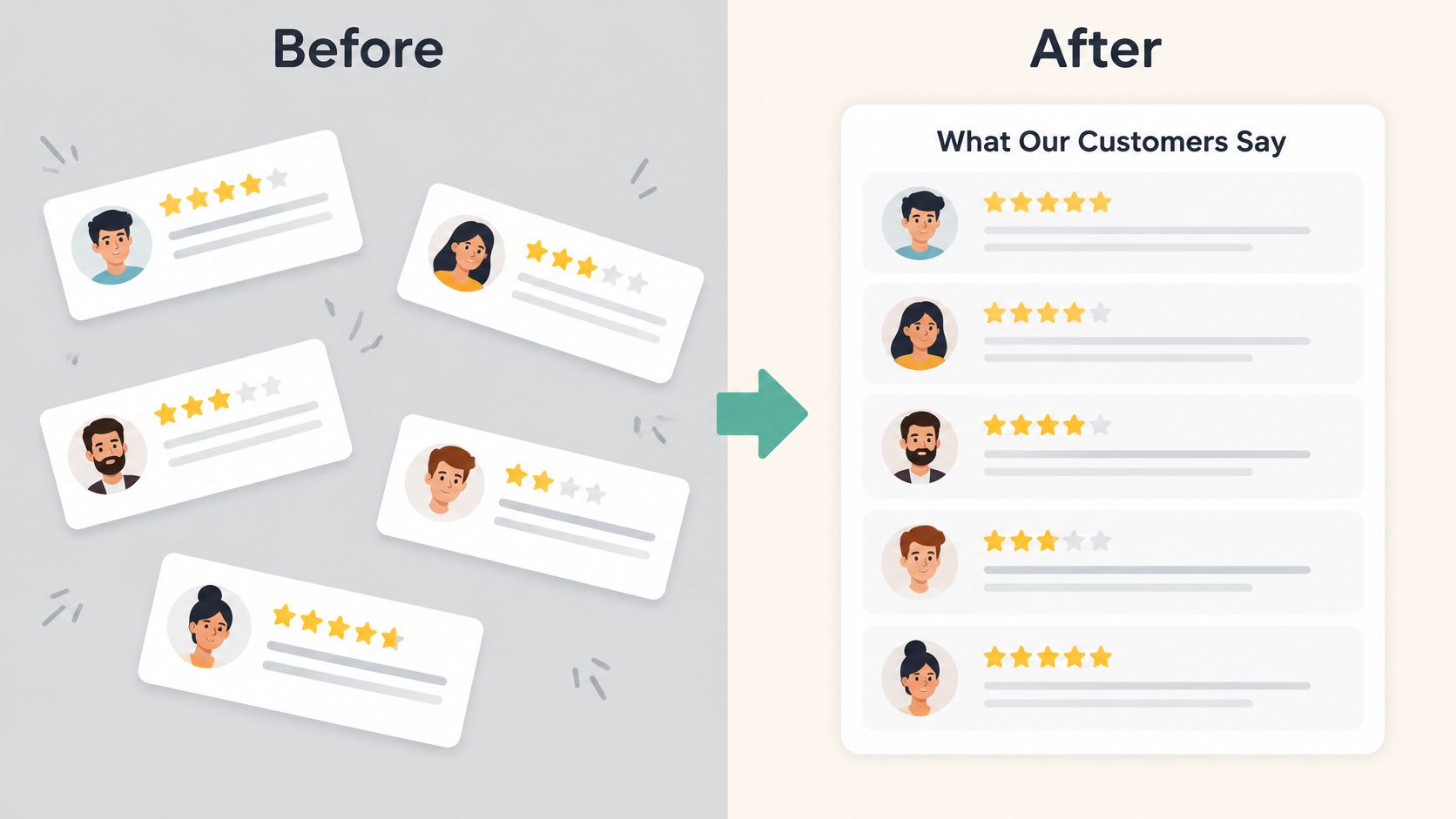
A longer version can sit in a case-study-style layout, with the customer's original words kept prominent. For a short landing-page quote, use a badge or ribbon that captures the clearest contrast, then link it to more context if available. A tight excerpt should preserve what changed rather than turning the review into a sweeping claim.
A before-and-after review works when a reader can understand both the old friction and the new routine.
5. Video Testimonial Review
Video adds voice, expression, and visible context to a customer's account. It can help on a high-consideration product page, a consultancy's services page, or a homepage where visitors need to hear a real customer explain their experience. But a video isn't automatically more convincing than text. If the customer speaks in broad generalities or the clip takes too long to reach the point, visitors may skip it.
A useful video has a focused story. Ask the customer what they needed, what they tried, and what they'd tell someone considering the same product or service. Let them speak naturally. Overly polished scripts can make a genuine experience sound like an advertisement, while a rambling recording makes it hard for viewers to find the useful detail.
Make it easy to watch
Keep the opening direct, add captions so the clip works without sound, and choose a thumbnail that accurately represents the video. Place it where the testimonial answers a relevant question, such as alongside a service description or near a purchase decision. Don't bury the best context behind a long introduction.

A customer unboxing a product may work on an ecommerce homepage, while a client describing a project may belong on an agency services page. Choose a presentation that fits the content, and make clear who is speaking when you have permission to identify them. Bragly's video testimonials feature includes a video highlight layout for displaying customer clips without custom development.
6. Local Business Recommendation Review
A local recommendation tells potential customers what it's like to choose a nearby business. The review may be brief, but useful details make it more than a star rating: a bakery customer might mention consistent bread and friendly staff, while a dental patient could describe a calm first visit. These specifics help a reader picture the visit and decide whether the business suits their needs.
Local reputation isn't built on one listing alone. BrightLocal's 2024 Local Consumer Review Survey found that 77% of surveyed US consumers used at least two review platforms when researching a local business. For an owner, that's a practical reason to keep review profiles visible and current across the places customers already consult.
Show variety and respond in public
A grid of short reviews can work on a contact or about page, especially when it brings together different kinds of feedback rather than repeating the same praise. Connect relevant listings so the website display can stay current, and respond to reviews with a professional tone. A thoughtful reply can clarify a concern for the next person reading the thread, not just the original reviewer.
Invite customers to describe what they experienced, whether they came in for a routine appointment or needed help with a specific issue. Don't steer them toward a particular rating, and don't hide criticism just because it's inconvenient. A trustworthy local profile reflects the service customers receive.
7. Ease of Setup and Onboarding Review
A setup review answers a common hesitation before a customer signs up: how much work will this take? Software can look useful in a demo and still feel risky if the buyer expects a complicated implementation. A customer who explains that a review widget was added to a Wix site by copying and pasting an embed gives a more practical signal than one who only calls the product “simple.”
Ask new customers what they expected setup to involve and what the actual process was like. Useful details include whether they needed a developer, whether the instructions were clear, and what they could do once setup was complete. Keep the review tied to the customer's real configuration. A no-code install on one site builder doesn't prove that every integration will be identical.
Put setup reassurance near the sign-up
Place this type of review near a trial or sign-up button, or on an onboarding page where implementation concerns are likely to come up. Bragly's no-code widgets work with Webflow, WordPress, Wix, and custom sites through copy-and-paste embedding, which can help teams publish reviews without building a bespoke integration.
A good collection prompt is direct: “How long did setup take, and what steps did you need to complete?” Let customers answer in their own words rather than suggesting a time or outcome. If they needed help, include that context. Clear expectations attract the right buyers and reduce the risk of promising an effortless setup to someone with a more complex site.
8. Long-Term Value and Consistency Review
A review written after sustained use answers a different question from a first-impression testimonial: does the product or service continue to deliver? That matters for subscriptions, repeat purchases, and services where reliability is part of the value. A customer who has renewed over time can discuss what stayed consistent, what changed, and whether the ongoing cost still makes sense.
For example, a SaaS customer might describe how the product fits into their routine after several renewal cycles. A returning shopper could explain that the quality has remained consistent across repeat orders. The detail that makes these reviews persuasive is not duration alone. It's what the customer has had enough experience to evaluate.
Invite an update, not a scripted endorsement
Reach out to long-standing customers with open questions such as “What has remained useful over time?” or “Has anything changed in how you use the service?” Don't ask them to endorse a fixed claim or make a statement they can't verify. Tag these reviews separately so they can support retention pages, renewal messaging, or product pages where durability matters.
Bragly's auto-sync can keep connected review sources current, while collection forms can give businesses a way to request first-party updates. If you feature an older testimonial, show its date and check that the details still apply. An out-of-date review can create doubt even when the original experience was genuine.
8 Types of Good Customer Reviews at a Glance
| Review Type | Best For | Where to Display | Collection Difficulty |
|---|---|---|---|
| Quantified Results Review | ROI-focused B2B and SaaS buyers | Pricing pages, calls to action, or landing pages | Hard to collect; requires customers to share measurable results |
| Detailed Use-Case Review | Complex products and niche audiences | Industry-specific pages, carousels, or review widgets | Challenging; requires detailed customer responses |
| Support Experience Review | Buyers concerned about reliability and service | Help center, contact, pricing, or onboarding pages | Moderate; request after a resolved support issue |
| Before-and-After Transformation Review | Brands needing to show a clear change in outcomes | Landing pages, case studies, or featured testimonial badges | Moderate; customers need to reflect on their starting point |
| Video Testimonial Review | High-consideration purchases, agencies, and consumer brands | Homepage, landing pages, or pricing pages | Difficult; requires recording, editing, and customer permission |
| Local Business Recommendation Review | Location-based businesses seeking community trust | Contact, about, or local business pages | Easy to moderate; often collected from walk-in customers |
| Ease of Setup and Onboarding Review | Software buyers concerned about implementation effort | Sign-up, trial, or product pages | Moderate; ask recent users about their setup experience |
| Long-Term Value and Consistency Review | Subscription and recurring-revenue businesses | Retention, loyalty, or product pages | Challenging; requires feedback from long-standing customers |
Turn These Review Types Into Social Proof That Sells
Start by reviewing what you already have. Sort testimonials into the eight types and note where you have useful evidence, where you only have general praise, and which customer questions remain unanswered. A useful review inventory can be as simple as a spreadsheet with columns for review type, customer context, source, date, and possible page placement.
Then choose collection prompts that fill the gaps. If your product page lacks practical context, ask customers how they use the product. If prospects worry about implementation, ask recent users to describe setup. If your service depends on ongoing support, invite customers to explain how a resolved issue was handled. Keep the invitation consistent and open-ended so customers can give honest feedback, not just the answer you want.
How a review appears matters too. Use a short badge beside a decision point, a grid for a range of local recommendations, or a video highlight when a customer's spoken account adds useful context. Tag reviews by topic and audience so teams can find relevant evidence instead of pasting the same testimonial everywhere. For a wider presence across discovery platforms, this StartupSubmit directory submissions guide offers a complementary perspective on business visibility.
Protect trust while you collect and publish reviews. The FTC's Consumer Reviews and Testimonials Rule announcement says the rule took effect on October 21, 2024, and prohibits fake or false reviews, including AI-generated reviews that falsely appear to come from real customers. Don't buy testimonials, invent customer experiences, or condition incentives on a particular sentiment. Keep the reviewer's meaning intact, provide context where needed, and respond constructively to criticism.
Bragly can help teams bring reviews from more than 50 sources into one place, organize them with tags, and publish them through no-code widgets. That's useful when feedback is scattered across third-party platforms or needs different layouts on different pages. It doesn't replace good collection practices or careful editorial judgment. Audit the reviews you have, identify the type that would answer your buyers' biggest concern, and request that feedback from every eligible customer through the same fair process.
Collect reviews from multiple platforms, organize customer stories by use case, and display them with no-code widgets through Bragly. Start by bringing your existing feedback together, then add targeted prompts to fill the gaps on the pages where buyers need reassurance.