

Looking for a Shorter Overview?
AI Summary
Key Moments
Importance of Specific Reviews
Detailed feedback on food, service, and atmosphere helps diners make informed decisions and guides owners to improve.Effective Owner Responses
Respond to reviews politely, acknowledge issues, and offer private follow-up without overpromising.Review Aggregation Best Practices
Display selected, relevant reviews on websites to provide evidence without overwhelming visitors.Building a Review Routine
Owners should track reviews consistently, tagging topics and spotting patterns to address operational improvements.You're choosing a place for dinner, scrolling through reviews, and finding one that says, “Great food, nice atmosphere, would come back.” It has four stars, but it doesn't answer the questions that matter. Was the service quick? Is the dining room noisy? Which dish earned the praise? Would the restaurant work for a family, a date, or a rushed weekday meal?
A few lines of specific feedback can do far more than a high rating with no context. Restaurant reviews help diners make practical decisions, while giving owners a clearer view of what guests actually experience. The difference between a forgettable comment and a useful review often comes down to a few concrete details.
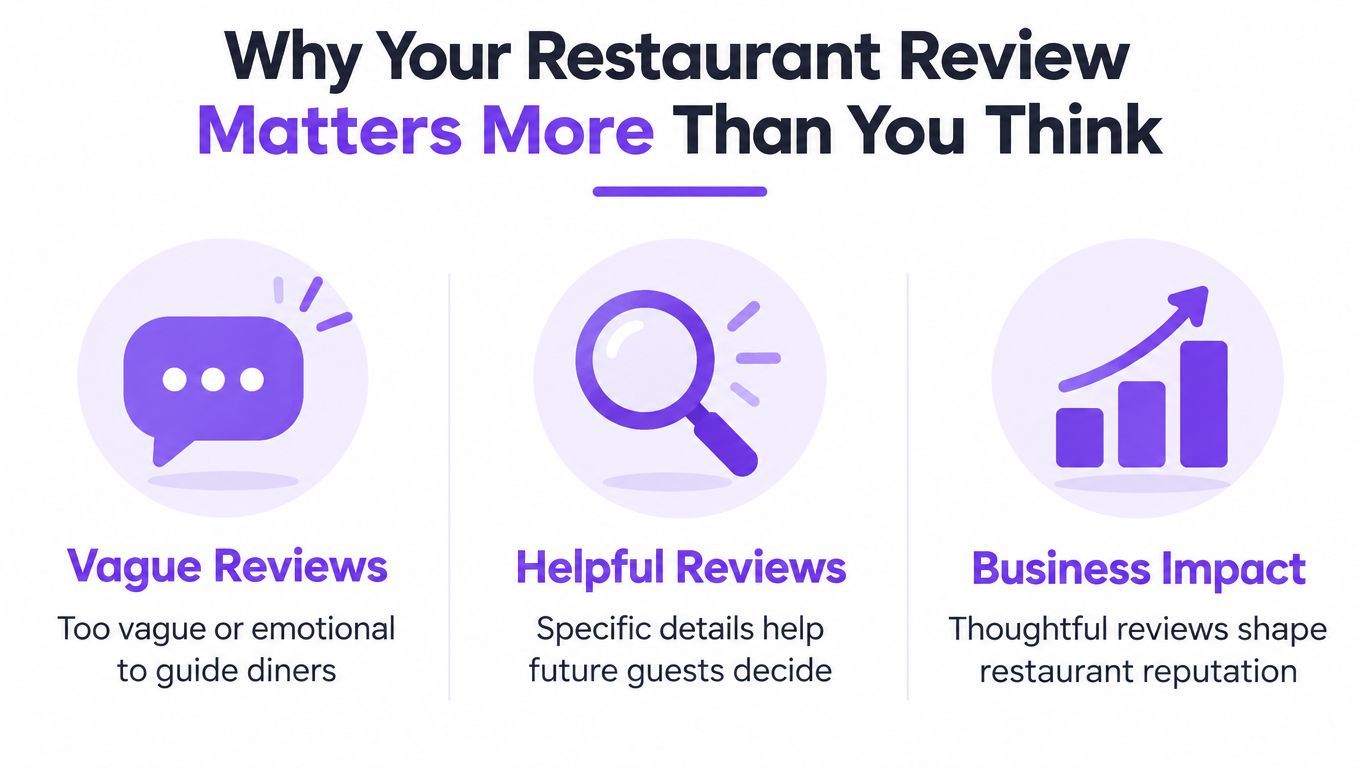
Why Your Restaurant Review Matters More Than You Think
A diner who reads “Nice place, good food” still has to guess. A more useful review might explain that the pasta arrived hot, the dining room became loud during the evening rush, the server handled an allergy question carefully, and the dessert was worth ordering. That review gives future guests something they can use.


The shift from guidebooks to digital review platforms has made restaurant feedback part of the decision process itself. The Michelin Guide began in France in 1900, when 35,000 copies were distributed free to motorists. Michelin later introduced anonymous inspectors, began its single-star system in 1926, established the modern zero-, one-, two-, and three-star hierarchy in 1931, and published its star criteria in 1936. Its international editions later reached Italy, Britain, New York City, Tokyo, and Hong Kong and Macau, while the guide has sold more than 30 million copies and evaluates over 30,000 establishments in more than 30 territories. These milestones are documented in BrightLocal's review research.
Today, a review can influence a decision within minutes. Customers compare ratings, inspect photos, scan recent comments, and look for evidence that a restaurant suits their specific needs. Owners face the same reality from the other side. A review isn't only a score to monitor. It's a public record of how the business handles praise, disappointment, confusion, and legitimate criticism.
Practical rule: Write the review you wish you'd found before booking the table.
A thoughtful review doesn't need to be long or literary. It needs to be accurate, firsthand, and useful. Diners who want to improve the quality of their feedback can also consult these Google review tips for SMBs for practical guidance on making review requests and responses more effective.
What to Include in a Helpful Restaurant Review
Start with the facts that shape the visit. Mention what you ordered, whether you dined in or collected takeaway, and anything that affected your experience, such as a busy service, a dietary requirement, or a reservation problem. Readers don't need a dramatic verdict first. They need enough context to understand whether your experience resembles the one they're likely to have.
A useful review usually covers five areas:
- Food quality: Name specific dishes and describe flavor, temperature, freshness, texture, or portion. “The roast chicken had crisp skin and moist meat, but the vegetables were under-seasoned” helps more than “The food was amazing.”
- Service: Explain what happened rather than assigning a label. “Our server noticed the allergy question and checked the sauce ingredients” is more actionable than “Excellent staff.”
- Atmosphere: Describe noise, seating, lighting, cleanliness, music, accessibility, or the pace of the meal when those details matter.
- Value: Say whether the price felt reasonable for the portion, quality, and experience. Value is personal, so explain your standard instead of presenting it as an objective fact.
- Useful guidance: Identify a dish worth trying, a booking detail, a parking limitation, or a situation future guests should anticipate.
Replace reactions with evidence
Weak review: “Terrible place. Never again.”
Stronger review: “We waited a long time for the main courses during a busy dinner service. The burger arrived lukewarm, although the server replaced it promptly after we mentioned the problem. The dining room was lively and well kept, but I'd allow extra time during peak hours.”
The second version still communicates dissatisfaction, but it separates the food issue, service recovery, and timing context. That distinction helps diners judge the experience for themselves and gives the owner a clearer operational signal.
The same principle applies to praise. “Best restaurant in town” creates enthusiasm but little understanding. Naming the dish, preparation, service moment, or setting makes the compliment credible.
Use photos when they answer a question
A photo can show portion size, presentation, seating, menu wording, or the condition of a dish. It adds value when it gives future guests information they can't easily get from text. Avoid uploading several nearly identical images, photos that expose other diners without permission, or pictures so dark that they create a misleading impression.
Mixed experiences deserve mixed reviews. A restaurant can serve an excellent meal with slow service, or recover well from an initial mistake while still leaving you disappointed. Keep the tone firm but constructive, and don't turn one unpleasant moment into an accusation about every employee or every visit.
How to Respond to Restaurant Reviews as a Business Owner
A review response is written for more people than the reviewer. Future diners read it to judge whether the owner is attentive, defensive, generous, or careless with criticism. The response should acknowledge the experience without revealing private details or arguing about a guest in public.
Begin by sorting the review into a practical category:
- Positive feedback deserves a specific thank-you. Mention the dish, service detail, or occasion the guest described.
- A recoverable failure calls for acknowledgment and a clear next step.
- A serious allegation should be escalated internally before anyone posts a quick reply.
- A suspicious or policy-breaking review should be reported through the platform rather than debated in the comments.
Research on early review patterns has found that very small review samples can be unstable. In an analysis of approximately 3,000 restaurants on each of Yelp and TripAdvisor, the share of Yelp restaurants with only one to four reviews receiving a low rating was 17.6%, compared with 9.3% among restaurants with five to ten reviews. On TripAdvisor, the corresponding figures were 5.6% and 0.6%. The findings are discussed by Ohio State University's news team. That's why owners should build a consistent feedback process rather than reacting only when a complaint appears.
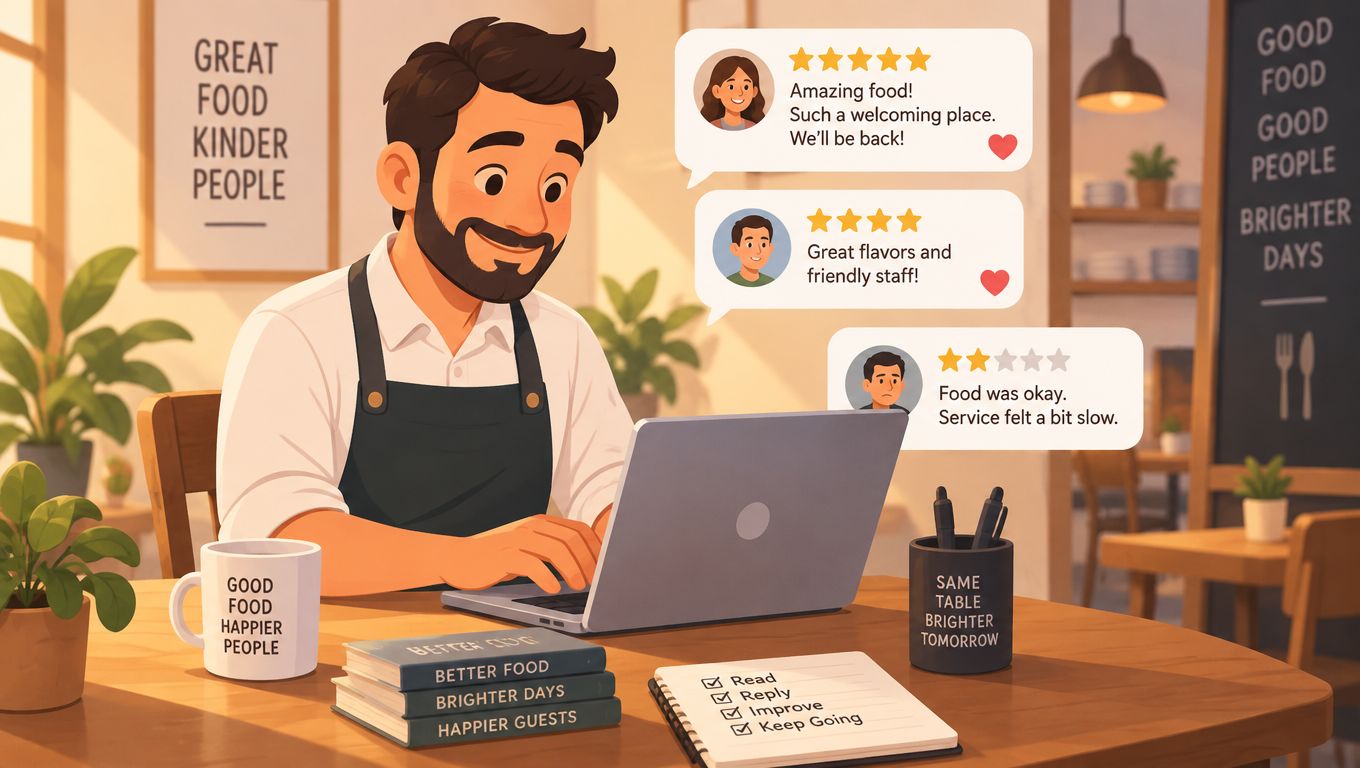
Write responses that sound human
For a missed reservation:
“We're sorry that your table wasn't ready when you arrived. We understand that a reservation should give you confidence in your arrival time, and we're reviewing how the booking was handled. Please contact us directly so we can understand the details and address this properly.”
For a cold meal:
“Thank you for telling us. Your dish should have reached the table at the right temperature, and we're sorry it didn't. We're reviewing the handoff between the kitchen and dining room, and we'd appreciate the chance to learn more privately.”
For a rude interaction:
“We're sorry that our service felt disrespectful. That isn't the standard we expect, and we're taking the feedback seriously. Please contact the manager directly with the visit details so we can investigate with the team.”
Don't promise a refund, staff action, or policy change you can't deliver. Don't copy the same paragraph beneath every review. A concise, personal response with a private contact route is stronger than a long public defence. Owners who need starting points for different situations can use these review response templates, then adapt the language to the actual complaint.
Google requires reviews to reflect a genuine firsthand experience and prohibits paid or incentivized submissions, including discounts or free goods offered in exchange for posting, revising, or removing feedback. Its Google Maps review policy also prohibits businesses from posting damaging reviews on competitors' listings. A strong response process must protect credibility as carefully as it protects ratings.
Aggregating and Displaying Reviews Without Overwhelming Visitors
A restaurant website shouldn't become a review dump. Visitors need enough social proof to feel confident, but they also need to see the menu, location, opening information, reservation options, and practical details without wading through a wall of testimonials.
Start by matching review content to the page. A private dining page should surface comments about group service and event coordination. A menu page can feature feedback about specific dishes. A location page benefits from comments about access, atmosphere, and booking convenience. Relevance matters more than displaying every available review.
A workable display usually combines:
- A compact rating summary: Show the overall platform context without making the score the entire story.
- Selected excerpts: Choose comments with concrete detail, not only praise.
- Source labels: Make clear whether a comment came from Google, Yelp, TripAdvisor, or another platform.
- A visible path to more feedback: Let visitors inspect the original platform when they want broader context.
- Freshness controls: Remove outdated information when menus, locations, or service formats change.
A no-code tool can reduce the manual work involved in collecting and formatting reviews. Platforms such as testimonial widgets can support layouts including carousels, grids, sliders, and other page-specific formats. The right choice depends on the page. A carousel can work near a booking button, while a simple grid may be easier to scan on a dedicated testimonials page.
Aggregation also creates an analysis problem. Don't treat the average star rating as an unbiased measure of quality. In a study of nearly 71,000 restaurant reviews, tourists were at least 13.4% more likely than local residents to give a higher rating. The difference persisted across price levels, reviewer gender, and city size. The research is available in this restaurant review methodology study. Track reviewer context where available, then separate topics such as food, service, cleanliness, atmosphere, value, and location.
Fraud screening matters too. Tripadvisor reported identifying and removing 1.3 million fake reviews in 2022, with 72% detected before publication. Fake submissions represented 4.37% of all submissions that year, compared with 3.6% in 2020 and 2.4% in 2018, according to its 2023 transparency report. Its later report says the platform processed 31 million reviews from 21 million members across 30 million devices in 2024, identified the location of 93% of submissions, and blocked or removed 2.7 million fraudulent reviews. Those figures appear in the 2024 review transparency report.
Use aggregation to reveal patterns, not to hide criticism. Guidance on responding to customer feedback can help owners build a repeatable process around what visitors see and what the team changes behind the scenes.
Next Steps to Improve Your Review Strategy
Diners and owners contribute to the same information system, but they have different jobs. A diner should describe the experience accurately. An owner should make the feedback useful to the team and reassuring to future guests.
For your next review, check four things before publishing:
- Specificity: Name the dishes, service moments, or practical conditions that shaped your visit.
- Context: Mention whether the restaurant was busy, whether you had a reservation, and whether a special requirement affected the experience.
- Balance: Include what worked and what fell short when both were true.
- Evidence: Add a useful photo when it clarifies portion, presentation, seating, or another decision.
For owners, create a simple weekly review routine. Check each major platform, record the date and rating, tag the main topic, identify whether the issue requires service recovery or operational investigation, and respond with language suited to the actual experience. Then look for repetition. One comment may be an isolated mismatch, while the same complaint across several reviews points to a process that needs attention.
Keep the review record structured. Track the source, reviewer context when available, date, rating, and topic-level sentiment separately. Use minimum-volume thresholds before drawing strong conclusions, and compare rating distributions rather than relying only on a raw average.
A direct review request can make participation easier for satisfied and dissatisfied guests alike. A Google review link generator can simplify the path, but the request must remain neutral. Don't offer incentives, pressure guests to leave positive feedback, or ask only the people who appear delighted.
The strongest reputation isn't built by eliminating criticism. It comes from collecting genuine feedback, responding with care, and making visible operational improvements when a pattern deserves action.
Bragly helps restaurants collect, manage, analyze, and display reviews from multiple sources through no-code widgets and review forms. Use it to bring relevant social proof onto your website while keeping the underlying feedback organized, then visit Bragly to explore the platform.