Looking for a Shorter Overview?
AI Summary
Key Moments
Customer Testimonial Widgets
Embedding relevant, objection-focused customer testimonials near decision points boosts conversions and relevance.Multi-Platform Review Aggregation
Centralizing customer feedback from various platforms reveals broad sentiment patterns and saves monitoring time.Review Response and Engagement Strategy
Timely, personalized responses to reviews improve reputation, resolve issues, and demonstrate commitment to customers.Review Analytics and Public Reporting
Transparent reporting on feedback themes and resulting actions builds accountability and shows continuous improvement.Positive reviews aren't an advocacy program. They're only the visible residue of one.
A useful system captures what customers experienced, matches that proof to the questions future buyers are asking, and republishes it across the customer journey. A testimonial can reassure someone on a landing page. A review response can show that your team listens. A tagged collection of feedback can help a buyer find evidence from a business like theirs. Public reporting can prove that feedback changed a product, service, or policy.
These examples of advocacy follow that progression. They move from collecting authentic customer feedback to aggregating it, analyzing it, segmenting it, publishing it, responding to it, and reporting what changed. The strongest programs combine collection, curation, distribution, engagement, and measurement. They also avoid a common trust mistake, presenting only polished praise while ignoring concerns, limitations, or customer privacy.

1. Customer Testimonial Widgets
A testimonial widget puts customer evidence beside the decision it needs to influence. An e-commerce brand can place product reviews near a purchase button. A SaaS company can feature a relevant customer quote in its homepage hero section. A local service business can display review badges near its booking form instead of making visitors search another site.
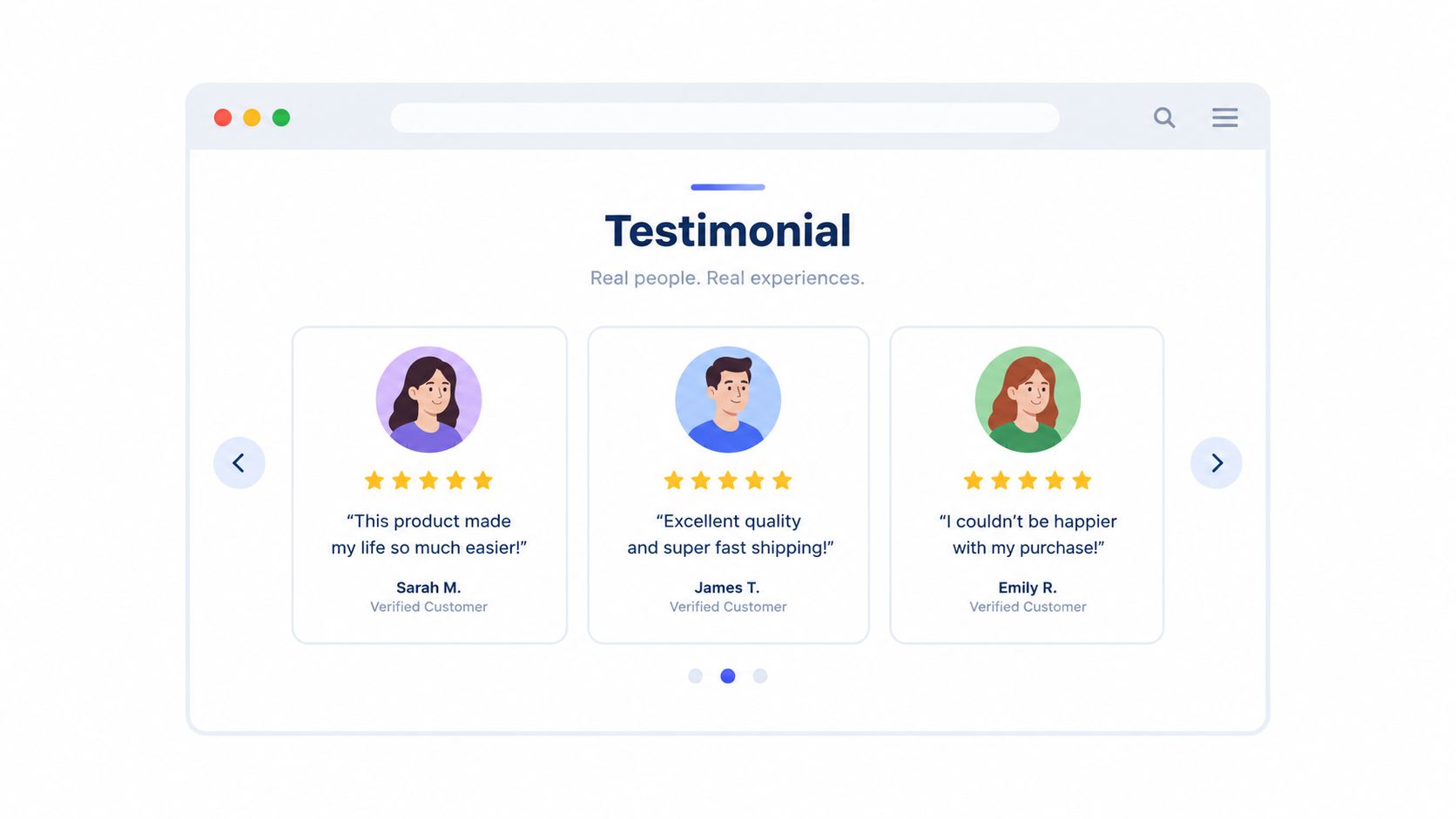
The best widget isn't the one with the most reviews. It's the one with the most relevant proof. If prospects worry about implementation, show a customer discussing setup. If they question service quality, prioritize feedback about support and reliability. A carousel, grid, slider, mosaic, or video highlight can work, but the format should serve the page rather than compete with its primary call to action.
Make the proof useful
Curate testimonials around real objections, not just flattering language. A short review that answers “Will this work for a team like mine?” often does more than a vague statement that a product is excellent. Use names, roles, companies, photos, or video only with appropriate permission, and don't edit customer words until they become misleading.
A widget also creates a maintenance obligation. Rotate stale content, check that links and media still work, and remove claims that no longer reflect the product. A Wall of Love can give visitors a broader browsing experience, while focused widgets usually work better on product, service, and checkout pages. Bragly's Wall of Love feature can support that curated browsing format without sending visitors to competitor platforms.
Practical rule: Put the shortest, most objection-specific proof closest to the action you want a visitor to take.
2. Multi-Platform Review Aggregation
Customers leave feedback wherever it feels natural. A SaaS buyer might use G2 or Capterra, an app user might review an App Store listing, and a local customer might choose Google, Facebook, or Yelp. If your team monitors each source separately, important themes can remain scattered across disconnected inboxes and spreadsheets.
Aggregation creates a working view of customer sentiment. A hospitality business can compare TripAdvisor, Google, and Airbnb feedback. An e-commerce brand can bring together reviews from Google, Trustpilot, Facebook, and Shopify. A product team can examine what customers say across Product Hunt, app stores, and direct feedback forms.
Use the collection as an operating surface
Don't treat an aggregate dashboard as a trophy cabinet. Establish a review routine and assign ownership. One person can watch for urgent complaints, another can tag recurring themes, and a product or service lead can review patterns during planning.
Useful operating habits include:
- Set a review cadence: Review the complete collection regularly, with more frequent checks for channels that receive active customer feedback.
- Create issue alerts: Route low-rating or safety-related reviews to the person who can investigate them.
- Tag recurring topics: Mark mentions of onboarding, shipping, support, pricing, quality, or specific features.
- Compare source context: A platform used by enterprise buyers may surface different concerns from a channel used by local consumers.
- Share constructive praise: Give teams access to specific customer appreciation, not only complaints.
The trade-off is breadth versus context. Aggregation helps you see patterns, but star ratings from different platforms aren't automatically equivalent. Don't combine them into a single impressive-looking figure unless you can explain the methodology. Preserve the original source, date, customer segment, and permission status for every review you republish.
3. First-Party Review Collection Forms
A first-party form can reveal what public review sites miss. Send it after a purchase, onboarding milestone, completed project, or support interaction, while the experience remains clear enough for a specific account. Ask about product quality, delivery, implementation, service, and the outcome the customer expected.
Use the customer's situation to shape the request. An e-commerce store can ask about packaging and shipping after delivery. A SaaS company can request feedback on one workflow. A service business can invite a long-term client to describe the relationship in writing or video. Keep participation easy, explain where the response could appear, and offer a clear consent choice.
Ask for evidence, not a slogan
Prompts should produce material your team can later reuse in product pages, sales conversations, or case studies:
- Before the purchase: What problem were you trying to solve?
- During adoption: Which part of setup or delivery mattered most?
- After use: What changed in your workflow or experience?
- For future buyers: What should someone know before choosing this solution?
Keep the form focused. More fields increase the effort required, while leading questions can make the response sound manufactured. Incentives may attract more submissions, but disclose them and never tie them to positive sentiment.
Request feedback only after the customer has enough experience to answer candidly. Send one follow-up when appropriate, then organize the response by use case, customer type, and permission status. Bragly's review collection forms capture text and video testimonials for later organization and publication. Store consent with each response, especially when using a customer's name, image, company, or recording. The trade-off is response volume versus credibility. A shorter form may yield more replies, while focused questions produce stronger proof.
4. Video Testimonial Showcases
Written reviews communicate information. Video can also communicate voice, expression, hesitation, and enthusiasm. That makes it useful when a buyer needs to understand not only what a customer achieved, but what the experience felt like.
A SaaS business might publish a short customer story about onboarding. An e-commerce brand can show an unboxing and product-use clip. A B2B firm can record a client interview about the project. A coaching business can invite a participant to describe the experience in their own words. These examples become more credible when customers speak naturally instead of reading a polished script.
Remove production friction
Most customers don't need a studio. Give them a few prompts, explain the expected length, and let them record on a phone if that produces a more authentic result. Ask permission before editing, adding captions, cropping the video, or using the recording in paid campaigns.
Short clips usually fit high-intent pages more easily than lengthy interviews, but don't cut out the context that makes the story believable. Show different customer types, industries, use cases, and levels of experience. A library containing only the happiest or most similar customers can make the advocacy program look narrow.
“Make the customer the subject, not the production quality.”
Add captions, a transcript, a visible name or role when approved, and a clear description of what the customer is discussing. Refresh the showcase when the product, service, or customer situation changes. A video that describes an outdated feature can undermine trust even if the customer was sincere.
5. Case Studies and Detailed Success Stories
A case study is long-form advocacy for a complicated decision. It gives a potential buyer enough context to understand the customer's starting point, the obstacles involved, the solution process, and the evidence available afterward.
A strong story begins with the customer's problem, not the vendor's feature list. It explains what the customer tried, why the problem mattered, how implementation worked, and what the customer would tell a similar buyer. For a SaaS product, that might involve onboarding and internal adoption. For an agency, it could describe the project constraints and decision process. For an e-commerce tool, it could focus on merchandising, operations, or customer experience.
Protect the credibility of the result
Use metrics only when the customer can verify them and the measurement method is clear. Name the period, comparison point, scope, and source when the customer approves those details. If the result is qualitative, say so. “The team replaced a manual handoff with a shared workflow” is more credible than an unsupported claim about dramatic efficiency gains.
Build case studies for distinct segments and use cases, but don't force every customer into the same success narrative. Some stories should cover a difficult implementation, a limitation the team worked around, or a product change prompted by feedback. Include direct customer words only with approval, and distinguish the customer's statement from your interpretation.
Repurpose one approved story into a sales enablement page, a short video, a product-page excerpt, an onboarding email, and an internal learning document. Track which version is used and update the story when the product or customer's circumstances change. Advocacy becomes reusable proof when the source, consent, context, and evidence remain attached to every derivative asset.
6. Strategic Review Tagging and Segmentation
A growing review library only helps when marketers can find proof for a specific buyer, use case, or objection. Tag reviews by customer type, industry, use case, product area, feature, sentiment, lifecycle stage, and objection. This turns collected feedback into evidence that can later support targeted publishing and trust-building.
Start with a small vocabulary before importing the full archive. Labels should be clear enough for two people to apply them consistently. Keep customer context separate from review content: “Enterprise” identifies the customer, “Integration” identifies the topic, and “Positive” records sentiment without replacing the actual theme.
Use examples to test the system. An agency might filter reviews by service type. A B2B company could separate enterprise implementation from smaller-team use cases. An e-commerce brand might classify feedback by product category, fit, material, delivery, and support. A larger taxonomy can improve precision, but it also increases maintenance and disagreement. Add detail only when it changes how a team selects or publishes proof.
Review the tags as new feedback arrives:
- Find coverage gaps: An important segment without approved proof becomes a collection priority.
- Keep topics specific: Split “Support” into response time, technical help, and training when those distinctions affect buyer questions.
- Record evidence stage: Mark activity, an intermediate change, or a verified outcome.
- Preserve nuance: One review may praise onboarding while criticizing pricing.
- Use automation carefully: AI can suggest tags, but a person should verify sensitive or high-stakes interpretations.
Apply segments to customer-facing content without hiding criticism. A useful system matches relevant evidence to each audience, preserves context and consent, and exposes the limits of what the feedback proves.
7. Review Response and Engagement Strategy
A public review response is advocacy for two audiences: the customer who wrote it and future buyers assessing how your company handles praise, mistakes, and uncertainty.
Start with the specific experience. Thank a customer for naming a helpful feature rather than posting a generic response. For a shipping complaint, acknowledge the delay, explain the next step, and move account details to a private channel. If a software customer reports a bug, confirm that the team has logged it without promising a fix that is not yet available.
Make the response part of the operating system
Set ownership and escalation rules before reviews accumulate. Frontline staff can handle ordinary questions and approved remedies. Privacy, safety, legal, refund, and account-specific issues should reach the appropriate specialist. Staff also need a clear tone guide, because consistency should not mean copying one template.
A useful response contains four practical elements. Acknowledge the experience by reflecting the actual concern. Explain the action by stating what the team checked, changed, or offered. Set honest expectations only when a named person owns the next step. Invite resolution through a safe channel for private details.
The trade-off is speed versus judgment. Fast replies show attention, but a rushed answer can dismiss the customer, expose information, or create an obligation the business cannot meet. Never argue about feelings, publish private details, or offer public compensation before the facts are clear.
Treat recurring responses as operational evidence. Record the original review, response, investigation, and resolution. Tag the underlying issue for product or operations teams, then reuse approved response examples in staff training and customer-facing proof. If later reporting shows that a process changed, describe the change and the evidence available without claiming the response alone caused the improvement.
8. AI-Powered Review Analysis and Highlights
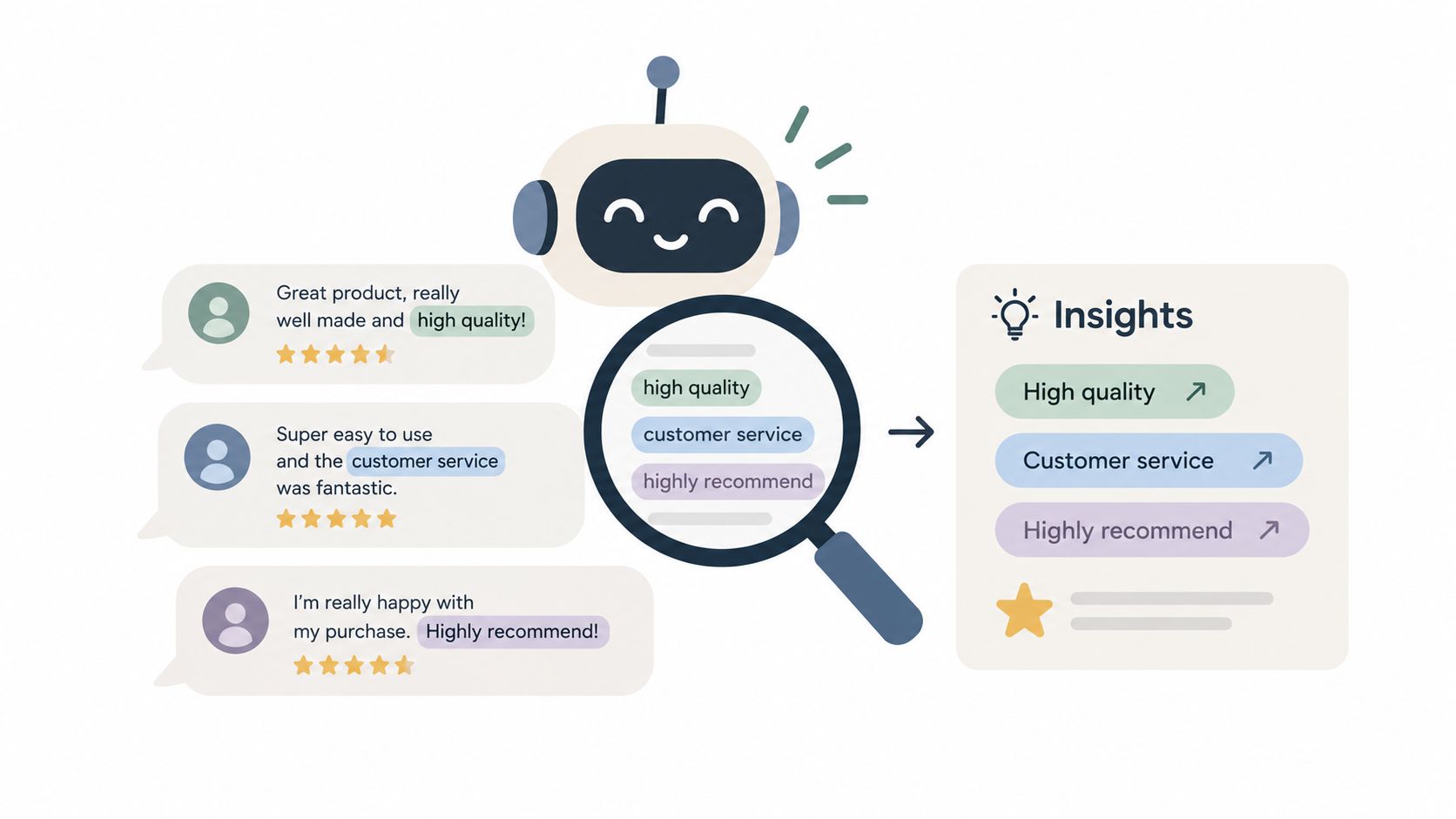
AI should not decide which customer stories your business publishes. It should reduce the reading burden, reveal patterns, and help analysts examine a large review archive without losing the original customer voice. It can group recurring themes, suggest sentiment categories, identify representative excerpts, and show how views differ between customer segments.
Human review remains required. An automated system may remove a qualification, combine unrelated concerns, or read sarcasm as praise. Check every excerpt against its full review, preserve the original response, and keep automated summaries out of final product, support, or marketing decisions unless an accountable person has verified them.
Build an evidence trail from themes
Begin with a specific question, such as which onboarding issues recur, which feature customers mention most often, or which segment reports the clearest value. Compare the output with sales conversations, support tickets, interview notes, and direct feedback. A theme supported across these sources is more useful than an isolated keyword count.
Use the analysis as a handoff system:
Collect the source material from first-party responses and approved external reviews. Analyze by topic and segment so broad praise does not conceal a local problem. Validate representative excerpts for wording, context, consent, and date. Route findings to product, operations, or marketing according to the issue. Record the decision, including what changed, what stayed the same, and why.
Bragly's review sentiment analyser can help convert collected reviews into summaries and highlights. Turn verified themes into reusable proof, while retaining the source review and its context. AI handles sorting; people remain responsible for judgment, privacy review, and publication.
9. Review Badges and Trust Signals
A badge gives visitors a fast answer to a basic question: have other customers evaluated this business? It can sit in a header, footer, contact section, checkout flow, or service page. A local company may show its Google rating beside its address. A SaaS company may display a recognized category badge near a product explanation.
The format is compact, but the standard should remain high. Use the platform your target audience recognizes, show the source clearly, and link to the underlying reviews when the platform's terms and your implementation allow it. Multiple badges can demonstrate breadth, but a crowded row of logos may look more like decoration than evidence.
Treat every badge as a promise
Verify that the displayed rating and review count remain current. If a widget syncs automatically, check that the connection still works and that old content isn't being presented as recent. Don't crop or redesign a badge in a way that changes its meaning. Don't use a high rating to imply universal satisfaction.
The trade-off is speed versus depth. A badge reassures quickly, but it can't explain why customers were satisfied or how your team handled criticism. Pair it with a relevant testimonial, a link to full reviews, or a short explanation of the criteria behind an award.
Use badges where uncertainty is highest. A first-time visitor may need reassurance on a pricing page, while an existing customer may care more about onboarding documentation or service access. Test placement by observing whether people engage with the underlying proof, not merely whether the badge draws attention.
10. Review Analytics and Public Reporting
Public reporting makes customer advocacy accountable. Instead of presenting isolated praise, publish the feedback themes you reviewed, the issues you addressed, and the decisions customer input influenced. A product team might document a change to its onboarding flow. A service business could explain how it investigated a recurring complaint and changed its operations.
A useful report defines its period, collection method, and limits. Remove private customer details, explain how feedback was selected, and avoid presenting a flattering sample as the whole customer experience. The World Health Organization's evaluation of Global Health Days from 2019 through 2023 identifies visibility, behavior and community engagement, policy advocacy, and partnerships as areas of achievement, alongside challenges involving prioritization, coordination, resources, and long-term measurement. Customer advocacy has the same measurement problem. Attention may increase before the underlying experience improves.
Separate activity from customer impact
Research on human-rights advocacy distinguishes outputs, intermediate outcomes, and final outcomes. Outputs are actions the team controls, such as collecting reviews, publishing responses, or releasing a product update. Intermediate outcomes include shifts in attention, commitments, adoption, or access. Final outcomes describe the improvement customers experience. The human-rights advocacy evaluation research explains why these layers should remain separate when change takes time or occurs indirectly.
Structure the report around an evidence chain:
- Activity: Feedback received, themes examined, and responses published.
- Change in understanding: Findings that changed messaging, prioritization, or staff training.
- Operational response: The product, service, or policy decision that followed.
- Customer outcome: Evidence that the response addressed the original issue.
- Remaining limitations: Open questions, unresolved problems, or customer segments not represented.
Use consistent collection methods before comparing trends. Segment findings by meaningful customer groups, protect anonymity where required, and show representative comments alongside summaries. Invite corrections when a public account misstates the source material.
The format can be a quarterly update, product changelog, service review, or public accountability page. Its value comes from traceability: readers should be able to see how feedback became a decision, what changed afterward, and what the business still needs to investigate.
10 Advocacy Examples Compared
| Item | Implementation complexity | Resource requirements | Expected outcomes | Ideal use cases | Key advantages |
|---|---|---|---|---|---|
| Customer Testimonial Widgets | Low, embed no-code widgets | Minimal, design and curation time | Increased on-site conversions and SEO | Product pages, landing pages, checkout flows | Fast to deploy, keeps visitors on site, auto-updates |
| Multi-Platform Review Aggregation | Medium, connect multiple accounts | Moderate, initial setup and ongoing sync | Centralized reputation view; time saved monitoring platforms | Brands present on many review sites; reputation management | Comprehensive cross-platform visibility; reduces manual work |
| First-Party Review Collection Forms | Low–Medium, forms + email workflows | Moderate, email sequences, incentives, follow-up | High-quality, owned testimonials tailored to needs | Case study sourcing, controlled feedback collection | Full ownership of content; customizable questions; segmentation |
| Video Testimonial Showcases | Medium–High, collect, host, embed videos | High, customer effort and production resources | Strong engagement and persuasive social proof | Homepages, high-value offerings, conversion-focused pages | Emotional authenticity; higher conversion impact; SEO benefit |
| Case Studies and Detailed Success Stories | High, interviews, writing, design | High, time, customer cooperation, verification | Persuasive evidence of ROI for complex decisions | B2B sales, enterprise deals, high-ticket purchases | Deep, measurable proof; supports sales and marketing conversations |
| Strategic Review Tagging and Segmentation | Medium, taxonomy and tagging setup | Moderate, initial taxonomy + ongoing maintenance | More relevant testimonials; improved personalization | Segmented audiences, dynamic page displays | Matches social proof to visitor intent; scalable curation |
| Review Response and Engagement Strategy | Medium, workflows and team coordination | Ongoing, staff time for monitoring and responses | Improved reputation, customer loyalty, issue mitigation | Service businesses, companies needing active reputation management | Demonstrates responsiveness; can convert negatives into positives |
| AI-Powered Review Analysis and Highlights | Low–Medium, enable AI features and integrate | Low–Moderate, depends on review volume and plan limits | Automated insights, theme extraction, highlight generation | Large review volumes; product and marketing insight needs | Scales analysis, surfaces trends quickly, saves reading time |
| Review Badges and Trust Signals | Low, embed badge widgets | Minimal, design placement and connection | Quick credibility boost and visible trust signals | Headers, footers, trust sections, compact placements | Compact, credible, auto-updating proof from known platforms |
| Review Analytics and Public Reporting | Medium–High, analytics & public dashboard setup | Moderate–High, data analysis, reporting, context creation | Transparency of trends; shows improvement and accountability | Brands emphasizing transparency or tracking satisfaction over time | Differentiates via data transparency; supports strategic decisions |
Turn Customer Praise Into a Repeatable System
The ten examples work best as one operating loop, not as isolated marketing assets. First, collect feedback directly from customers through a short form, interview, support interaction, or review request. Then aggregate external reviews so the team can see what customers say across the places where they already participate.
Next, analyze recurring themes and tag the evidence by audience, use case, concern, and consent status. A review about easy onboarding belongs in a different proof set from a review about advanced reporting. A customer story from a small local business shouldn't be presented as if it proves the same thing for an enterprise buyer. Relevance is part of credibility.
Then publish each form where it does the most useful work. A concise testimonial widget can support a product page. A video can add human context to a high-intent landing page. A case study can support a complex sales conversation. A badge can provide quick reassurance. A public response can show prospective customers how your team handles criticism.
The loop doesn't end at publication. Respond to feedback, route recurring problems to the people who can fix them, and record the decision. When a customer concern leads to a product, service, or policy change, preserve the original feedback and the resulting evidence. That creates a defensible before-and-after narrative without claiming that every improvement came from one review.
Measurement should separate activity from impact. A testimonial collected is an output. A change in the questions prospects ask may be an intermediate signal. A verified improvement in customer experience is a final outcome. The documented Western Australian heavy-vehicle advocacy campaign offers a useful model for this discipline. The campaign defined a health problem, built a coalition, placed the issue on the public agenda, mobilized decision-makers, and pursued policy change. Its evaluation examined whether the issue gained agenda status, whether decision-makers were pressured, and whether a policy or environmental change occurred. Customer advocacy programs can apply the same logic by connecting feedback activity to a documented business or customer decision.
Start small. Choose one high-intent page, such as a pricing, product, service, or checkout page, and one collection workflow. Define the audience concern the proof should answer. Collect a manageable set of responses, tag them consistently, publish the strongest approved evidence, and schedule a review of what changed.
Bragly can support that workflow by aggregating reviews from 50+ sources, collecting first-party testimonials, analyzing themes, and publishing synchronized no-code widgets. Its source coverage, collection forms, tagging tools, AI-based analysis, basic analytics, and website widgets can help a small team move from scattered feedback to maintained customer proof. Use the platform as part of an operating process, not as a replacement for consent, judgment, response ownership, or follow-through.
Build your advocacy system around Bragly by bringing third-party reviews and first-party testimonials into one workspace, then turning approved proof into no-code widgets, highlights, and organized feedback themes. Visit Bragly to collect, manage, analyze, and publish customer advocacy across your website.