
Looking for a Shorter Overview?
AI Summary
Key Moments
Value of Review Summaries
Summaries consolidate diverse reviews into a clear picture of themes and customer sentiment for better decision-making.Manual Analysis Approach
Organizing reviews in spreadsheets and tagging themes helps capture nuanced customer feedback accurately.AI Summary Risks
Automated summaries can misinterpret sarcasm, causation, or minority complaints, requiring careful evidence tracking.Hybrid and Custom Solutions
Tools like Bragly offer practical AI-assisted summaries with centralized management, while custom pipelines ensure auditability and integration.83% of U.S. consumers used Google to find reviews about local businesses, and 27% relied on only one review website before deciding. That makes a google review summary useful fast, but only if it stays tied to real review evidence instead of polished guesswork.
You're probably staring at a pile of praise, complaints, and half-useful comments right now, trying to figure out what actually matters. Manual summaries are slow but accurate, AI is fast but risky, and the workable middle ground is a structured workflow that keeps speed without sacrificing factuality.
Why You Need a Google Review Summary
A five-star review lands while you're answering emails. A one-star review arrives after a rough service day and sits in the back of your head all evening. Meanwhile, the rest of the feedback is scattered across dates, locations, and platforms, and the only way to make sense of it all is to pull the noise into something practical.


That's where a google review summary earns its keep. It turns individual comments into a working picture of customer sentiment, which is useful for reputation management, product decisions, and marketing language. A good summary also helps separate patterns from emotional outliers, so you're not overreacting to one loud complaint or missing a repeated weakness.

The business case is simpler than the software pitch
More dashboards aren't always the answer; fewer blind spots often are. A review summary helps you see which themes recur, which issues are isolated, and which strengths deserve to be repeated in your messaging. That matters because Google reaches a large share of review-seeking consumers, but the review set can still be messy, uneven, and easy to misread in raw form (BrightLocal 2025 Local Consumer Review Survey).
The practical payoff shows up when you stop treating reviews as postmortems and start treating them as operating input. That shift is especially valuable for multi-location businesses, service brands, and local companies where the same issue can surface in different wording from one week to the next.
For teams building a broader feedback process, a useful companion read is ROI-focused customer feedback systems, because the win isn't collecting more opinions, it's turning them into decisions.
If you want a deeper look at how review patterns can be organized once they're pulled together, the review analytics feature shows the kind of breakdown that makes recurring themes easier to spot.
Practical rule: if you can't point to the reviews that support a summary sentence, you don't have a summary yet, you have a guess.
How to Extract Review Insights Manually
Start with the reviews in a spreadsheet, not a prompt. A local coffee shop with a few hundred reviews doesn't need a fancy system to get value out of the data, it needs discipline: one row per review, one column for date, star rating, location, and the main theme. That simple structure is enough to separate praise for friendly baristas from repeated notes about slow service during rush hour.
Read for themes, not for single lines
The work is slower than people expect, but it's cleaner than a quick skim. Read each review once for the overall tone, then tag the atomic claims inside it, such as product quality, wait time, cleanliness, or staff behavior. If the same phrase appears in different reviews, tag it the same way every time, otherwise the summary will drift into subjective wording.
A solid manual pass usually asks four questions:
- What is repeated? Repetition is stronger than intensity.
- What changed recently? A theme that appears only in newer reviews may point to a staffing or process shift.
- What's an outlier? One angry review can be an exception, but several similar complaints are a pattern.
- What is the review about? Star rating alone doesn't tell you whether the issue is product quality, service speed, or expectations.
Use the right lens for the job
Manual analysis works best when you need nuance. It helps you understand whether complaints are about one bad day or a structural issue, and it gives you a feel for language that customers keep using in their own words. That's especially helpful if you're also tracking broader account metrics in Google Business Profile insights explained, because the numbers and the narrative should reinforce each other.
Read for patterns first, sentiment second, and single-review drama last.
When you do this well, the summary you write afterward won't sound generic. It'll sound like a real customer base talking in aggregate, which is the whole point.
The Risks and Realities of AI Review Summaries
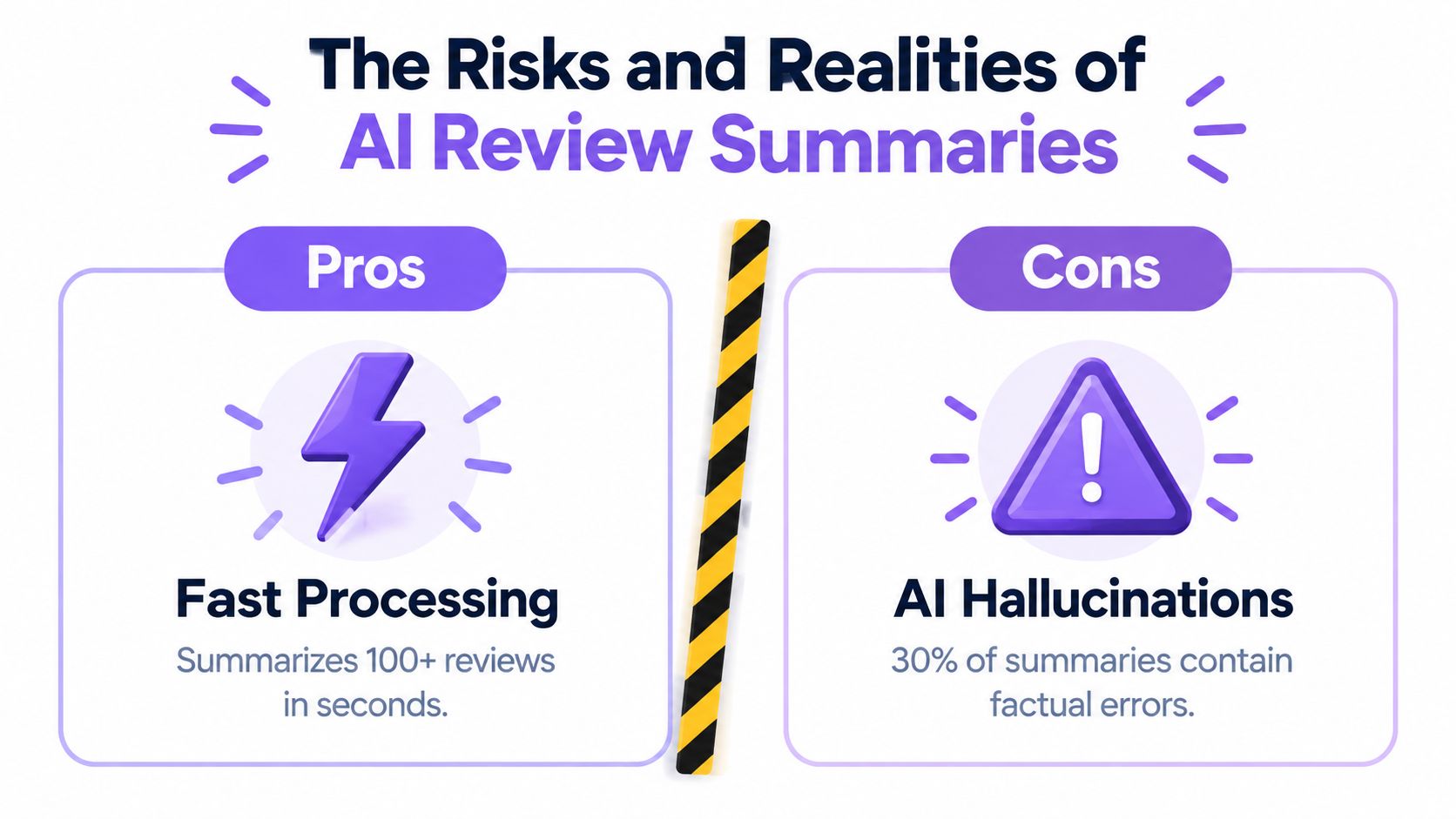
AI makes review summarization look easy because it can compress a long comment set into a neat paragraph almost instantly. The problem is that speed doesn't guarantee correctness, especially when the summary has to interpret mixed tone, partial context, or conflicting complaints. In factuality benchmarks, automated evaluation itself is uneven, with one study reporting up to 88% balanced accuracy on a relatively extractive benchmark but below 75% on more abstractive benchmarks, and a separate benchmark finding a 31.8% response-level error rate among evaluated factuality detectors (benchmark evidence).
What usually goes wrong
The failure modes are predictable once you've read enough bad summaries. AI can flatten sarcasm into literal praise, over-weight a long rant because it has more text, or stitch together unrelated details and act as if they prove causation. A review that mentions staff, delay, and frustration doesn't necessarily prove that staff caused the delay, but careless summarization often writes it that way.
The stronger approach is source-grounded and auditable. Normalize reviews by language, date, star rating, and location, deduplicate near-identical text, break each review into atomic claims, classify sentiment and topics, then generate only the statements you can trace back to evidence. Longer summaries should be checked sentence by sentence, because claim-level verification catches the kind of drift that a single overall score misses.
Build for evidence, not elegance
A defensible workflow also preserves review IDs and timestamps, stores evidence spans for every summary claim, and flags low-confidence or conflicting statements for human review. That matters because a summary can look polished while quietly losing minority complaints or conditions that only show up in specific locations.
The benchmark-oriented design that holds up best is the boring one: relevance, coherence, coverage, and factual consistency all checked separately, with a release gate that blocks anything unsupported. If a sentence lacks evidence, contains an unverified number, or crosses the line from synthesis into invention, it doesn't ship.
Using Bragly to Automate Your Review Summary
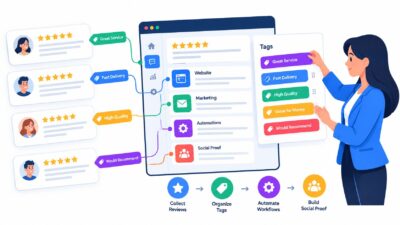
Bragly sits in the middle ground between spreadsheet grind and blind AI output. It centralizes reviews from many sources, including Google, and gives you AI-based analysis, tagging, and widgets without making you build the pipeline from scratch. For teams that don't want to maintain a custom system, that combination is often the practical compromise.
Where automation helps, and where it still needs supervision
The appeal is straightforward. Connected sources stay synced, analysis stays centralized, and you don't have to manually pull fresh review text every time new feedback arrives. That makes it easier to keep summaries current and to surface recurring themes without rebuilding the process for every campaign or location.
Still, automation doesn't remove judgment. A system can cluster themes, but it can't always tell whether a complaint is a one-off, a seasonal issue, or a sign that a specific location has a staffing problem. If you're using a tool like Bragly, the useful habit is to treat the generated summary as a draft that still needs review against the underlying comments.
What to check before you publish
A practical rollout usually comes down to a few checks:
- Theme fit: does the summary capture the recurring issues customers mention?
- Context fit: does it separate different locations, services, or customer groups?
- Evidence fit: can the main claims be traced back to the source reviews?
- Update fit: does the summary reflect the current review set, not last quarter's pattern?
That last point matters because review volume and topic mix change over time, and stale summaries can mislead as easily as inaccurate ones. If you're already managing review placement across a site, the no-code display options and source syncing can save repetitive work, but they don't replace editorial oversight.
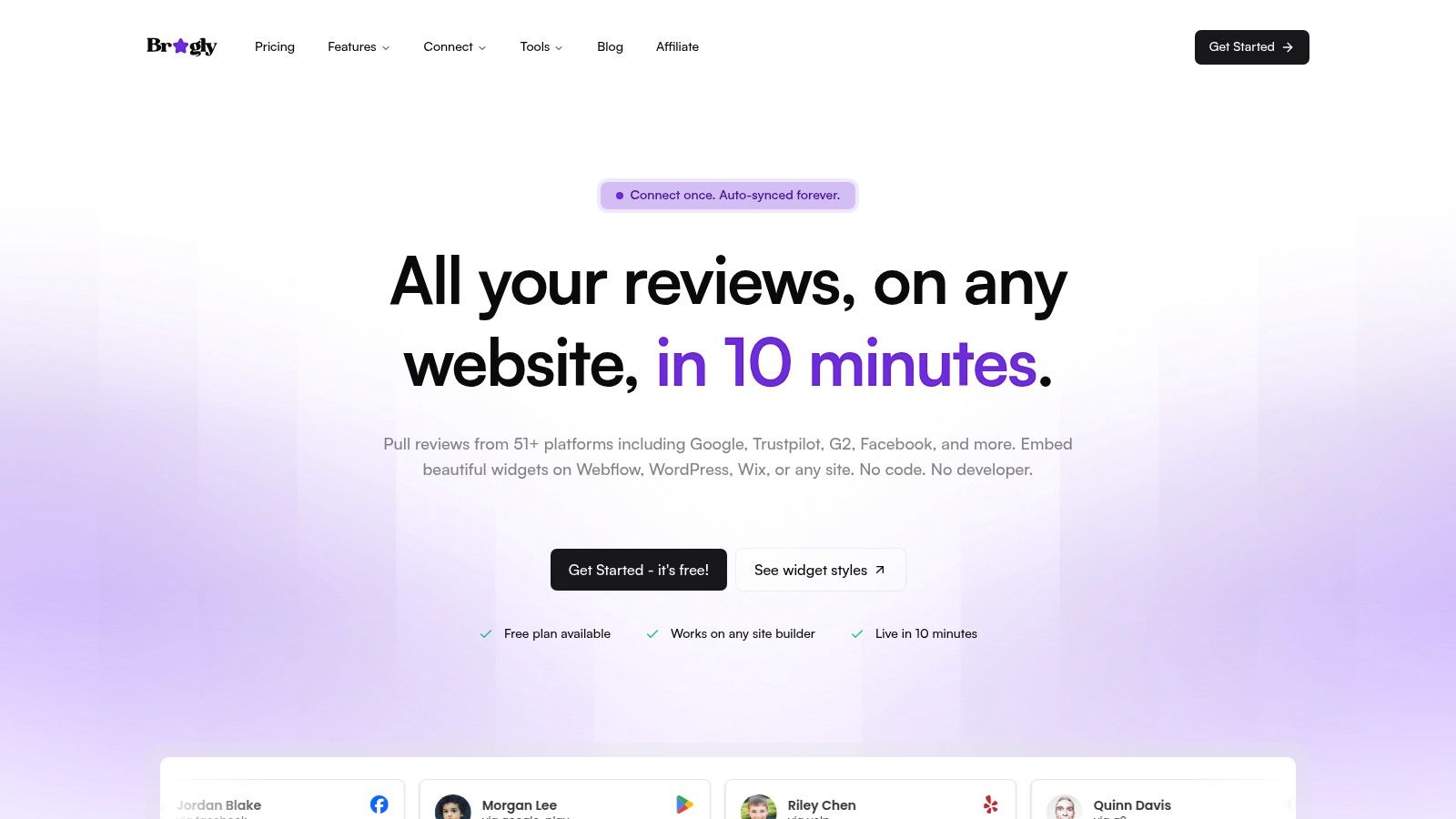
Bragly is one option for teams that want review summaries, tagging, and display widgets in one place, especially when they don't have the time or technical staff to maintain a custom workflow. The value isn't magic, it's consolidation.
Building a Custom Review Summary Pipeline
A custom pipeline makes sense when the review data has to be auditable, segmented, or integrated into another internal system. Start with ingestion from Google's Places API, then normalize the reviews so language, date, rating, and location are consistent before you do any summarization. If you skip that cleanup, the summary will inherit every duplicate, mismatch, and stray edge case from the source set.
The architecture that holds up
The most defensible systems treat summarization as a sequence of checks, not a single generation step. First comes aggregation and deduplication, then claim extraction, then topic and sentiment classification, then generation, then verification. Each stage should leave a trail, because that's what lets an editor audit why a summary sentence exists in the first place.
A practical release gate should block publication if a sentence lacks evidence, if the tone is contradicted by a meaningful minority of reviews, or if the output makes a claim that the source text doesn't support. That's also where sentence-by-sentence verification helps, especially for longer summaries where one weak clause can undermine the whole result.
What to protect in the data
Keep review IDs, timestamps, evidence spans, and the review sample window. Those details matter when a summary needs revision after a spike in new reviews or a shift in sentiment around a specific topic. They also make it easier to explain why a summary changed, which is a lot easier to defend than saying the model “updated itself.”
A custom build should also evaluate more than similarity. Relevance, coherence, coverage of important themes, and factual consistency are different tests, and a system that only optimizes one of them will usually fail on the others.
If your team needs to find the right place identifiers before wiring the pipeline together, the Google Place ID finder is the kind of utility that removes a small but annoying implementation step.
How Much Should You Trust Automated Summaries
Trust them as maps, not verdicts. That's the right mental model because summaries are useful for spotting recurring themes, but they can hide minority experiences, condition-specific complaints, and disagreements between reviewers. In consumer research, 46% of surveyed U.S. consumers found AI review summaries only somewhat helpful and still read individual reviews, while 20% found them unhelpful and preferred the original customer comments, even though 83% of U.S. consumers used Google to find reviews about local businesses (GatherUp and BrightLocal).
Why context matters more than polish
A clean summary can still mislead if the sample is narrow or the business is uneven across locations. One location may get praised for service while another gets criticized for speed, and one average paragraph can flatten that difference into something too neat to be useful. The same risk shows up with service lines, language groups, and customer segments that don't share the same expectations.
That's why a reliable summary should show how many reviews support each theme, how recent those reviews are, and which comments best represent the pattern. It should also make room for the negative themes that matter, not just the strengths that are easiest to market.
Treat summaries as evidence maps
If a summary is going to influence decisions, it needs to show its work. That means linking conclusions to representative reviews and resisting the urge to present an average rating as if it were the whole story. A small cluster of recent comments can distort the narrative just as easily as a large set of older ones can hide a current problem.
A summary that hides dissent is more dangerous than no summary at all.
The best summaries are useful because they tell you where to read next, not because they let you stop reading altogether. For teams comparing extraction methods, the review sentiment analyser is a practical way to see how sentiment breakdowns can support, but not replace, judgment.
Your Action Plan for Better Review Intelligence
Choose the method that matches your volume and your tolerance for risk. If you have a small review set, manual analysis can be enough. If you need faster turnaround with light operational overhead, a review platform with AI analysis can save time. If your reporting has to be auditable or fully integrated, build the custom pipeline and keep the evidence trail intact.
Start with a simple checklist
- Inventory your reviews: know where they live and how often they change.
- Set the summary scope: decide whether you need one location, one brand, or a full multi-location view.
- Pick your workflow: manual, automated, or custom.
- Define review rules: no unsupported claims, no invented numbers, no hidden context.
- Schedule refreshes: update summaries when the review set changes materially.
That approach also keeps you aligned with the FTC's rule on fake reviews and testimonials, which took effect on October 21, 2024, and with Google's own moderation and display requirements for review summaries. Compliance isn't just a legal box to tick, it protects the credibility of the summary itself.
If you run a practice or a local service brand, especially something as trust-sensitive as dentistry, it also helps to use review presentation and messaging that matches your patient journey. A resource like services built for dentists can be useful when you're thinking about how reviews support conversion, not just reputation.
Keep the workflow simple enough to repeat and strict enough to trust. That's the balance that saves time without turning your summary into marketing fluff.
Bragly helps you centralize reviews, analyze recurring themes, and keep summaries and widgets updated without rebuilding the process every time new feedback comes in. If you want a system that connects review intelligence to how your team works, visit Bragly and see how it can support a more accurate review summary workflow.