
Looking for a Shorter Overview?
AI Summary
Key Moments
Limitations of Sentiment-Only Tagging
Sentiment labels fail to identify the specific buyer objections a review addresses or its best placement.Building a Stable Tag Taxonomy
Develop clear, distinct tag categories across experience, decision context, audience, lifecycle, and performance for consistent classification.Ensuring Authenticity and Evidence Quality
Incorporate authenticity-related tags to flag potential fake or low-quality reviews for editorial scrutiny.Automating Review Workflows
Use ingestion, filtering, tagging, routing, and publishing automation combined with human judgment to efficiently manage reviews.Most advice about tag review starts with the same recommendation: label every testimonial positive, neutral, or negative. That sounds tidy, but it produces weak marketing decisions. A positive review about delivery speed may reassure a first-time buyer, while a positive review about API documentation belongs on a technical comparison page. Sentiment tells you how a customer felt. It doesn't tell you which objection the review resolves, where it belongs, whether it remains current, or how credible its evidence is.
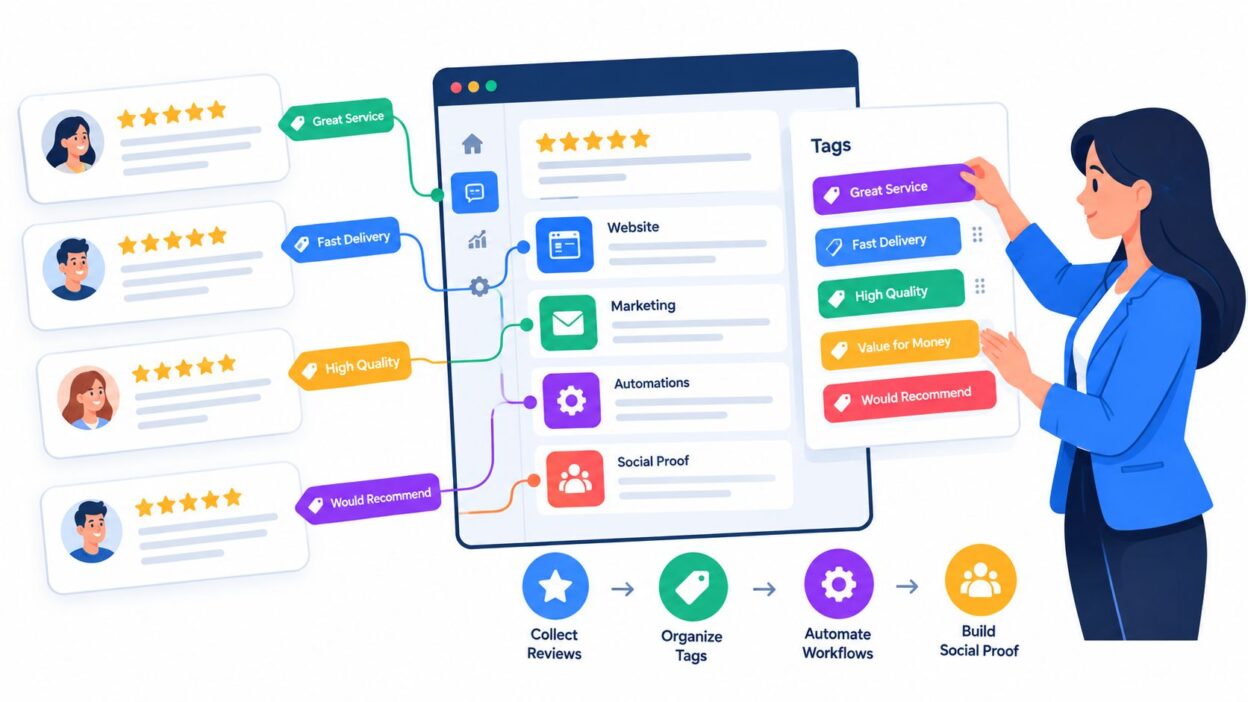
A useful tagging system turns customer feedback into a decision layer for your website. It connects review content to page intent, audience, product experience, lifecycle stage, and authenticity risk. The result isn't merely a cleaner database. It's a more disciplined way to decide which testimonial should appear beside pricing, onboarding, product features, or a purchase form.
Why Basic Sentiment Tagging Fails Modern Brands
A five-star review is not automatically the right testimonial for every placement. Praise for fast shipping can support a delivery message, yet leave implementation concerns unanswered. A detailed onboarding story may suit an activation page, while a homepage hero usually needs a concise statement of broader value.

Sentiment-only tagging fails because it sorts emotional direction while ignoring decision context. Visitors on a pricing page seek reassurance about cost, contract risk, value, and fit. A positive label cannot identify which of those questions a review addresses, or whether the evidence belongs beside pricing, a feature explanation, or a purchase form.
Practical rule: Tag the question a review answers, not just the emotion it expresses.
Use labels such as pricing confidence, easy setup, customer support, integration reliability, product quality, and delivery experience. Each tag should help an editor choose a page, widget position, or internal feedback queue. It should also indicate the customer's stage, since evidence useful during evaluation may differ from proof needed during adoption or renewal.
Map reviews to buyer intent
List the objections attached to each important page. A homepage may need broad credibility. A feature page may need proof of a specific outcome. A pricing page may need evidence that the product delivers enough value to justify investment. A comparison page may need testimonials addressing switching costs or differentiation.
One review can carry several tags when it serves different purposes. A customer might mention quick implementation, responsive support, and workflow improvement in one paragraph. Those are separate editorial signals, even if the overall rating is identical. They can guide widget placement, but they should not hide uncertainty about evidence quality or authenticity.
A study of review-tag functions across 340 popular products found that approximately 67%, or 228 products, used tags (the 2021 review-tag study). This shows that tags help visitors work through large feedback collections and find relevant evidence. They do not, by themselves, prove that a review is current, representative, or genuine.
Use sentiment as one field, not the organizing principle. Bragly's review sentiment analyser illustrates how sentiment can remain one signal among decision-context tags. For publication, prioritize audience, objection, use case, page intent, lifecycle stage, and evidence quality. That structure connects tagging to conversion decisions rather than treating positive emotion as the outcome.
Building a Conversion-Focused Tag Taxonomy
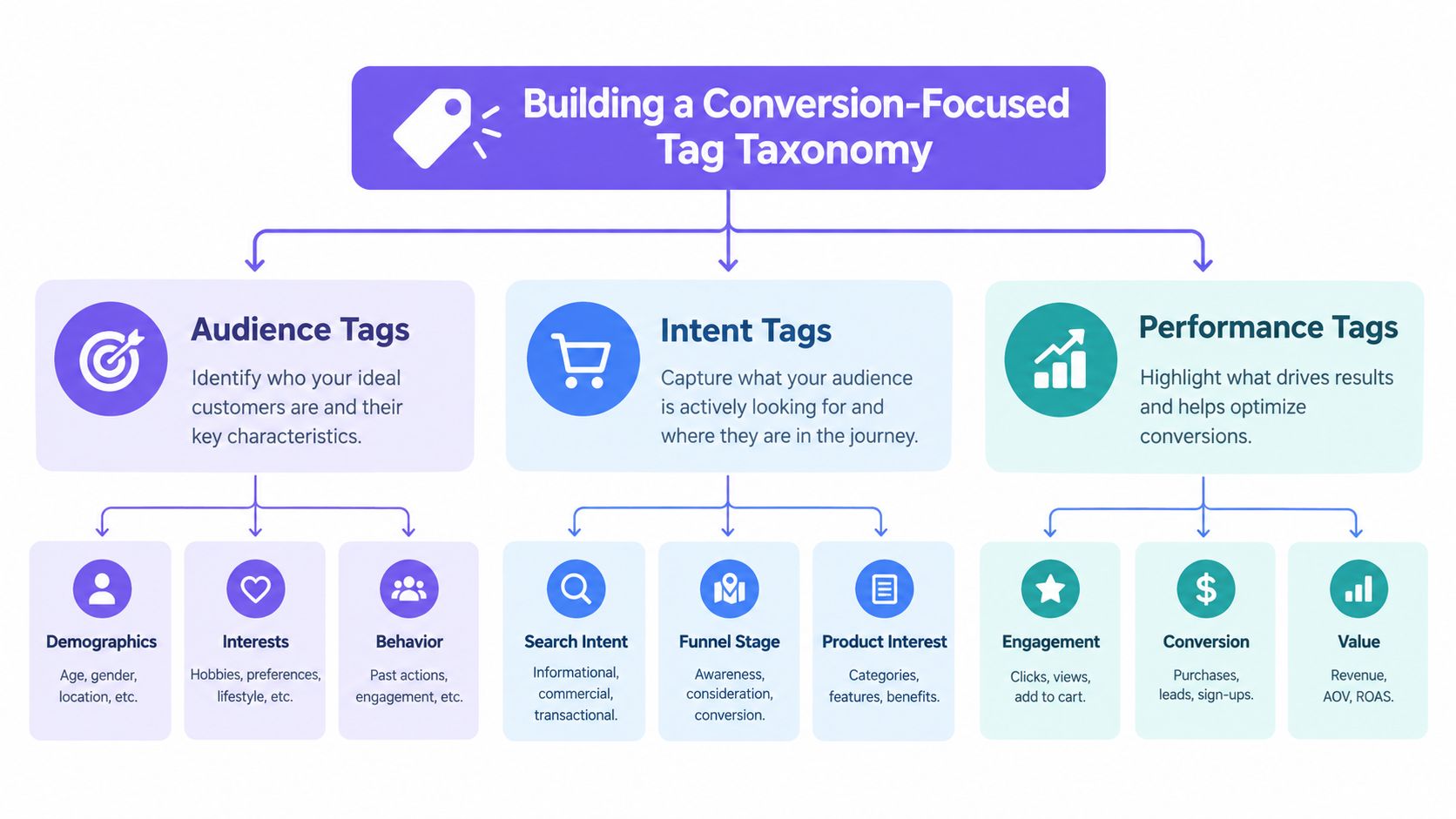
Treat tags as supervised classification labels, not as casual keywords added whenever someone notices a phrase. The taxonomy should make each label understandable to marketers, reviewers, analysts, and automation rules. If two tags mean nearly the same thing, they'll create inconsistent filtering and unreliable reporting.
Define the taxonomy before importing everything
Create a small set of stable dimensions. One dimension might describe the customer problem, another the experience being discussed, and another the intended placement.
A practical starting structure looks like this:
- Experience tags: product quality, usability, onboarding, delivery, support, billing, reliability.
- Decision-context tags: pricing reassurance, implementation risk, feature confidence, switching concern, compliance concern.
- Audience tags: industry, company size, role, customer segment, use case.
- Lifecycle tags: evaluation, purchase, implementation, adoption, renewal, expansion.
- Performance tags: approved, needs review, current, superseded, unclear.
Keep categories mutually exclusive where possible. If multi-label tagging is necessary, define the rule explicitly. “Support” might describe a service interaction, while “onboarding” describes getting started with the product. A review can contain both, but the definitions should prevent reviewers from choosing either label at random.
Build the data process around meaning
Normalize text before classification. Remove duplicates, preserve negations, detect language, and retain domain terms that generic language processing may treat as noise. “Not difficult to install” doesn't mean the same thing as “difficult to install,” and a rule that removes “not” can reverse the intended meaning.
Then create a representative calibration set. Include short reviews, mixed sentiment, sarcasm, detailed praise, complaints with positive ratings, and positive reviews that mention a problem. Have people label the sample before automating it. The resulting definitions should include both positive and negative examples, so reviewers know what belongs and what doesn't.
Don't map star ratings directly to topic tags. A four-star review may contain the most useful usability feedback in the entire collection, while a five-star review may offer little detail. One review-analysis implementation reported roughly 80% agreement with manual analysis, with performance varying by language, including about 85% for English, 72% for French, and 67% for Spanish (the published review-analysis study). Treat those figures as evidence that validation needs language-specific attention, not as a universal performance promise.
Closing the Gap Between Customer Language and Predefined Tags
A fixed taxonomy gives a team consistency, but it also creates blind spots. Customers rarely use the exact vocabulary chosen in a planning meeting. They may describe “setup without hand-holding,” “surprisingly painless migration,” or “the dashboard finally makes sense” instead of selecting the business labels your team created.
The gap becomes substantial in large review collections. Research proposing the AOT-Net framework reported that the proportion of absent tags in its e-commerce review data was close to 75%, meaning that about three out of every four relevant opinion concepts weren't already represented by the available vocabulary (the AOT-Net research paper). That figure belongs to the study's dataset and definition, but the operational lesson is broader: a static list can miss what customers discuss.
Combine stable labels with theme discovery
Keep business-critical categories stable. You still need consistent reporting for support, delivery, pricing, product quality, and feature requests. Those labels let teams compare feedback over time and route issues to the right owner.
Add a discovery layer that surfaces language outside the approved taxonomy. AI-based analysis can cluster recurring phrases, identify emerging concerns, and suggest candidate tags. It shouldn't auto-publish those suggestions. A new label such as “migration anxiety” may be useful, but a human needs to decide whether it describes a meaningful buyer objection or merely a handful of unusually worded comments.
Tools such as Bragly's AI review analysis can support this discovery process by helping teams extract patterns from collected testimonials. The output still needs editorial judgment. Automation is valuable for finding the signal. It isn't a substitute for deciding what the signal means.
Use a two-pass audit
First, have at least two domain reviewers independently label a calibration batch. Reconcile disagreements, revise definitions, and allow multiple tags or an explicit “unclear” status when a review doesn't fit cleanly.
Second, compare automated labels with the adjudicated set using macro-F1, per-class recall, and error counts weighted by prevalence. Pay special attention to high-risk categories such as billing, privacy, safety, and cancellation. A single overall accuracy score can hide poor performance on the tags that matter most.
Automated sentiment also deserves skepticism. A comparative study found weak alignment between automated sentiment outputs and actual review ratings, including a Spearman correlation of only 0.0099 for one tool (the comparative sentiment study). Ratings can be useful context, but they aren't ground truth for topic, intent, or authenticity.
Tagging for Authenticity and Evidence Quality
Most review libraries classify testimonials by product feature and sentiment, then treat every imported quote as equally trustworthy. That creates a dangerous blind spot. A polished testimonial with vague praise may be less useful than a modest review that identifies the customer's situation, action, and outcome.
Authenticity deserves its own tags. Use fields such as verified customer status, first-party or imported source, evidence specificity, incentive disclosure, duplicate suspicion, AI-generation risk, and verification state. These labels don't prove that a review is genuine. They help your team decide which content needs investigation before it reaches a prominent widget.
A 2025 European consumer report found that 66% of surveyed consumers had encountered fake reviews (the BEUC consumer report). The same source describes earlier country-specific research that identified suspected fake reviews on up to 8.4% of Amazon products, 6.2% of TripAdvisor hotels, and 2.1% of Booking listings. These figures apply to the cited research contexts, but they reinforce a practical point: positive sentiment and polished language aren't evidence of authenticity.
Make provenance visible internally
A testimonial should carry enough context for an editor to understand where it came from and why it can be displayed. Record the source platform, collection date, customer relationship, consent status, and whether the text was imported, submitted directly, edited, or summarized.
The FTC's Consumer Reviews and Testimonials Rule took effect on October 21, 2024. It prohibits businesses from creating, selling, purchasing, or distributing fake reviews when they knew or should have known the content was false, and it covers AI-generated reviews, nonexistent reviewers, and testimonials from people without actual product experience (the FTC rule announcement). It also addresses incentives conditioned on a particular sentiment.
Google's policy similarly prohibits payment, discounts, free products, or free services in exchange for posting, revising, or removing a review. It also prohibits discouraging negative reviews or selectively requesting positive ones (Google's review-content policy). Your workflow should therefore preserve balanced collection and display, rather than filtering testimonials until only praise remains.
Evidence beats polish: A review should earn prominent placement through relevance and provenance, not because it sounds unusually enthusiastic.
Automating Workflows with Filters and Webhooks
Manual sorting becomes fragile when reviews arrive from many sources. Automation should handle routing and repetition, while people retain control over approval, interpretation, and sensitive claims.
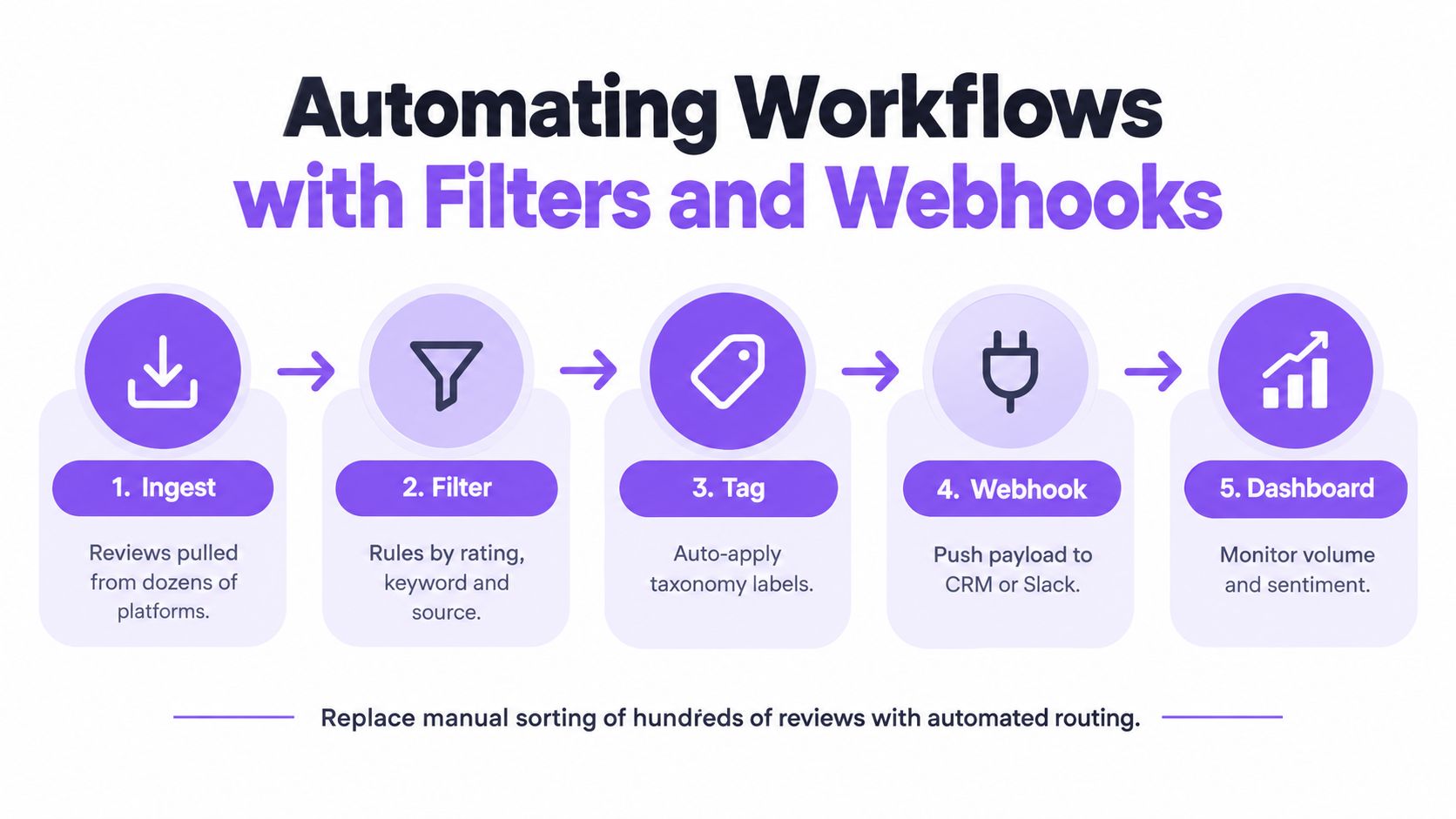
Start with an ingestion rule that captures the source, text, rating, language, date, and customer metadata. Normalize the record, remove duplicates, and apply the taxonomy. Then create filters tied to a clear editorial action. For example, a filter can identify reviews that mention easy setup, carry an approved status, and address onboarding. Those reviews can enter an onboarding-page queue instead of being mixed with general homepage testimonials.
Connect tags to concrete actions
A useful automation chain looks like this:
- Ingest: Pull new reviews into the central library.
- Filter: Match source, language, rating, keyword, lifecycle, and confidence conditions.
- Tag: Apply stable categories and discovery labels.
- Route: Send high-value or low-confidence records to the correct team.
- Publish or hold: Display approved reviews in the relevant widget, or place uncertain records in a review queue.
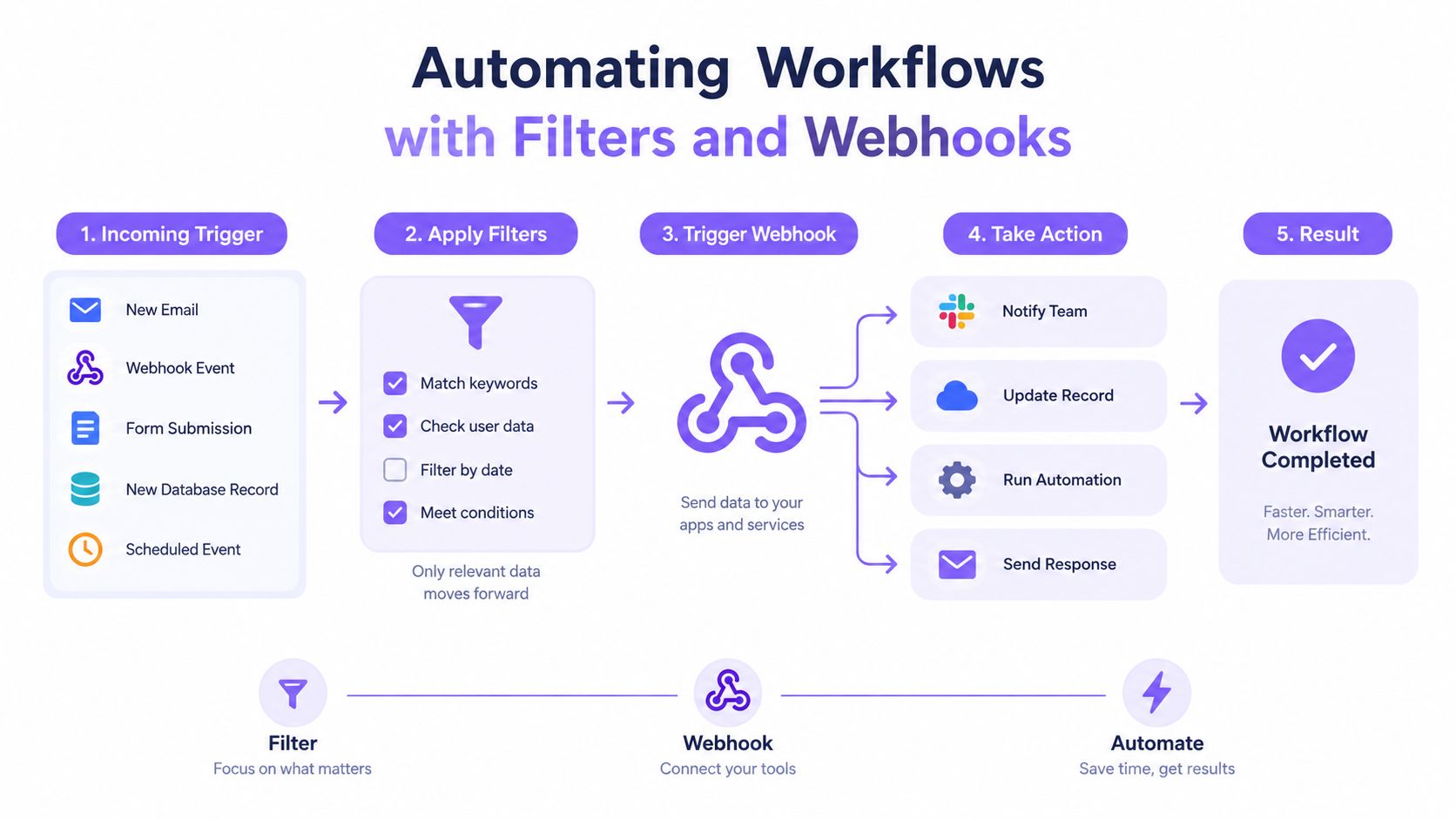
Webhooks make the system operational rather than merely analytical. A newly approved testimonial tagged “pricing reassurance” can notify marketing, create a CRM task, or trigger a content review. A low-confidence record tagged “billing” can go to a support or compliance queue instead of appearing automatically.
Platforms with review workflow integrations can connect tagged review data to the rest of the marketing stack. The exact destination matters less than the rule design. Every webhook should have an owner, a clear payload, and a failure path when a field is missing or a reviewer rejects the record.
Automate the routine, not the judgment
Avoid filters that rely on star rating alone. A five-star review may contain a serious product limitation, and a lower-rated review may offer the clearest evidence of how a team solved a problem. Combine rating with text, source, verification, language, recency, and confidence.
Set thresholds for escalation rather than pretending every classification is certain. High-confidence, low-risk reviews can move through quickly. Reviews that mention safety, privacy, billing, cancellation, or competitor comparisons should require human approval before publication.
Maintaining Freshness and Managing Review Lifecycle
A testimonial can be authentic and still become misleading. Product capabilities change, pricing changes, policies change, and customer segments evolve. A review that accurately described the buying experience last year may no longer represent the current product.
Add lifecycle tags that make this visible. “Current” means the claim still matches the live offer. “Superseded” means a newer product, pricing model, or process has replaced the referenced experience. “Under verification” signals that someone needs to confirm the details. “No longer representative” keeps the record available for historical analysis without allowing it into current widgets.
Create a light maintenance cadence
Sample newly imported reviews weekly for taxonomy drift. Look for new phrases, recurring objections that don't have a suitable label, language-specific errors, duplicate text, and source-level changes in rating conventions. Review the highest-visibility widgets after every major product or pricing update.
Use placement rules that reflect freshness and relevance. A testimonial about a discontinued feature shouldn't remain beside the current feature page just because it has strong sentiment. Rotate content based on current evidence, audience fit, and page intent, not on a desire to display the highest rating.
Research from Northwestern University's Medill Spiegel Research Center found that a product with five reviews had a purchase likelihood 270% greater than a product with no reviews, and that purchase likelihood generally peaked when ratings fell between 4.0 and 4.7 (the Medill Spiegel Research Center findings). The practical implication isn't to chase a perfect score. Display a meaningful body of authentic feedback and preserve credible variation.
For teams connecting review management to commercial outcomes, how reviews boost CPG sales offers useful context on how customer feedback can influence purchase decisions. The same discipline applies beyond consumer goods: place evidence where a buyer's uncertainty is highest, then retire it when the underlying claim changes.
A durable tag-review system has three layers: decision context, evidence quality, and lifecycle status. Sentiment remains useful, but it should inform the workflow rather than control it. When each review has a clear audience, purpose, provenance, and freshness state, your widgets become easier to manage and more credible to buyers.
Bragly centralizes reviews from multiple platforms, supports tagging and filtering, and provides no-code widgets for publishing relevant testimonials across your site. Use Bragly to organize social proof by decision context, route reviews for approval, and keep displayed evidence aligned with your current customer experience.