Looking for a Shorter Overview?
AI Summary
Key Moments
Google's Dominance in Hotel Reviews
Google is the primary platform travelers use for hotel discovery, surpassing TripAdvisor and Booking.com in review volume and influence.Effective Review Monitoring Routine
Regularly check, filter, and respond to Google reviews with clear ownership and operational follow-up to maintain service quality.Crafting Strategic Responses
Responses should be personalized, address specific feedback, and aim to build trust for future travelers to encourage direct bookings.Handling Fake Reviews
Implement a documented process to verify authenticity, collect evidence, flag suspicious reviews, and avoid damaging public disputes.Google overtook TripAdvisor as the largest hotel review platform in 2025, with 12.4 million Google mentions versus 10.3 million for TripAdvisor across an analysis of more than 40 million reviews from 12,000 hotels. The shift happened while global hotel review volume continued to grow, which makes the conclusion hard to ignore: Google reviews are no longer a secondary reputation channel. They're part of the hotel discovery and direct-booking funnel. (Tourismusconsult analysis)
For revenue managers, the job isn't to chase a perfect star rating and hope bookings follow. It's to manage Google as a high-impact, high-noise channel. That means generating authentic feedback, screening suspicious activity, writing useful public responses, and bringing credible social proof back to your own website, where the booking decision can become a direct reservation.
Why Google Dominates Hotel Discovery
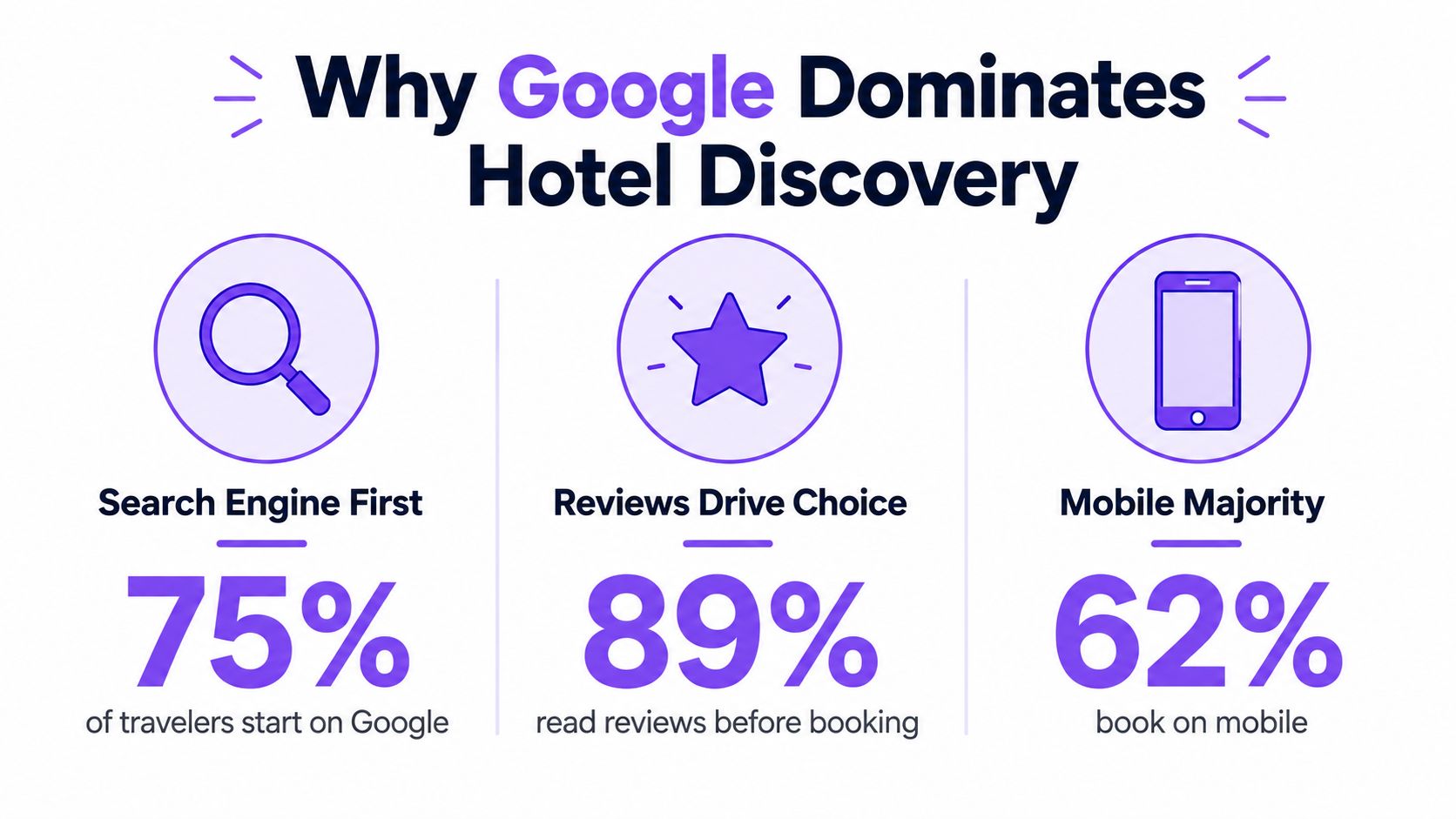
Google is often the first reputation checkpoint for hotel shoppers because it puts discovery, location, reviews, photos, rates, and booking paths in one place. A traveler can search for a property, compare nearby options, read recent comments, and decide whether to visit the hotel's own website without opening a traditional travel platform.


The behavior data matches that reality. A 2025 traveler study found that 71% of travelers look at Google reviews during research, compared with 44% for TripAdvisor and 38% for Booking.com. (Elfsight's summary of Google hotel review research) For revenue teams, the practical point is simple: a hotel can still lose the first comparison if its Google profile looks thin, neglected, or inconsistent, even with strong OTA coverage.
The thresholds that change booking behavior
Review volume and rating do different jobs. Independent survey data shows that 97% of consumers read reviews for local businesses, while 41% say they always read them. The same research found that 31% will only use a business rated 4.5 stars or higher, and 47% will not use a business with fewer than 20 reviews. (Mews overview of Google hotel reviews)
For a hotel, those findings create two operating gates:
- The volume gate: the first 20 authentic reviews can decide whether cautious shoppers view the property as credible.
- The rating gate: falling below 4.5 stars can remove the hotel from consideration for a meaningful share of travelers.
These are not guarantees of ranking or bookings. Google says hotel ratings use a 1 to 5 star scale, and the overall display relies on user ratings plus other signals meant to reflect hotel quality. Google also separates guest-review ratings from class ratings, which describe hotel classification and are not the same metric. (Google's explanation of hotel ratings)
Volume alone won't rescue weak experiences
A large review count cannot offset repeated complaints about cleanliness, service, noise, or misleading expectations. Reviews give revenue teams a public record of what guests value and what breaks trust. The useful question is not just how to get more stars. It is which changes will produce more specific, recent, believable feedback, and more direct bookings.
Google is also a noisy channel. One benchmark estimated that 10% to 12% of visible hotel reviews on Google may still be artificially generated, even after Google removed 170 million suspicious reviews in 2025, a 45% year-over-year increase. That means reputation work has to include fraud screening, response discipline, and a way to carry the strongest social proof back onto your own site.
Locating and Monitoring Your Property Feedback
Start with access, not analysis. The general manager, revenue manager, front office lead, and marketing owner should know who can view and answer reviews on the verified Google Business Profile. Without clear ownership, a review can sit unanswered while several people assume someone else handled it.
On desktop, search for the hotel's verified Business Profile while signed into the correct Google account. Select the profile management area, open the reviews section, and review new feedback from the most recent entries first. On mobile, use the Google Maps app, open the hotel's claimed listing, select the review area, and switch into the business management view if Google prompts you to do so.
A practical monitoring routine
Use filters where available to isolate low ratings, recent entries, and recurring terms. Search for operational language such as “breakfast,” “parking,” “noise,” “check-in,” “shuttle,” or the names of front desk and housekeeping staff. Google's interface can change, so the exact labels may vary, but the workflow remains consistent:
- Check new reviews first. Recent feedback can reveal a service failure before it becomes a pattern.
- Separate praise from defects. Positive comments can supply website proof, while negative themes should enter the operations log.
- Record ownership. Assign a response and an internal follow-up to a named person.
- Review edited feedback. A guest may update a review after the hotel resolves an issue.
- Check the listing itself. Photos, amenities, hours, contact details, and booking paths should match the experience described in reviews.
Google Search can also display hotel review data from approved third parties through structured data feeds. Google says those partners must be configured before the data can appear, and first-party and third-party review data receive equal treatment in how Search ranks, displays, and formats them. (Google's hotel review feed guidance)
For teams that manage several local profiles, a structured audit can expose missing access, inaccurate details, and inconsistent review handling. A useful starting point is this Google Business Profile audit tool. If you're building a broader local feedback process outside hospitality, the plain-language guide to post a quick review for Florida real also illustrates how reducing friction can make a review request easier to complete.
Crafting Responses That Drive Direct Bookings
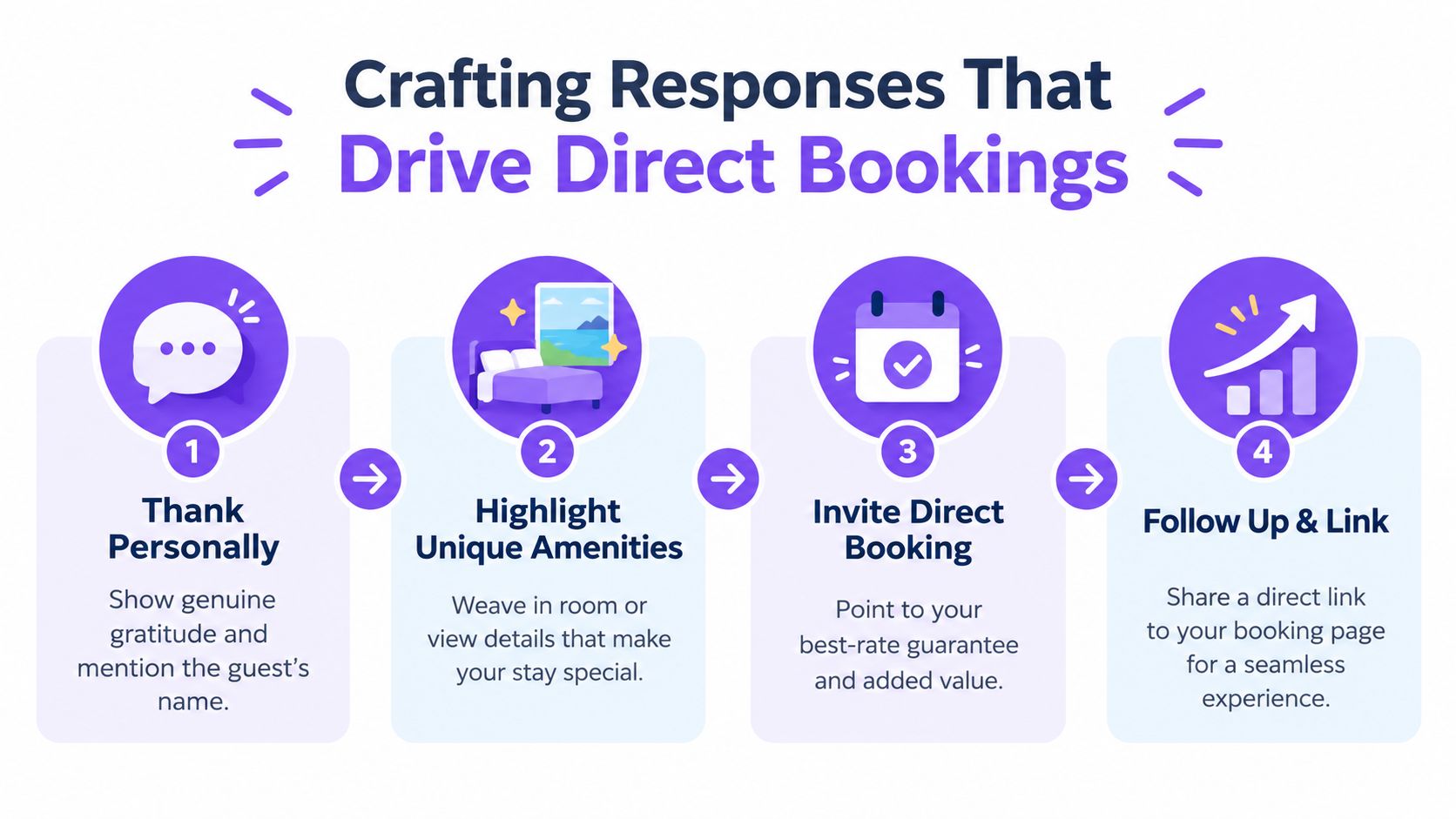
A Google response is public sales copy. Future guests use it to judge the hotel's standards, judgment, and personality, not just its courtesy. “Thank you for your feedback” may acknowledge a review, but it gives a researching traveler little reason to trust the property or book direct.
The available response-rate benchmarks point to an inconsistent operating standard. One 2026 hospitality benchmark reported a 68.8% global hotel response rate in 2025, based on more than 40 million reviews from 12,000 hotels, with an average response time of 3.5 days. Another industry summary placed the overall hotel response rate at about 40%. (Get Welcom's hospitality benchmark summary) Neither figure works as a universal target. The gap shows why each property needs a response process with a clear owner, timing, and quality check.
Write for the next traveler
Speed affects visibility and trust, but speed without substance can make a reply look automated. Set a response service level, then give the writer enough context to mention the actual stay. A late, thoughtful answer may miss a traveler's comparison window, while a fast generic one leaves the hotel indistinguishable from its competitors.
Positive reviews offer a simple opportunity. Thank the guest for a specific detail they volunteered, then reinforce the feature in natural language. If they praised the breakfast, courtyard, family rooms, or walkable location, acknowledge that attribute without repeating their wording mechanically. Close by inviting a direct relationship, such as a visit to the hotel website or contact with the booking team. Keep the invitation useful rather than turning the reply into an advertisement.
Negative reviews require a different tone. Acknowledge the guest's experience without confirming details the team cannot verify. Apologize for the impact, state the corrective action plainly when it is known, and move personal or sensitive details offline. Publicly disputing a guest's character makes the hotel look defensive and gives future readers less confidence.
Practical rule: Write every response for the next traveler reading it, not only for the guest who posted it.
Response language can also improve how search systems interpret the property, including AI-assisted travel searches. Use relevant amenities and location details only when they answer the review. A reply about a noisy room might mention the room location or improved quiet-room assignments. It should not force in a list of facilities or repeat keywords.
A response library keeps tone consistent across staff without requiring identical copy. Use it as a framework, then personalize every reply. These review response templates provide a starting structure, but managers still need to check accuracy, privacy, and any promised follow-up before publishing.
The commercial payoff is clearer expectation-setting, not a guaranteed ranking boost. A traveler who sees a calm, specific answer to a service problem has more usable information than someone who sees an unanswered complaint. That context can reduce hesitation and support a direct-booking decision.
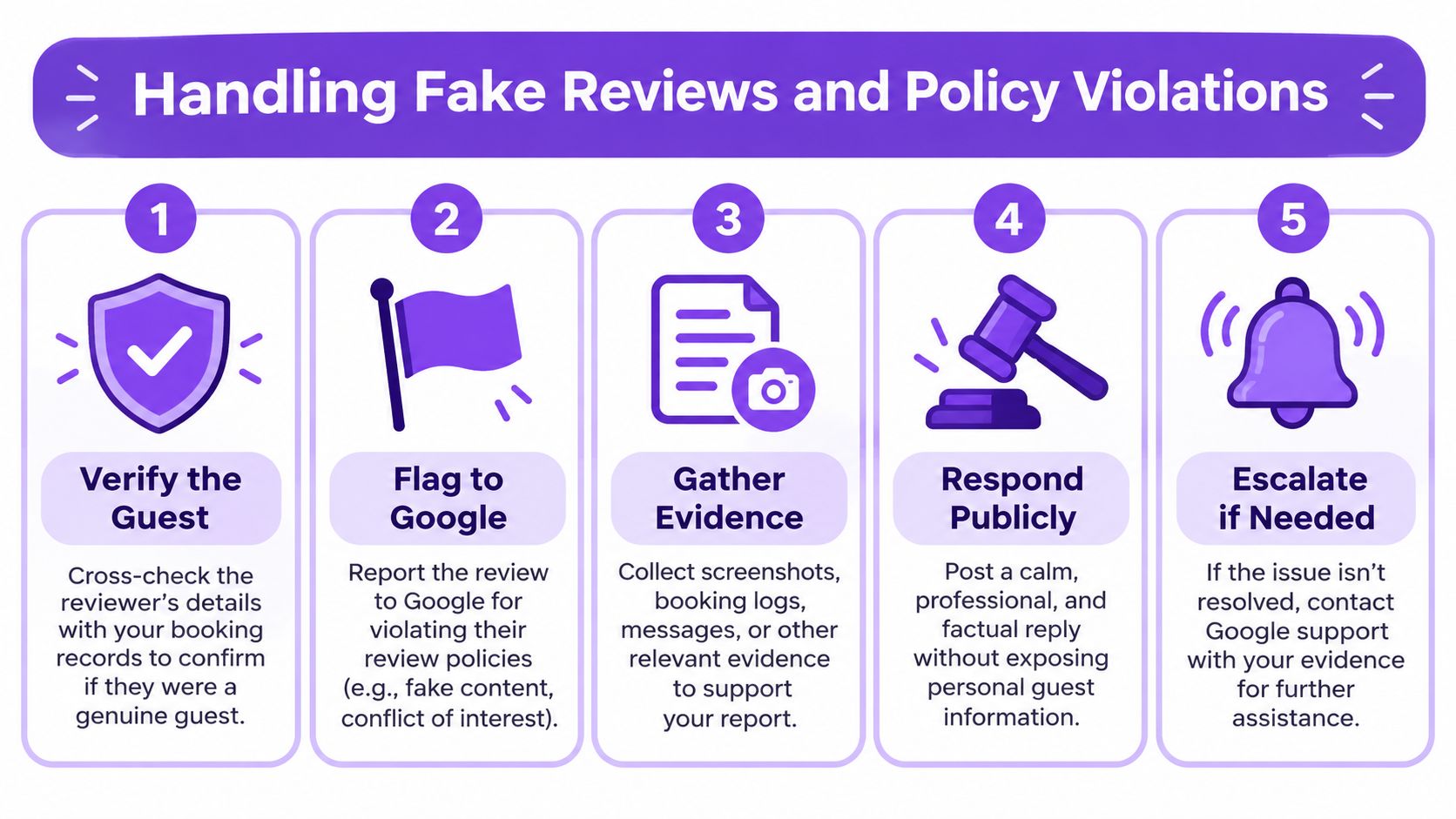
Handling Fake Reviews and Policy Violations
15% to 20% of hotel reviews across major platforms are now AI-generated, according to a 2025 Journal of Marketing Research study cited in BookingWhizz's review authenticity summary, compared with 4% to 6% in 2022. Human readers identified AI-written reviews correctly only 38% of the time, while 52% of travelers doubt review authenticity, up from 31% in 2023. A polished writing style alone proves nothing. Hotels need a documented screening process that separates an awkward genuine complaint from a review that may breach policy.
Start with the evidence, not the rating. Check whether the reviewer can be matched to a stay, then look for copied or duplicate wording, details unrelated to the property, conflicts of interest, promotional spam, threats, or a sudden coordinated burst of submissions. A low score may describe a real service failure, and an enthusiastic review may still be fabricated.
Keep the case file private and factual. Verify the guest against reservation records, stay dates, room assignments, and relevant communications. Gather evidence by saving screenshots, review links, timestamps, and internal notes. Do not publish personal guest information in a response. If the evidence indicates a breach, flag the content through the reporting route in Google Business Profile and select the policy reason that matches the record.
The public response needs a separate decision. If the review remains visible, say that the hotel cannot locate the stay or verify the details, then invite the reviewer to contact the property privately. Avoid accusing the person of lying. If Google rejects the report and the evidence remains concrete, escalate carefully through the available support or appeal route.
Google's rules for third-party hotel reviews also set requirements for eligible submissions. The submission must include the property ID, property name, full review content and date, the listing's review count, and the numeric or star rating. Reviews must be genuine, independent, unpaid editorial reviews, written in their original language and linked directly to the page hosting the review. Duplicate and syndicated reviews are not accepted. Hotels cannot edit, alter, or filter guest opinions before submission, apart from routine authenticity, abuse, or policy monitoring. See Google's third-party hotel review policy before escalating a case.
A suspicious review should be investigated like an incident, not deleted like an inconvenient comment.
Protect the channel's credibility at the source. Never offer a discount for a positive review, ask employees to post reviews, or pressure guests to use scripted wording. Those practices manufacture the appearance of trust and make genuine social proof less useful for future travelers.
Aggregating Social Proof on Your Direct Website
A strong Google reputation should do more than sit on a search results page. It should help close the booking once a traveler lands on your site. By that point, the guest is usually checking for fit, room quality, location, and whether the hotel delivers the same experience that the reviews promise.
The most useful on-site displays do not try to impress everyone with a generic badge. They put the right proof next to the right decision. Family comments belong near family room pages, breakfast praise belongs near dining content, and location feedback belongs near maps, transit notes, or neighborhood copy. That approach also works for properties competing for niche intent, including Cancun hotels for families.
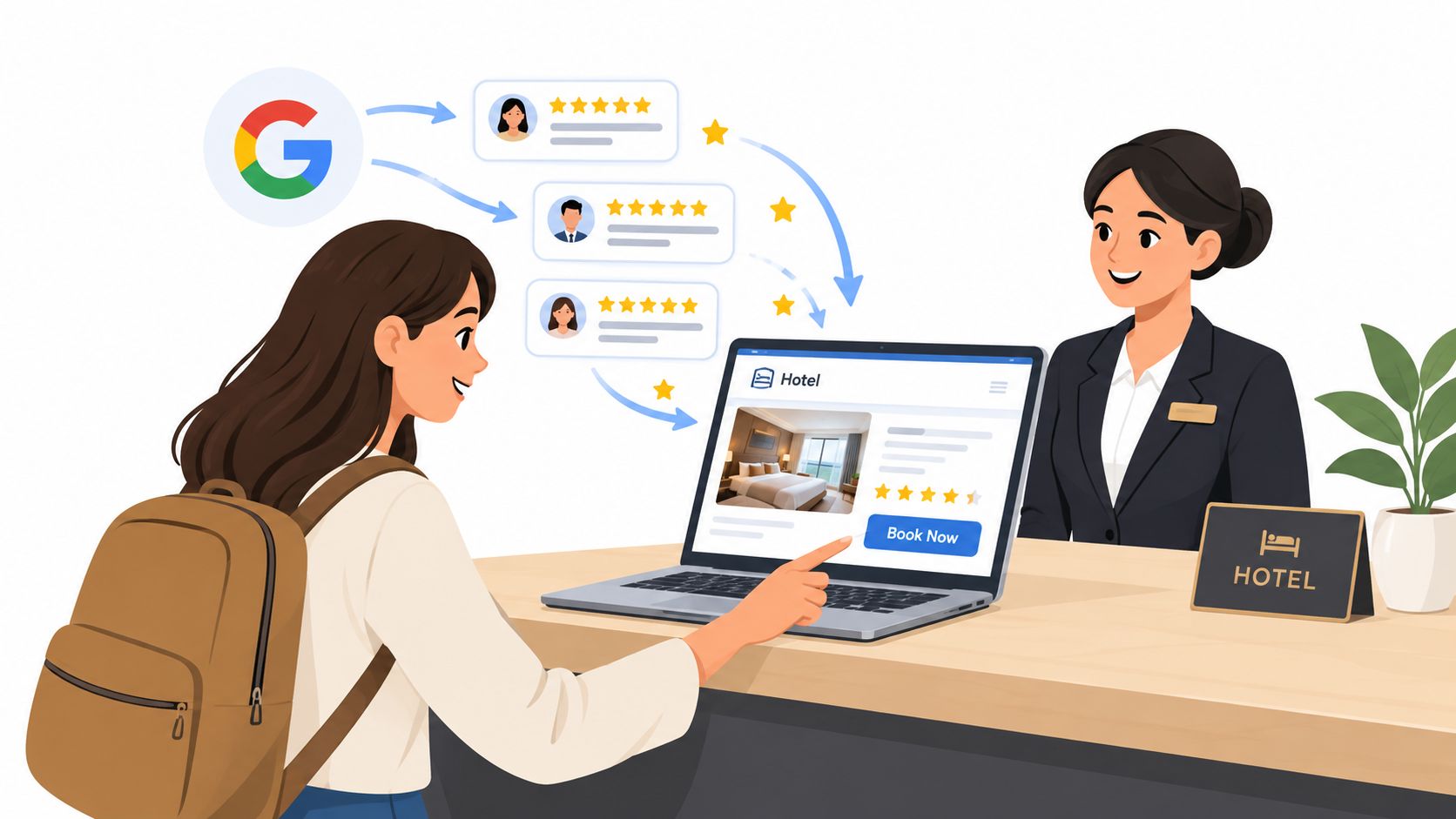
A review display should be built around the booking path, not as a side project tucked away on a separate page. A current rating and review count near the main booking button can reduce hesitation. Short excerpts on room, amenity, dining, and location pages can answer the questions that stop a direct reservation. A fuller proof section still has value for shoppers who want more context, but it should not be the only place social proof appears.
Source control matters. Keep the original source visible, tag reviews by theme, and let the display refresh as new feedback arrives. A short, specific comment about quiet rooms usually does more work than a vague five-star line because it speaks to a real booking concern.
If you use AI to sort themes from a large review set, verify the output before it goes live. Systems can mix up properties, soften a complaint into praise, or overstate a point that was only true for one guest. Editorial judgment still belongs to the hotel team.
For teams that want a simple way to surface reviews on the site, Bragly's Google review badge tool can pull Google feedback into a page layout. Other widgets can do similar work. The test is practical: does it keep attribution clear, sync new feedback, let staff tag or filter reviews, and stay out of the way of the booking flow?
The goal is not to pull every guest away from Google. It is to put the trust earned there where a direct booking can happen.
Building a Sustainable Reputation Workflow
Review management works when it becomes part of hotel operations rather than a task someone remembers after a bad rating. A property doesn't need a complicated command center. It needs clear ownership, a repeatable review queue, and a feedback loop that reaches the teams responsible for the guest experience.
A workable weekly rhythm might look like this:
- Every day: Check new Google reviews, assign responses, and escalate urgent service issues to the duty manager.
- Several times each week: Review unresolved themes, confirm that promised follow-ups happened, and check whether guests edited previous feedback.
- Once each week: Group comments by topic, such as rooms, cleanliness, breakfast, staff, noise, or arrival. Compare the themes with front desk logs and maintenance records.
- Once each month: Refresh the website's selected proof, review response quality, and identify one operational issue that deserves a measurable owner and deadline.
Automated notifications can reduce missed reviews, but automation shouldn't publish unchecked replies. A front office manager can handle service details, a revenue manager can monitor reputation alongside demand signals, and marketing can maintain the on-site display. One person should still own the final brand standard.
The best teams also ask every guest for honest feedback through a frictionless process, without filtering requests toward only happy customers. They use the responses to improve service, then let the resulting experience generate its own proof. That approach is more durable than chasing bursts of reviews after a weak month.
For broader hospitality management principles, how top operators build success offers useful context around consistency, accountability, and operational discipline. Those qualities matter here because Google reviews expose the gap between what a hotel promises and what guests repeatedly experience.
A sustainable workflow leaves the team with three visible outputs: a current response queue, an operations issue log, and a fresh bank of approved social proof. When those outputs become routine, hotel reviews on Google stop being a reputation emergency and start functioning as an input to service quality, search visibility, and direct revenue.
Bragly helps hotels collect, manage, analyze, and display reviews from Google and other sources through no-code website widgets, tagging, syncing, and review analytics. Visit Bragly to turn the feedback your property already earns into clearer social proof at the moments when guests are ready to book directly.