Looking for a Shorter Overview?
AI Summary
Key Moments
The Impact of Your Response
How your replies influence potential customers more than the reviews themselves.Understanding Reviewer Psychology
Sending specific, responsible, and solution-oriented messages changes skeptical readers' minds.Tailored Strategies by Review Type
Using different responses based on whether a review is legitimate, a misunderstanding, or false.Centralized Review Management
Managing all platform reviews in one place improves consistency and speeds response times.A customer leaves a one-star review. Your stomach drops. You read it three times, each time more frustrated. Your first instinct? Defend yourself. Explain why they’re wrong. Tell them they didn’t understand your product.
Stop.
That instinct will cost you. Not just with that one reviewer, but with the 99 other people reading your response—potential customers deciding whether to trust you. Here’s the thing: your response isn’t really for the person who complained. It’s for everyone else watching.

This guide shows you how to respond to negative reviews in ways that actually protect your reputation, recover lost trust, and sometimes even convert critics into customers.
Why Your Response Matters More Than the Review Itself
Most business owners get this wrong: they think the negative review itself is the damage. It’s not. The real damage happens when potential customers read the review and then see how you respond—or don’t respond at all.
Customers actually trust a business more when they see thoughtful responses to bad reviews than when they see no reviews at all. A bad review followed by a good response actually builds credibility. A bad review followed by silence or defensiveness? That destroys it.
Think of your response as serving three different audiences:
- The reviewer: Shows you take feedback seriously and want to make things right
- Potential customers reading: Demonstrates your values, professionalism, and commitment to customer satisfaction
- Your team: Creates a record of how you handle problems and what you’re committed to improving
When a potential customer sees a negative review, they’re not just evaluating your product. They’re evaluating how you treat people when things go wrong. Your response is the test.
The Psychology of Review Readers: What Actually Changes Minds
Before you write a response, think about what’s going through the mind of someone reading that negative review. They’re skeptical. They assume you’ll either ignore complaints or make excuses. When they see your response, they’re looking for three signals:
1. Do you actually understand what went wrong?
A generic response like “We’re sorry you had a bad experience” fails. A specific one like “We see you ordered on Tuesday and the item arrived damaged—that’s not acceptable” passes. Specificity shows you actually read the review.
2. Are you taking responsibility?
This doesn’t mean admitting fault if they’re wrong. It means acknowledging their experience as real. “I understand why you’d be frustrated” works. “That’s not what happened” doesn’t.
3. What’s your actual solution?
Vague promises don’t work. Specific actions do. “We’ll send a replacement today and include a prepaid return label” is a solution. “We value your feedback” is just words.
Readers are running a quick mental test: “If I buy from this company and something goes wrong, will they actually help me?” Your response is their answer.
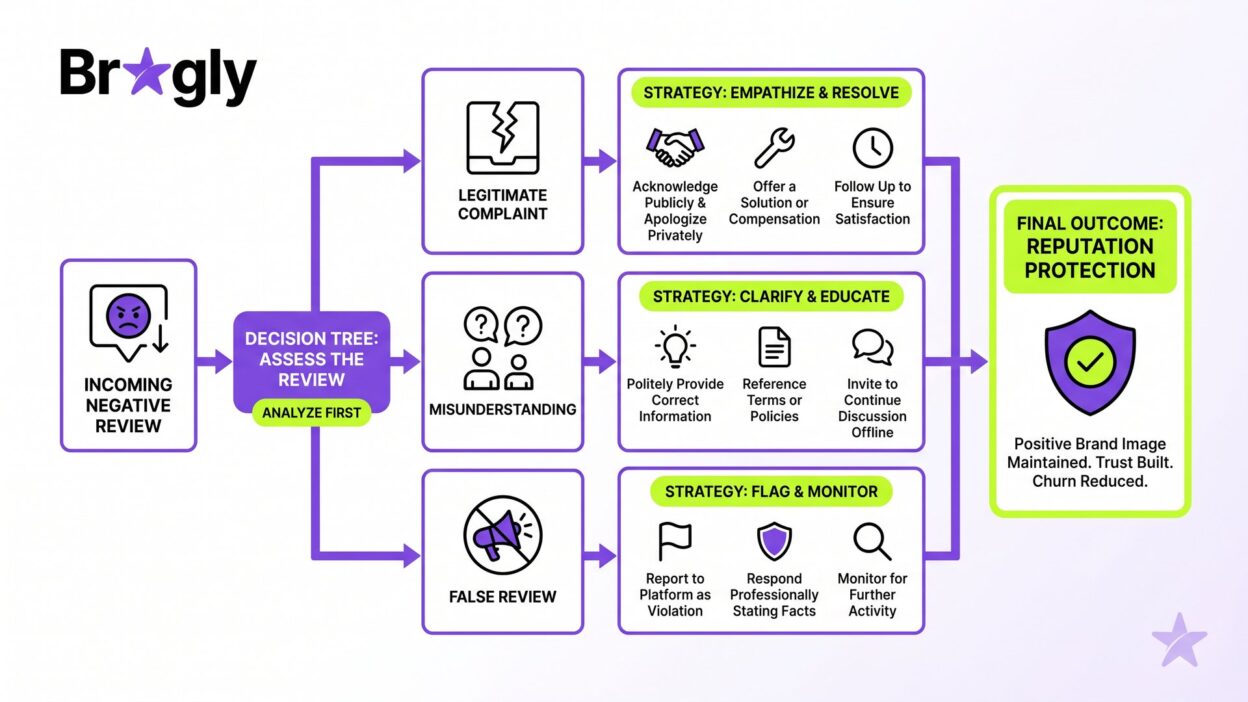
Response Strategy by Review Type: A Decision Tree
Not all negative reviews are the same. Treating a legitimate complaint like a competitor attack is a mistake. Here’s how to tell the difference:
Type 1: Legitimate Complaint (The Customer Has a Valid Point)
Signs: Specific details, reasonable frustration, describes a real problem with your product or service
Response Strategy:
- Acknowledge the specific problem without defensiveness
- Apologize genuinely (not “sorry you feel that way”—actually sorry)
- Explain what went wrong (if relevant)
- Offer a concrete fix
- Ask to take it offline to resolve
Example: “You’re right—your order shipped late. That’s on us. I’ve looked into your account and there was a fulfillment delay we should have communicated better. I’m sending a replacement today with overnight shipping and a $20 credit. Can you reply to this message with your preferred contact info so I can follow up personally?”
Type 2: Misunderstanding or Unmet Expectations
Signs: Customer expected something your product doesn’t do, misunderstood features, or had unrealistic expectations
Response Strategy:
- Empathize with their expectation (don’t dismiss it)
- Clarify what the product actually does
- Offer alternatives or workarounds if they exist
- Suggest a conversation to find a solution
Example: “I see you expected the widget to work with Shopify. We currently support WooCommerce and Wix, and I understand that’s frustrating if you’re on Shopify. We’re planning Shopify integration next quarter. In the meantime, I’d love to chat about workarounds—can you message me directly?”
Type 3: False or Malicious Review
Signs: Factually incorrect, competitor attack, personal vendetta, or clearly fabricated
Response Strategy:
- Don’t engage emotionally
- Respond factually and briefly
- Offer to resolve offline
- Flag for platform review if appropriate
- Document everything
Example: “We appreciate feedback, but this review contains inaccurate information about our pricing and features. We’d like to resolve this. Please contact us directly at [email protected] so we can clarify. We also welcome you to flag this review to the platform if you believe it violates their guidelines.”
The Multi-Platform Challenge: Why Centralization Matters
Here’s the reality most businesses face: your reviews aren’t in one place. A customer leaves a 2-star review on Google. Another leaves 1-star on Trustpilot. A third complains on Facebook. You’re logging into four different platforms, checking each one separately, and trying to maintain a consistent voice across all of them.
That’s where most businesses fail. Inconsistent responses make you look disorganized. Delayed responses make you look like you don’t care. And managing it all manually takes hours every week.
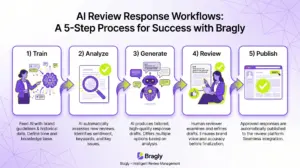
This is why using a centralized dashboard for review management matters. Instead of logging into Google, Trustpilot, Yelp, and Facebook separately, you manage all your reviews in one place. You see all incoming reviews in real-time. You draft responses once and publish them to the right platform. You maintain a consistent brand voice across Google Business Profile, Trustpilot, and every other platform where your customers leave feedback.
The result? Faster response times, better consistency, and less time spent juggling platforms.
Best Practices for Negative Review Responses
Keep it short. 2-3 sentences for positive reviews. 3-4 for negative ones. Anything longer and you’re over-explaining.
Be specific. Reference details from the review. Show you actually read it.
Acknowledge their emotion. “I understand why you’d be frustrated” goes a long way. Even if they’re wrong about the facts, their frustration is real.
Offer a solution, not an excuse. Excuses make you look defensive. Solutions make you look professional.
Take it offline when appropriate. “Please message us directly” or “Call us at [number]” shows you’re serious about resolving it.
Never get defensive or sarcastic. Even if the review is ridiculous, your response needs to be professional. Remember: you’re writing for the 99 people reading, not the 1 person complaining.
Respond within 24-48 hours. Speed signals that you care. Waiting a week signals that you don’t.
Use AI-powered response suggestions to draft faster. You still review before publishing, but AI can handle the initial draft. This cuts your response time from 10 minutes to 2 minutes per review.
Measuring the Impact: How to Know If Your Strategy Is Working
After you implement a solid review response strategy, how do you know it’s actually working? Track these metrics:
Response rate: What percentage of reviews are you responding to? Aim for 80%+.
Response time: How long until you respond? Faster is better. Most businesses should aim for under 48 hours.
Sentiment shift: Are people’s perceptions improving? Check your review analytics to see if your average rating is trending up.
Conversion impact: Are customers who see your responses more likely to convert? Track this by comparing conversion rates on pages with and without review responses visible.
Customer retention: Do customers who had a negative experience but received a great response come back? This is the ultimate test.
Common Mistakes to Avoid
Mistake 1: The Generic Apology
“We’re sorry you had a bad experience” is meaningless. It could apply to any business, any review. Specific responses work better.
Mistake 2: Arguing With the Reviewer
Even if they’re wrong, arguing in a public response makes you look bad. Save the debate for a private conversation.
Mistake 3: Ignoring Negative Reviews
Silence is worse than a response. A negative review with no response looks like you don’t care. A negative review with a professional response looks like you do.
Mistake 4: Responding Inconsistently Across Platforms
Your voice should be recognizable across Google, Trustpilot, Yelp, and Facebook. Wildly different responses confuse customers and look unprofessional.
Mistake 5: Making Promises You Can’t Keep
“We’ll fix this immediately” is risky if you can’t. “We’ll investigate and get back to you by Friday” is safer and more credible.
The Bottom Line: Your Response Is Your Reputation
A negative review isn’t a disaster. It’s an opportunity. An opportunity to show potential customers how you treat people when things go wrong. An opportunity to turn a critic into an advocate. An opportunity to demonstrate that you actually care about customer satisfaction, not just making sales.
The businesses winning right now aren’t the ones with perfect reviews. They’re the ones with thoughtful, professional responses to bad reviews. They’re the ones who respond fast, take responsibility, and actually fix problems.
If you’re currently responding manually to reviews across multiple platforms, you’re spending 10-20 hours a month on this. If you’re not responding at all, you’re leaving money on the table.
Start this week. Pick one review. Write a thoughtful response. See what happens. Then do it again. Build the habit. Your reputation depends on it.