Looking for a Shorter Overview?
AI Summary
Key Moments
Set Up a Collection Form
Create a simple, branded page for customers to leave feedback anytime to ensure ongoing submissions.Ask at the Right Moment
Timing requests immediately after customers experience value maximizes meaningful responses.Use NPS to Target Promoters
Automate testimonial requests triggered by high NPS scores to reach your happiest customers.Personal Outreach Yields Quality
Direct personal asks to top customers dramatically improve quality and response rates.72% of customers will leave a review when asked. The problem isn’t getting people to say nice things — it’s having a system that actually asks them at the right moment. Most companies leave testimonials entirely to chance. This guide fixes that.
Use these seven approaches together to build a testimonial engine that runs on its own. They’re roughly ordered by how much effort they take versus the results they deliver.
1. Set Up a Collection Form (Your Always-On Channel)
A branded collection form is where it starts. It’s a custom page — your logo, your colors, your questions — where customers can leave feedback in their own words whenever they want.


Drop the link into your email signature, your thank-you page, your invoice footer, and your onboarding sequence. When customers can submit whenever they want, you stop relying on catching them at the right moment by luck.
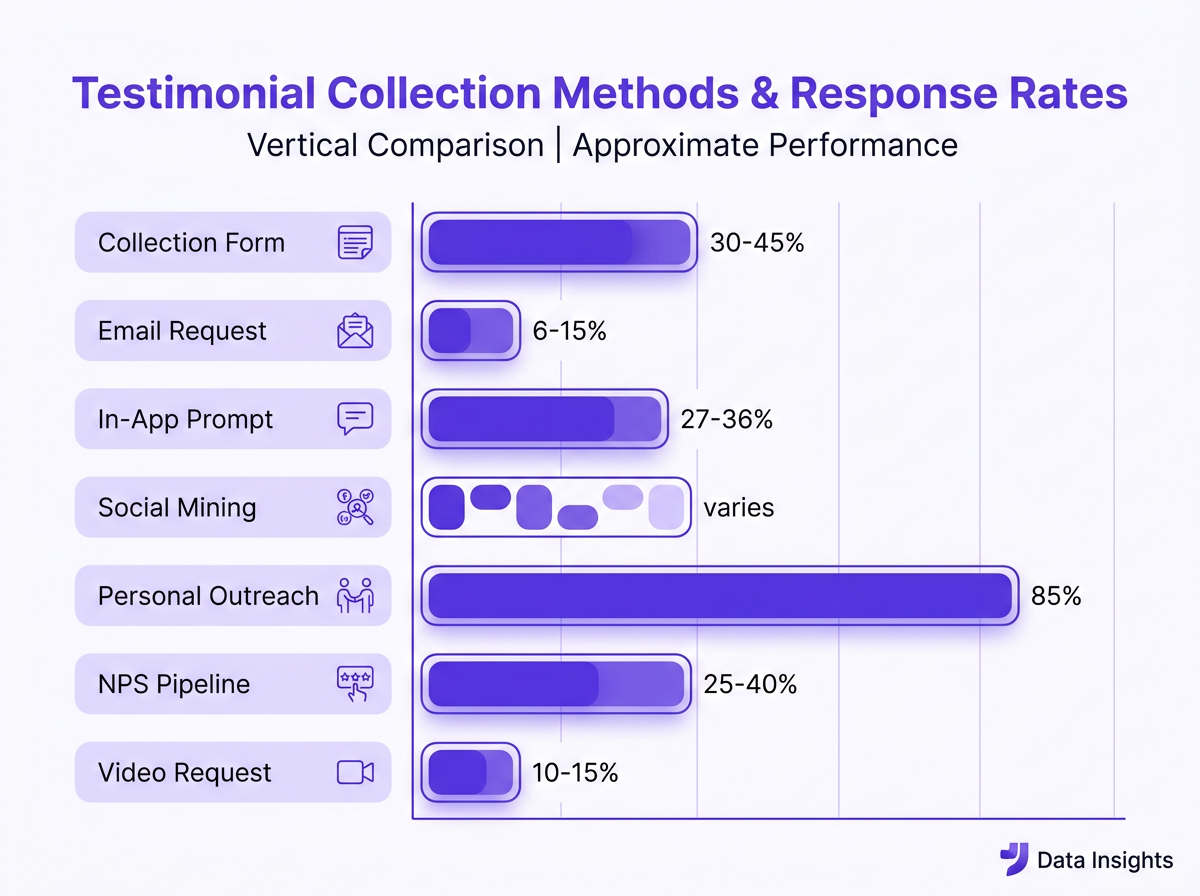
Keep the form short. Name, a text field (or video upload), and email for follow-up. Every extra field cuts completion rates by 10-20%.
Bragly’s collection forms handle both text and video submissions, and you can write your own questions to steer customers toward the kind of specific answers that actually help other buyers make decisions.
2. Ask at the Right Moment
Most testimonial requests fail because of when they’re sent, not what they say. Ask too early and the customer hasn’t experienced enough value to have anything meaningful to share. Ask too late and they’ve forgotten the specifics that make a testimonial useful.
The right timing depends on your business:
- E-commerce: 7-14 days after delivery, once they’ve used the product a few times
- SaaS: Right after a key milestone — onboarding finished, first meaningful result hit, or a positive NPS score submitted
- Services: Within 48 hours of project completion, while the experience is still fresh
The best time to ask is right after a customer achieves something meaningful with your product. That’s the emotional peak — they’ve just realized your product delivered real value. That’s your window.
3. Build an NPS-to-Testimonial Pipeline
If you’re measuring NPS, you already know who your happiest customers are. Anyone who gives you a 9 or 10 just told you they love what you do — give them a place to say it publicly.
Set up an automation: a positive NPS score triggers a follow-up within 24-48 hours with a direct link to your collection form. This one workflow can triple your testimonial volume because you’re targeting people who already self-identified as advocates.
Bragly’s NPS tracking automatically flags your promoters and shows which customers are most likely to become long-term advocates — so you can route them into your testimonial pipeline without any manual work.
4. Find Your Existing Organic Mentions
Some of your best testimonials are already out there. Customers post about your product on LinkedIn, leave comments on your Instagram, mention you in Reddit threads, or review you on app stores — without knowing you’d want to feature them.
Check for unprompted brand mentions once a week. When you find something specific and positive, reach out personally: thank them, and ask if they’d mind their words appearing on your site with credit.
These tend to be the most authentic testimonials you can get — real enthusiasm, natural language, real names. It costs nothing but a few minutes of searching.
5. Ask Directly (For Your Best Customers)
Automated requests handle volume. Personal outreach handles quality. For your best customers — the ones who’ve renewed, referred others, or sent you unprompted positive feedback — a personal message outperforms any template.
Keep it short. Reference something specific they said or did. Don’t send a form — ask them to reply with a few words about their experience. Bonus points: draft 2-3 sentences yourself based on what you know about their results and ask them to tweak or approve. People who can just say yes do it at far higher rates than people who have to start from a blank page.
In-person asks at events convert at 85% or better. Conference, trade show, or a quick Zoom call — whenever you’re face-to-face with a happy customer, take 60 seconds to ask.
6. Use In-App Prompts for SaaS Products
If you run software, your product is your most underused testimonial channel. Customers are already engaged when they’re using it — that’s when they’re most likely to have something worth saying.
Trigger a testimonial prompt after a user completes a key action: exports their first report, hits a usage milestone, or gets a positive result from support. The prompt should reference what they just accomplished and include a one-click path to your form.
In-app prompts hit 27-36% response rates, way higher than email’s 6-15%. The key is context: ask when the user just experienced value, not when they’re in the middle of something.
7. Move Your Best Contributors to Video
Text testimonials are easier to collect at scale. Video testimonials are more convincing and convert up to 34% better on landing pages. The right approach uses both — in the right order.
Start with text. Go after broad submissions with low friction. Then, for your most enthusiastic customers — the ones who gave especially detailed, enthusiastic text responses — follow up with a video request. They’re already warm prospects, so a video ask feels natural rather than pushy.
Keep video requirements minimal. 30-60 seconds on their phone works fine. Give them 2-3 talking points to choose from, and offer to handle editing. Most people will record something short if you remove the guesswork.
The Bottom Line
Collecting testimonials at scale comes down to two things: asking the right people at the right moment, and making the submission process painless. No single method works perfectly on its own — the businesses that do this well use several of these approaches together.
Start with a collection form and an NPS pipeline. Those two alone will generate a steady flow without much ongoing effort. Add in-app prompts if you have a SaaS product, and personal outreach for your top accounts. Check for organic mentions that are already out there waiting to be found.
Once you’ve collected testimonials, you need the right way to display them. Our guide to review display permissions covers everything you need to know before putting them on your site.