
Looking for a Shorter Overview?
AI Summary
Key Moments
Comprehensive Reputation Management Activities
Effective ORM involves monitoring, responding, generating reviews, analyzing, and improving customer experience.Importance of Timely Responses
Responding to all reviews within 24-72 hours shows care and prevents negative issues from escalating.Automated Review Generation
Automate review requests at optimal moments via SMS and email to build a stronger, more consistent review profile.Use Reviews for Operational Insights
Analyzing review themes and sentiment helps identify areas for operational improvements, not just reputation metrics.Your business reputation lives in more places than you can manually check. Google, Yelp, Trustpilot, Facebook, LinkedIn, industry-specific platforms, Reddit threads, app stores — every one of these surfaces shapes what potential customers believe about you before they ever visit your website. Online reputation management (ORM) is the practice of staying on top of all of it, responding the right way, and steadily building a presence that works for you rather than against you.
What ORM actually covers in 2026
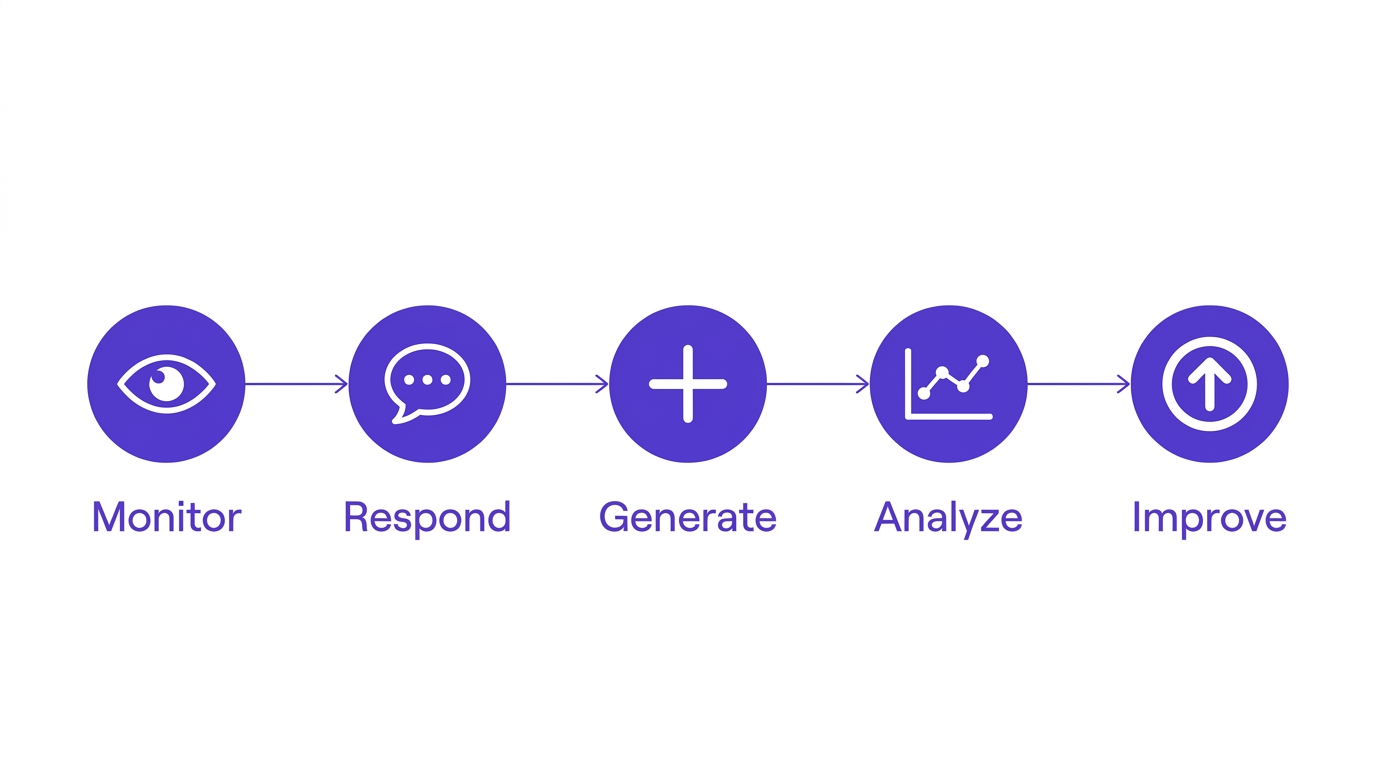
Most articles treat ORM as a single thing. It’s not. Effective reputation management breaks into five distinct activities:
- Monitoring — knowing what is being said about your business, across all platforms, in real time
- Responding — engaging with reviews and feedback professionally
- Generating — building systems that pull in new positive reviews from happy customers
- Analyzing — reading what your reviews collectively reveal about your customer experience
- Improving — using those insights to fix root causes so future reviews naturally reflect better experiences
Most businesses only do one or two of these. The ones with the strongest reputations do all five consistently. This guide covers each one.

1. Monitor everywhere your reputation lives
You can’t fix what you can’t see. The first step is auditing every platform where your business appears, then setting up ongoing monitoring so new content surfaces automatically.
Where to audit
- Google Business Profile — your most important surface. Reviews here appear directly in search results and Google Maps. Check weekly at minimum.
- Trustpilot, Yelp, Facebook — depending on your industry, one or more of these will be where your customers are most active. Claim your profiles and note your current rating and review count.
- G2 and Capterra — if you sell software or B2B services, tech buyers live here. These platforms carry significant weight in purchase decisions.
- Industry-specific platforms — TripAdvisor for hospitality, Healthgrades for healthcare, Houzz for home services, Clutch for agencies. Each surfaces in searches specific to your sector.
- Social media and forums — Reddit, Quora, LinkedIn groups, and industry forums are where candid conversations happen without your knowledge.
Setting up monitoring without expensive tools
For small teams on a budget, start with free options:
- Google Alerts — free. Set alerts for your business name, key product names, and your own name. Receive an email whenever new content matching your terms appears online.
- Platform notifications — enable email or push notifications on Google Business Profile, Yelp, and Facebook so new reviews trigger an alert immediately.
- Weekly incognito search — search your business name in an incognito browser window once a week. Note what appears on page one of results and whether the composition reflects the reputation you want.
As your reputation work scales, Bragly aggregates all your reviews from every platform that matters into a single dashboard with AI-powered response drafting, sentiment analysis, and team assignment for responses — so you manage everything from one place instead of jumping between tabs.
2. Respond to every review — positive and negative
Businesses that respond to reviews earn more revenue. According to ReviewTrackers, companies that respond to all reviews generate 35% more revenue than those that ignore feedback. The response itself is for the hundreds of future customers reading it, not just the reviewer.
The 24-72 hour rule
Speed matters. 53% of customers expect a response within a week of leaving a review, but the faster you respond, the better you signal that you care about customer experience. For 1-star reviews especially, same-day responses prevent small issues from becoming reputation crises.
How to respond to positive reviews
Thank the reviewer by name. Reference something specific they mentioned. Keep it to two or three sentences. It takes less than a minute and shows every future reader that you are paying attention.
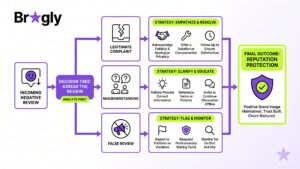
How to respond to negative reviews
Never argue publicly. Never deflect. Never make excuses. Follow this structure:
- Acknowledge the experience and apologize sincerely
- Reference something specific from their feedback
- Explain what corrective action you have taken or will take
- Invite them to continue the conversation offline — provide an email or phone number
A thoughtful, personalized response to a negative review reshapes how prospective customers interpret the feedback — and often leaves them feeling more positively toward the business than if the negative review had never been posted.
Writing responses faster with AI
If you manage reviews across multiple platforms, drafting responses manually becomes unsustainable. AI-powered response tools like Bragly generate a first-draft reply in around 30 seconds by analyzing the review content and tone. You review, tweak if needed, and send. The goal is not to automate empathy — it is to remove the blank-page problem so your team spends time on judgment, not typing.
3. Build a review generation system
Waiting for customers to voluntarily leave reviews is leaving your reputation to chance. The businesses with the strongest review profiles have automated systems that ask the right customers at the right moment.
The right timing for review requests
- E-commerce — 7 to 14 days after delivery, once the customer has used the product a few times
- SaaS — right after a key milestone such as onboarding completion, first meaningful result hit, or a positive NPS score
- Services — within 48 hours of project completion, while the experience is still fresh
Multiple channels, not just email
Text messages consistently outperform email for review requests. SMS has a 98% open rate compared to email’s 20%. A combination of email and SMS, timed to the right moment in the customer journey, will generate significantly more reviews than email alone.
Use a direct link to your Google review page — not your homepage or your Google listing. The fewer clicks between intent and action, the higher your completion rate.
Connecting review generation to your dashboard
Tools like Bragly’s collection forms let you send review requests at specific trigger points — after onboarding, after a support resolution, after a purchase. These forms feed directly into your review dashboard so new submissions appear alongside reviews from Google, Trustpilot, and every other platform in one unified view.
4. Analyze reviews for operational insights
Your reviews are customer feedback you did not have to ask for. The businesses that improve fastest treat every review as a data point, not just a public statement.
Track three things consistently:
- Volume and velocity — how many new reviews are you getting per week? Is that number growing?
- Sentiment distribution — what percentage are 5-star, what percentage are 1 or 2-star? Is the ratio improving?
- Recurring themes — if three customers mention long wait times in the same month, that is a signal worth acting on operationally, not just a reputation metric to track
The recurring-theme analysis is where reviews become genuinely strategic. A customer complaint about checkout complexity is a UX fix you would have missed without the review. A pattern of praise for your support team is an angle worth featuring in your marketing. NPS and review analytics surface these themes automatically rather than requiring you to read every review individually.
5. Protect your search results long-term
A single negative article or review can cost you up to 22% of potential customers, according to research cited by ReputationX. The solution is not to remove negative content — usually you cannot — it is to ensure positive, authoritative content occupies the positions that matter most.
Claim your digital real estate
For every platform you have not claimed, a critic potentially could. Start with the foundations:
- Google Business Profile
- LinkedIn company page
- Facebook page
- Yelp Business Account
- Trustpilot brand page
- Any industry-specific directory relevant to your sector
Each claimed profile is a page you control that ranks for your business name — and a page a critic does not.
Publish content under your brand name
Regular blog posts, case studies, and press coverage published on your own site build the kind of domain authority that pushes negative content lower in search results. This is not about hiding problems — it is about making sure the full picture of your business is visible and recent.
Your daily, weekly, and monthly ORM routine
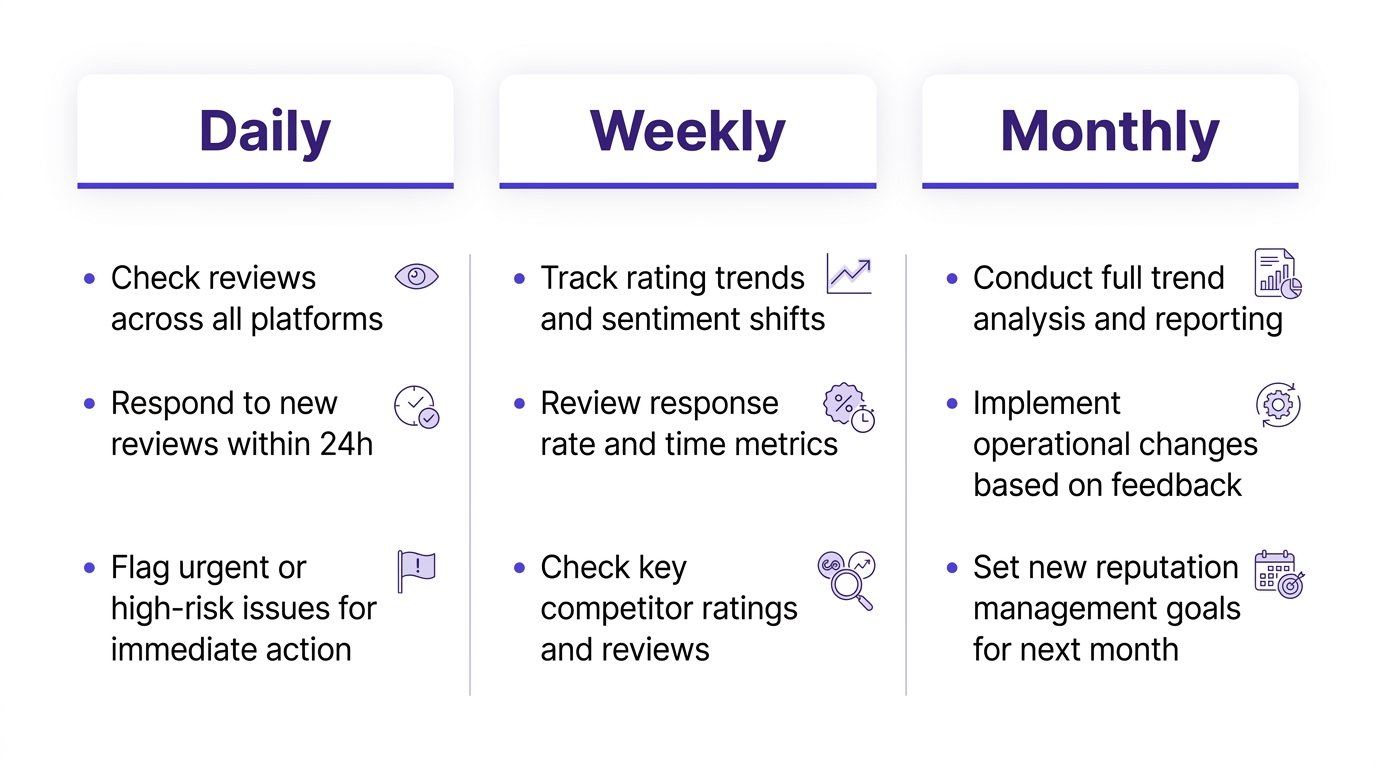
The gap between having an ORM strategy and doing it consistently comes down to routine. Here is a practical time commitment that keeps your reputation healthy without consuming your day:
Daily — 5 minutes
- Check for new reviews across all connected platforms
- Draft and send responses to any new reviews (use AI drafts if available)
- Flag any reviews that suggest an urgent operational issue
Weekly — 15 minutes
- Record your current aggregate rating and new review count in a tracking sheet
- Identify the top positive and negative themes from the past seven days
- Check your Google Business Profile for any updates or new photos from customers
- Verify all platform notification settings are still active
Monthly — 30 minutes
- Full trend analysis: rating direction, review velocity, sentiment distribution
- Competitive benchmark — how do your top two or three competitors look this month?
- Identify which negative themes are increasing or decreasing
- Plan one operational change based on what reviews revealed this month
- Set a review generation target for next month
The Bottom Line
Online reputation management is not a project you finish. It is a system you run. The businesses with the best reputations did not get there by hoping for good reviews — they built monitoring, response, and generation into their weekly operations, treated reviews as operational data, and fixed the root causes that created bad experiences in the first place.
Start with the daily five-minute review check. Build the habit of responding to every review. Set up one automated review request channel this week. Bragly’s collection and response tools handle the monitoring, drafting, and analytics across 33+ platforms in a single dashboard — so your reputation work happens in one place rather than scattered across tabs.
Frequently Asked Questions
What is the difference between review management and ORM?
Review management is a subset of ORM focused specifically on monitoring and responding to customer reviews. ORM is broader and includes managing your overall online presence: search results, social media mentions, directory listings, and public perception across all channels. For most small businesses, review management covers the highest-impact activities at the lowest time investment.
How long does it take to improve a bad reputation?
It depends on how bad the situation is and how systematic your approach is. A consistent review generation program running for 3 to 6 months can meaningfully shift an average rating. Responding professionally to negative reviews starts changing perception immediately — prospective customers reading a thoughtful business response often come away with a more positive impression than if the negative review had never existed.
Can I remove negative reviews?
Not generally. You can flag reviews that violate a platform’s terms of service — fake reviews, spam, off-topic content — through each platform’s reporting process. For legitimate negative reviews, the most effective strategy is responding professionally, generating positive reviews to dilute the average, and creating enough positive content that the negative result occupies a lower position in search results.