
Looking for a Shorter Overview?
AI Summary
Key Moments
Replace generic praise with detailed evidence
Effective testimonials include concrete customer details that address specific buyer objections.Use first-party and third-party reviews strategically
Combine detailed first-party stories with broader third-party feedback to build depth and breadth of trust.Place testimonials where buyers need reassurance
Position testimonials precisely near claims or conversion points to directly answer visitor doubts.Maintain authenticity and legal compliance
Preserve customer voice, disclose material connections, and avoid misleading edits to build credibility and follow FTC guidelines.The most popular advice about testimonials on websites is also the least useful: collect a few nice quotes, place them on the homepage, and wait for conversion rates to rise. A polished quote wall can look reassuring while giving a skeptical buyer no way to tell who said what, when they said it, or whether the business selected only the most flattering feedback.
Effective testimonials are not decorative filler. They're customer evidence, and evidence needs context, specificity, provenance, and a place in the buying journey. The strongest systems combine first-party stories with third-party reviews, keep source information visible, and update displays as customer sentiment changes.
Why Most Website Testimonials Fail to Convert
A positive sentence isn't automatically persuasive. “Great service,” “Amazing product,” and “Highly recommended” may sound pleasant, but they don't answer the questions that create buying confidence. What problem did the customer have? What changed? Why should a visitor with a similar situation believe the claim?


Website testimonials began serving a broader credibility function as online shopping became more dependent on customer feedback. By 2016, 51% of online review readers believed reviews generally gave an accurate picture of product quality, while 48% said it was often hard to tell whether reviews were truthful and unbiased, according to Pew Research findings summarized by Capital One Shopping. That tension still defines the job of testimonials today. Buyers want reassurance, but they also inspect the reassurance itself.
A static block of carefully edited praise fails when it resembles advertising more than customer experience. It often lacks a date, source, customer context, platform attribution, or link to a fuller story. Worse, every visitor sees the same generic quote, even though different visitors arrive with different objections.
Practical rule: A testimonial should help a specific buyer make a specific decision.
Replace praise with evidence
A useful testimonial usually contains at least one concrete detail. A SaaS customer might describe the workflow that became easier. A local service customer might explain how the company handled a difficult appointment. An ecommerce buyer might mention fit, delivery, setup, or the precise use case that mattered.
The point isn't to force every customer into a case study. Short reviews can work well when the surrounding interface supplies the missing context. Show the customer's name or permitted identifier, role or location where appropriate, review date, source platform, product or service category, and a path to more detail.
Research cited in recent industry analysis reports that displaying customer reviews can boost sales by 19.8%, verified-buyer reviews can increase conversion by 15%, and conversion rates can rise 76.7% when retailers display online product reviews. The same analysis reports that the gain can reach at least 143% when more than 100 reviews are shown, with conversion rates peaking around a 4.75 to 4.9 out of 5 rating. These figures come from SocialPilot's review statistics analysis, and they shouldn't be treated as a promise for every page. They do show why review volume, verification, and rating quality deserve strategic attention.
A better starting point is to audit the social proof and conversion relationship before choosing a widget. Ask which objection each testimonial addresses, which audience it represents, and what proof a skeptical visitor could independently verify.
For video, the same standard applies. A customer speaking naturally about a real experience can supply tone, hesitation, detail, and identity that a polished quote often lacks. A practical testimonial video production guide can help teams plan the interview without turning the customer into a scripted spokesperson.
First-Party vs Third-Party Reviews
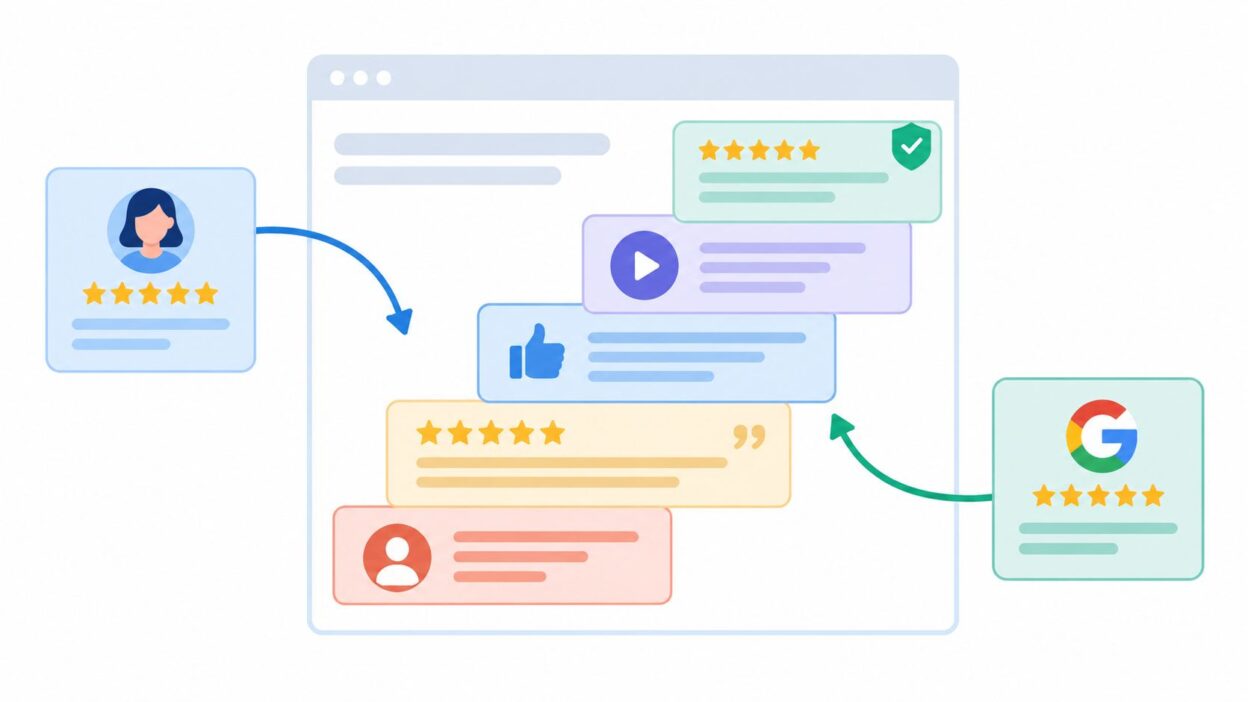
First-party and third-party reviews solve different trust problems. Treating them as interchangeable usually produces a testimonial system that is either too controlled or too thin.
First-party testimonials come directly from your own collection process. You can ask a customer about the original challenge, the implementation, the experience of working with your team, and the outcome they're comfortable describing. That makes first-party collection especially useful for detailed customer stories, video interviews, case studies, and testimonials relevant to a particular service or product.
The trade-off is perceived control. Visitors know the business requested the testimonial and chose where to display it. That doesn't make the testimonial untrustworthy, but it means the page should preserve the customer's voice and disclose relevant context. Ask open questions instead of supplying a flattering sentence for approval. Edit for clarity, not meaning.
Third-party reviews appear on platforms outside your direct publishing environment. Their value comes from separation. A visitor can see the original source, review profile, rating context, date, and other customer feedback rather than encountering one isolated endorsement selected by the brand.
Third-party reviews are particularly useful for establishing baseline credibility. A business with feedback distributed across platforms looks less dependent on its own editorial choices. Imported reviews also preserve the informal language, minor imperfections, and mixed experiences that polished marketing pages tend to remove.
| Source | Strongest trust signal | Best use | Main risk |
|---|---|---|---|
| First-party collection | Specific story and customer context | Case studies, videos, service pages | Can feel heavily curated |
| Third-party platform | External provenance and broader pattern | Homepage credibility, local business pages, product summaries | Less control over length and relevance |
| Direct customer interview | Voice, tone, and nuanced experience | High-consideration offers | Requires permission and production |
| Embedded review feed | Freshness and source visibility | Reusable site-wide proof | Can create clutter without filtering |
Use first-party collection when you need depth. Ask a customer to explain what changed and why the experience mattered. Use third-party imports when you need breadth, recency, and evidence that customers talk about you outside your own website.
The strongest arrangement combines both without pretending they mean the same thing. A landing page might feature a concise first-party story near the main call to action, followed by a sourced review feed that lets visitors inspect a wider range of experiences. A product page might show verified purchase feedback beside product-specific questions, while a service page uses a longer customer interview to explain the working relationship.
Don't hide the distinction in a tiny label. “Customer story,” “Google review,” “G2 review,” and “Verified buyer” communicate different forms of evidence. Clear labeling helps visitors judge the proof instead of asking them to accept an undifferentiated stream of praise.
Strategic Placement and Formatting for Maximum Impact
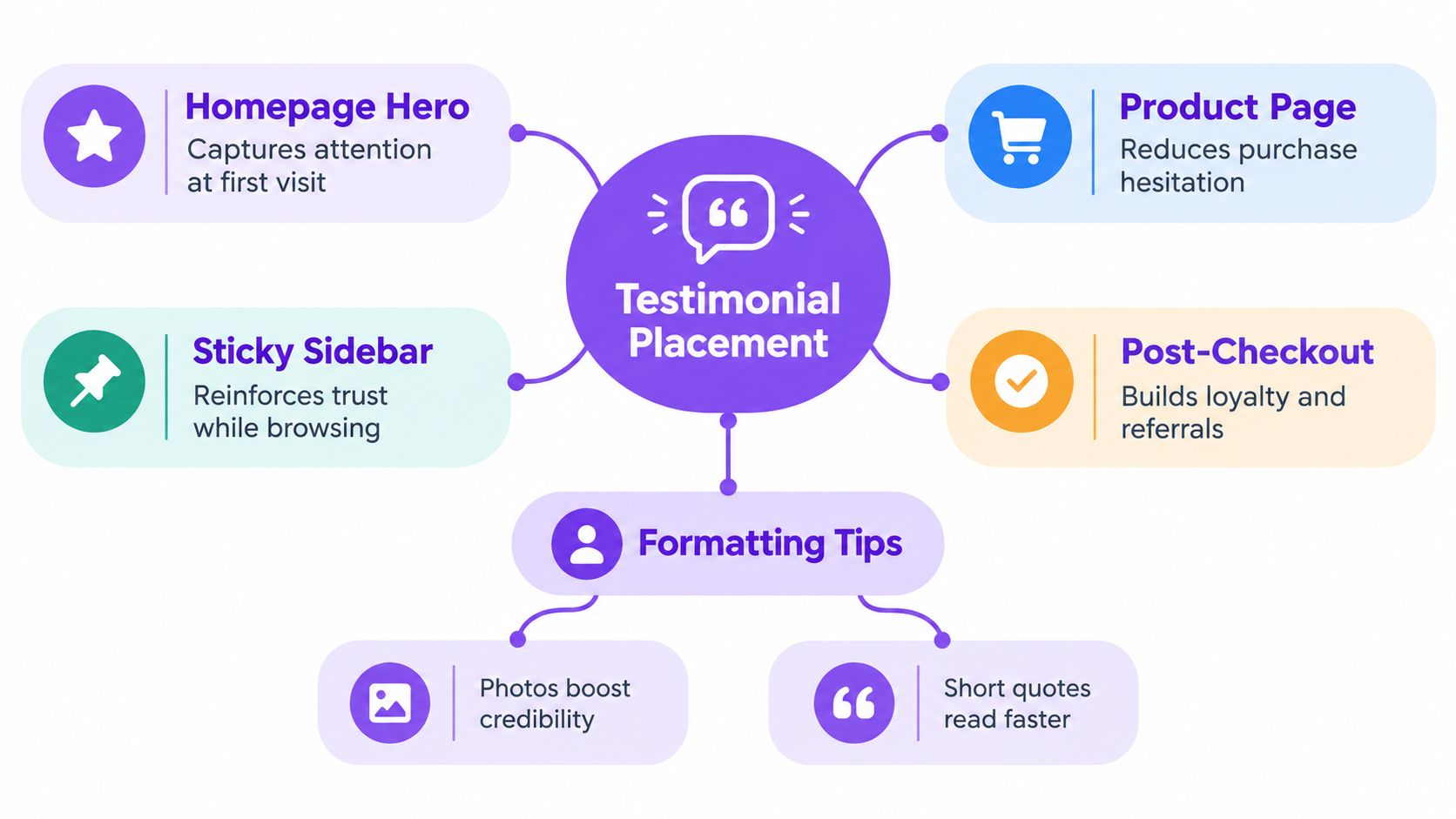
Placement should follow hesitation, not convention. A testimonial belongs where a visitor needs reassurance, not merely where a template happens to leave space.
Match the format to the decision
On a homepage, use a compact proof layer near the first meaningful value proposition. A rating summary, a few short reviews, or a restrained logo and customer strip can establish that real people already engage with the business. Avoid filling the hero with a long quote that competes with the main promise.
On a product or service page, make the testimonial specific to the offer. Show reviews that mention setup, results, support, delivery, fit, or another decision factor immediately beside the relevant feature or call to action. A visitor comparing plans shouldn't have to leave the page to find feedback about onboarding.
At a high-consideration conversion point, richer formats earn their space. A video highlight can convey personality and confidence. A mosaic grid can show several customer types at once. A longer case-study excerpt can connect the initial problem to the customer's experience. The format should make the proof easier to evaluate, not merely more visually impressive.
A controlled landing-page test reported that text testimonials raised conversion from 59.46% to 74.55%, a 25% relative lift, while a video-testimonial variant increased conversion from 11.62% to 34.96%, a 201% relative lift. The MarketingExperiments test report also makes the necessary caution clear through its context. Those results came from particular page designs and baselines, so they support testing richer formats, not assuming video will produce the same outcome everywhere.
Build persistent reassurance into the interface
A sticky sidebar can carry a short review while the visitor evaluates a long page. A narrow ribbon can reinforce a rating or source without interrupting reading. A footer badge can provide a final credibility cue, but it shouldn't replace substantive proof near the decision itself.
Carousels can work when each card is short and navigation is obvious. They fail when important reviews are hidden behind automatic movement, inaccessible controls, or a single visible slide. Grids offer greater scanability and comparison, while lists support longer text and source details. On mobile, prioritize readable text, visible attribution, and tap targets over decorative layouts.
For a broader set of design patterns, website carousel examples can help you compare how motion, card density, and navigation affect the way visitors consume proof. The right choice depends on the page's job, not on which widget looks most dynamic in a demo.
Use a placement sequence
- Capture attention: Place concise, relevant proof near the first claim or offer.
- Answer objections: Add testimonials beside features, pricing, forms, or comparison points.
- Support commitment: Use detailed stories, video, or sourced reviews near the primary conversion action.
- Reinforce confidence: Keep a restrained rating, badge, or review signal visible through later browsing and checkout.
Formatting should preserve the evidence. Show enough of the review to make the claim understandable, keep the source accessible, and use photos or video only when the customer has given appropriate permission. A testimonial that's easy to scan but impossible to verify is still a weak trust signal.
Building Credibility and Navigating Legal Requirements
Testimonials create legal exposure when a business treats customer words as decoration rather than advertising. The FTC's endorsement guidance treats testimonials as broad advertising messages. The endorser's statement must reflect their honest opinions, findings, beliefs, or experience, and an implied claim is not acceptable if the advertiser couldn't make that claim directly without deceiving consumers.
That rule affects editing, selection, and placement. You can't turn a customer's limited experience into a broad promise. You also shouldn't present an atypical result without clearly explaining what consumers can generally expect. If a customer received unusual support, an exceptional outcome, or special treatment, the page needs enough context to prevent visitors from assuming the experience is standard.
Material connections matter too. If an endorser has a relationship with the marketer that the audience wouldn't reasonably expect, the relationship must be disclosed clearly and conspicuously. A disclosure buried below a “read more” interaction or separated from a video may not communicate the relationship at the moment a visitor evaluates the endorsement.
Treat authenticity as a design requirement
Credibility isn't created by adding a headshot to a quote. An integrative review of 70 studies examined 77 distinct trust factors and found relatively clear effects for reviewer integrity, argument quality, and consistency with other reviews, as reported in the Cyberpsychology research review. In practice, that means a specific claim supported by consistent evidence is more useful than vague praise attached to an attractive portrait.
Use a review workflow that records:
- Permission: Obtain consent for the exact channels and formats where you intend to publish the testimonial.
- Provenance: Preserve the original platform, date, reviewer identity details, and relevant product or service context.
- Meaning: Make only light edits for length, grammar, or privacy, and don't alter the customer's intended claim.
- Disclosure: State material connections and clarify unusual circumstances where they affect interpretation.
- Balance: Don't imply that one selected review represents every customer experience.
The FTC's consumer-review rule makes fake and false reviews a distinct compliance issue. Its business guidance on endorsements, influencers, and reviews also emphasizes clear and conspicuous disclosures, including in media where an endorsement is audible or visual.
A credible system doesn't suppress every negative comment. It groups feedback transparently, responds to legitimate problems, and lets visitors see enough range to understand the pattern. A page full of perfect claims may look less believable than a sourced collection with occasional criticism and thoughtful responses.
A customer testimonial template can make collection easier, but prompts should invite honest detail rather than steer customers toward predetermined praise.
Overcoming Skepticism with Authentic Social Proof
A static quote wall asks visitors to trust the business's selection process. Modern buyers often want to compare the claim with evidence elsewhere, especially when the purchase involves money, personal information, or a long-term commitment.
Recent market data identifies authenticity as the top trait consumers look for when deciding whether to trust online reviewers, and reports that 89% of consumers in major Western markets cross-check claims across multiple platforms, according to eMarketer's analysis of reviewer trust. A website testimonial therefore needs to work as part of an evidence trail, not as a sealed statement inside a brand-controlled page.

Make verification easy
Show the original platform when permission and platform terms allow it. Include a review date, reviewer details appropriate to the customer's privacy needs, and a link or recognizable source indicator. If a customer story expands into a case study, connect the quote to the fuller account instead of presenting the quote as standalone proof.
Video can close a different part of the trust gap. Viewers can assess voice, pacing, setting, and whether the customer sounds like a person describing an experience rather than an actor reading copy. Unscripted doesn't mean careless. Give the customer useful prompts, let them answer in their own words, and avoid editing that removes all hesitation or personality.
Preserve relatable imperfection
Perfect grammar isn't the same as credibility. A review can remain persuasive while retaining casual phrasing, a small detail about the situation, or a limitation that makes the account feel grounded. The goal isn't to publish unusable text. It's to avoid polishing every customer into the same corporate voice.
Specificity also helps visitors recognize themselves. Sort proof by use case, customer type, concern, or product. A visitor seeking implementation help should be able to find a review about implementation, not only a general statement about quality.
Credibility test: If a visitor challenged the testimonial, could you show where it came from and explain how you edited it?
Cross-platform consistency doesn't require identical wording everywhere. It means the central facts align. The company name, service experience, product capability, and broad customer sentiment shouldn't contradict one another across the website, review platforms, social channels, and case studies.
Managing and Updating Testimonials at Scale
Manual testimonial maintenance breaks as soon as reviews spread across multiple platforms. A team copies a strong quote into a page, forgets the source date, changes the product, and leaves the old claim live long after the customer experience has moved on.
Build an operating system with four connected layers.
Collect: Create a regular request process after meaningful customer moments, such as a completed project, successful onboarding, delivery, or resolved support issue. Ask questions that produce usable detail, and separate permission to collect feedback from permission to publish it.
Aggregate: Bring external reviews into one working library while preserving their original source. Keep first-party submissions in the same system, but label them differently so editors know what each review represents.
Organize: Tag feedback by offer, audience, objection, feature, sentiment, and format. A review about customer support should be easy to find when building a support-focused page. A review about setup belongs in the onboarding proof set, not only in a general testimonials archive.
Publish and monitor: Use synced widgets where freshness matters, then review the display for relevance, readability, accessibility, and legal context. Set an owner for permissions, source changes, and removal requests.
Bragly offers review aggregation from 50+ sources, no-code widgets for major site builders and custom sites, first-party collection forms, tagging, AI-based review analysis, and basic review analytics. It can serve as one operational option for teams that want third-party imports and direct customer submissions managed in the same environment.
Automation should reduce repetition, not remove judgment. AI can summarize themes, identify recurring objections, and suggest relevant excerpts, but a person still needs to verify the original meaning, permission status, source, and compliance context before publication.
Keep a simple review log with the customer identifier, source, date collected, consent status, approved wording, permitted formats, and pages where the testimonial appears. When a customer updates or removes a review, that record helps the team find every dependent display instead of discovering one outdated quote months later.
Auditing and Upgrading Your Current Social Proof
A testimonial audit should begin with the visitor's experience, not the widget settings. Open the main pages on a phone and ask whether the proof is visible at the moment of hesitation, readable without excessive scrolling, and specific enough to support the adjacent claim.
Check these points:
- Source clarity: Can visitors tell whether each item came from your collection process or an external platform?
- Freshness: Do dates, products, pricing references, and customer descriptions still match the current offer?
- Permission: Can your team document consent for the name, image, video, quote, and placement?
- Coverage: Does the library address real objections, or does it repeat generic praise?
- Balance: Does the display create a credible pattern without implying that every experience is identical?
- Functionality: Do links, filters, video controls, carousel navigation, and mobile layouts work?
- Action alignment: Is the testimonial placed beside the decision it supports?
Remove anything you can't verify. Replace vague praise with customer language that explains the situation, preserve useful source context, and connect deeper stories to the relevant offer. Then compare formats and placements through controlled testing, measuring the action the testimonial is meant to support rather than treating attention alone as success.
The upgrade isn't “add more quotes.” It's a shift from a curated wall to a maintained proof system, one that combines specific customer stories, external reviews, transparent sourcing, appropriate disclosures, and regular updates.
Bragly helps businesses collect first-party testimonials, aggregate reviews from external platforms, and publish them through no-code widgets that can be placed across product, service, pricing, and checkout pages. Visit Bragly to build a more current, verifiable social proof system for your website.