
Looking for a Shorter Overview?
AI Summary
Key Moments
Strategic Oversight is Essential
Agencies must retain control over client relationships, reporting, and approvals to ensure fulfillment aligns with business goals.Core Local SEO Deliverables
Effective local SEO packages include accurate business profiles, consistent citations, location-aligned pages, and review workflows.Pricing Should Reflect Outcomes
Agencies need to price services based on contribution margin and avoid guaranteeing local ranking positions.Choose Partners with Proven Processes
White-label partners must demonstrate operational maturity and detailed reporting to support agency trust and client retention.White label local SEO services let digital marketing agencies sell local search optimization under their own brand while an expert partner handles the technical execution. The demand is substantial: 80% of U.S. consumers search online for local businesses at least weekly, and 32% do so daily, according to BrightLocal's summary of the 2024 SOCi Consumer Behavior Index.
That's the situation many agencies face now. A client asks for Google Business Profile optimization, location pages, review management, local rank tracking, and a report that connects all of it to booked work. Your sales team says yes, but your delivery team is already full. Hiring every specialist internally is expensive and slow, while passing the client to another provider can weaken your margin and your relationship.
White-label fulfillment solves the capacity problem, but it doesn't solve the strategy problem by itself. The agencies that retain clients are the ones that connect execution to business outcomes, maintain control of client data, adapt to AI-mediated discovery without making unrealistic promises, and report more than keyword positions.


Table of Contents
- What Are White Label Local SEO Services
- Core Deliverables in Local SEO Packages
- Agency Pricing and Profit Margins
- How EmbedMyReviews Can Help
- Integrating Review Management and Widgets
- Choosing the Right White Label Partner
- Avoiding Common White Label Pitfalls
- FAQs About Local SEO Reselling
- What does a white-label local SEO provider actually do?
- Does the client need to know that fulfillment is outsourced?
- How long does local SEO take?
- Can a white-label partner guarantee map-pack rankings?
- How should agencies report local SEO results?
- Is AI visibility a replacement for traditional local SEO?
- What should an agency do first?
What Are White Label Local SEO Services
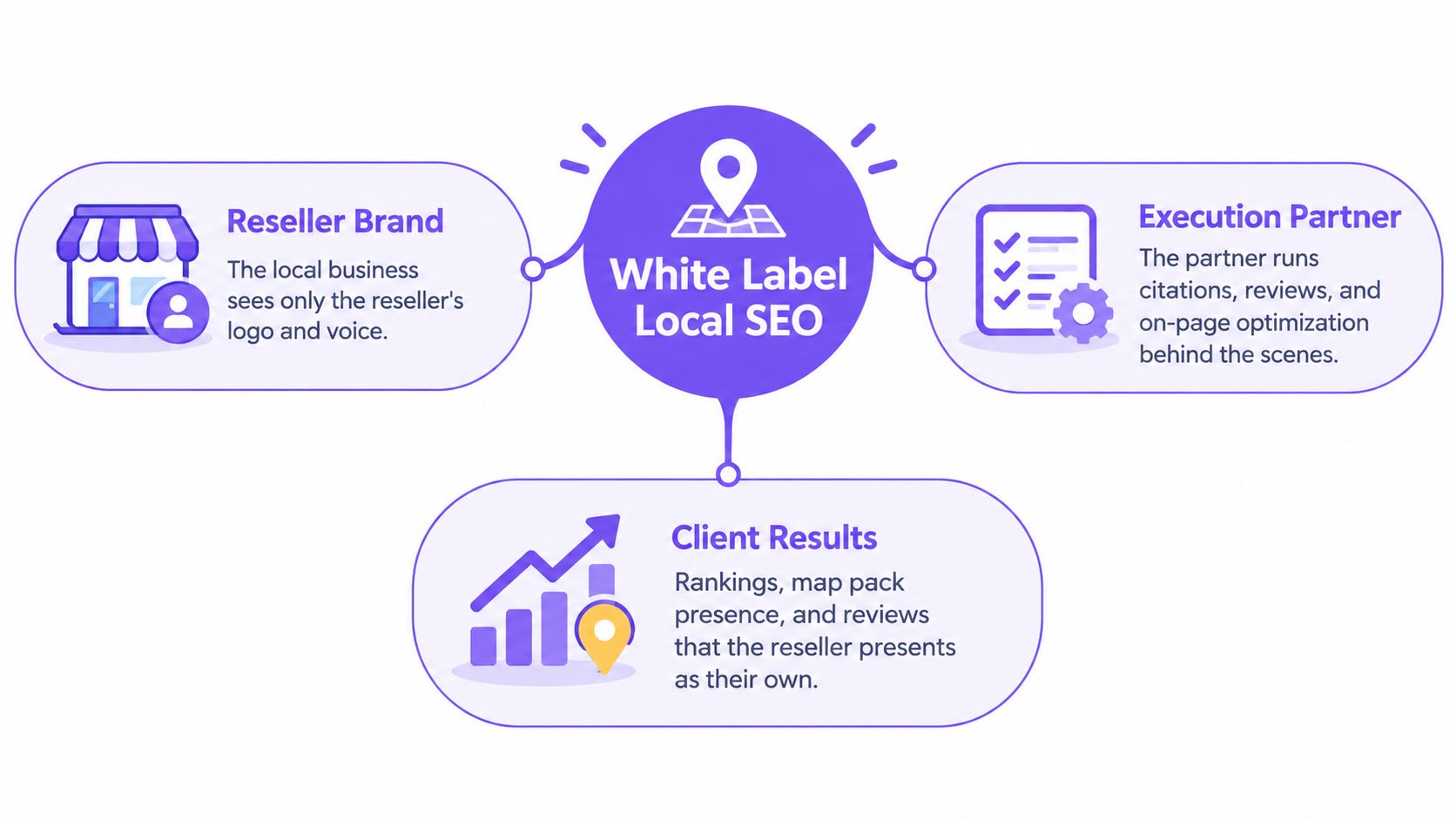
A regional dental group hires a web design agency to improve local visibility across several offices. The agency understands conversion design and client communication, but lacks the staff to manage profiles, listings, reviews, location pages, and local measurement. A white-label local SEO partner supplies that production under the agency's brand, while the agency remains accountable for the client relationship and commercial result.
The arrangement resembles a general contractor coordinating specialist trades. Your agency defines the scope, sets priorities, approves work, and presents the finished service. The fulfillment partner handles agreed operational tasks without appearing as a separate provider. The client receives your reporting language, account support, and recommendations.
The operational handoff
The partner might audit each Google Business Profile, correct directory inconsistencies, coordinate review requests, check location pages, and monitor map visibility. It should return evidence in your format and follow your approval process before changes reach the client.
Your agency still owns the decisions that affect trust and retention:
- Set the commercial promise: Define scope, reporting cadence, approval rules, and realistic expectations.
- Own the relationship: Explain priorities and turn technical findings into client decisions.
- Protect access and ownership: Keep the business owner in control of Google Business Profile assets.
- Review the work: A raw fulfillment file is not a strategy document.
- Connect activity to outcomes: Measure calls, direction requests, forms, appointments, and other agreed conversions where tracking allows.
The strategic layer now includes attribution and AI-mediated discovery. Local visibility may influence a call, a branded search, a map interaction, or a visit that does not follow a simple ranking-to-sale path. Reports should therefore connect profile actions, review activity, website engagement, lead quality, and booked work where the client's systems permit.
Reviews also serve as public evidence about the local entity. Consistent business details, accurate ownership, genuine customer feedback, and a clear response process help maintain that entity across search surfaces. A partner that only reports keyword positions misses whether the business is being represented accurately and whether visibility produces useful demand.
Local SEO is recurring operational work, not a one-time directory submission. The partner must maintain listings, monitor changes, flag access problems, and adapt reporting as search interfaces change.
Who benefits most
White-label fulfillment suits agencies with trusted client relationships but limited specialist capacity. Web agencies can add ongoing local search work after a site launch. Paid media firms can support organic acquisition and reputation. Brand and franchise consultancies can standardize location-level execution without hiring a separate team for every market.
It also provides overflow capacity for larger consultancies. The trade-off is dependency. Poor quality assurance, slow turnaround, weak data handling, or unclear communication can create more account-management work than outsourcing removes.
A practical decision rule is simple: if a task cannot be described in the scope document without naming a specific tool, define the expected outcome first. The provider can choose the method, while your agency retains control of what success means.
Core Deliverables in Local SEO Packages
A local SEO package earns its fee by connecting operational work to business outcomes. Google groups local ranking around relevance, distance, and prominence. Complete business information supports relevance, proximity affects distance, and signals such as links and reviews contribute to prominence, according to Google's local ranking guidance. Citations support that system, but they are only one part of fulfillment.
Start with the business profile
Onboarding should verify the business name, address, phone number, primary and secondary categories, hours, services, photos, website URL, service area, and alignment with the relevant landing pages. The profile should describe the actual operation. Adding nearby city names that the business does not serve creates approval and trust problems rather than useful coverage.
A profile audit gives the team a workable starting point. A Google Business Profile audit tool can surface missing or weak fields, but the score is not the deliverable. The agency needs a prioritized fix list, an owner for each change, an approval path, and a way to confirm that the update was published correctly.
Profile work also needs governance. Record who can edit each location, which changes require client approval, and how access issues will be escalated. This protects the account when staff, agencies, or business details change.
Build location consistency
Citation work involves finding relevant directories, correcting conflicting information, and deciding which listings deserve attention. Publishing identical data across low-quality sites can create maintenance work without adding meaningful visibility.
For a multi-location client, the provider should maintain a source-of-truth record for every location. Include the approved name, address, phone number, URL, hours, categories, service areas, and tracking parameters. Check every listing update against that record, then document unresolved conflicts and ownership barriers.
Align pages with local intent
A location page needs more than a city name in its title tag. It should explain the services available there, include genuine local details, answer practical questions, and lead visitors to a measurable action. Service-area businesses may need a different structure from storefronts because customers do not visit the listed address.
Content production earns its place when it reflects the client's service model and supports demand capture. Near-identical pages for every town, vague local claims, and publication volume without a conversion path create indexation and quality risks.
Treat reviews as an operating workflow
Reviews affect customer trust and can support local visibility. A package should cover review requests, response guidance, negative-feedback escalation, source monitoring, and reporting. The workflow should also distinguish public reputation from private service recovery, so the client can address operational problems instead of merely producing replies.
A monthly service should usually include:
| Task Category | Key Actions | Business Value |
|---|---|---|
| Business Profile | Audit fields, categories, hours, photos, services, posts, and Q&A | Improves relevance and reduces avoidable data errors |
| Citations | Correct core listings and maintain approved location data | Supports consistency and entity confidence |
| Local pages | Improve service-location alignment, internal links, calls to action, and local detail | Clarifies coverage for search engines and visitors |
| Reviews | Request feedback, monitor sources, respond appropriately, and escalate issues | Builds conversion trust and supports prominence |
| Authority | Earn relevant local or industry mentions and links | Adds evidence of prominence without guaranteeing placement |
| Measurement | Track location-level visibility, actions, leads, and completed work | Connects fulfillment to business outcomes |
Reporting should go beyond ranking positions. Show profile actions, calls, direction requests, form submissions, tracked leads, review trends, completed changes, and blocked approvals where the available systems support those measures. This helps the agency separate visibility from attributable demand and gives clients a clearer basis for renewal.
The provider should document what changed, what remains blocked, and what the client must approve. That audit trail supports reliable entity governance across search surfaces and gives the account team evidence when performance, attribution, or scope is challenged.
Agency Pricing and Profit Margins
White-label economics work when the service is standardized without becoming careless. A per-location model can make costs easier to forecast for a small single-location client, while a flat package can protect margin as a client adds locations. Neither structure is automatically profitable. The correct choice depends on fulfillment effort, approval friction, reporting demands, and the amount of account management your agency provides.
Start with a simple contribution calculation:
Client fee minus fulfillment cost, account-management time, software cost, revision time, and payment or support overhead equals contribution margin.
Do the calculation by service tier and by location type. A storefront with one profile and a focused service area may need a lighter workflow than a multi-location healthcare group with different hours, providers, landing pages, and review escalation rules. If you use one flat promise for both, the complex account will consume the margin from the simple one.
Where agencies lose margin
The most common leak is unscoped work. A client buys local SEO, then requests new pages, social posts, review responses, directory corrections, photography coordination, and urgent profile changes without a defined boundary. Your partner may charge for some of those tasks, while your account manager absorbs the rest.
Other leaks include:
- Manual reporting: Someone exports data, formats slides, writes commentary, and chases missing inputs every month.
- Revision loops: The client rejects deliverables because the approval process was never defined.
- Duplicate data work: The agency and fulfillment partner each maintain different location records.
- Unpriced complexity: Multi-location permissions, separate campaigns, and unusual service areas receive no additional scope.
- Weak conversion tracking: The agency proves activity but cannot explain whether the client received qualified demand.
Price the outcome responsibly
Don't price around a guaranteed map-pack position. Google states that businesses can't request or pay for better local rankings, and distance depends substantially on the searcher's location, as explained in Google's Business Profile ranking documentation. Sell a managed improvement process instead: accurate data, relevant pages, legitimate reputation work, stronger measurement, and clear decisions.
Bundling can improve economics when the services reinforce one another. A website agency might combine technical maintenance, local page optimization, review workflows, and conversion reporting. A paid media agency might add local reputation management to improve the trust layer around the same acquisition program. The bundle should still show separate deliverables and outcome definitions, so the client understands what each component contributes.
How EmbedMyReviews Can Help
EmbedMyReviews is a white-label reputation management platform for agencies, consultants, franchises, and operators serving local businesses. It brings review collection, response workflows, Google Business Profile posts, local rank tracking, analytics, and sales intelligence into an agency-branded environment.
Its capabilities cover several operational needs:
Agency deployment: Custom domain, SSL, branded interface, help center, API documentation, page builder, and 27 interface languages.
Review workflows: Collection across 67+ sources, BYOK email, SMS, and WhatsApp campaigns, private feedback routing, QR and NFC tracking, and first-party testimonials.
Approval-based automation: AI response drafting through agency-provided model keys, prompt templates, tone matching, and human approval.
Local visibility: Geo-distributed rank tracking, recurring scans, keyword schedules, and branded PDF exports.
Reporting and sales support: Audit reports, Trust Score, competitor benchmarks, AI visibility testing, scheduled reporting, permissions, and multi-location dashboards.
Commercial controls: Client plans, credit limits, add-ons, Stripe billing, sales territories, and commission tracking.
The platform's stated model is a flat $99 per month for unlimited clients, locations, and users, with no per-location or seat-based pricing in the base platform. That can make the economics easier to model for agencies with expanding location counts, although messaging, AI, and provider usage still need to be evaluated under the agency's own BYOK arrangements.
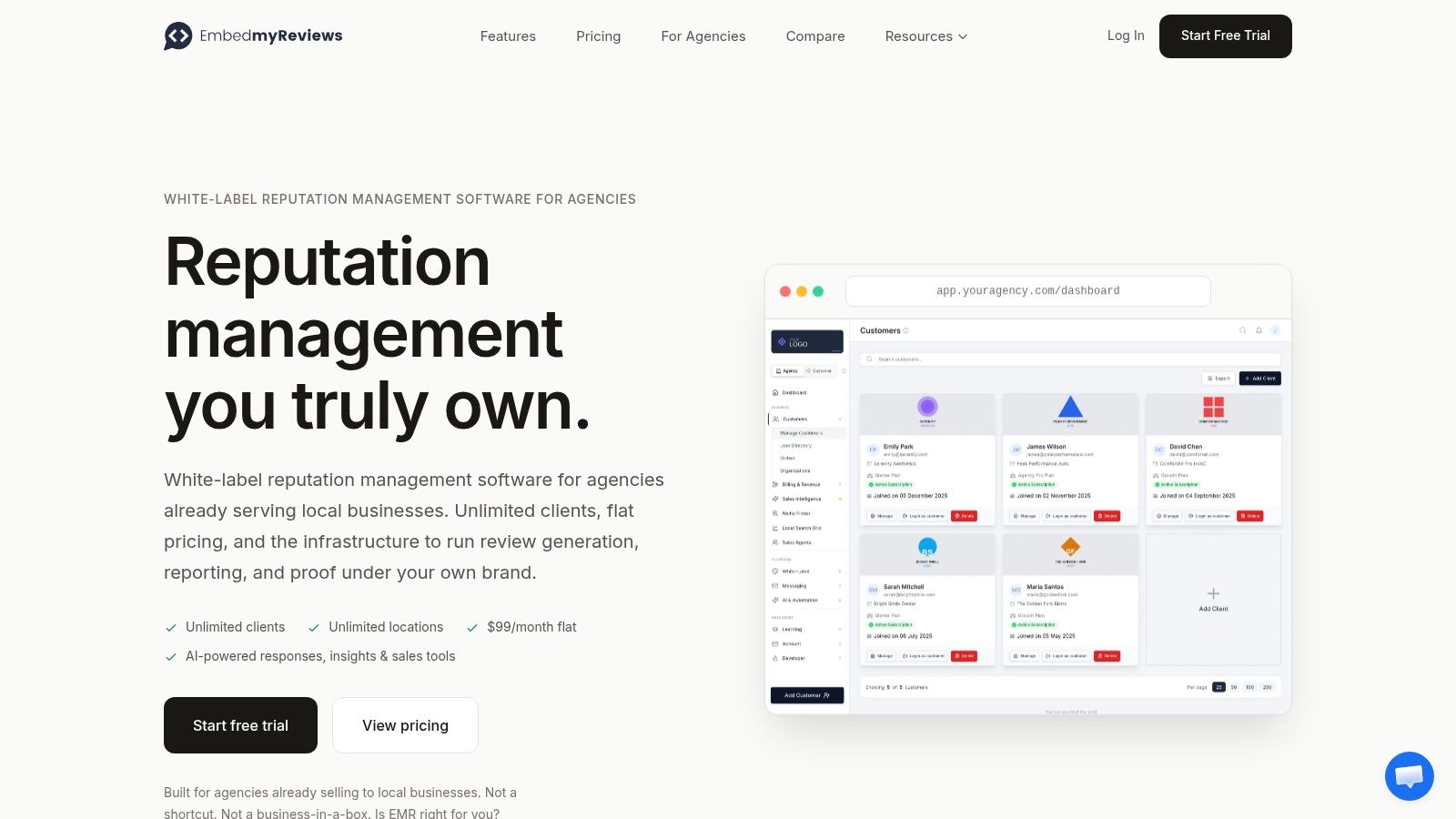
For agencies comparing white label local seo, the relevant question is whether the platform improves ownership and reporting, not whether it adds another dashboard. It may fit when per-location software costs squeeze margin, review and rank data live in disconnected tools, or sales teams need branded audits before a contract begins.
Integrating Review Management and Widgets
Reviews belong in the local SEO operating system, not in a separate reputation silo. Google remained the most-used review source in the 2024 survey, but its share fell from 87% in 2023 to 81% in 2024, while consumers continued checking multiple platforms, according to BrightLocal's review research. For an agency, that makes source coverage, response consistency, and attribution part of delivery rather than optional reputation work.
The workflow serves two connected purposes. It creates and maintains public reputation signals across relevant platforms. It also places selected customer proof on the client's website, where visitors can assess the business after arriving through organic search, maps, paid media, referrals, or AI-generated recommendations.
Compare the workflow, not just the feature list
A basic review monitor collects ratings and alerts someone when a review arrives. That can work for an owner who checks one inbox every day. It becomes unreliable when an agency manages several brands, sources, locations, approval rules, and reporting requirements.
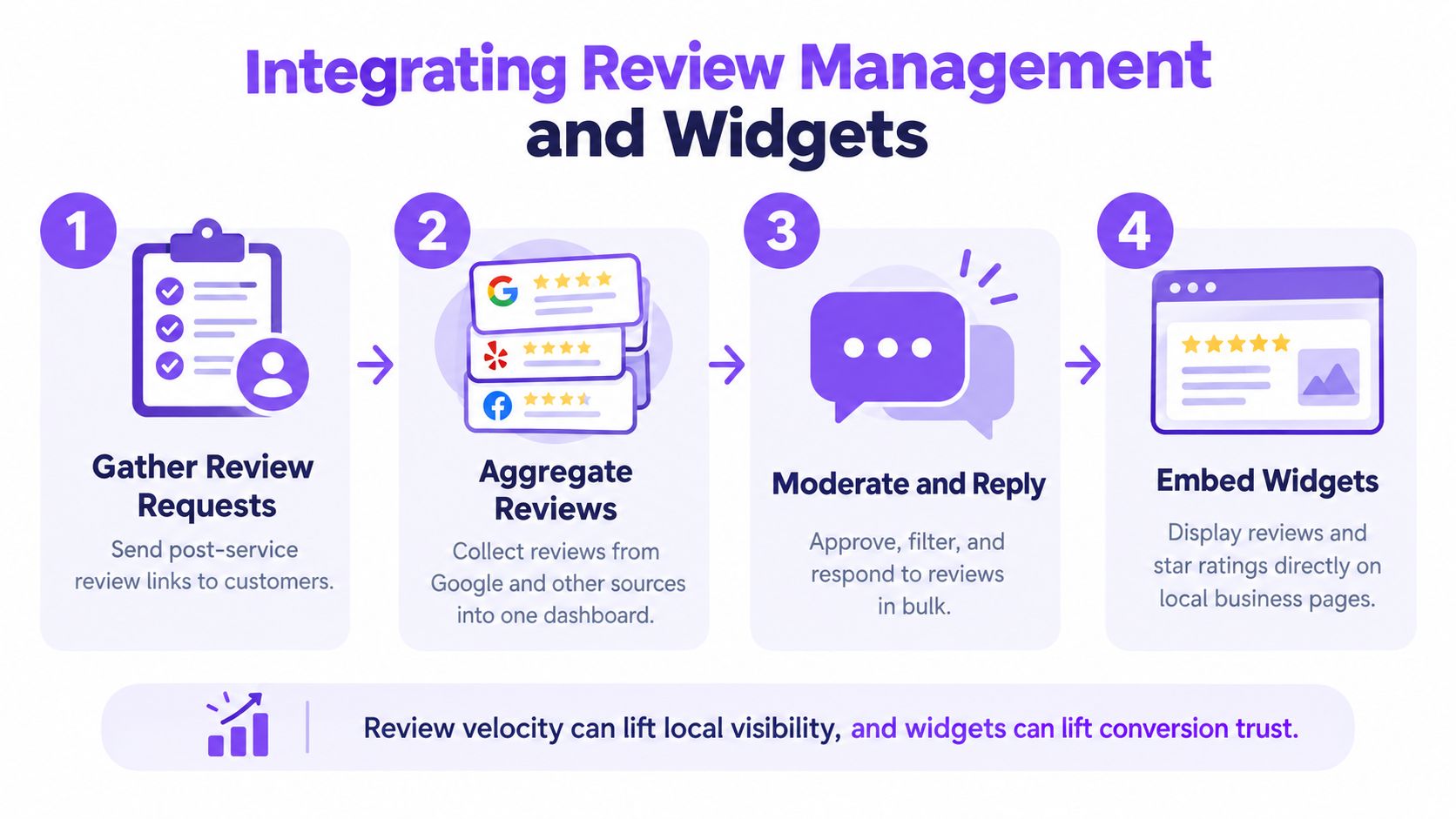
A white-label workflow should cover:
- Gathering: Send post-service requests through an approved channel, using the client's consent and brand voice.
- Routing: Direct dissatisfied customers to private feedback while keeping the public review process transparent and policy-compliant.
- Aggregating: Bring Google and relevant industry or marketplace sources into one working view.
- Responding: Draft consistent replies, route them for approval, and record who approved the published text.
- Publishing: Display suitable testimonials on relevant pages without hiding material context or inventing endorsements.
- Reporting: Track review volume, response activity, recurring themes, sentiment changes, and their relationship to local visibility and lead activity.
A no-code widget reduces implementation work for an agency. Bragly's testimonial widgets offer embeddable layouts including carousels, grids, sliders, mosaics, ribbons, badges, and video highlights. The format should serve the page. A service page may need a compact proof block near its call to action, while a home page can present a wider selection of recent customer comments.
Connect reviews to local entity governance
A review is customer feedback and part of the public record around a business entity. If the business name, location, services, or customer language varies across profiles, pages, and third-party sources, investigate the inconsistency before treating it as a content opportunity. Consistent, specific review language can also give teams useful material for service-page updates and for testing how AI search systems describe the business.
Review governance should cover:
- Business facts: Name, address, phone, hours, categories, and service areas.
- Service language: Whether reviews and pages describe services the location provides.
- Location context: Whether the profile and page represent a real storefront or a legitimate service-area model.
- Freshness: Whether recent customer experiences appear in the visible proof.
- Response quality: Whether replies clarify the business, acknowledge concerns, and avoid templated language.
- Source fit: Whether the selected platforms matter to the client's customers and industry.
- Attribution: Whether review activity can be connected to profile actions, page engagement, enquiries, or qualified leads.
Widgets can improve conversion, but they do not substitute for local SEO or guarantee rankings. Structured review markup must follow search-engine guidelines, and agencies should not promise star displays or increased visibility merely because a widget is installed. The defensible promise is cleaner proof, easier maintenance, stronger entity consistency, and reporting that explains how reputation assets support customer decisions.
Reviews need owners, workflows, freshness rules, and measurable uses. Counting stars alone is not reputation management.
Choosing the Right White Label Partner
A ranking dashboard can look impressive while hiding weak delivery. If the report shows positions but can't explain calls, appointment requests, direction actions, review changes, or data errors, the agency still has an attribution problem.
The partner evaluation should begin with access and ownership. Google requires client consent for third-party management, and the business owner must retain ownership or co-ownership of the Business Profile. Google also requires agencies to explain management changes, disclose fees, and return control when the relationship ends. The Google policy for third-party Business Profile management states that the client should be able to regain exclusive control within 7 business days after notice.
Ask what the report can prove
A strong provider should help your agency distinguish:
- Branded discovery: Searches and actions from people already looking for the business.
- Non-branded discovery: Searches that reveal the business through a service, category, or local need.
- Visibility: Grid or location-specific ranking movement.
- Engagement: Calls, direction requests, website visits, messages, and profile actions.
- Commercial outcomes: Qualified leads, appointments, sales, and offline conversions where systems can connect them.
- Unproven areas: Activity that cannot be attributed reliably because tracking, consent, or CRM data is incomplete.
This distinction matters because local search is fragmented. BrightLocal's 2025 consumer search research found that 45% of U.S. consumers default to Google for local searches, one in five search directly within maps, and 67% often or always inspect reviews after a local-business search. The same research also shows why a single rank metric is insufficient: discovery happens across search, maps, reviews, and other channels. You can review BrightLocal's consumer search behavior research for the underlying findings.
Test operational maturity
Request a sample report, onboarding checklist, escalation path, and change log. Ask how the partner handles duplicate profiles, suspended listings, incorrect hours, ownership disputes, review policy issues, and client offboarding. A provider that can't answer those questions may be selling task volume rather than dependable fulfillment.
AI-mediated discovery adds another layer. Rio SEO reported that 60% of surveyed U.S. consumers clicked AI-generated Google overviews, 75% read at least four reviews before deciding, and 53% said inaccurate listings would drive them away in its 2025 study, available through Rio SEO's local search consumer behavior report. Those findings support better data governance, but they don't justify guarantees of inclusion in AI answers.
Look for a partner that monitors source accuracy, supports location-level reporting, documents limitations, and gives your team direct evidence. Agency collaboration and permissions should be visible from the start. A teams and agencies workflow is useful only if it reinforces accountability rather than creating another opaque layer.
Avoiding Common White Label Pitfalls
Most failures begin before the first campaign launches. The agency promises a broad result, the partner interprets the scope differently, and the client receives a polished report that doesn't answer the question, “What did this do for my business?”

Fix the handoff before scaling
Create one onboarding record for every location. It should hold approved business facts, access owners, categories, hours, service areas, landing pages, conversion definitions, review policies, and client contacts. Assign an owner for every approval. If nobody owns a decision, the fulfillment partner will either wait or make an assumption.
Service-area businesses require particular care. Google allows one profile for the central office or location, with the address hidden when customers aren't served there. A virtual office is not acceptable unless it's staffed during business hours. Google also says the service area should generally extend no farther than about 2 hours of driving time from the base, and its settings allow up to 20 areas selected by named places or postal codes, not an arbitrary radius, as explained in Google's service-area guidance.
Common failure patterns include:
- Invented locations: Creating profiles for towns where the business has no eligible presence.
- Unapproved edits: Changing categories, hours, services, or descriptions without client consent.
- Generic pages: Publishing thin location content that adds no useful local information.
- Review automation without judgment: Sending poorly timed requests or publishing careless responses.
- Ranking-only reporting: Showing movement without connecting it to actions or lead quality.
- No offboarding plan: Leaving ownership, access, and data recovery unclear.
A practical quality check should happen before client delivery. Review the work against the original source-of-truth record, confirm that links and calls to action work, inspect any published text for factual accuracy, and verify that every reported metric has a defined meaning.
The reporting system should also disclose attribution limits. Call tracking may miss calls from forwarded numbers. CRM records may not identify the original discovery path. Offline conversions may arrive late or lack a reliable location association. Explaining those limitations increases trust because it separates measured outcomes from reasonable inference.
The implementation should finish with a monthly narrative, not a data dump. State what changed, what the business did, what the customer response indicates, what remains uncertain, and what decision comes next.
White-label local SEO works when the agency keeps the strategic center. Outsource repeatable execution, standardize the data, protect client ownership, treat reviews as reusable assets, and measure the path from discovery to action rather than presenting rankings as revenue.
FAQs About Local SEO Reselling
What does a white-label local SEO provider actually do?
The provider performs agreed local SEO work behind your brand. That may include profile audits, Business Profile updates, citation correction, local page recommendations, review workflows, rank tracking, and branded reporting. Your agency remains responsible for the client relationship, commercial promise, approvals, and interpretation.
The exact division should appear in a written scope. Avoid vague language such as “full local SEO” unless it defines the included locations, platforms, content volume, review responsibilities, reporting fields, and revision rules.
Does the client need to know that fulfillment is outsourced?
Your commercial and legal obligations depend on your agreement and jurisdiction, but outsourcing doesn't remove Google's requirements around consent, access, ownership, and disclosure. The business owner should retain control of the Business Profile, and your agency should be able to explain who manages what, how changes are approved, and how access is returned.
Transparency about operational roles is safer than presenting an anonymous system that the client cannot understand or control.
How long does local SEO take?
Local SEO doesn't have one universal timeline. Existing data quality, competition, location, website condition, review activity, authority, and the client's ability to approve changes all affect progress. Distance also means that two searchers can see different local results, so a single citywide ranking claim can mislead.
Set expectations around work completed, data accuracy, visibility trends, profile actions, qualified inquiries, and documented constraints. Don't promise a fixed position.
Can a white-label partner guarantee map-pack rankings?
No responsible provider should guarantee a specific local position. Google says local ranking depends primarily on relevance, distance, and prominence, and it explicitly says businesses can't request or pay for better local ranking. A partner can improve controllable inputs and report movement by location or grid point, but it can't control the searcher's proximity or every competing signal.
How should agencies report local SEO results?
Use a layered report. Start with work completed and unresolved issues. Add location-level visibility, branded and non-branded discovery, profile interactions, calls, direction requests, forms, appointments, and revenue data where tracking supports the connection.
Include review volume, response activity, sentiment themes, and data accuracy. Explain attribution limits instead of assigning every conversion to the latest ranking change.
Is AI visibility a replacement for traditional local SEO?
No. AI-generated answers may use business facts, reviews, photos, first-party pages, and third-party sources, but agencies can't guarantee that a system will cite a particular business. The practical response is to keep entity information consistent, maintain accurate profiles, publish useful location-specific answers, monitor incorrect summaries, and separate experimental AI visibility indicators from established conversion metrics.
What should an agency do first?
Choose one repeatable client type and document the full workflow before selling it broadly. Define the source-of-truth fields, profile access rules, review approvals, conversion events, reporting format, escalation process, and offboarding procedure. Run a pilot, inspect the fulfillment quality yourself, and revise the scope before adding more locations.
If your agency wants to build a measurable local search offer, start by auditing one client profile, mapping its review and conversion data, and writing a location-level reporting template. Then evaluate a fulfillment partner against that template, insist on client ownership and documented access, and sell only the work your team can explain clearly in the next monthly meeting.
Choose a white-label local SEO partner that can show exactly what changed, why it changed, and how the change relates to customer action. That standard will help you protect margins, retain client trust, and turn local search fulfillment into a durable agency service rather than another opaque deliverable.