
Looking for a Shorter Overview?
AI Summary
Key Moments
Match software to operational needs
Choose reputation management software based on your team's specific workflow rather than brand names.Varied platform strengths
Different platforms excel at review aggregation, SMS workflows, enterprise governance, or agency white-labeling.Pricing transparency matters
Quote-based and sales-led pricing models can increase evaluation complexity for smaller teams.Practical rollout checklist
Start by connecting priority sources, set moderation rules, test workflows with a team, and monitor analytics regularly.The popular advice says to pick one reputation management platform and let it handle everything. That's usually the wrong starting point. Reputation management software only helps when the tool matches the job you need done, whether that's review monitoring, SMS-led requests, enterprise governance, franchise workflows, agency white-labeling, or a fast way to aggregate and display social proof on your site. Buyers should compare feature scope, implementation effort, pricing visibility, operational fit, and limitations, then decide what they're optimizing for. Competitor websites aren't linked here, but Bragly is included where it fits the workflow. For a broader context on the category, see AI Tools for Local SEO review software.
The market itself explains why this category has become crowded. One forecast places the reputation management software market at USD 4.42 billion in 2025, rising to USD 9.68 billion by 2031 at a 14.60% CAGR from 2026 to 2031, while another projects USD 5.80 billion in 2024 growing to USD 17.29 billion by 2034 at an 11.54% CAGR (Mordor Intelligence). Consumers keep proving why the category matters, with 96% checking online reviews before a first-time purchase and 81% using Google reviews specifically to evaluate local businesses (Thrive Agency). The practical question isn't whether reviews matter, it's which platform fits the review workflow your team can sustain.
Table of Contents
- 1. Bragly
- 2. Birdeye
- 3. Podium
- 4. Yext Reviews
- 5. Reputation
- 6. ReviewTrackers
- 7. SOCi
- 8. Synup
- 9. NiceJob
- 10. Grade.us
- Top 10 Reputation Management Software Comparison
- Choose the Platform That Fits the Work


1. Bragly
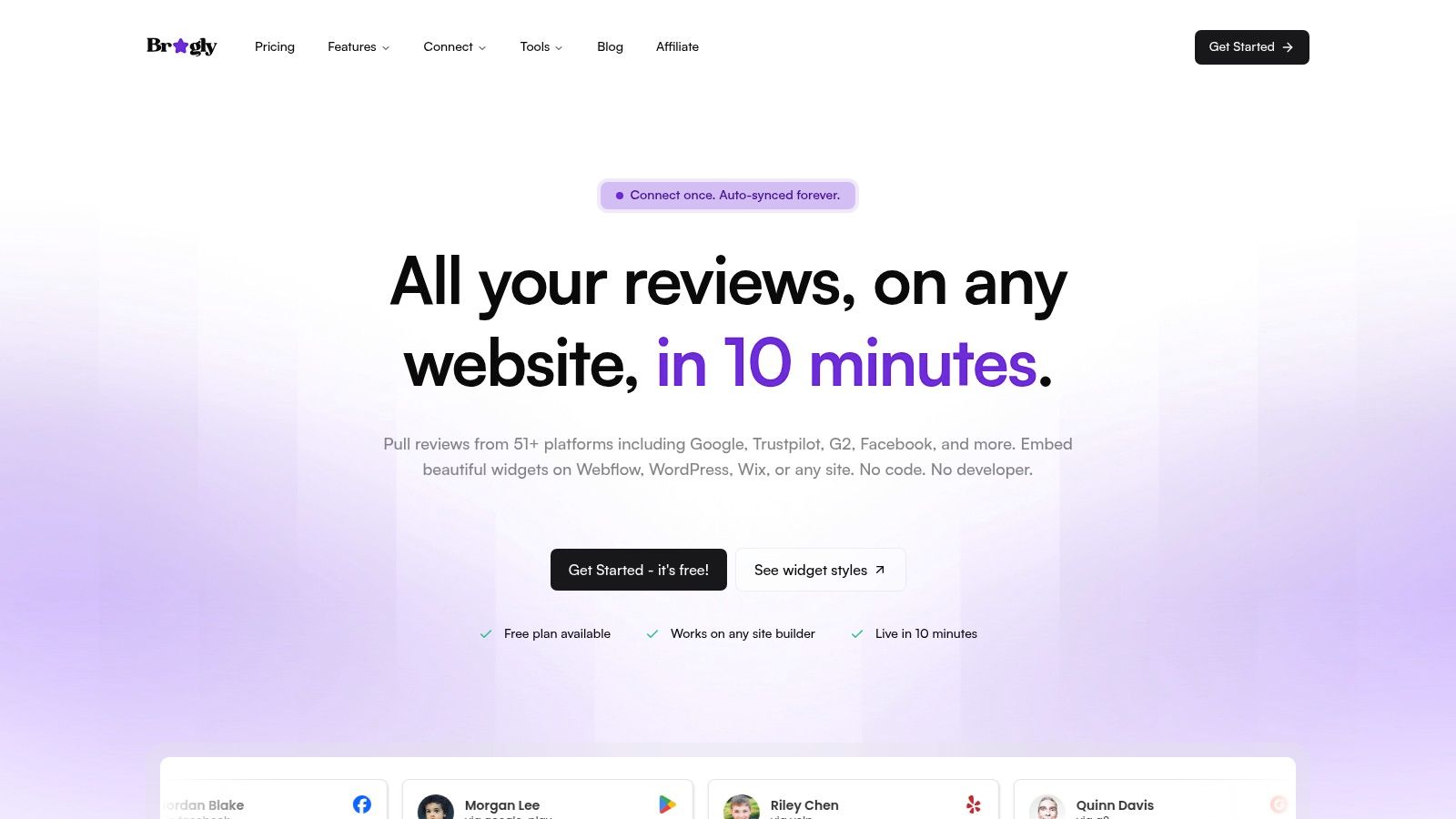
Bragly is the cleanest fit for teams that want review aggregation plus no-code display rather than a sprawling reputation suite. It pulls reviews from 50+ sources and turns scattered proof into on-brand widgets you can place on a site in under 10 minutes; the setup is no-code, using a single div and script, and it works with Webflow, WordPress, Wix, Shopify, and any HTML site. That matters when the bottleneck isn't review volume, it's the time it takes to turn existing proof into something buyers can trust on the page.
The product is broad without feeling heavy. Bragly supports auto-syncing, first-party collection forms for text and video, tagging, filtering, manual uploads, webhooks, and an SEO-friendly rich-snippet option for star ratings in search results. It also adds AI-powered analysis for sentiment, theme detection, highlight extraction, and reply suggestions, so teams can see what customers keep saying without exporting data into a second system.
Practical rule: choose Bragly when your team already has reviews scattered across sites and needs a faster, cleaner way to publish them without engineering help.
Pricing is unusually transparent for the category. Bragly lists a Free starter tier, Pro at $14/month with a trial, and Business at $67/month. The trade-off is that some useful limits sit behind paid plans, including collection-form caps and monthly AI-analysis limits. That's a reasonable constraint for smaller teams, but larger programs will want to confirm whether the Business tier covers their workflow before rolling it out across multiple properties.
A useful way to think about Bragly is as the tool for consolidation, display, and freshness. If your problem is that trust signals are spread across too many platforms, this is the platform that brings them into one branded system and keeps them current. Its main limitation is scope, since it's not trying to be the entire local marketing stack.
Brands with thin or outdated testimonial pages usually get more immediate value from Bragly than from a heavier suite, because the site experience changes fast and the maintenance burden stays low.
Pros:
- Aggregates from 50+ review sources so you can consolidate broader social proof.
- True no-code embeds with layouts like carousel, grid, badges, video highlights, and sticky trust widgets.
- Auto-sync, moderation, tagging, and webhooks support current, organized displays.
- AI analysis and reply suggestions help surface themes without extra tools.
- Transparent pricing with a free tier and clear paid plans.
Cons:
- Plan limits on forms and AI usage matter as the program grows.
- Auto-sync still needs moderation so off-brand reviews don't reach the site unchecked.
Website: Bragly
2. Birdeye
Birdeye fits organizations that want a broad customer-communications hub rather than a narrow review tool. The platform combines reviews, listings, webchat, messaging, surveys, and social, which makes it useful when a team wants one system for customer touchpoints across multiple locations. It's the kind of platform buyers choose when review management can't be separated from inbox management or location data.
The operational advantage is centralization. Birdeye's unified inbox brings together webchat, SMS, social, and Google messages, while its review generation and response tools are built for scale across major sites. Its listings distribution and profile sync also matter for brands that need consistency across local presence, not just review response speed. The AI and analytics layer helps summarize sentiment and trends, which is valuable when a multi-location team needs a single view of what's changing.
The limitation is commercial rather than technical. Birdeye's pricing is quote-based, and the public material is intentionally high-level, so buyers don't get the same upfront visibility they would with a simpler SaaS tool. That usually signals a sales-led process, which can be fine for larger teams but frustrating for smaller operators who want to budget quickly.
Birdeye makes the most sense when the problem is workflow sprawl. If one team handles reviews, another handles listings, and a third handles customer messaging, the platform's breadth can reduce fragmentation. If you only need a display layer or lightweight testimonial management, it's probably more platform than you need.
Decision cue: pick Birdeye when your reputation workflow is tied to multiple customer channels and location consistency matters as much as review volume.
Website: Birdeye

3. Podium
Podium is built around SMS-first customer communication, which is why it stands out for businesses that want review requests to feel like part of a live conversation. It helps teams collect reviews, capture web leads through chat, manage messages, and accept payments inside the thread. For service businesses, that combination can shorten the distance between a happy customer, a review request, and a completed action.
Why SMS matters here
Podium's biggest strength is how naturally it fits mobile behavior. Textable review invites, centralized responses, and a unified inbox for SMS, Google, and Facebook messages make it practical for front-desk teams, field teams, and owners who manage reputation on a phone between jobs. The platform's AI Employee also points to a deeper automation use case, first responses and follow-ups can happen with less manual effort, which matters when leads and review requests arrive all day.
The payments layer is part of the same operational logic. Text-to-pay and in-thread payments reduce friction after a service interaction, so the same conversation can move from support to billing to review solicitation without jumping tools. That makes Podium feel less like a review tool and more like a communications system that happens to produce reviews.
The limitation is pricing visibility. Podium's official pricing is quote-based, and the exact costs can vary depending on the package and the third-party reports a buyer sees. That makes comparison harder, especially for teams trying to isolate the cost of reputation workflows versus the rest of the communication stack.
If your team is already comfortable handling customers by text, Podium can be a strong fit. If you want a transparent, low-friction review display layer, it's not the first stop.
Internal reference for teams comparing request workflows, see SMS review request patterns.
Website: Podium
4. Yext Reviews
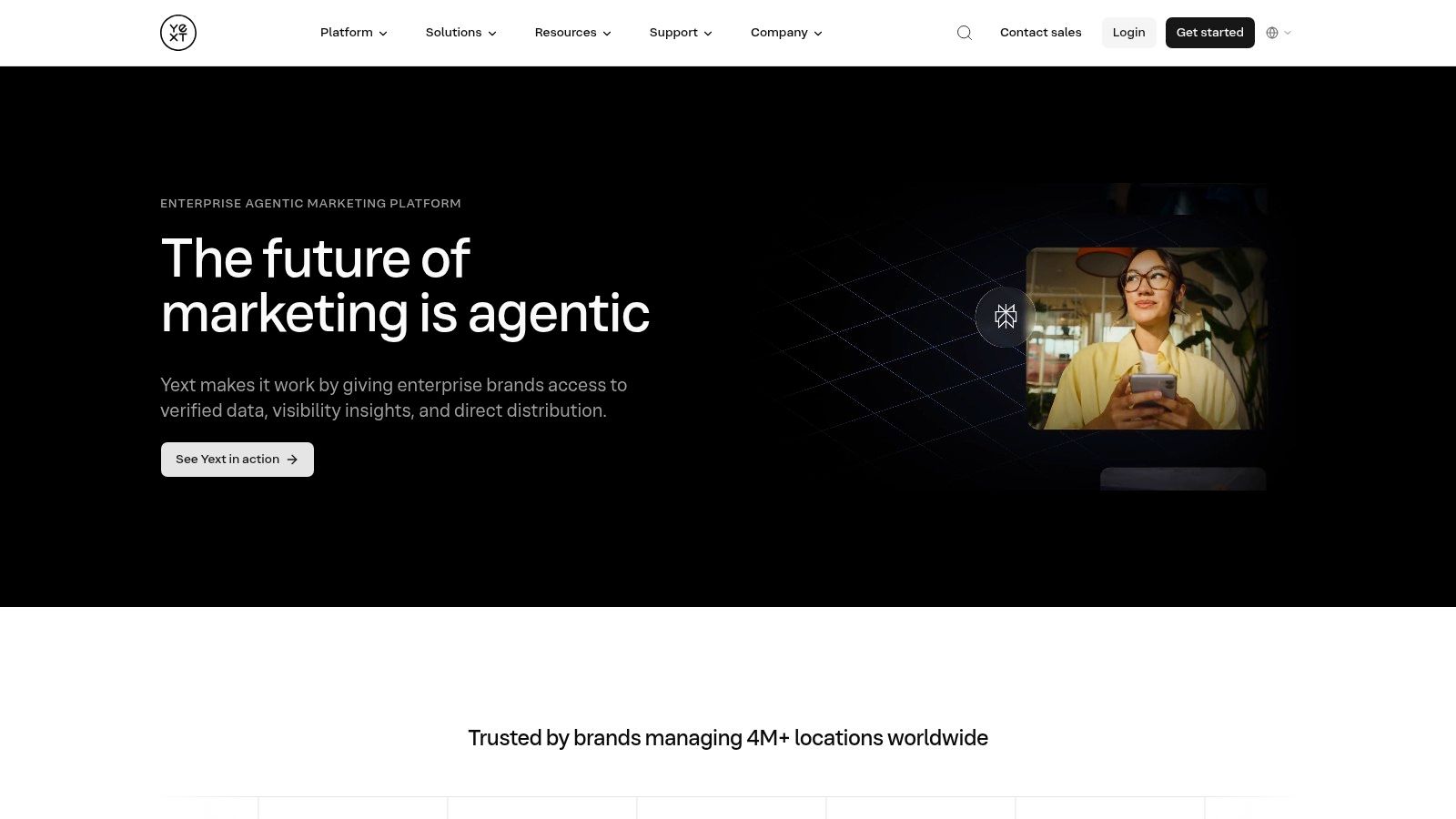
Yext Reviews is a better fit for multi-location brands that need governance, publisher integrations, and a broader location data strategy. It sits inside the larger Yext platform, so the review workflow connects naturally to listings and pages. That matters when the same organization has to keep location details, local content, and review responses aligned across many properties.
The core value is control. Yext supports review monitoring and response, automated requests, on-site review widgets, and review summaries, while also giving enterprises the roles, approvals, and governance they need to keep messaging consistent. The brand's listings ecosystem is a major part of the appeal because reputation management often breaks down when location data drifts or a local page gets out of sync with the rest of the system.
Best fit for governed organizations
Yext makes sense when reputation is a compliance and process issue, not just a marketing one. A franchise, healthcare network, or distributed retailer may need approvals before responses go live, and that's where the platform's enterprise controls matter. The mobile app also helps location managers work within the same system instead of relying on disconnected emails and spreadsheets.
The trade-off is obvious. Yext is sales-led and usually better suited to enterprise buyers than SMBs, so smaller teams often end up paying for capabilities they won't fully use. If your only goal is to aggregate reviews and display them neatly, the platform may be more infrastructure than you need.
This is the sort of platform that pays off when review management sits inside a larger publishing and listings strategy. If the team is already managing many locations and needs a single governed workflow, Yext is a serious contender.
Internal reference for source alignment across location pages, see Google integration details.
Website: Yext Reviews
5. Reputation
Reputation.com is designed for enterprise CX and reputation management, especially in regulated or multi-location verticals like auto and healthcare. It combines reviews, social listening, surveys, messaging, listings management, and analytics into a single program, which is helpful when customer experience and brand reputation are treated as one system.
The platform's strength is depth. Its review acquisition and managed response options are useful for teams that need central oversight, while its listings management and social listening modules extend the workflow beyond a single review site. Role-based analytics and Reputation Score-style reporting make more sense in a large organization where different leaders need different views of the same customer data.
Enterprise buyers often need a system that can absorb complexity without turning every location manager into a power user.
That's where Reputation.com tends to fit. It can support governance, reporting, and verticalized use cases in a way that simpler tools usually can't. The downside is that it is commonly overkill for small teams, and its pricing is sales-led, so buyers should expect a longer evaluation cycle.
The platform's operational value shows up when a company needs more than response management. If surveys, social listening, and listings all feed the same reporting model, Reputation.com can become the backbone of a larger customer experience program. If you only need a branded review wall or lightweight collection flow, it's not the efficient choice.
Website: Reputation.com

6. ReviewTrackers
ReviewTrackers is built for teams that care most about review operations, especially franchises and mid-market businesses with multiple locations. It centralizes reviews by location, supports AI-assisted draft responses, and gives managers dashboards that roll up performance across the organization. That narrower focus is part of the appeal, because it keeps the tool closer to the daily work of reading, responding, and reporting on reviews.
Location teams need speed
The platform's practical edge is in response workflow. Alerts, templates, mobile support, and a Chrome extension help teams reply faster without bouncing between sites. For a franchise manager or regional operator, that matters because the first challenge isn't strategy, it's keeping up with incoming reviews across dozens of listings and locations.
ReviewTrackers can also help standardize tone. AI-assisted draft responses reduce the blank-page problem, while the dashboards make it easier to spot patterns across different branches. That makes it a useful middle ground for teams that want more than simple monitoring but don't need a full enterprise CX suite.
The limitation is scope. ReviewTrackers is more specialized than platforms that bundle listings, chat, or payments, so some organizations may eventually outgrow it as their operational needs widen. Pricing is another consideration, since current pricing still requires a sales conversation even though the site has a plans page.
When review management is the job, not one feature among many, ReviewTrackers stays relevant. Its focus can be a strength if the team values clarity and location-level execution over all-in-one breadth.
Internal reference for sentiment workflow comparison, see review sentiment analysis tools.
Website: ReviewTrackers
7. SOCi
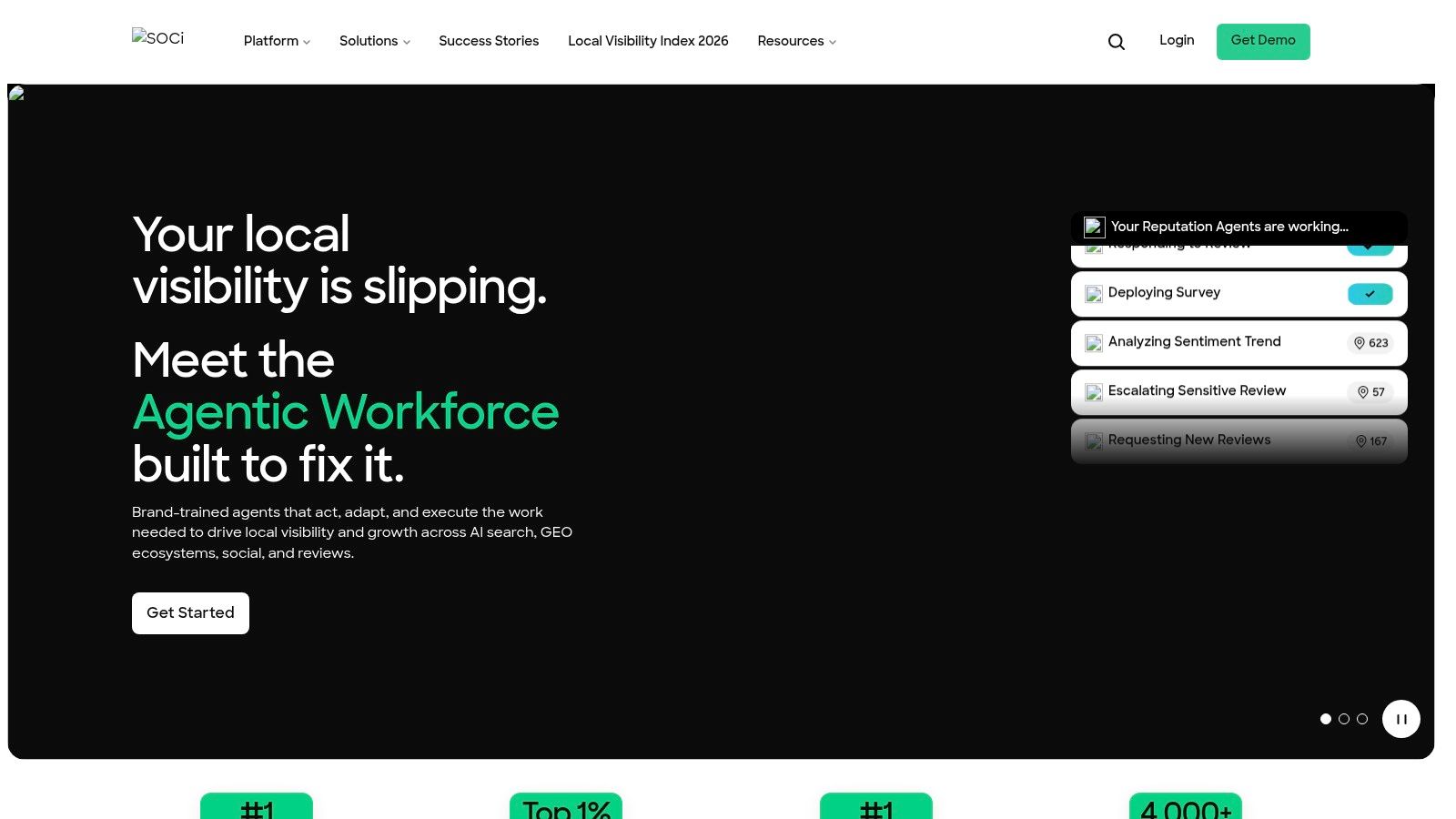
SOCi is the strongest fit for franchises and enterprise brands that need local marketing, reputation, and governance in one place. It combines reputation management with listings, local pages, social publishing, and approval workflows, which means it's designed for organizations where every location needs to act consistently without losing local relevance.
The platform's structure matters. Its reputation module handles review monitoring and response, while its listings and local pages tools support local discoverability across many branches. The inclusion of AI “Genius” agents shows where the platform is headed, toward more guided execution and less manual busywork for distributed teams.
Where SOCi earns its keep
SOCi is less about a single feature and more about operating model. If one corporate team needs compliance, location managers need approvals, and regional marketers need a repeatable publishing system, SOCi can reduce process drift. The Salesforce integration also helps when reputation data has to live beside broader customer or pipeline systems.
The trade-off is complexity. SOCi is sales-led and generally heavier than SMB-focused tools, so smaller teams may find the learning curve too steep for the problems they have. That doesn't make it bad, it just means the platform is solving a different class of problem.
SOCi is most compelling when reputation work is part of a larger local marketing system. If your primary requirement is no-code testimonial display, it's not the right level of machinery.
Website: SOCi
8. Synup
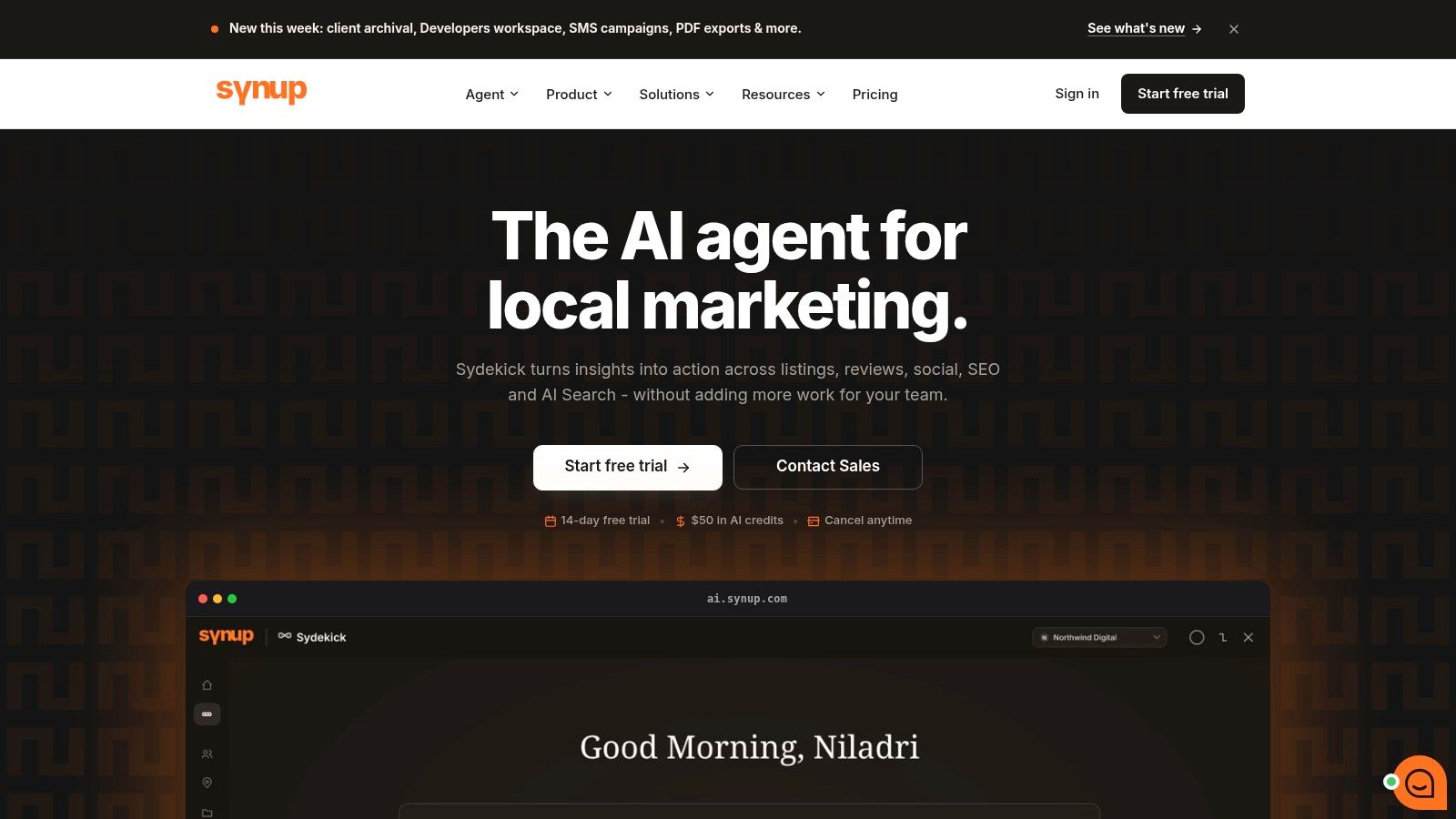
Synup is a local marketing platform for teams that want reputation management tied to listings, social publishing, and AI-search visibility. That combination is useful when the problem isn't just collecting reviews, it's keeping local information consistent across publishers and making sure AI-driven search experiences surface the right signals.
The review workflow includes monitoring, generation campaigns, and response handling, while the listings side syncs to Google, Apple, Bing, Facebook, and 100+ publishers. Synup also uses an AI agent called Sydekick to automate recurring tasks, which is the kind of feature that matters when location teams are drowning in routine updates and follow-up requests.
Agent-driven automation can reduce busywork
Synup's pitch is practical: less dashboard churn, more task automation. That makes it a good fit for multi-location brands that want to reduce manual review checks and repetitive publisher updates. The platform's free trial and pricing visibility also make evaluation easier than with some larger enterprise systems, even though third-party pricing can still vary by volume and should be confirmed before rollout.
The main limitation is the same one many location platforms face. Once you add listings, local SEO, social publishing, and reputation automation together, the stack gets broad enough that exact costs and workflow fit need careful checking. It's not a light-touch display tool, and it's not meant to be.
Synup makes the most sense when reputation is part of a local discoverability program. If your team wants one system for reviews and local presence, it can be efficient. If you only need polished widgets and review aggregation, it's more platform than the job requires.
Website: Synup
9. NiceJob
NiceJob is aimed at service businesses that want more reviews and more visible social proof without a complicated setup. It focuses on automated review requests, follow-ups, and simple widgets that make testimonial publishing easy. The inclusion of feedback routing also matters, because unhappy customers can be captured privately before they post publicly.
That workflow fits the rhythm of local services. A contractor, clinic, or agency can ask at the right moment, route feedback privately when needed, and publish the best results on the site with minimal friction. NiceJob's connections to Google, Facebook, and other review sites support the public side of that process, while its integrations make it easier to connect with the SMB tools many small teams already use.
The appeal is simplicity. NiceJob is not trying to become a full enterprise suite, and that keeps the setup lighter for small teams. The platform also offers a 14-day free trial, which is helpful when a buyer wants to test whether the automation fits their customer journey.
The limitation is scope. Advanced analytics are lighter than what enterprise platforms offer, and the platform doesn't try to replace listings management or broader social workflows. That's fine if you want a reputation marketing tool, less fine if you need a multi-channel governance layer.
NiceJob is best when the job is to create a steady flow of public proof from satisfied customers. It's less about broad control and more about reliable review generation.
Website: NiceJob

10. Grade.us
Grade.us is the most clearly agency-oriented platform on this list. It focuses on review generation funnels, centralized monitoring, reporting, and social proof widgets, all in a white-label package that agencies can resell under their own brand. If the operating model is multi-client service delivery, that matters more than a shiny feature list.
The platform's workhorse features are straightforward. Review funnel landing pages and automated campaigns help agencies drive requests, while monitoring across 100+ sites keeps oversight centralized. White-label dashboards, emails, and collateral support a branded client experience, and the API and Zapier integrations help connect review operations to the rest of an agency's stack.
White-labeling is the point
Grade.us earns its keep when an agency needs to present reputation management as part of its own service offering. The platform's structure supports rollout at volume, and that can make onboarding simpler for consultants who don't want to build a client portal from scratch. It's also often viewed as competitively priced for agency use cases, though the public pricing details are sparse.
The limitation is that the interface and public pricing pages can feel dated. That won't bother every buyer, but teams that want modern UX polish may notice it quickly. It also means you should confirm pricing directly with sales before you commit to a client-facing workflow.
Grade.us is not the best option for a brand looking for simple testimonial display. It is the better option when the agency itself needs the platform.
Website: Grade.us
Top 10 Reputation Management Software Comparison
| Product | Core features | Quality & UX (★) | Pricing / Value (💰) | Target audience (👥) | Unique selling point (✨) |
|---|---|---|---|---|---|
| Bragly 🏆 | Aggregates 50+ sources, no-code embeds, auto-sync, forms, AI analysis, webhooks | ★★★★☆ polished widgets; fast lazy-load; easy 1‑div install | 💰 Free / Pro $14/mo / Business $67/mo, transparent limits | 👥 SMBs, DTC/e‑commerce, SaaS, agencies, founders | ✨ Broad source coverage + large widget library + built‑in AI analysis & SEO rich snippets |
| Birdeye | Reviews, listings, unified inbox, surveys, social | ★★★★☆ robust enterprise UX; scalable | 💰 Quote-based; can be costly per location | 👥 SMB → enterprise, multi-location brands | ✨ Unified inbox + broad CX automation across touchpoints |
| Podium | SMS-driven review invites, webchat, payments, AI chat | ★★★★☆ excellent mobile & SMS experience | 💰 Quote-based; sales-led | 👥 Local businesses prioritizing SMS/mobile workflows | ✨ Text-to-pay, mobile app, AI "Employee" for messaging |
| Yext Reviews | Review monitoring, listings, on-site widgets, governance | ★★★☆☆ enterprise controls; frequent updates | 💰 Sales-led enterprise pricing | 👥 Multi-location enterprises needing governance | ✨ Deep publisher integrations & enterprise approval workflows |
| Reputation.com | Reviews, social listening, surveys, managed response | ★★★★☆ enterprise CX focus; verticalized reporting | 💰 Sales-led; enterprise oriented | 👥 Regulated industries (health, auto) & large orgs | ✨ Enterprise reporting, managed response & compliance features |
| ReviewTrackers | Aggregation, AI draft responses, location dashboards | ★★★☆☆ practical for franchises; focused ops UX | 💰 Contact sales (mid-market pricing) | 👥 Franchises, multi-location mid-market businesses | ✨ Location-level dashboards + AI response templates |
| SOCi | Reputation, listings, social publishing, ads, AI agents | ★★★☆☆ built for complex enterprise workflows | 💰 Sales-led; enterprise pricing | 👥 Franchises & enterprises with compliance/approval needs | ✨ Centralized local marketing + governance & AI 'Genius' agents |
| Synup | Reviews, listings sync (100+), social publishing, AI agent | ★★★☆☆ transparent trial; AI automations | 💰 Free trial; per-location pricing (varies) | 👥 Local/multi-location businesses focused on local SEO | ✨ AI agent "Sydekick" + local SEO / Answer Engine focus |
| NiceJob | Automated review requests, widgets, feedback routing | ★★★☆☆ easy setup for SMBs; strong automations | 💰 14-day trial; SMB-friendly plans | 👥 Service businesses & local SMBs | ✨ Feedback routing to capture private feedback pre-publication |
| Grade.us | Review funnels, white-label dashboards, API & Zapier | ★★★☆☆ agency-oriented UX; scalable for clients | 💰 Agency pricing; volume discounts | 👥 Agencies & resellers managing multiple clients | ✨ White-label tooling & multi-client management APIs |
Choose the Platform That Fits the Work
The wrong way to buy reputation management software is to start with a brand name and work backward. The right way is to map the operational problem first, then choose the platform that solves it with the least friction. If your team needs broad source coverage, no-code widgets, first-party collection, automatic syncing, and transparent plans, Bragly is the most direct fit. If the job is more specific, the comparison changes fast. Birdeye and Synup make more sense when reviews sit inside broader local marketing and listings workflows. Podium fits SMS-heavy operations. Yext Reviews and Reputation.com serve governed, multi-location organizations. ReviewTrackers is focused and practical for franchises. SOCi leans into enterprise local marketing. NiceJob simplifies review generation for service businesses. Grade.us is the white-label answer for agencies.
Pricing visibility should stay on the checklist throughout the process. Quote-based tools can be the right choice for enterprise teams, but they raise the evaluation cost for smaller buyers. You should also compare source coverage, response and solicitation workflows, messaging or listings needs, location and approval complexity, display requirements, integration effort, and the total cost of ownership. Those are the details that determine whether the tool gets used after the demo.
The market data points to continued demand, but the category still bundles very different jobs together. That's why some tools are better at monitoring, some at requests, and others at display or governance. The best platforms don't just collect reviews, they fit the way your team operates.
A practical rollout checklist keeps the decision grounded. Connect your priority sources first. Define moderation rules before auto-sync goes live. Test request timing and response ownership with one team or one location. Publish the right widget in the right place. Review analytics regularly so you can see which sources, formats, and messages move trust.
Bragly gives you a fast way to consolidate reviews, build no-code widgets, and keep social proof fresh without adding extra operational drag. If your team wants a practical reputation layer that's easy to launch and easy to maintain, Bragly is worth a close look.