
Looking for a Shorter Overview?
AI Summary
Key Moments
Importance of Aspect-Based Sentiment Analysis
Connecting opinions to specific subjects reveals nuanced feedback beyond overall star ratings.Three Main Methods of Sentiment Analysis
Lexicon-based, classical machine learning, and transformer models each offer trade-offs in accuracy and data needs.Challenges with Fake Reviews and Language Nuances
Authenticity and linguistic complexities like sarcasm affect sentiment reliability and require verification.Evaluating Sentiment Analysis Solutions
Testing models for accuracy, confidence, coverage, and evidence transparency ensures practical and trustworthy insights.You open your review dashboard expecting a quick read. Instead, you find praise for the product, complaints about delivery, questions about setup, and a few comments that seem positive until you read the details. You can answer some manually, but the recurring pattern stays hidden.
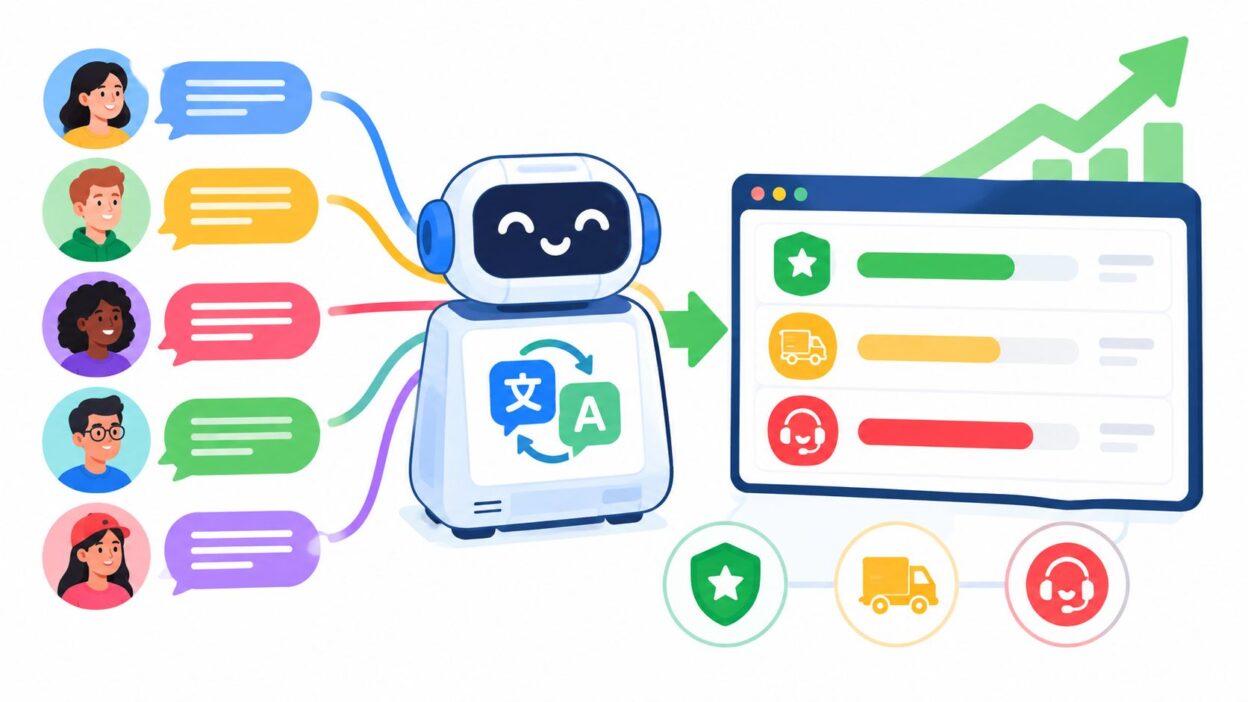
That's the problem review sentiment analysis helps solve. It turns scattered customer language into usable signals, so your team can understand what people like, what frustrates them, and which issues deserve action first.
Why Review Sentiment Analysis Matters for Your Business
A small accommodation owner might read every new guest review personally. At first, that works. Over time, reviews accumulate across booking platforms, Google, and social channels. The owner still sees individual comments, but no longer sees the pattern connecting them.

Several guests may praise the location while mentioning slow check-in. Others may love the room but complain about missing kitchen supplies. A rating can look healthy while the written feedback points to an operational problem that keeps appearing.
Review sentiment analysis is the practical translation layer between collecting feedback and deciding what to do next. It can group comments by emotional direction, identify repeated subjects, and help a team distinguish an isolated irritation from a persistent weakness.
For a vacation rental, even practical resources such as Avistar vacation rental supply tips can help owners think through the details guests notice. Sentiment analysis then shows which of those details matter most in the actual guest experience.
Four useful jobs for sentiment data
- Track brand health: Watch whether customer language is becoming more enthusiastic, neutral, or frustrated over time.
- Prioritize responses: Find negative or mixed reviews that need a thoughtful reply instead of treating every comment identically.
- Surface testimonial highlights: Identify specific praise about service, quality, speed, or results that marketing can present with the original evidence.
- Flag operational issues: Detect recurring complaints about delivery, support, onboarding, cleanliness, packaging, or usability.
Practical rule: A review becomes useful when someone can connect it to an action, owner, or decision.
Without analysis, a large review collection behaves like a crowded inbox. With analysis, it can support a product roadmap, improve customer support priorities, sharpen marketing language, and reveal where the customer experience falls short of the promise.
The important distinction is that the technology shouldn't replace judgment. It should help a busy team see the evidence it would otherwise miss.
The Core Idea Behind Review Sentiment Analysis
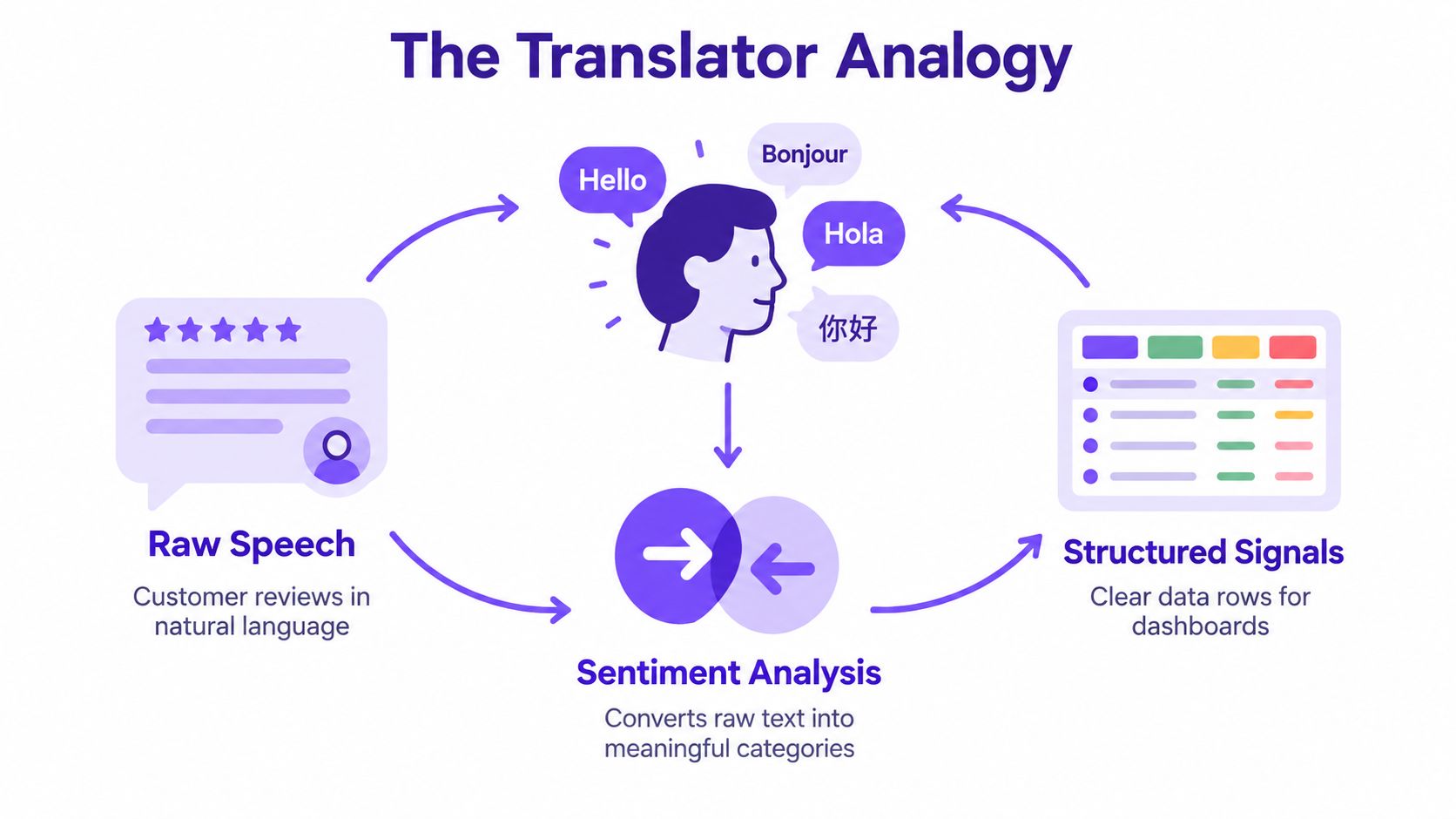
Think of a customer review as raw speech and sentiment analysis as a translator. The customer uses natural language, while your dashboard needs structured fields it can sort, compare, and route to the right team.
A review might say:
“The product feels excellent and support answered quickly, but delivery was late and the package arrived damaged.”
That single sentence contains several signals. A useful system doesn't force it into one simple label and move on.
The four building blocks
Polarity describes the broad emotional direction. The review contains positive language about product quality and support, plus negative language about delivery and packaging. Some systems also preserve a neutral or mixed category rather than forcing every sentence into praise or criticism.
Aspect identifies what the customer is discussing. In this example, the aspects include product quality, support, delivery, and packaging. Aspect-based analysis matters because “negative” alone doesn't tell the warehouse, support manager, or product team what needs attention.
Confidence expresses how certain the system is about its interpretation. Clear wording such as “arrived damaged” is easier to classify than irony, slang, or a sentence containing conflicting signals. Low-confidence results should be visible rather than presented as unquestionable facts.
Aggregation combines findings across reviews. One complaint may be useful context, but repeated comments about late delivery create a stronger operational signal. Aggregation should preserve the underlying evidence, not hide it behind a single score.
A working mental model
You can think of the output as a structured row:
| Aspect | Polarity | Evidence | Confidence |
|---|---|---|---|
| Product quality | Positive | “feels excellent” | High or medium |
| Support | Positive | “answered quickly” | High or medium |
| Delivery | Negative | “was late” | High |
| Packaging | Negative | “arrived damaged” | High |
The exact fields vary by tool, but the principle stays consistent. Sentiment scoring is a structured summary, not absolute truth. It helps you organize customer language, while people still need to check context, source quality, timing, and business impact.
Three Main Methods That Power Sentiment Analysis
The same review can produce different results depending on the method behind the system. Three approaches appear often: lexicon-based analysis, classical machine learning, and transformer-based models.
Take the sentence, “The product is beautifully made, but the delivery was painfully slow.” A lexicon-based system checks words against predefined lists. “Beautifully made” contributes positive signals, while “painfully slow” contributes negative ones. This approach is easy to explain and can work with little training data, but it may struggle with context, negation, and sarcasm.
Classical machine learning learns patterns from labeled examples. If people label many reviews as positive, negative, neutral, or mixed, an algorithm can learn which words and combinations tend to accompany each label. It can be practical for a specific industry, but performance depends on the quality and representativeness of the examples.
Transformer models, including BERT and RoBERTa, examine relationships between words across a sentence. They're better equipped to understand that “not slow” differs from “slow,” or that praise for the product can coexist with criticism of delivery. A 2025 Trustpilot study reported RoBERTa exceeding 90% accuracy for sentiment classification in a 12,000-review English dataset, while a BERT-based model achieved an 84% F1 score for aspect detection. Results varied by merchant, with test accuracy ranging from 88% to 100%, which shows why model performance must be tested in the intended domain. The study's findings provide useful context, not a guarantee for every business.
| Method | How It Works | Data Needed | Best For |
|---|---|---|---|
| Lexicon-based | Matches words and phrases to sentiment dictionaries | Little or no labeled business data | Transparent rules and simple monitoring |
| Classical machine learning | Learns patterns from labeled examples | A representative set of labeled reviews | Focused domains with stable language |
| Transformer-based | Uses contextual language representations | Training or fine-tuning data, plus evaluation samples | Nuanced reviews and aspect-level interpretation |
Cost and maintenance also differ. Lexicons are usually easier to audit but require rule updates. Classical models need labeled examples and periodic retraining. Transformer systems can interpret richer language, but they need careful evaluation, monitoring, and governance.
If you're comparing tools or implementation paths, a practical overview of how teams compare NLP solutions can help you frame the decision around data, use case, and maintenance rather than algorithm names alone.
Why Aspect-Based Analysis Beats a Single Star Rating
A four-star review can look reassuring until you read the sentence behind it:
“The product itself is excellent and easy to use. I'm giving four stars because delivery took too long and the box arrived damaged.”
An overall rating records a relatively positive experience. It doesn't tell the fulfillment team that shipping is failing, or the packaging team that damage is reaching customers.
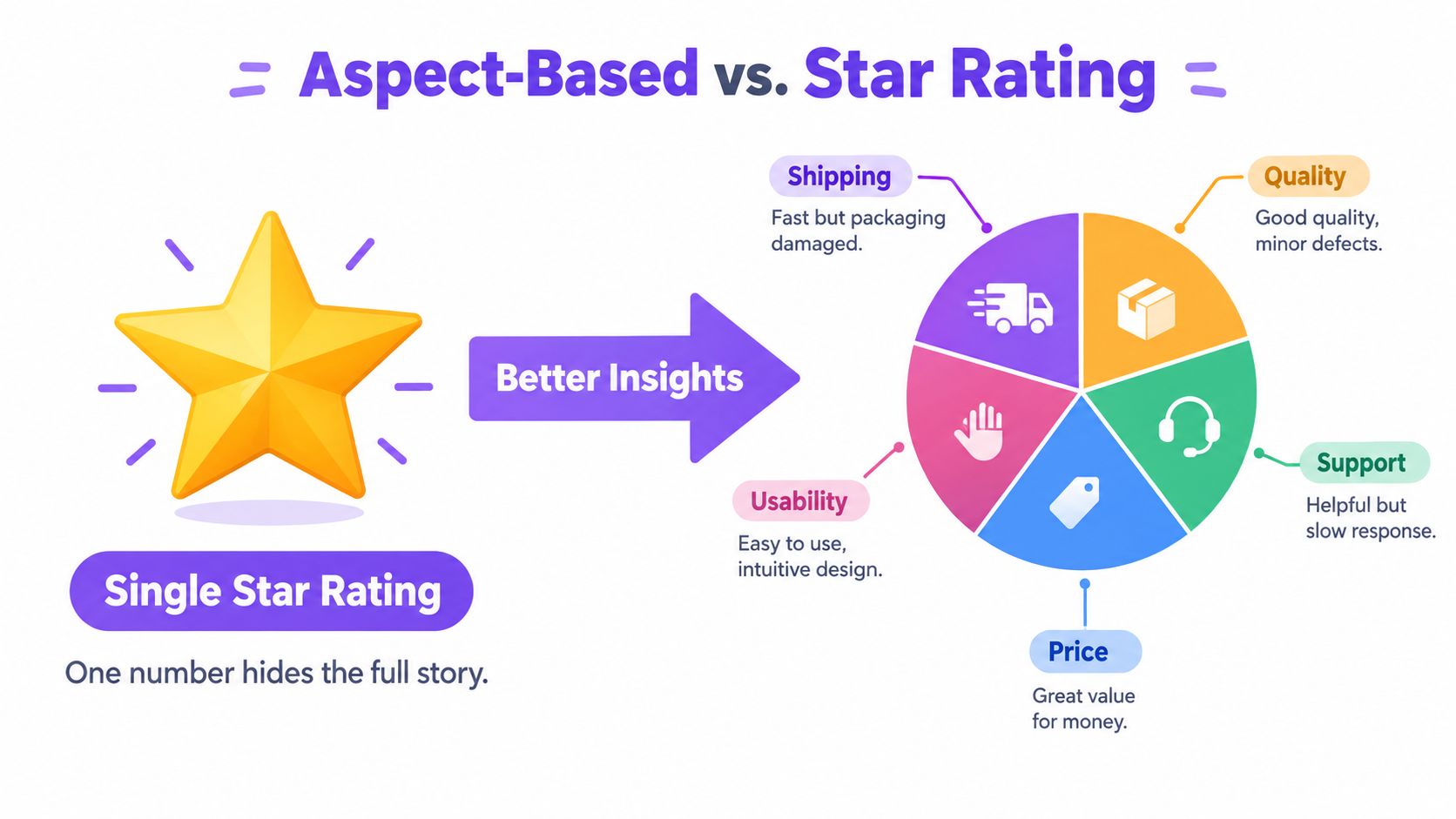
Aspect-based sentiment analysis, often called ABSA, connects an opinion to the subject of that opinion. Instead of producing only “positive,” it can identify positive sentiment about product quality and usability, then negative sentiment about delivery and packaging.
What a single score conceals
Aggregate ratings are useful as a quick signal, but they compress several experiences into one number. A strong average can contain recurring complaints about support. A high product rating can coexist with poor delivery. A positive review can still reveal a defect that the customer tolerated because other parts of the experience were good.
The 2024 comparative study of Amazon reviews illustrates why ratings should be treated as labels, not perfect emotional truth. Researchers analyzed 32,054 reviews collected across product categories, with dates ranging from May 2015 through February 2024. Each record contained review text and a star rating, allowing the rating to act as a practical proxy for sentiment. The researchers used approximately 24,000 reviews for training and 6,000 for testing. The comparative study also emphasizes that written content and ratings can diverge.
Routing insight to the right team
ABSA makes the output operational. A shipping complaint can reach logistics, a usability complaint can reach product, and a support complaint can reach the customer-care manager.
A useful record might include:
- Aspect: Delivery
- Polarity: Negative
- Evidence span: “took too long”
- Confidence: High
- Source: Original review platform
That structure supports better summaries and safer testimonial selection. It also prevents a favorable overall rating from concealing a problem customers repeatedly describe in their own words.
Common Pitfalls That Undermine Review Sentiment Insights
A sentiment score can look precise while resting on unreliable input. That happens when a business treats every review as authentic, linguistically clear, and representative.
Fake or incentivized reviews are the first problem. The U.S. Federal Trade Commission's Consumer Reviews and Testimonials Rule took effect on October 21, 2024, and prohibits creating, buying, selling, or distributing fake or false reviews, including AI-generated reviews and reviews from nonexistent people. It also prohibits incentives conditioned on expressing a particular sentiment, such as a discount offered only for a five-star review. The FTC's rule announcement explains the compliance implications.
Consumers also have difficulty judging authenticity. A 2025 study reported that 89% of respondents rely on online reviews, while only 34% believed they could accurately identify fake reviews. Participants exposed to fake reviews experienced a 26% decline in trust and a 20.5% decrease in purchase intent. The research on fake reviews and trust shows why authenticity should be treated separately from sentiment.
Language creates another layer of uncertainty
Sarcasm can reverse the literal meaning of a sentence. “Fantastic, another two-week delivery” contains positive vocabulary but communicates frustration. Slang, dialects, cultural references, emojis, and translation artifacts can create similar errors. A system trained on one language or market may not interpret another market's review style reliably.
Trust is also weakening. BrightLocal's 2025 Local Consumer Review Survey found that 42% of U.S. consumers trust online reviews as much as personal recommendations, compared with 79% in its 2020 survey. The survey also found that 96% are open to writing a review. BrightLocal's survey indicates that businesses still have plenty of feedback available, but they need stronger quality and provenance practices.
Use a fake review checker when suspicious patterns need separate attention from ordinary sentiment classification.
More automation can reduce trust when nobody verifies what the automation is saying.
The safer approach is to preserve source, language, date, evidence, and uncertainty. Treat sentiment as an evidence layer, not a headline that automatically speaks for every customer.
Putting Sentiment Analysis to Work in Your Stack
A useful workflow starts before the model produces a summary. It begins by bringing review sources into one manageable place, while retaining where each review came from and when it appeared.
Step one is source aggregation
Customers consult multiple channels, so a single platform can leave important feedback outside your view. BrightLocal's 2025 survey reported that 83% of consumers use Google to read reviews, followed by local news outlets at 48%, Yelp at 44%, Facebook at 40%, and YouTube at 34%. It also found that 74% check at least two review sites before deciding. The channel findings support a cross-platform approach, provided the sources remain distinguishable.
Connect the relevant channels, normalize basic fields, and preserve the original review text. A Google review, a marketplace review, and a first-party testimonial may follow different norms, so combining them without source labels can distort interpretation.
Step two is analysis with evidence
Run overall sentiment and aspect-level analysis together. The output should identify themes such as delivery, quality, price, support, or usability, then attach representative evidence. Low-confidence or conflicting statements should go to a person rather than becoming automatic website copy.
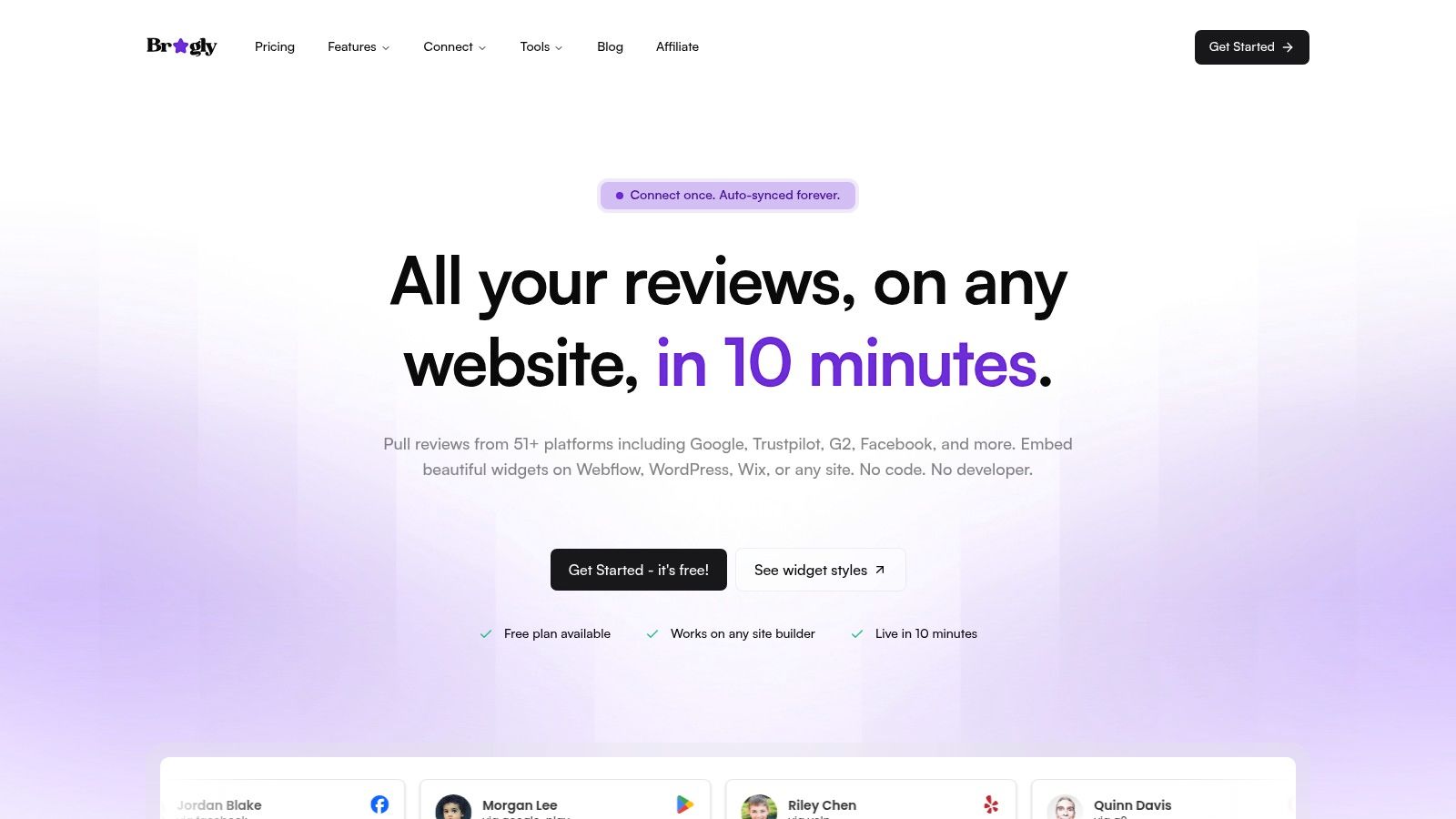
Bragly can aggregate reviews from 50+ sources, apply AI-based analysis that produces summaries and highlights, and provide no-code widgets for publishing selected social proof on a website. Its workflow is an example of how a small team can connect collection, interpretation, organization, and display without building a data science operation internally.
Step three is routing and publishing
Send recurring product issues to product teams, service complaints to support, and strong evidence-backed praise to marketing. Businesses that need Google feedback in their workflow can review the Google integration as part of that setup.
An embeddable widget should support careful selection rather than exposing every star. Choose testimonials with clear evidence, relevant context, and appropriate confidence. Keep the underlying source visible where possible, and refresh connected content so outdated praise doesn't become the only story visitors see.
Evaluating Any Sentiment Analysis Solution Before You Commit
A vendor demo can show attractive summaries. Your evaluation should test whether those summaries remain useful when reviews are mixed, ambiguous, multilingual, or operationally inconvenient.
Start with the model metrics. Accuracy alone can reward a system that predicts the dominant class while missing neutral or mildly dissatisfied customers. In hotel-review experiments, BERT reached 86% overall accuracy, with F1 scores of 0.93 for positive, 0.79 for negative, and only 0.43 for neutral sentiment. Under-sampling improved neutral recall to 0.79, but overall accuracy fell to 0.73. The benchmark results show why a single headline metric can mislead.
Ask for the evidence behind the score
Request macro-F1, per-class recall, confusion matrices, and confidence distributions. These measures help answer practical questions:
- Neutral coverage: Does the system preserve uncertainty, or does it turn mild dissatisfaction into praise?
- Negative recall: Will it catch issues your support team needs to see?
- Aspect quality: Can it distinguish delivery from product quality?
- Confidence behavior: Does it route ambiguous language to human review?
- Source coverage: Can you compare platforms without erasing provenance?
- Language coverage: Has the system been evaluated on the languages and dialects your customers use?
- Manipulation signals: Can it flag suspicious or incentivized content separately from sentiment?
- Evidence excerpts: Can a manager inspect the text behind a summary?
The Stanford Amazon review work provides a useful warning about task definition. A 2017 project described a dataset containing 142.8 million reviews collected from May 1996 through July 2014, while using 8.9 million book reviews for computational analysis. An LSTM achieved 46.66% accuracy when predicting one of five exact ratings. A separate 2018 experiment used 34,627 reviews and reported best accuracy around 70%, while noting limited generalization. The Stanford project illustrates why results from one category or label design shouldn't be treated as universal.
Also check governance. The workflow should support sentiment-neutral review collection, avoid publishing unverified AI-generated claims, and align with the FTC requirements described earlier. A strong review analytics setup should help people inspect trends and evidence, not just admire a score.
The goal isn't a perfect number. It's a dependable decision layer that tells your team what customers are saying, what the system may have misunderstood, and what action deserves attention next.
Bragly brings reviews from multiple sources into one workspace, adds AI-based summaries and highlights, and provides no-code widgets for displaying selected social proof. Visit Bragly to turn scattered review text into organized, evidence-backed insight for your website and customer workflows.