
Looking for a Shorter Overview?
AI Summary
Key Moments
Importance of Testimonial Structure
The way testimonial requests are phrased shapes responses that provide meaningful, contextual social proof.Core Elements of Effective Testimonials
Collect original problem, specific change, outcome, audience, identity, and publication permissions for strong testimonials.Strategies for Collecting Authentic Feedback
Time testimonial requests to follow meaningful successes and use focused prompts to increase response quality.Managing Permissions and Compliance
Capture explicit, channel-specific permissions and disclosures to ensure legal compliance and maintain testimonial freshness.You have customers who like your product, yet your website still displays a few vague lines such as "Great service" or "Highly recommended." Sales teams ask for better proof, customers forget to respond, and the testimonials you do collect often lack a name, context, permission, or a clear result. The problem usually isn't customer satisfaction. It's the customer testimonial template used to turn that satisfaction into publishable evidence.
A useful template does more than request a quote. It captures the original problem, the change that followed, the customer's identity, the conditions behind the result, and permission to use the story. It also gives your team a system for keeping proof current and matching it to the page, audience, and buying stage where it can do the most work.
Why Your Testimonial Template Dictates Your Conversion Rate
A business can have delighted customers and still produce weak social proof. Asking, “Would you recommend us?” tends to generate short praise because the question requires almost no reflection. It also gives the customer no direction about what a future buyer needs to know.

The structure of the request determines the structure of the answer. Ask about the customer's original problem, the specific change, and the result, and you create the conditions for a useful narrative. Ask for a generic opinion, and you'll usually receive generic approval.
That matters because reviews are part of the decision process, not decorative website content. A 2026 consumer survey found that 77% of Americans consider online reviews important when purchasing, while 33% won't buy without reading reviews first. The same research reports that 80.2% have been influenced not to purchase because of reviews. These findings are documented in ConsumerAffairs' online review statistics.
Structure creates usable evidence
A testimonial becomes persuasive when a reader can recognize the situation behind it. “The platform is amazing” says little. “Our support team struggled to organize incoming requests, and the new workflow gave managers a clearer way to assign them” gives a prospect something to compare with their own circumstances.
The request should therefore collect more than sentiment. It should establish:
- The starting point: What problem, risk, or inefficiency existed before the purchase?
- The intervention: What product, service, or process did the customer use?
- The change: What became easier, faster, clearer, or more reliable?
- The context: Who used it, and in what environment?
- The evidence: What observable result supports the customer's conclusion?
Practical rule: If a prospect can't tell whether a testimonial applies to their situation, the quote is probably under-contextualized.
Review research reinforces this preference for identifiable, detailed proof. One research summary reports that 79% of people trust online reviews as much as personal recommendations, while 78% need to see at least 100 reviews before trusting a business. It also reports that 73% of customers value the written review more than the star rating. Those figures appear in SmartCustomer's review research.
A testimonial template is therefore a conversion asset and a data-capture system. It turns scattered customer sentiment into structured material that marketing, sales, and customer success teams can reuse without rewriting every story from scratch.
Core Elements of a High-Converting Testimonial Format
A testimonial earns trust when the form captures enough context to verify the story and present it naturally. The quote is only one field. Identity, permission, audience, and publication timing determine whether the finished asset functions as evidence or polished advertising.
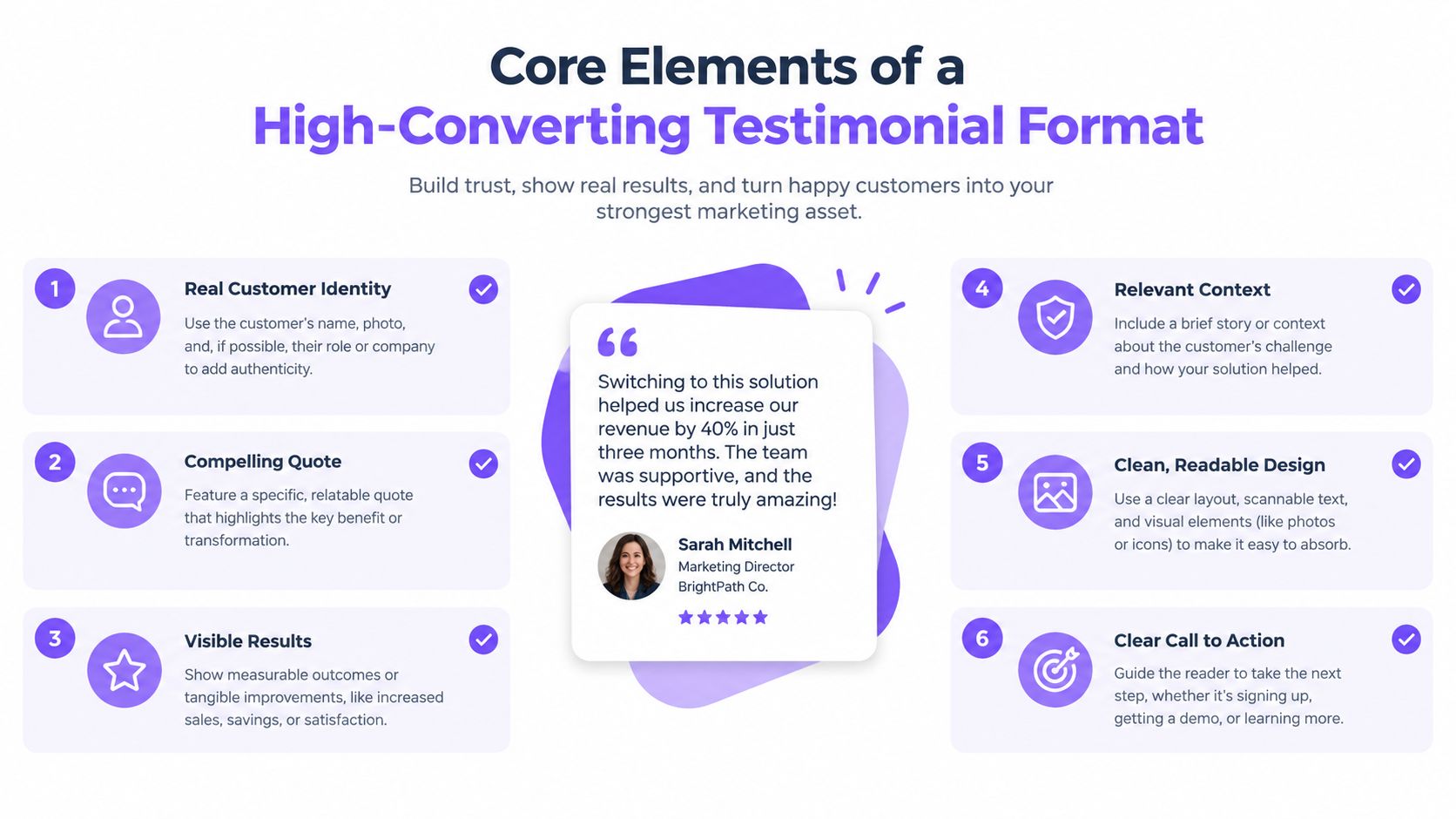
Build the collection form around six fields
The customer's original problem. Ask, “What were you trying to solve before using us?” A recognizable starting point keeps the response grounded in the customer's situation rather than a list of product features.
The specific change. Ask, “What changed after you adopted the product or completed the engagement?” Keep the prompt open. The answer may describe a workflow improvement, a better experience, or an outcome your team did not expect.
The concrete outcome. Request a measurable or observable result where one exists. Do not pressure customers to provide a number. A specific operational change is stronger than an unsupported metric.
The intended audience. Ask, “Who would benefit most from this?” The answer helps segment proof by industry, use case, role, and buyer stage. A short quote may suit an early-stage landing page, while implementation detail belongs with prospects comparing vendors.
Identity and verification. Capture the customer's full name, role, company, photo, website, and permission to display those details. Research summarized by Senja's testimonial statistics guide reports that testimonials containing a photo, name, and company can convert 22% better than text-only quotes.
Publication permission and relationship disclosure. Use separate checkboxes for light editing, publication on named channels, and disclosure of any discount, payment, loyalty benefit, or other material connection. Permission for one channel does not automatically cover every channel, so record the approved placements.
Keep the prompt easy to answer
A long questionnaire increases abandonment. Use a small set of focused questions, mark optional fields clearly, and let customers submit text, audio, or video. Collect the short response first, then request an interview when a fuller case study is justified.
Maintain a simple review schedule so approved testimonials do not remain unchanged after the product, service, or customer context shifts. Reconfirm permission before major reuse, especially in paid campaigns or partner materials.
Preserve the customer's language. Light editing can remove repetition or improve clarity, but rewriting the response into brand voice weakens authenticity. Anonymous praise can support internal feedback, but public proof should identify the speaker whenever permission allows.
Fillable Templates for Text, Video, and Case Studies
A template should match the buyer's question at each stage. A short quote can reduce hesitation on a product page. A case study gives cautious buyers evidence about implementation, fit, and risk. Video adds human context, while creating extra work for recording, editing, accessibility, approvals, and channel permissions.
| Testimonial Format | Collection Effort | Best Use Case | Conversion Impact |
|---|---|---|---|
| Short text review | Low | Product pages, checkout support, landing-page highlights | Strong for quick reassurance when the quote includes a specific detail |
| Video testimonial | Moderate | Consideration pages, sales follow-up, high-trust purchases | Useful when tone, delivery, and customer context matter |
| Long-form case study | High | Enterprise evaluation, complex services, implementation-heavy decisions | Strongest for objections, fit, constraints, and documented outcomes |
Text template
Use a short form when the customer has a clear opinion but limited time. Ask:
- What problem were you trying to solve?
- What changed after using the product or service?
- What specific result or improvement stood out?
- Who would you recommend it to?
- May we publish your name, role, company, and photo?
- Which channels may we use this response on?
That final question prevents a common operational gap. Permission for a website quote does not automatically cover paid ads, sales presentations, partner materials, or social posts. Record the approved channels alongside the response.
Keep one concrete detail in the finished quote. “The onboarding team helped us move from uncertainty to a repeatable process” gives buyers more to assess than “The team was fantastic.” Mark optional fields clearly, and let customers submit text, audio, or video.
Video template
Give customers a simple script rather than asking them to say whatever comes to mind.
- Introduce yourself and your company.
- Explain what was difficult before.
- Describe why you chose this solution.
- Show what changed after implementation.
- Share the result or most meaningful improvement.
- Explain who should consider it.
Keep the recording conversational. Customers do not need a studio setup, but they do need a clear prompt, release language, and a defined approval process. Bragly's video testimonials workflow can help manage approvals and publishing. For longer interviews, a tool that can turn long-form video into shorts can repurpose approved footage for different placements, provided each clip preserves the original meaning and disclosures.
Case study template
A case study should examine the customer's situation rather than decorate a success page. Ask about the environment, constraints, decision criteria, implementation experience, adoption, result, and remaining limitations. Include the customer's own explanation of why the solution fit.
Segment the finished story by buyer stage. Use implementation details for evaluators, outcome evidence for decision-makers, and practical fit guidance for prospects comparing alternatives. This makes one approved case study useful across several channels without turning every audience into a generic reader.
Do not force every customer into a success narrative. A useful case study can explain where the product fits, what preparation it required, and which buyer should choose a different approach. Recheck approval before major reuse, especially when the customer's role, results, product experience, or approved channels have changed.
Strategies for Collecting Authentic Customer Feedback
A good testimonial request depends on timing as much as wording. Send it after a moment the customer can clearly recognize as successful, such as a completed implementation, resolved issue, delivered project, or measurable outcome.
For software and services, ask soon after a meaningful win. For physical goods, wait until the customer has used the product long enough to form a useful opinion. These timing recommendations and a low-friction prompt sequence are covered in Refunnel's testimonial collection guidance.
Use a short sequence, not a blank request
Ask about three points: the problem, the change, and the result. A focused sequence produces more usable proof than a blank “tell us what you think” field. Keep text submissions brief enough to finish in a few minutes, and keep video requests close to three minutes, based on the same guidance.
Follow up two or three times over two weeks, spacing reminders and changing the framing slightly. The first message can request feedback, the second can provide focused questions, and the final message should make declining easy. A clear opt-out protects the relationship and reduces pressure.
Segment prompts by buyer stage. Prospects evaluating fit need context and constraints. Decision-makers need credible outcomes. Existing users may provide implementation details, adoption lessons, or limitations. Generic praise rarely serves all three groups.
Connect requests to customer workflows
Trigger each request from an event your team already records:
- Customer success: Send after a documented outcome or renewal conversation.
- Support: Ask after a meaningful issue is resolved, rather than after every ticket.
- E-commerce: Send after delivery and a reasonable usage period.
- Sales: Ask when a customer volunteers a positive result during a call or in an email.
- Marketing: Route approved submissions into a searchable testimonial library.
Bragly's testimonial collection feature can support first-party submission workflows. The operating principle stays simple: ask at demonstrated value, use specific prompts, and capture the buyer context alongside the quote.
Video requests can create reusable content across channels. Before publishing, obtain approval for the original recording and each intended placement. Teams can also turn long-form video into shorts, but every clip must preserve the customer's meaning, context, and required disclosure.
Managing Permissions, Freshness, and Legal Compliance
A completed form is not automatically a publishable testimonial. The common operational mistake is treating customer approval as a single, permanent yes, even when the quote will later appear on a website, in paid advertising, inside a sales deck, and in social clips.
Build permission into the template. Ask whether the customer approves the exact quote, their name and role, company identity, photograph, video, logo, and each proposed channel. Record the approval date, the approved version, and any restrictions.
Capture relationships and conditions
The FTC treats an advertisement using a consumer endorsement as a claim that the product or service works for the purpose shown. Advertisers need adequate substantiation for those claims, including competent and reliable scientific evidence when appropriate, as explained in the FTC endorsement guides.
If a customer received payment, a discount, loyalty benefit, free access, or another material benefit, disclose that relationship clearly and conspicuously. The template should include a required disclosure field, not leave the issue to a copywriter's memory.
Don't ask customers to exaggerate or provide language they couldn't support. The FTC's consumer-reviews rule identifies fake or false consumer reviews and testimonials as unfair or deceptive conduct, as described in its consumer reviews rule materials.
Review old proof
Testimonials age. A product changes, an employee leaves, an integration is retired, and a result that depended on unusual conditions may no longer represent the typical experience. The FTC says that when an endorsement presents an atypical result, the advertisement should clearly and conspicuously disclose the generally expected performance, with substantiation for that statement, as outlined in its revised endorsement guidance.
Maintain a review date, owner, source, permission record, and channel list for every asset. Refresh, annotate, or retire testimonials that no longer reflect the offer.
Displaying and Organizing Social Proof on Your Website
A testimonial library becomes useful when your team can find the right proof quickly. Tag each submission by industry, customer size, use case, product area, objection, funnel stage, format, and permission status. These tags turn one collection of quotes into several targeted proof systems.
A visitor on a security page needs different evidence from a visitor comparing implementation effort. A new buyer may respond to a concise quote, while an enterprise evaluator may need a detailed account of adoption and outcomes. Relevance beats volume when the testimonial answers the question the visitor is asking at that moment.
Match layout to decision stage
Use a compact quote near a call to action, a grid for comparison-oriented browsing, and a video highlight when personality and trust matter. A dedicated case-study module can carry more context without crowding a transactional page.
Auto-sync is valuable when reviews originate on external platforms, but synchronization doesn't replace editorial governance. Your team still needs to check permissions, remove outdated claims, and decide whether a third-party review belongs beside first-party testimonials.
For broader context on why proof deserves a deliberate placement strategy, this guide to the importance of customer reviews offers a useful reputation perspective. Bragly provides tagging, review aggregation, auto-sync, analytics, and testimonial widgets for organizing and displaying approved social proof across website layouts.
Track which formats and placements assist meaningful actions, but don't reduce testimonial quality to a single click metric. A quote that answers an important objection may influence a sale without receiving an interaction of its own.
Bragly helps teams collect first-party testimonials, organize proof with tags, aggregate reviews from external sources, and publish approved content through no-code widgets. Build a permission-aware testimonial workflow, keep displays current, and visit Bragly to see how it can support your review system.