
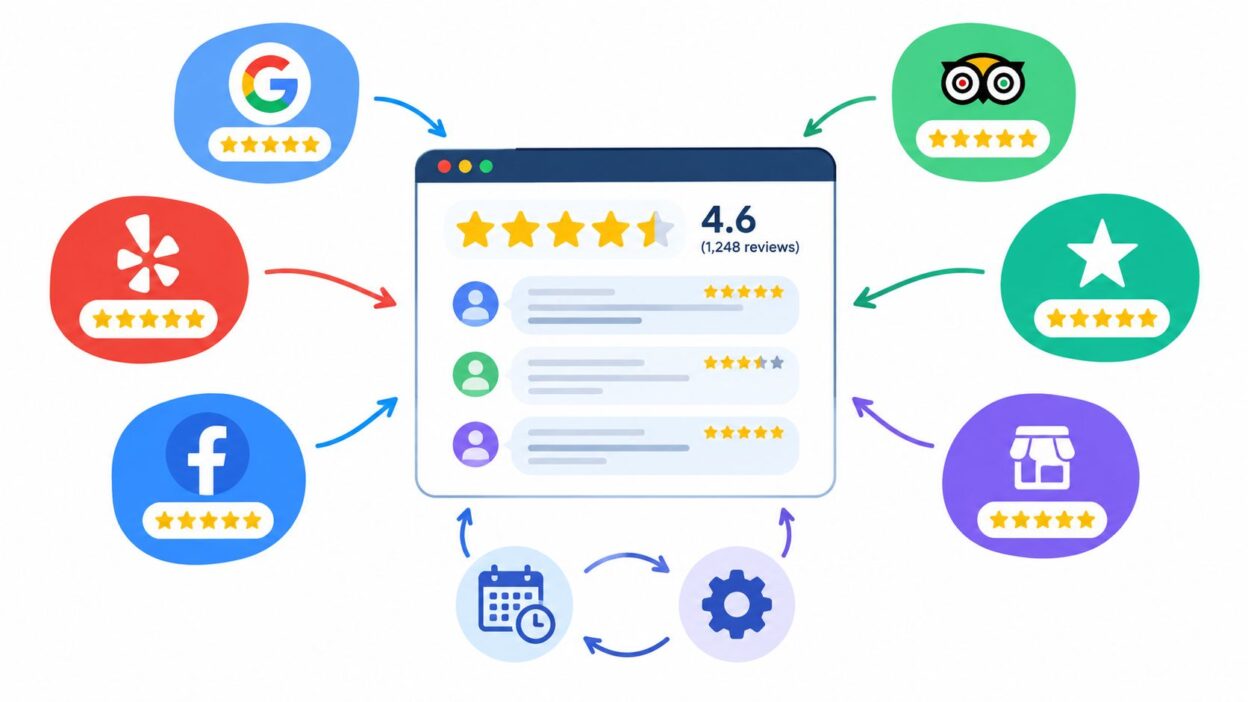
Looking for a Shorter Overview?
AI Summary
Key Moments
Source Inventory Importance
Listing and evaluating all review sources prevents noise and focuses on trustworthy, high-volume channels.Tailored Auto-Sync Cadence
Setting different refresh rates by source optimizes data freshness without overloading systems.Conflict Resolution Rules
Establishing clear handling for duplicates, edits, deletions, and rating drifts maintains testimonial integrity.Governance to Maintain Trust
Active oversight and removal SLAs ensure reviews remain credible and relevant for buyers.You know the moment. The homepage still shows a glowing quote from a customer who churned months ago, the review badge in the footer points to a score that no longer reflects reality, and a prospect is the first person to notice. At that point, the problem isn't design, it's sync reviews discipline. If your displayed testimonials drift away from current source data, the brand story on the site stops matching what buyers can verify, and that gap becomes a sales problem, a trust problem, and sometimes a compliance problem.
The fastest way out is not “turn on auto-sync” and hope for the best. The operational fix starts with source selection, then moves into cadence, conflict rules, webhook timing, and governance. That's the difference between a review widget that looks fresh and a review system that behaves like part of your reputation operations.
The Moment Your Testimonials Stopped Matching Reality
A SaaS team I worked with had a polished homepage, a strong testimonial carousel, and a support lead who assumed everything was fine until a prospect screenshotted the page during a sales call. The quote in the hero was from a customer who had already churned, and the team didn't catch it because nobody owned the review pipeline end to end. That sort of mismatch is common when testimonials get treated like static assets instead of a live feed.

The fix begins with accepting that review content ages differently from most marketing copy. Buyers read online reviews as part of normal purchase behavior, and that habit has only hardened over time. Pew found in 2016 that 82% of U.S. adults at least sometimes read online customer ratings or reviews before buying something new, and 40% said they do it always or almost always, which is a useful baseline for why freshness became central to trust Pew Research Center survey summary.
Practical rule: If a testimonial can be contradicted by current source data, it no longer belongs in a high-visibility slot.
The operational antidote is simple in principle and messy in practice. You need to know which sources are authoritative, how often each source should refresh, how to handle duplicates or edits, and what happens when a review disappears from the upstream platform.
Inventorying Your Sources Before You Turn Anything On
Before a sync job runs, list every place reviews live. For many teams that means Google Business Profile, Trustpilot, G2, Capterra, Yelp, niche directories, in-product NPS exports, CSV imports, and even support tags that capture praise. The goal is not to connect everything immediately, it's to understand what each source contributes and where it creates noise.
What to record for each source
Track three things for every channel, connection method, monthly volume, and how much control customers have over their own text. That tells you whether the source is stable enough for automated display or whether it belongs in a later phase.
| Source | Avg Monthly Volume | Connection Method | Editable by Customer | Sync Priority |
|---|---|---|---|---|
| Google Business Profile | High | API or connected sync | Limited, platform-controlled | High |
| Trustpilot | High | API or connected sync | Platform-controlled | High |
| G2 | Medium | API or connected sync | Some edits possible | High |
| Capterra | Medium | API or connected sync | Some edits possible | High |
| Yelp | Variable | API availability depends on setup | Platform-controlled | Medium |
| Industry directories | Low to medium | API, export, or manual import | Varies by directory | Medium |
| NPS exports | Variable | CSV or internal export | Fully controlled by you | Phase two |
| Support ticket tags | Variable | Manual or internal integration | Fully controlled by you | Phase two |
A clean first pass usually means prioritizing the sources with steady volume and trustworthy metadata, then leaving low-volume channels for later. Anything under ten reviews a month often creates more noise than signal, especially if the text is short, repetitive, or heavily edited. That's where sync can create the illusion of breadth without adding much decision value.
Decision filter: If a source rarely changes, it doesn't need aggressive automation. If it changes often and buyers see it often, it does.
For teams that need a broader widget strategy, a practical integration map helps more than a generic list of platforms. A setup guide like Bragly's integration overview can be useful as a reference point when you're checking which sources you can connect cleanly and which ones need manual handling.
End the inventory phase by pulling the last 30 days of testimonials currently displayed on the site. Flag anything older than twelve months, and flag anything that's contradicted by newer source data. If a testimonial is both old and prominent, it deserves a human review before it stays public.
Setting Up Auto-Sync the Right Way
Auto-sync works best when it's configured per source, not flipped on globally. Google and Trustpilot can justify near-real-time handling when they're moving fast, while quieter sources can run on a slower schedule without harming credibility. The important part is matching refresh cadence to actual review velocity, not to internal enthusiasm for automation.
Cadence by source, not by opinion
High-velocity sources can be polled frequently or pushed through webhooks when available. Mid-volume directories usually work well on a slower interval, and low-volume sources can refresh overnight without hurting the user experience. That keeps your sync jobs from hammering every system at once and reduces the chance that a widget shows half-updated data.
Per-source override logic matters just as much as cadence. Set a minimum star threshold for public widgets if your policy requires it, choose a language filter if you operate in more than one market, and define a character-length cutoff so one-line reviews don't dominate the carousel. A deduplication window between 14 and 30 days is usually enough to keep repeat submissions from crowding out fresh input, especially when the same customer posts across more than one platform.
Practical rule: Stagger sync jobs so they don't all hit your widget cache at the same minute, and cap how many testimonials one source can occupy in a single widget.
That cap matters more than most teams expect. If one platform floods your feed, it can crowd out the diverse sentiment you want visitors to see. The widget should reflect a healthy source mix, not whichever platform happened to update most recently.
For the display layer, a no-code widget system like Bragly's testimonial widgets is useful when you need to control format without turning every change into a dev task. The point isn't the widget itself, it's the discipline behind it. A fast sync schedule with weak filters still produces stale-looking or misleading output.
Resolving Conflicts When Sources Disagree
Once you sync more than two sources, conflicts are normal. The hard part isn't detecting them, it's deciding which version wins without creating a brittle ruleset that breaks the moment a reviewer edits a comma. That's where a small reputation-ops team needs a decision matrix, not a clever algorithm.
The four conflict patterns that show up in production
Duplicates happen when the same review appears across more than one platform. Edited text shows up when a customer shortens or revises a quote after the first publish. Deleted reviews create another problem, because the source removes them but your widget still serves cached content. Rating drift appears when platforms recalculate scores or normalize data in different ways.
A workable rule set is usually straightforward. Pick a canonical source for star counts so the same review doesn't produce two different numerical truths. Use hash-based deduplication with a freshness window, and don't let identical text appear twice just because it came from two imports. If a review disappears upstream, mark it with a tombstone flag and suppress it for a short holding period instead of deleting it instantly. That keeps your cache stable while the system settles.
| Conflict Type | What Happens | Resolution Rule | Side Effect to Watch |
|---|---|---|---|
| Duplicate review | Same text appears on two platforms | Hash-based dedup with freshness window | A real cross-post can be hidden if matching is too strict |
| Edited text | Reviewer trims or revises wording | Keep newest version, retain source history | Old copy may linger in cached renders |
| Deleted review | Review disappears from source but remains public | Tombstone flag, then suppress after review period | Public widget can lag if logs aren't checked |
| Rating drift | Platform recalculates a score | Canonical-source priority for star values | Cross-platform averages can look inconsistent |
I also like to pair conflict rules with an authenticity check before anything goes live. A fake review checker can be part of that review, especially when imported content comes from multiple channels and the source mix gets messy. That doesn't replace human judgment, it just reduces the chance that a suspicious item sneaks into a high-trust placement.
Using Webhooks to Make Sync Actionable
Webhooks turn review sync from a passive pull into an operational signal. A new review shouldn't just land in a database, it should trigger the right response in the right place, and only once. That means the payload has to be clean, the retry logic has to be sane, and the downstream action has to be worth the noise.
Here's the shape that matters. The event should include an event type such as review.created, review.updated, or review.deleted, the source platform, the review body, the star rating, the author handle, and a timestamp. Keep the payload focused on the fields the downstream system needs, because bloated webhook objects become harder to troubleshoot when something fails.
Operational rule: Subscribe to events that change customer-facing truth, not every internal metric the vendor exposes.
That means new reviews, rating changes, removals, and response-posted events are usually useful. Raw pageview metrics and internal-only flags are not. A downstream stack should also handle retry behavior cleanly, with exponential backoff, dead-letter handling, and idempotency keys so one flaky delivery doesn't create duplicate alerts or duplicate testimonial records.
The useful integrations are the ones that change work. A Slack alert can fire only for negative new reviews, a CRM update can tag the contact record with the latest sentiment, and a ticketing handoff can open a support task when a review drops below three stars. For broader workflow design, the generic shape of the payload matters less than whether the action lands in front of the right owner fast enough.
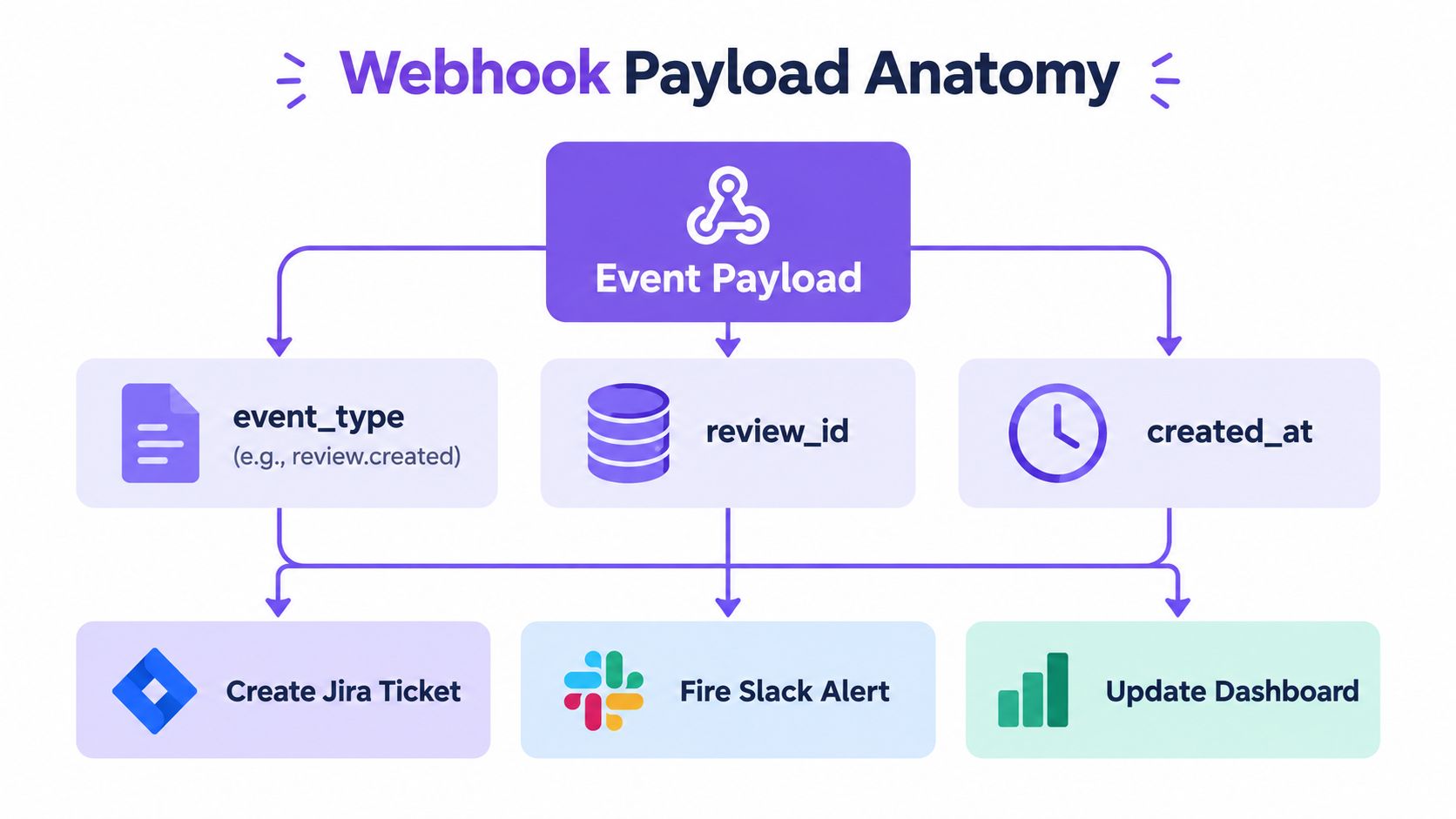
The simplest test is this. If a webhook fires and nobody needs to act, it's noise. If it fires and the right team sees a review before the prospect does, it's doing its job.
Governing Sync So Freshness Stays Trustworthy
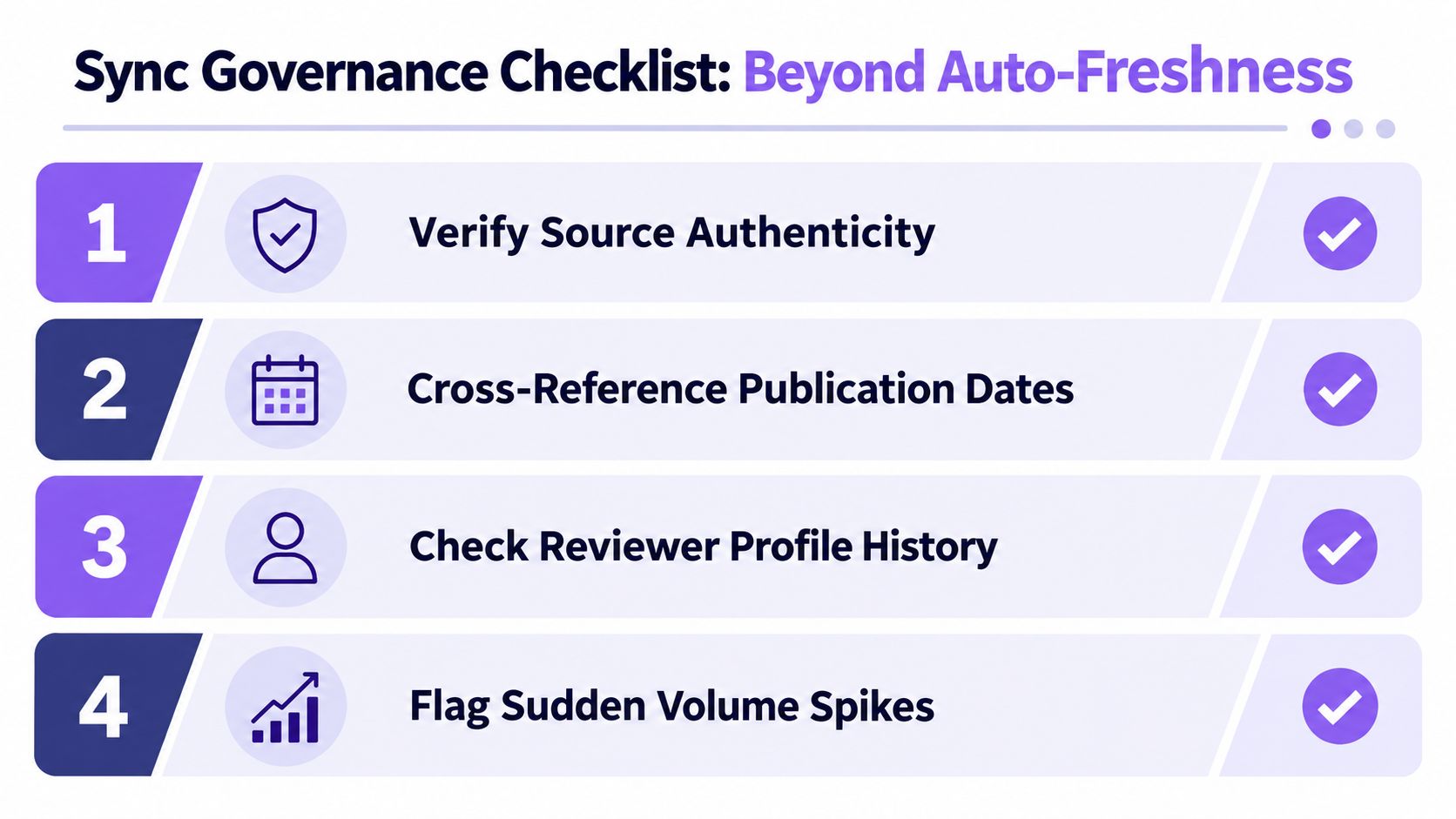
Auto-sync is a freshness strategy, not a trust strategy. Newer content can be more relevant, but newer does not automatically mean more credible, more representative, or more useful. If you only optimize for recency, you can accidentally make the widget feel volatile instead of reliable.
The governance layer should live above the widget. Cap any single platform so it never dominates the displayed mix, and use recency weighting to surface recent praise without erasing older testimonials that still reflect a stable customer experience. A stale-content audit should flag anything older than eighteen months for manual review, and a diversity check should keep one reviewer from appearing too often in the rotation.
Good governance is visible in the gaps, not just the fresh content.
Removal handling needs a hard SLA. If a source review is deleted, it should disappear from public widgets within 24 hours, not after the next quarterly cleanup. That one rule protects you when a product issue, policy shift, or legal complaint makes old content suddenly misleading.
The bigger question is what happens when automation starts hiding judgment. Recent consumer behavior makes the stakes obvious. ConsumerAffairs reported that 77% of Americans said online reviews are important when making purchasing decisions, one in three said they would not buy without reading reviews first, and 80.2% said reviews had influenced them not to purchase a product or service ConsumerAffairs analysis summarized by Starfish Reviews. If review visibility can push buyers away that easily, then the governance around what gets shown has to be deliberate.
Your Sync Reviews Runbook and What to Watch Next
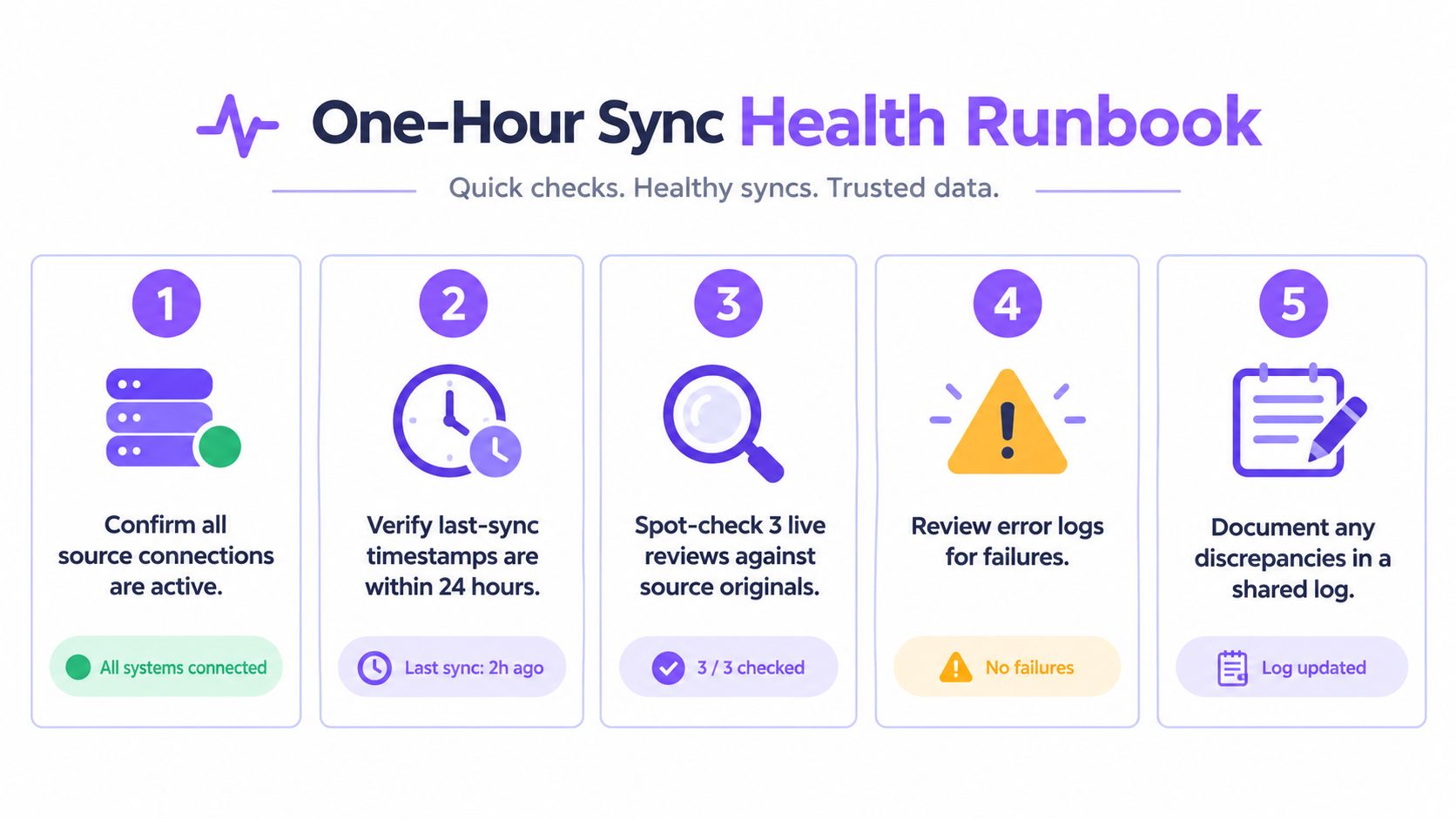
A small team can run a useful sync health check in under an hour. Confirm source connections are active, verify last-sync timestamps, spot-check three live reviews against the source originals, resolve any flagged conflicts, review webhook delivery logs, and audit source-mix weighting. That gives you a practical view of whether the system is healthy without turning the check into a project.
The next round of changes will mostly come from vendors and regulators, not from your widget. Expect tighter API rate limits, richer profile metadata, and more sources that are worth quoting in public. AI-generated review detection is also moving into mainstream tooling, which means provenance and labeling will matter more when you choose what to display.
The operational decisions that need revisiting are straightforward. Webhook retry policy may need to change if a vendor changes signing, display filters may need to adjust when regulation lands, and source governance gets harder once the team crosses roughly ten connected sources. That is where a spreadsheet stops being enough and a real workflow becomes necessary.
If you need a system that can pull testimonials from multiple sources, keep them synced, and give you a way to manage widgets without turning every update into manual work, take a look at Bragly. It's built for centralizing reviews, syncing connected sources, and publishing them in no-code widgets with enough control to support real review operations, not just a static badge on a homepage.