
Looking for a Shorter Overview?
AI Summary
Key Moments
Match tool to review workflow
Select an alternative based on what happens after a review arrives—proof display, routing tasks, appointments, local SEO, or agency reporting.Bragly for public review proof
Ideal for aggregating reviews from multiple platforms and turning them into website-visible customer proof.Birdeye’s enterprise multi-location scope
Best for large organizations needing a unified platform across reviews, listings, messaging, marketing automation, and reporting.Podium for fast lead response
Focused on converting customer inquiries into quick appointments using AI-assisted messaging workflows.ReviewTrackers makes sense when reviews need to reach location managers, experience analysts, and operations teams. It combines reputation work with feedback requests, response workflows, experience analysis, competitor insights, and local-listings options. That is a serious operating model for a brand with many locations.
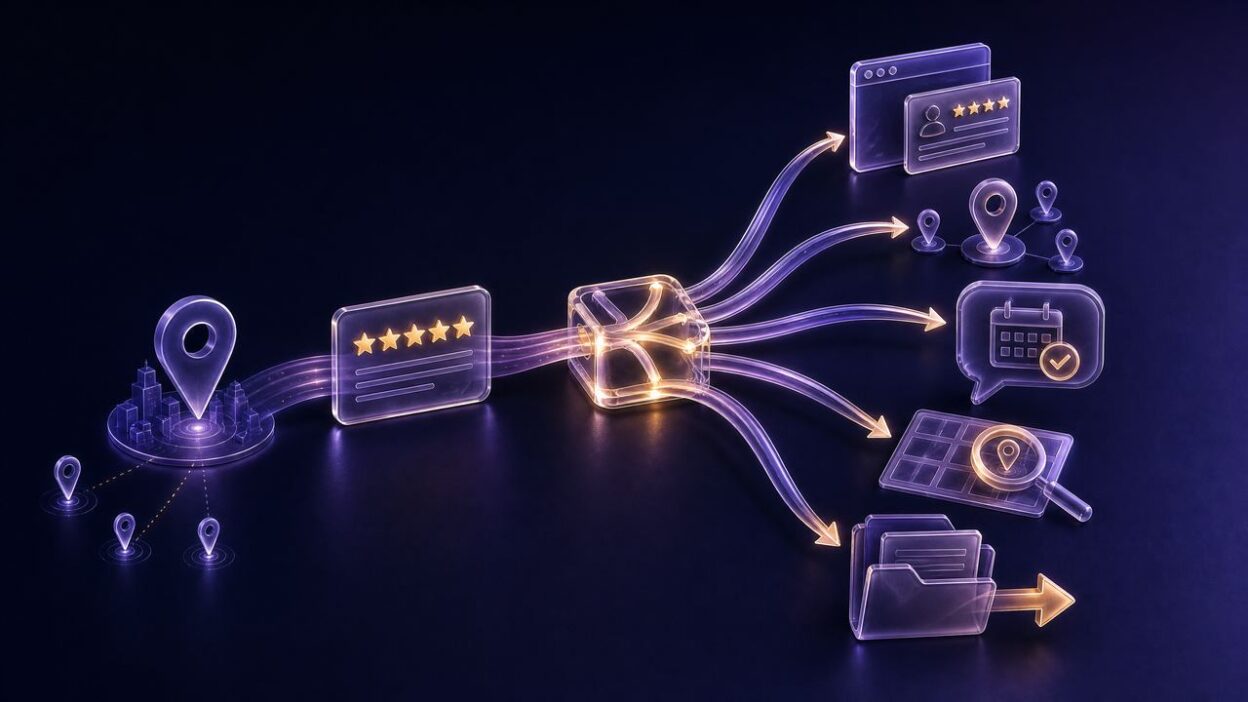
But the next step after a review arrives is not the same for every organization. Some teams need selected reviews on a website. Others need a faster reply to a new lead, a cleaner citation profile, or a white-label report for a client. Those needs create a more useful way to assess alternatives than a feature checklist alone.
I looked for tools that take distinct routes through that work. The list below includes Bragly for review aggregation and public proof, Birdeye for a broad multi-location program, Podium for lead response and booked appointments, BrightLocal for local SEO, and Grade.us for agency delivery. If you are also comparing broader platforms, this guide to review management software gives useful context on the category.

The goal is not to replace ReviewTrackers for the sake of it. It is to choose the product that matches where reviews, feedback, and customer conversations need to go in your own operation.
Quick comparison
| Tool | Best for | Core approach | Pricing posture | Choose it when |
|---|---|---|---|---|
| Bragly | Public review aggregation and website proof | Imports, collection, response support, and display | Free plan; Pro from $14/month | Reviews should become useful proof on your site without building a location-operations program. |
| Birdeye | Enterprise multi-location operations | Reviews, listings, messaging, surveys, insights, and reporting | Enterprise pricing | You need a broad system across a large footprint. |
| Podium | Conversations that become appointments | Lead response, qualification, booking, and re-engagement | Demo-led | Fast follow-up and booked work are the immediate business goal. |
| BrightLocal | Local SEO visibility | Rankings, listings, citations, reviews, and reporting | From $31/month | Search visibility and citation accuracy are the central jobs. |
| Grade.us | White-label agency delivery | Branded reporting, automation, and multi-client review management | Trial and public plans | You sell reputation management as a client service. |
Key takeaways
- Start with the operational handoff. Decide whether a review should become public proof, a routed task, an appointment, a local-search improvement, or a client deliverable.
- Choose Bragly for flexible proof. It is the strongest fit when public reviews live across platforms and need to become collection campaigns, response work, and website displays.
- Choose Birdeye for a wider enterprise suite. It fits organizations that want reviews alongside listings, messaging, surveys, social work, and reporting across locations.
- Choose Podium for response and booking. It is built around moving local customer conversations toward an answered question or confirmed appointment.
- Choose BrightLocal or Grade.us for a specialist job. BrightLocal is the local-search option, while Grade.us is the agency-delivery option.
1. Bragly
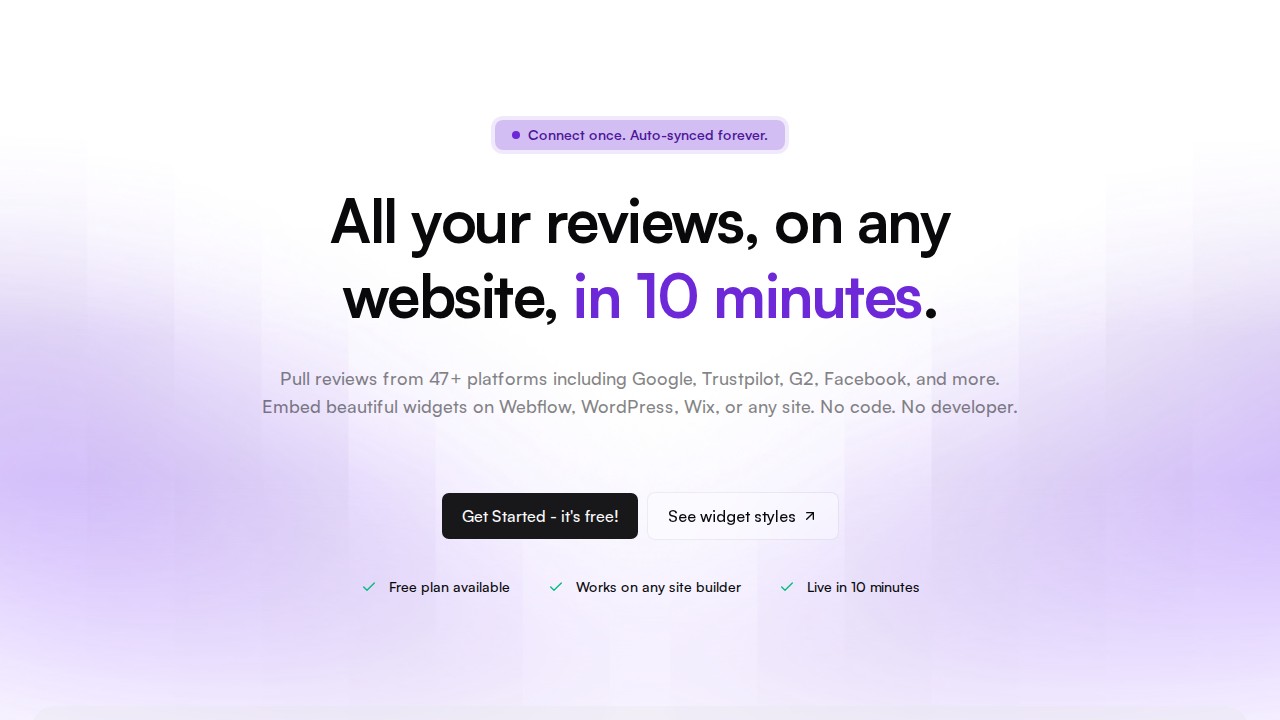
Bragly is the ReviewTrackers alternative I would start with when the main problem is scattered public proof. A service brand may have Google reviews, a SaaS team may have G2 feedback, an e-commerce company may have marketplace reviews, and an agency may need to present all of that work cleanly to a client. The useful question is not only where to monitor those reviews. It is how to turn the best of them into something customers can see and trust.
Bragly brings reviews from 47+ platforms into one workspace, then gives teams collection forms for text and video feedback, QR-code and email collection routes, AI response suggestions, moderation, and more than 30 website-display layouts. A free plan supports up to 100 reviews, while Pro begins at $14 per month. That makes it a practical choice for a team that does not need an enterprise location program just to collect and present proof.
The product is also useful when review ownership sits across several people. An agency can build a review system for a client and transfer the project later. A marketing team can filter reviews by source, rating, or theme before using them in a widget or Wall of Love page. If the hard part today is switching between sources, a single review dashboard can reduce that manual work.
| Where Bragly fits | What it gives you | Where ReviewTrackers may still fit better |
|---|---|---|
| Reviews from different public platforms need one home | Imports, collection forms, response support, moderation, and public displays | Your primary need is location-level routing, experience analysis, and a broader reputation program. |
| Your website needs visible proof | 30+ layouts, embeds, Wall of Love pages, custom domains, and flexible filtering | A website display is only a small part of a much larger location operation. |
| An agency is building proof systems for clients | Team access, client project transfer, and flexible embeds | You need enterprise reporting and governance for a large corporate footprint. |
Bragly is not a replacement for every location-operations workflow. It is a better match when the review program needs to produce visible proof, not only monitoring data. If that is your goal, look at testimonial widgets and the practical choices in this guide to displaying reviews on a website.
2. Birdeye
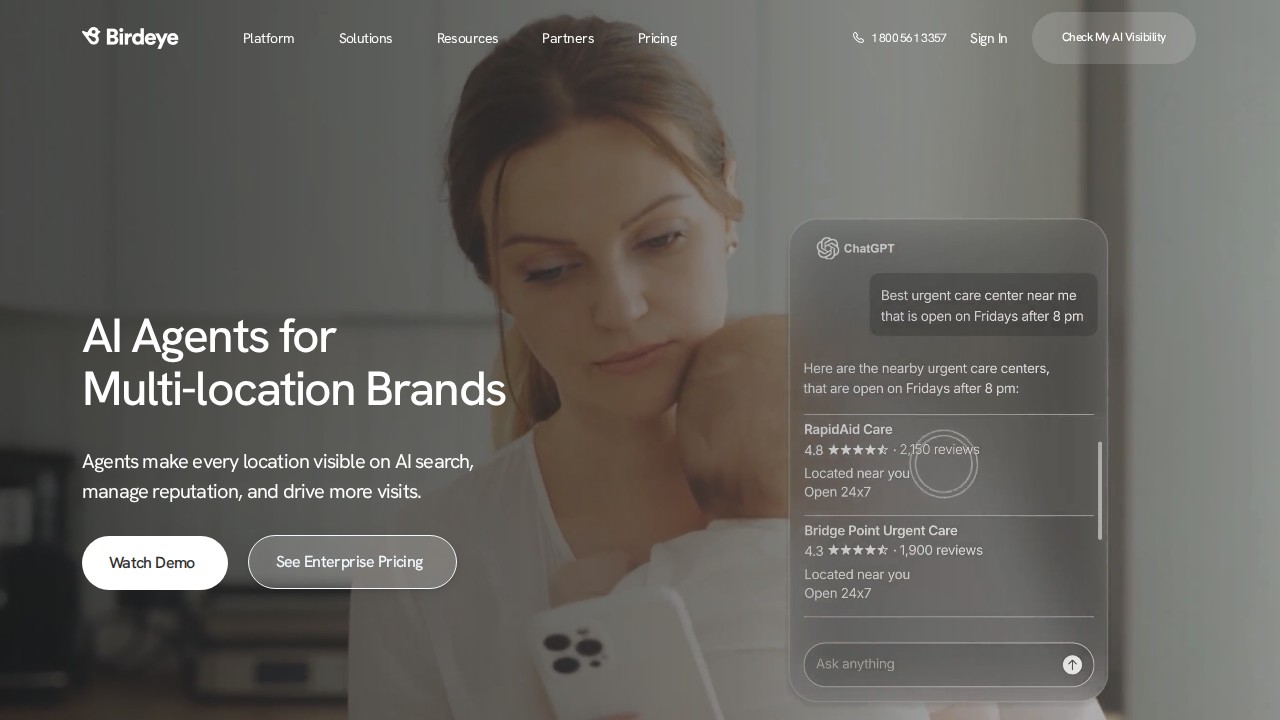
Birdeye is the stronger alternative when ReviewTrackers feels too narrow for a large multi-location organization. Its current platform extends past review management into listings, social publishing, search visibility, marketing automation, messaging, surveys, insights, reporting, and ticketing. That scope can make sense for brands that want one system across marketing, operations, and customer experience.
This is not a lighter version of ReviewTrackers. It is a wider enterprise suite. A healthcare group, restaurant chain, property operator, or retail brand may need location-level data, industry integrations, central standards, and different tools for teams in marketing, customer experience, and operations. Birdeye is built for that kind of complexity.
The trade-off is that a broad suite asks for a broader buying decision. If your only current goal is to show imported reviews on a website or run a simple collection flow, you may not need its larger set of modules. It makes more sense when several connected workflows already matter.
| Where Birdeye fits | What it gives you | Where ReviewTrackers may still fit better |
|---|---|---|
| A large footprint needs one multi-location platform | Reviews, listings, social, messaging, surveys, marketing, insights, reports, and ticketing | You want a reputation and experience program without adopting a wider operating suite. |
| Several departments need shared location data | Industry-specific integrations and tools for marketing, operations, and customer experience | Your team needs a more focused review-monitoring and feedback-analysis setup. |
| Corporate governance matters as much as public proof | Centralized workflows across locations | Your work does not justify a full enterprise platform. |
Choose Birdeye when the review program is part of a larger location technology stack. Choose a more focused tool when the review workflow itself is the problem you need to solve.
3. Podium
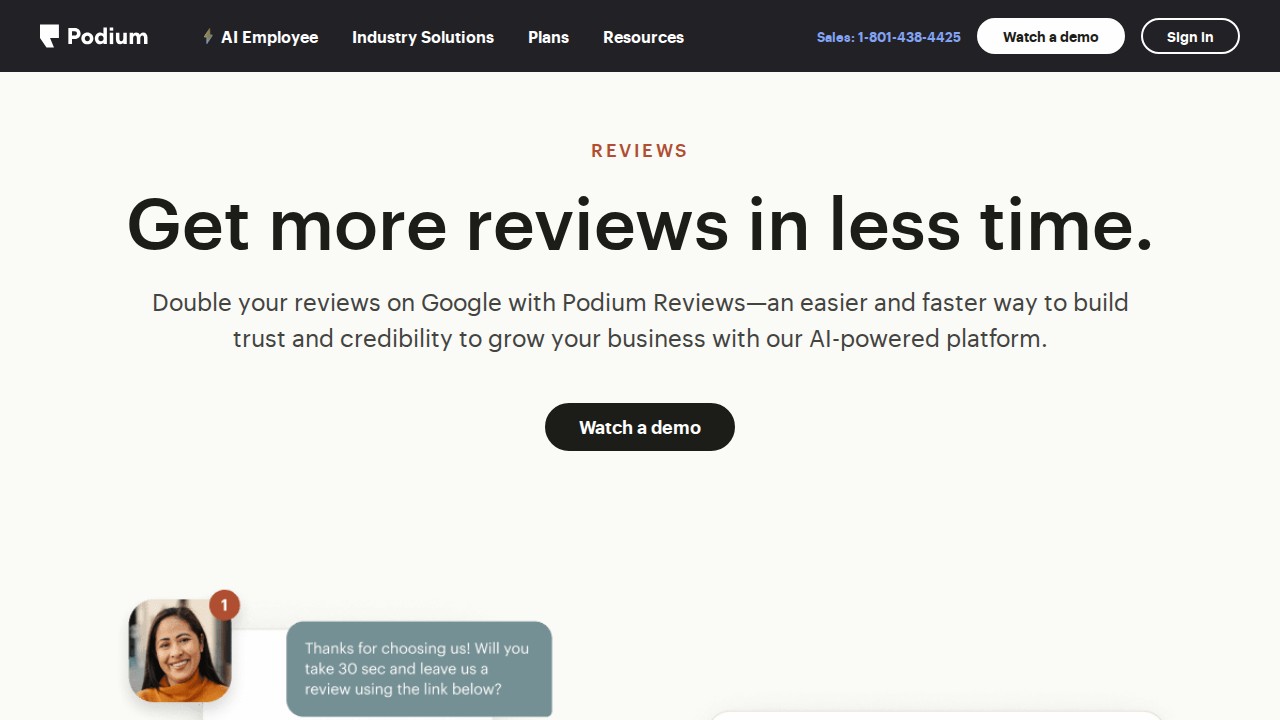
Podium takes a different route. It is aimed at local businesses and operators that want customer inquiries to turn into timely conversations and booked appointments. Its current positioning centers on an AI Employee that responds to leads, qualifies interest, books appointments, confirms details, and re-engages past customers.
That focus matters because a new review and a new lead do not create the same task. ReviewTrackers is useful when a review should become a routed issue, a response, an insight, or a reputation signal. Podium is more useful when a text message, web inquiry, or missed call needs an immediate answer before the prospect contacts a competitor.
This makes Podium a natural option for home services, automotive, aesthetics, retail, and other local operations where speed to response changes the outcome. It is not the first product I would choose simply to unify public reviews and display them on a website.
| Where Podium fits | What it gives you | Where ReviewTrackers may still fit better |
|---|---|---|
| Leads need a quick reply | AI-assisted response, qualification, appointment booking, and confirmation | Reviews and customer feedback need to be monitored and analyzed across locations. |
| Revenue depends on booked work | Conversation and follow-up workflows tied to local conversion | Your core metric is reputation and customer-experience performance. |
| Teams miss inquiries after hours | Continuous coverage for customer messages | You need more reporting depth around reviews, sentiment, and competitor activity. |
Podium wins when a local customer conversation is the scarce resource. ReviewTrackers wins when feedback across many locations is the operational signal you need to understand and act on.
4. BrightLocal
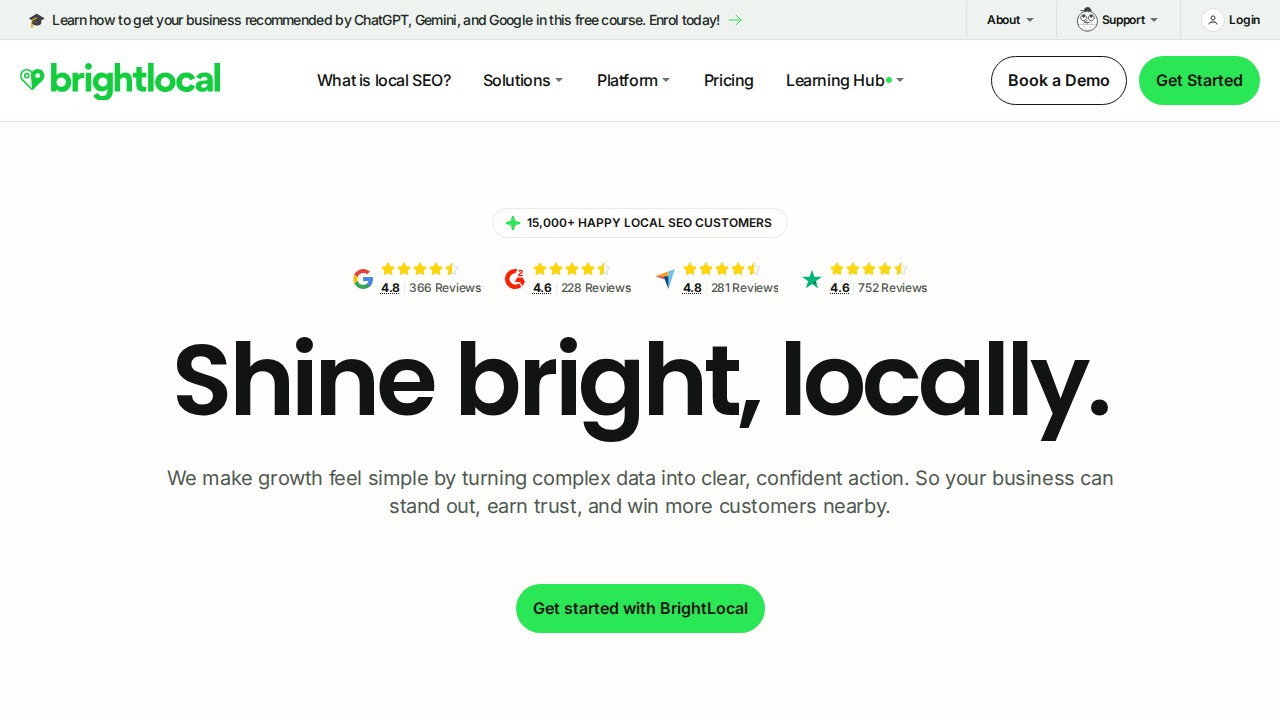
BrightLocal is the alternative for local-search work. It combines local rank tracking, listing management, citation building, review monitoring, reporting, and APIs for agencies and platforms. Its all-in-one platform starts at $31 per month, with citation work starting at $2 per citation, which gives buyers a visible starting point instead of a demo-only pricing conversation.
The distinction is simple. ReviewTrackers treats reviews and feedback as inputs to reputation, customer experience, and acquisition work. BrightLocal treats reviews as one part of local visibility alongside rankings, listings, citations, and search results. A marketer working on whether a location is discoverable in a map pack or whether its business data is accurate across directories may find that framing more useful.
BrightLocal can also work well for agencies that need local search reporting across clients. It is not built around converting customer messages into appointments, and it is not a dedicated public-proof system for a marketing website.
| Where BrightLocal fits | What it gives you | Where ReviewTrackers may still fit better |
|---|---|---|
| Local discovery is the first concern | Rankings, listings, citations, reviews, local SEO reporting, and APIs | You need customer-experience analytics and review routing across a location program. |
| Citation accuracy needs attention | Citation cleanup and building work | Listings are an add-on rather than the central workflow. |
| Agencies need local-search reporting | Client-oriented local SEO tools and visibility data | You are running a broader reputation and feedback operation for one brand. |
Pick BrightLocal when the question you ask most often is, “Can customers find this location in local search?” Pick ReviewTrackers when the question is, “What are customers saying, and who needs to act on it?”
5. Grade.us
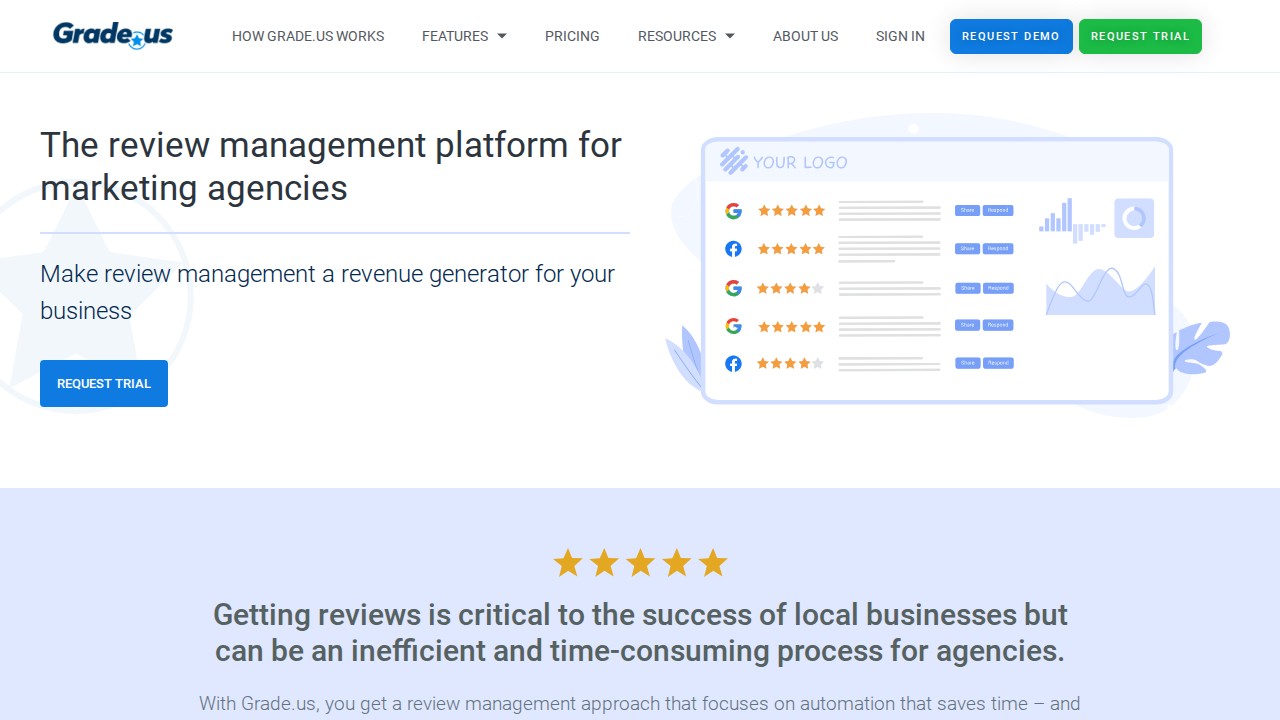
Grade.us is the agency-focused choice. It frames review management as a sellable service: agencies can organize multiple brands and locations, automate review work, create white-label reporting, customize the platform, and use a branded client experience. It also offers a 14-day trial.
That is a different buying case from a company choosing a platform for its own reputation program. An agency may need to onboard new accounts quickly, deliver regular reports under its own brand, and make review management part of a recurring client offer. Grade.us is built around that delivery model.
ReviewTrackers has white-label options, too, so this is not an either-or claim. Grade.us is worth considering when white-label agency delivery is the center of the decision rather than an add-on around a location-based enterprise plan. Bragly can also suit agencies that want a flexible way to collect and display proof, especially when they plan to transfer the completed project to a client. See how teams and agencies can use that model.
| Where Grade.us fits | What it gives you | Where ReviewTrackers may still fit better |
|---|---|---|
| Agencies sell review work to clients | White-label reporting, branding, automation, and multi-client organization | One corporate brand needs a deeper multi-location reputation operation. |
| Client onboarding must stay efficient | A client-delivery product built around agency workflows | Your team needs experience analysis and location-level program management. |
| Branded reporting is a core service | Customizable presentation under the agency brand | White label is only an occasional requirement. |
Choose Grade.us when your buyer is an agency owner asking how to package review management for clients. Choose ReviewTrackers when the buyer is leading a location-based reputation program inside one organization.
How to choose a ReviewTrackers alternative
The fastest way to make this decision is to write down the next required action after a review, feedback item, or customer message appears. Do not start with the longest feature list.
| If the next action is… | Start with… | Why |
|---|---|---|
| Put trustworthy reviews on a site, landing page, or testimonial hub | Bragly | It joins review aggregation, collection, and display in one flexible proof workflow. |
| Coordinate reviews, listings, surveys, messages, and reporting across a large footprint | Birdeye | Its scope is broad enough for a multi-location enterprise stack. |
| Respond to a prospect and get a booking | Podium | It is designed around fast lead engagement and appointment conversion. |
| Improve map visibility, citations, listings, and local rankings | BrightLocal | Its core job is local-search performance. |
| Deliver branded review management to multiple clients | Grade.us | Its product is shaped around white-label agency operations. |
Also look at what needs to be visible to customers. A reputation platform can help a team monitor feedback, but that does not automatically create a useful proof experience on the website. If you are trying to move from monitoring to conversion, put the review-display requirement in the buying brief from the start.
Finally, ask who owns the workflow. A location operations leader, local SEO specialist, agency account manager, and conversion-focused marketer will each value different outputs. That ownership question often explains why a well-regarded product still feels wrong after implementation.
Final thoughts
ReviewTrackers remains a good choice for location-based reputation and experience work. The alternatives above are not a ranking from weak to strong. They are different operating models.
Bragly is the practical choice when reviews from many platforms need to become visible proof and usable customer stories. Birdeye suits a wider multi-location platform decision. Podium suits a lead-response problem. BrightLocal suits local-search work. Grade.us suits agency delivery.
Before booking another demo, map the handoff that matters most in your business. If the answer is “make trusted customer voices visible where people decide,” start with a review proof workflow and consider AI-assisted review responses where faster, consistent follow-up would help.
Frequently asked questions
What is the best ReviewTrackers alternative for public review displays?
Bragly is a strong fit when you need to import public reviews, collect new customer feedback, filter the strongest proof, and show it in website widgets or a dedicated testimonial page. ReviewTrackers is more focused on a location-based reputation program, while Bragly is designed to make customer proof visible in marketing and sales journeys.
Is Birdeye better than ReviewTrackers for multi-location businesses?
Birdeye can be the better fit when a multi-location business wants reviews, listings, messaging, surveys, social work, marketing automation, insights, and reporting in one larger platform. ReviewTrackers can be a better fit when reputation management and experience analysis are the main jobs rather than a wider suite.
Should a local service business choose Podium or ReviewTrackers?
Choose Podium if the immediate need is responding to inquiries and converting them into booked appointments. Choose ReviewTrackers if reviews, feedback trends, reputation, and location-level performance need ongoing monitoring and action.
Is BrightLocal a review-management tool?
BrightLocal includes review monitoring, but its central purpose is local SEO. It is a better fit when rank tracking, listings, citation consistency, and local visibility are as important as review work.
Which ReviewTrackers alternative is best for agencies?
Grade.us is purpose-built for white-label agency delivery, reporting, automation, and organization across client accounts. Bragly is another option for agencies that need to build review-collection and proof-display systems, particularly when they want to hand completed projects over to clients.