

Looking for a Shorter Overview?
AI Summary
Key Moments
Identify Where Your Customer Proof Originates
Starting with the source of your reviews or testimonials helps select the right review management tool.Bragly for Aggregating Public Reviews
Bragly excels at importing reviews from over 47 platforms and managing them with powerful display and moderation tools.EmbedSocial for Mixed Social and Review Content
EmbedSocial uniquely combines review widgets with social media feeds to showcase visual proof alongside reviews.Trustmary and Senja for Feedback and Testimonial Collection
Choose Trustmary if starting from surveys and feedback, or Senja if building up customer story testimonials including video.Trustindex is a sensible choice when you want public reviews in one place and on your website in a polished format. Its review sources, display options, collection tools, and social-feed features cover a lot of ground. If reviews already live across Google, Facebook, Trustpilot, marketplaces, or industry sites, that breadth can make the first widget easier to launch.
The harder question comes after that first widget is live. Some teams need public reviews from more types of sources and a place to moderate new text or video proof. Others need reviews and Instagram content in the same page section. A customer-success group may care more about survey responses and NPS than layouts. A creator or SaaS founder may want customer stories that can become a Wall of Love, a case study, or a short social clip.
I compared five Trustindex alternatives with that decision in mind. Bragly is my first pick for teams turning public reviews and new customer proof into website assets. EmbedSocial is for review and social-content displays together. Trustmary is for feedback-led review work. Senja is for testimonial collection and reuse. Elfsight is for a review widget inside a wider website-widget toolkit.


Quick comparison
| Tool | Best for | Core approach | Pricing posture | Choose it when |
|---|---|---|---|---|
| Bragly | Public reviews plus new proof on your own site | Imports, collection forms, moderation, AI-assisted review work, filtering, and display | Free plan; Pro from $14/month | Reviews already exist across public platforms and need to become useful proof across your website. |
| EmbedSocial | Review widgets and social-content displays | Social-feed aggregation, review widgets, moderation, and visual content widgets | Free plan; paid from €24/month billed yearly | Google reviews, Instagram, TikTok, or other social posts need to appear together. |
| Trustmary | Surveys, feedback, reviews, testimonials, and widgets | Feedback collection, review requests, imports, NPS or CSAT, and display | Free widget allowance; paid options | Customer feedback should lead into review and testimonial work. |
| Senja | Text and video testimonial collection and reuse | Forms, imports, testimonial library, Walls of Love, widgets, case studies, and social assets | Free tier; Starter from $29/month | Customer stories are the main proof source, not only public-review profiles. |
| Elfsight | A Google-review widget inside a wider widget stack | No-code Google reviews and other website apps | Free plan; single-app paid plans from $4/month billed yearly | The review widget is one part of a larger collection of website tools. |
Key takeaways
- Start with the origin of your proof. Public reviews, social posts, survey feedback, customer stories, and a single on-page widget create different requirements.
- Choose Bragly for public proof that needs a home. It brings reviews from 47+ platforms together with fresh text or video collection and flexible website display.
- Choose EmbedSocial when social content belongs beside reviews. It is built around visual review and feed displays rather than a review-only workspace.
- Choose Trustmary or Senja when the workflow starts before the review exists. Trustmary begins with feedback and surveys, while Senja puts testimonial collection and reuse first.
- Choose Elfsight for a broader widget catalog. It makes the most sense when Google reviews are one of several website utilities you want to manage.
1. Bragly
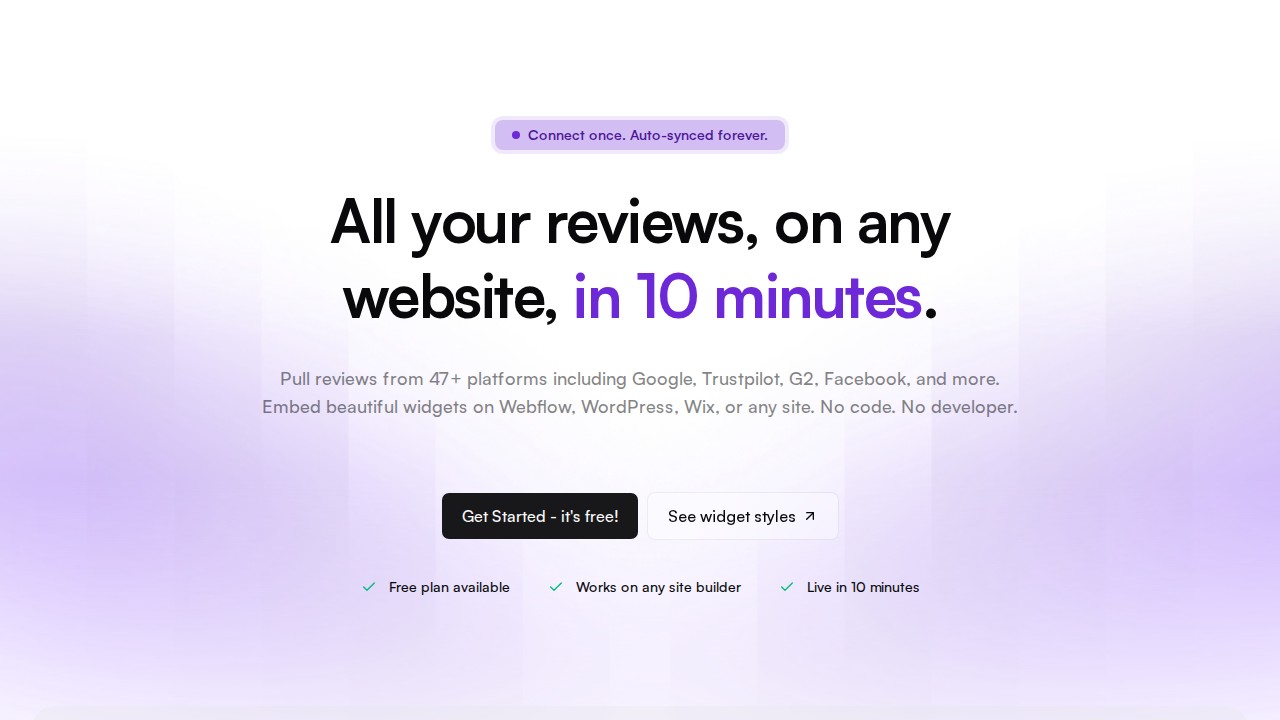
Bragly is the Trustindex alternative I would start with when public reviews are already scattered across the places customers use to research you. A SaaS company may have G2 and Capterra feedback. A travel or hospitality brand may have Booking, Expedia, or Tripadvisor reviews. An e-commerce company may need Amazon, Etsy, Shopify, and Trustpilot proof in the same library. Agencies may need to set up proof for several clients without rebuilding every page by hand.
Bragly connects with 47+ review platforms and gives teams text and video collection forms, moderation, tags, analytics, AI-assisted review responses, Wall of Love pages, and more than 30 display layouts. The free plan supports up to 100 reviews, and Pro starts at $14 per month. Teams can combine imported proof with new customer stories and use the right proof on the right page.
Both platforms have widgets. The difference is where daily work happens after reviews arrive. Bragly gives you one workspace to organize proof by source, rating, keyword, or tag, then create a different display for a homepage, pricing page, product page, or full testimonials page. You can also add a testimonial widget wherever your site supports HTML.
| Where Bragly fits | What it gives you | Where Trustindex may still fit better |
|---|---|---|
| Reviews are spread across public platforms | Imports from 47+ sources, filtering, tags, moderation, and website displays | You want one of Trustindex’s many preset widget or social-feed configurations without changing the rest of your process. |
| A website needs proof that matches each page | 30+ widget layouts, source filters, rating filters, keyword filters, and Wall of Love pages | You only need a narrow, established review-widget setup for one public source. |
| Teams or agencies deliver proof for clients | Collaborator access and teams and agency workflows, including project handoff | Your work is organized primarily around Trustindex domains under an annual plan. |
Bragly also works well when the review library needs attention after import. You can collect new text or video proof, approve what appears on the site, and draft consistent replies with AI-assisted review responses. For broader category context, see review management software, a single review dashboard, and displaying reviews on a website.
2. EmbedSocial

EmbedSocial is the more natural option when the visual material around your reviews matters as much as the reviews themselves. Trustindex has social-feed widgets, but EmbedSocial builds its plans around social media aggregation and the website displays that come from it. Google reviews can sit beside Instagram, TikTok, YouTube, Facebook, LinkedIn, or other social content instead of being a separate proof project.
That is useful when your brand’s evidence is mixed. A restaurant may want customer photos and a review widget on the same landing page. A retailer may need shoppable social content near a product collection. A service company may want Google review proof and recent social posts in one visual system.
EmbedSocial’s free plan is limited to one source and 500 monthly views. Its paid plans start at €24 per month when billed yearly, with more sources, views, and faster update intervals. Check the view allowance before choosing it for a high-traffic site.
| Where EmbedSocial fits | What it gives you | Where Trustindex may still fit better |
|---|---|---|
| Reviews and social posts need to work together | Widgets for reviews and social feeds, visual-content moderation, and social platform coverage | Your priority is broad public-review aggregation rather than a social-content presentation layer. |
| A retail or marketing page needs visual proof | Instagram, TikTok, YouTube, Facebook, and review-display options in one account | You want Trustindex’s review-management features, certificates, or trustmarks more than social widgets. |
| You can plan around view limits | A clearly metered source and view model across tiers | You prefer annual domain-based pricing with unlimited widget views. |
Choose EmbedSocial when you want the proof section of your site to look like a living mix of customer reviews and customer content. If the goal is instead to manage many kinds of public reviews, gather new proof, and show selected reviews across an entire site, Bragly is the closer fit.
3. Trustmary

Trustmary is the Trustindex alternative to consider when the process begins before a customer leaves a public review. It places surveys, NPS or CSAT, feedback forms, review requests, imports, testimonials, and widgets in one feedback program. That matters for teams that want to learn from customer feedback, guide a satisfied respondent toward a public review, and show selected proof on a website.
For example, a multi-location service team may send a post-service survey, identify happy customers, ask them for a review, and keep the response data for follow-up. A B2B company may collect feedback after onboarding and turn a strong reply into a testimonial. The widget is an output, not the starting point.
Trustmary offers a free review-widget allowance based on monthly views. Its Trustindex comparison page lists paid options from $19 to $129 per month, although plans and limits can change. Review the live price page and view allowance before buying. Its deeper feedback workflow can add more moving parts than a team needs when it only wants public reviews displayed quickly.
| Where Trustmary fits | What it gives you | Where Trustindex may still fit better |
|---|---|---|
| Feedback should lead into review or testimonial collection | Survey forms, NPS or CSAT, review requests, imports, and display options | You already have the public reviews and mainly need aggregation and widget display. |
| Customer experience data matters to operations | A feedback-to-proof process rather than a display-first tool | You do not need survey responses or feedback analysis in the review workflow. |
| Several request routes are useful | Link, QR code, email, SMS in Europe, and embedded form options | You want Trustindex’s source breadth and widget customizations without a survey program. |
Trustmary is a better fit when review management starts with the customer experience itself. Trustindex remains a sensible choice when the strongest asset is the public proof your company has already earned and the immediate job is bringing it onto a website.
4. Senja

Senja is the choice for teams whose best proof comes from customer stories rather than public-review profiles. It collects text and video testimonials through forms, imports proof from other channels, sorts the material in a testimonial library, and turns selected stories into widgets, Walls of Love, social assets, and case-study material.
That makes it useful for SaaS companies, agencies, consultants, course businesses, communities, and brands that can ask customers for a fuller account of their experience. A public Google review might be a sentence or two. A testimonial can explain the problem, the result, and what changed.
Senja’s free tier includes up to 15 text and video testimonials. Its Starter plan begins at $29 per month and adds unlimited testimonials, branding controls, custom domains, HD video exports, and automation options. The main choice is between public-review aggregation across many sources and a system for asking customers to tell a useful story.
| Where Senja fits | What it gives you | Where Trustindex may still fit better |
|---|---|---|
| You need original text and video testimonials | Collection forms, video handling, invites, follow-up, and a curated testimonial library | Public review profiles are the main source of proof. |
| A marketing team needs many ways to reuse stories | Widgets, Walls of Love, images, social clips, and case-study creation | You want a review-management tool with a wider set of public-source connections. |
| Customer proof needs context | Tags, search, testimonial analysis, and exports | Your immediate job is a review widget rather than a fuller customer-story process. |
Choose Senja when the best next move is asking a customer for a quote or video and putting that response to work across your marketing. Choose Trustindex or Bragly when most of the proof is already public and needs to be gathered into a dependable website library.
5. Elfsight

Elfsight is a good alternative when a Google Reviews widget is only one item on a longer website to-do list. Its Google Reviews app connects a business profile to a no-code widget, lets you control layout and review filtering, and adds a review-request call to action. Beyond that single product, Elfsight has a broad app collection for chat, forms, feeds, notification bars, calendars, and other on-site functions.
That toolkit approach helps a marketer or site owner who would rather manage multiple website utilities in one service. A company refreshing a Webflow or WordPress site may want reviews, an Instagram feed, a form, and chat in the same account. It is a weaker match when the next requirement is a public-review workspace with many sources, collection forms, review response work, and dedicated proof management.
Elfsight’s free tier includes one widget and 200 monthly views. Its single-app Basic plan is listed from $4 per month when billed yearly, and the broader app pack uses separate limits. Check expected traffic and whether the review widget will appear on several pages.
| Where Elfsight fits | What it gives you | Where Trustindex may still fit better |
|---|---|---|
| Google reviews are one site feature among many | A review widget alongside a large catalog of no-code website apps | Reviews, reputation activity, and public-review sources are a major operating priority. |
| You want a quick widget for a business profile | Google connection, review filtering, display layouts, and review-request prompts | You need Trustindex’s broader review-platform aggregation. |
| Your team accepts a view-based plan | Low entry price for a focused single widget | You want unlimited widget views under an annual review-management plan. |
Elfsight is a practical website-tool decision. Trustindex is a more review-focused decision. The right choice depends on whether reviews are the system you are buying or one useful block inside a bigger website build.
How to choose a Trustindex alternative
Start with the first place your proof appears. A public-review source, a customer survey, a testimonial request, an Instagram post, and a website widget requirement may all end with reviews on a page, but they do not need the same software.
| If proof begins with… | Start with… | Why |
|---|---|---|
| Public reviews across Google, Trustpilot, G2, marketplaces, or industry sites | Bragly | It brings existing proof into one workspace and adds new collection, moderation, filtering, and website display. |
| Customer reviews plus photos, short videos, and social posts | EmbedSocial | It puts reviews and social-content widgets in the same visual system. |
| Survey answers or customer-experience feedback | Trustmary | It is built to turn feedback into review, testimonial, and website work. |
| A customer story you want to collect and reuse | Senja | It focuses on text and video testimonials, curation, and content reuse. |
| One Google-review widget inside a wider site build | Elfsight | It treats the review widget as one app in a broad website toolkit. |
Then check how a plan measures usage. Trustindex’s paid tiers are organized around domains. EmbedSocial and Elfsight use view allowances. Trustmary also uses widget views in its free offering. Bragly’s pricing is based on plan features and review limits, while Senja differentiates plans by testimonial and workflow access. Choose the model that matches the sites, sources, page loads, forms, reviews, and collaborators you expect to have after the first few months.
Finally, think about ownership and day-to-day work. An agency may need to prepare a client proof library and hand it off. A SaaS team may need G2 review proof in a pricing section and a customer story in a campaign. Pick the platform that makes the next normal task easier, not the one with the longest feature list.
Final thoughts
Trustindex remains a good option for teams that want public reviews aggregated and displayed with plenty of widget choices. Moving to another platform makes sense when the source of your proof or the work that follows it has changed.
Bragly is the first option to consider when public reviews need to become a managed, filtered, display-ready proof library across a website. EmbedSocial is for review and social-content display. Trustmary is for feedback and surveys that should create proof. Senja is for customer stories. Elfsight is for a review widget inside a wider website-tool stack.
Before you choose, write down where your strongest customer proof is today and where you want it to appear next. That one sentence will narrow this list faster than a long feature checklist.
Frequently asked questions
What is the best Trustindex alternative for public reviews?
Bragly is a strong fit when customer proof already lives across Google, Trustpilot, G2, Facebook, marketplaces, and other sources. It brings those reviews into one workspace, supports new text and video collection, and gives teams many ways to show proof on their website.
Does Trustindex have a free plan?
Trustindex documents a free WordPress-plugin option for one review source and a permanent widget. Its registered free package provides a time-limited paid-feature trial, after which website widgets do not continue displaying unless a paid plan is chosen. Check its current documentation before setting up a live widget.
Which Trustindex alternative is best for surveys and review requests?
Trustmary is the closer fit when surveys, NPS or CSAT, feedback forms, review requests, testimonials, and widgets need to work together. It is useful when customer feedback is part of the process, not only a source of public proof to import later.
Is Senja better than Trustindex for video testimonials?
Senja is usually the closer fit for teams that want to collect, organize, display, and reuse text and video customer stories. Trustindex has review collection and display functions, but Senja is organized around testimonial forms, video, Walls of Love, and customer-story reuse.
Is Elfsight a review-management platform?
Elfsight provides Google Reviews and All-in-One Reviews widgets, but its wider purpose is a large collection of website apps. It is a better option when your review widget is one part of a broader site toolkit. Teams that need a dedicated review workspace should compare it with Bragly or Trustindex first.