Looking for a Shorter Overview?
AI Summary
Key Moments
Google’s shrinking review share and rise of AI
Google’s share dropped from 83% to 71%, while AI tools usage jumped from 6% to 45% for local recommendations.Consumers demand recent and numerous reviews
73% of consumers only trust reviews from the past month and read an average of 10 before trusting a business.Star ratings strongly influence revenue and rankings
A one-star increase can boost revenue 5-9%, and 4.5 stars minimum is needed to compete effectively.Responding to reviews drives revenue and trust
Businesses responding to reviews earn up to 18% more revenue and gain better customer trust and local ranking signals.Most business owners know reviews matter. But knowing how much they matter, and where the numbers are actually moving, is a different thing. The data from 2026 is sharper than it’s ever been. Consumer habits have shifted. Google’s grip on the review market is loosening. And the gap between businesses that treat reviews as a system and those that don’t is getting harder to close.
This article covers the most important Google review statistics for 2026, organized by what they mean for your business. Not a raw dump of numbers. Each section ends with a direct takeaway you can use.
Key Takeaways
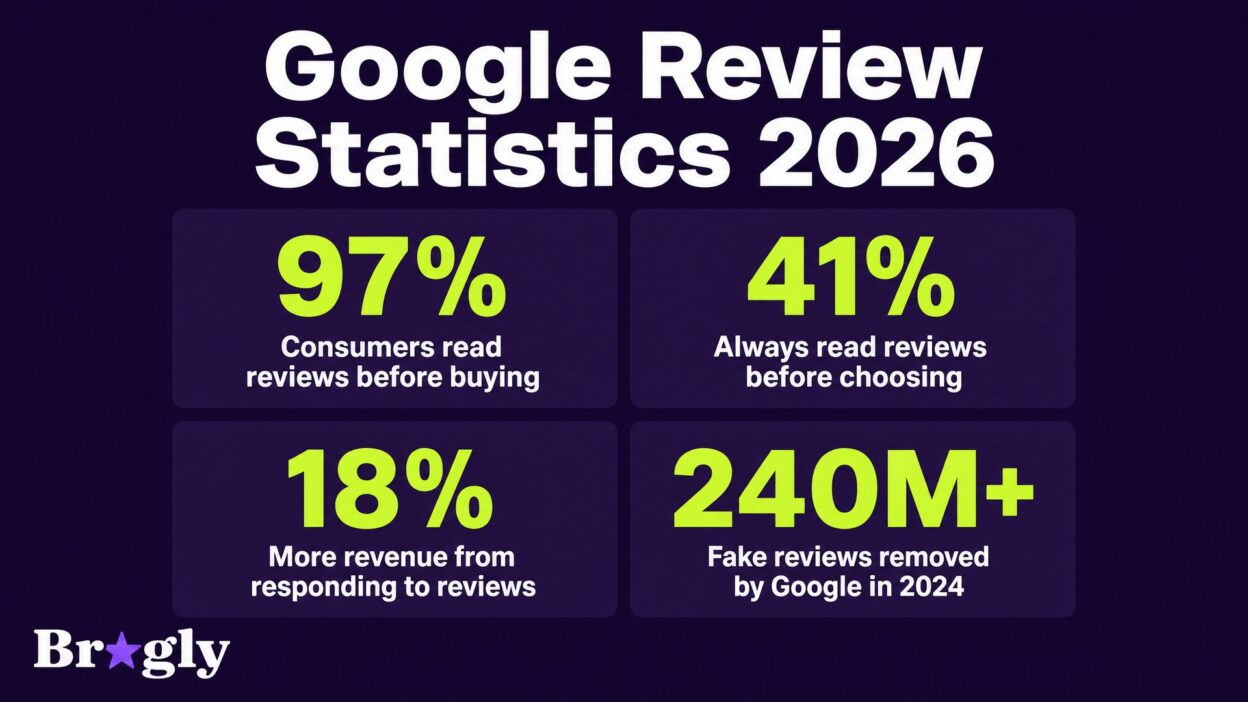
- 97% of consumers read reviews before choosing a local business in 2026
- 41% of consumers now “always” read reviews when browsing, up from 29% in 2025
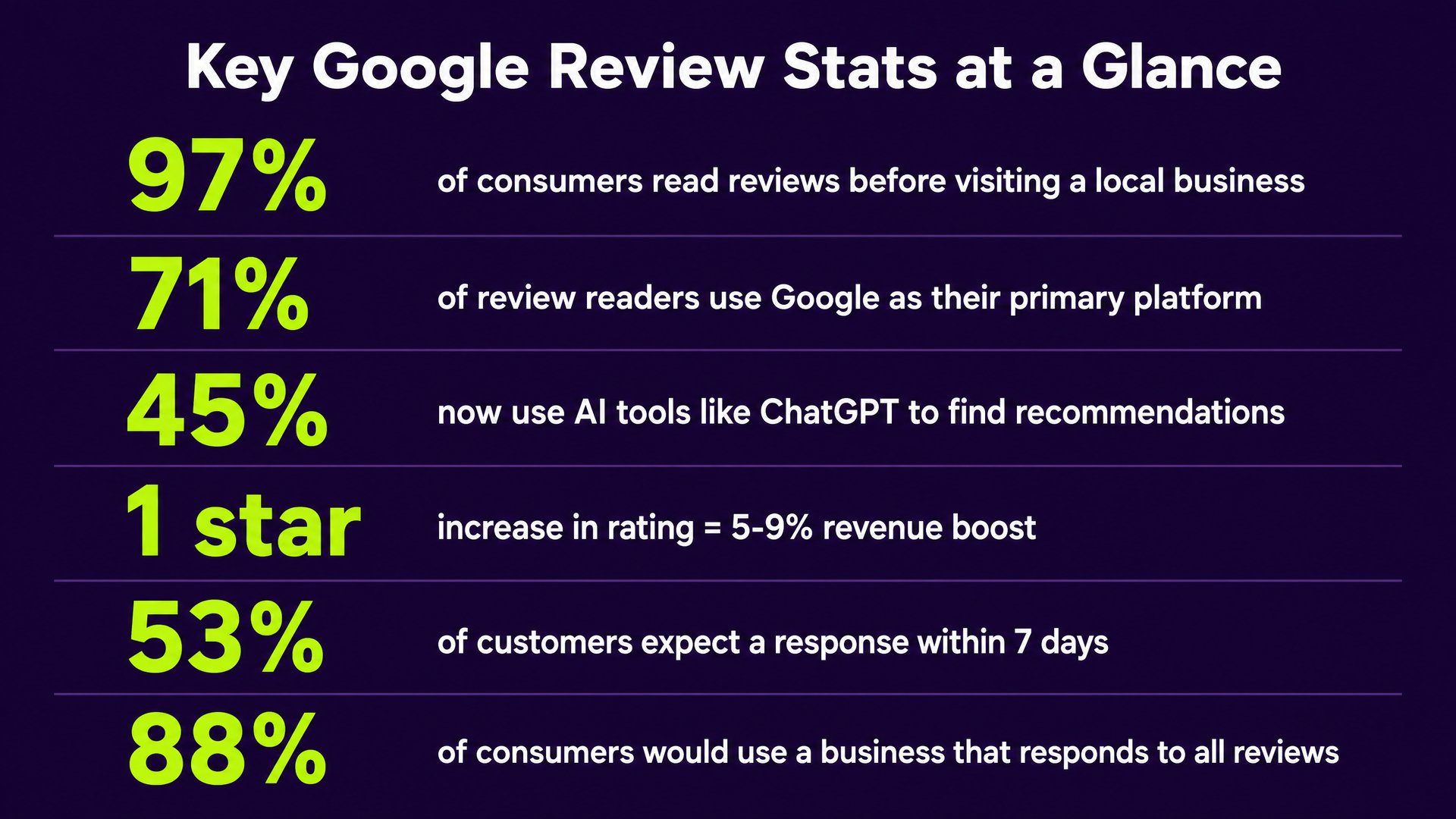
- Google’s share of all online reviews dropped from 83% to 71% in one year
- ChatGPT and AI tools are now the third most used source for local business recommendations
- Businesses that respond to reviews earn up to 18% more revenue than those that don’t
- A one-star increase in your average rating can boost revenue by 5 to 9%
- 73% of consumers only trust reviews written within the last month
Google’s Dominance Is Real, But It’s Changing
Google still controls more of the review landscape than any other platform. But 2026 brought the biggest single-year shift in years.

- Google hosted 71% of all online reviews in 2026, down from 83% in 2025
- 81% of consumers use Google specifically to evaluate local businesses
- 63.6% check Google reviews before visiting a business in person
- The average consumer now uses six different review sites when making decisions
- ChatGPT and other AI tools jumped from 6% to 45% usage for local recommendations in a single year, making AI the third most popular source behind Google and Facebook
- YouTube, Instagram, and TikTok are all gaining traction as review channels, especially with younger consumers
The 12-point drop in Google’s review share is the headline number here. It doesn’t mean Google is losing relevance. It means your reputation now lives in more places than it used to. A business with 200 Google reviews but nothing on Trustpilot, Facebook, or Yelp is increasingly exposed.
The AI jump is the other story. ChatGPT going from 6% to 45% in one year is not a trend to watch. It’s already here. AI tools pull from review data across multiple platforms when making recommendations. If your reviews are thin, inconsistent, or only on one platform, you’re invisible to a growing slice of the market.
What this means for your business: Google is still your most important review platform. But it’s no longer enough on its own. Managing reviews across multiple sources from a single place is no longer optional for businesses that want to stay visible.
How Consumers Use Reviews Before They Buy
Consumer review behavior shifted hard in 2026. People read more reviews than ever, read them more carefully, and trust them less unless specific criteria are met.
- 97% of consumers read reviews before choosing a local business
- 41% “always” read reviews when browsing for businesses, up from 29% in 2025
- 96% regularly look for reviews before buying something for the first time
- 54.7% check at least four reviews before making a purchase decision
- Consumers read an average of 10 reviews before trusting a business
- 73% only trust reviews written within the last month
- 67% won’t trust a high rating unless a substantial number of reviews back it up
- 83% believe reviews only hold value if they’re recent and relevant
The recency numbers are the ones most businesses get wrong. 73% of consumers only trust reviews from the last month. A business with 50 reviews from two years ago is starting over in the eyes of most shoppers. Volume matters. Velocity matters more.
The jump from 29% to 41% of consumers who “always” read reviews is a 12-point increase in a single year. Rising prices and economic uncertainty pushed people to research more before spending. That habit is not going away.
What this means for your business: A one-time review collection push won’t hold up. You need a steady stream of recent reviews. Businesses that automate review requests after every transaction are the ones that stay visible month after month.
Star Ratings: The Numbers That Drive Decisions
Star ratings get processed in under a second. Before a consumer reads a single word, they’ve already formed an opinion based on your number. The data on what that number does to revenue is hard to ignore.
- A one-star increase in average rating can boost revenue by 5 to 9%
- 86% of consumers avoid businesses with bad reviews
- 25% of consumers won’t use a business with less than a 4-star rating
- 4.5 stars or higher is now the minimum to compete in most industries
- Top-ranking businesses typically hold between 4.8 and 4.9 stars
- A 25% increase in positive reviews can lead to a 3.2% increase in revenue
- Positive reviews can result in an 18% increase in conversion rates directly within search results
The 4-star floor is real. One in four consumers won’t consider your business if you’re below 4 stars, regardless of price or location. The gap between 4.2 and 4.8 is not cosmetic. It’s the difference between ranking in the top 3 local results and sitting in positions 7 to 10.
The revenue impact of a single star increase shows up consistently across research. A 5 to 9% revenue lift from moving your average rating up by one star is not a rounding error.
What this means for your business: If you’re sitting below 4.2 stars, that’s the most urgent thing to fix. The path there is a combination of collecting more recent positive reviews and responding to negative ones in a way that shows future customers you take feedback seriously.
Google Reviews and Local SEO Rankings
Google reviews are not just a trust signal. They’re a direct input into Google’s local ranking algorithm. If you want to appear in the Local Pack, the three-business block above organic results, reviews are one of the clearest levers available.
- Review signals account for roughly 20% of Google’s Local Pack ranking algorithm in 2026
- Businesses in the top 3 local search positions average 47 Google reviews
- Businesses in positions 7 to 10 average only 38 reviews
- Businesses with consistent new reviews rank higher than those with a one-time burst
- 80% of local searches on Google Maps lead to a physical visit within 24 hours
- Businesses with complete Google Business Profiles receive 5x more engagement than incomplete listings
- 58% of customers say a Google Business Profile increases their likelihood of visiting in person
The difference between 47 and 38 reviews doesn’t sound like much. But those nine reviews, spread across the right timeframe, are often what separates a top-3 ranking from page-two obscurity. 80% of local searches convert to a physical visit within 24 hours. Local search is not a research channel. It’s a buying channel.
What this means for your business: Review velocity matters as much as review volume for local rankings. A business that collects 5 reviews a month consistently will outrank a business that collected 50 reviews in one campaign and then stopped.
Why Responding to Reviews Is Not Optional
Most businesses focus on collecting reviews. Far fewer respond to them. That’s a mistake the data makes clear.
- Businesses that respond to reviews earn up to 18% more revenue than those that don’t
- 53% of customers expect a response to negative reviews within 7 days
- 45% say they’re more likely to visit a business that responds to negative reviews
- Slow or generic responses are increasingly seen as a red flag by consumers in 2026
- Responding to reviews signals to Google that your business is active, which supports local rankings
The 18% revenue figure is the one that changes behavior. Responding to reviews is not a customer service nicety. It’s a revenue activity. Your response to a negative review is read by every future customer who finds that review. A good response turns a 2-star review into proof that you handle problems well.
The challenge is time. Writing thoughtful, on-brand responses to every review across multiple platforms is hard to keep up with. That’s where AI-assisted review responses have become practical. You review and approve, but the drafting happens automatically.
What this means for your business: Set a response target: every negative review within 48 hours, every positive review within a week. If volume makes that hard, use AI drafts and human approval. The goal is consistency, not perfection.
Fake Reviews: What Google Is Doing About It
Fake reviews are a real problem. Google has been aggressively cleaning them up, and the numbers show how seriously the platform takes enforcement.
- Google removed or blocked over 240 million policy-violating reviews in 2024
- Consumers increasingly expect platforms and businesses to be held accountable for fake reviews
- Businesses caught manipulating reviews face severe penalties, including listing removal
- Review authenticity is now a factor consumers actively look for before trusting a rating
240 million removed reviews is not a small sweep. Businesses gaming the system risk losing their entire review history. Authentic, earned reviews from real customers are the only strategy that holds up.
Shoppers are getting better at spotting fake reviews. Generic language, clustered dates, and suspiciously high ratings with no detail are patterns consumers have learned to distrust. Genuine reviews, including critical ones, build more credibility than a suspiciously perfect 5-star profile.
What this means for your business: Don’t buy reviews. Don’t incentivize reviews in ways that violate platform policies. Build a system that makes it easy for real customers to leave honest feedback. That’s the only approach that compounds over time.
What These Stats Mean for Your Review Strategy in 2026
The data points in one direction. Reviews matter more than they did last year. Consumers are more demanding. The platforms where your reputation lives are multiplying. Here’s what to do about it.
Collect reviews consistently, not in bursts. Recency is now as important as volume. A steady flow of recent reviews beats a one-time campaign every time. Build review requests into your post-purchase workflow so they happen automatically.
Manage reviews across multiple platforms. Google is still the priority, but with consumers using an average of six review sites and AI tools pulling from across the web, your reputation on Trustpilot, Facebook, Yelp, and industry-specific platforms matters more than it did two years ago. A centralized review dashboard that pulls from 30+ sources saves hours of tab-switching every week. If you’re evaluating tools, see our breakdown of the best Google review management tools in 2026.
Respond to every review. The 18% revenue lift from responding to reviews is one of the most replicated findings in the research. Make it a habit, not an afterthought.
Display your reviews where buyers are looking. Collecting reviews is only half the job. Getting them in front of potential customers on your website, in your email campaigns, and on your product pages is where the conversion impact happens. Testimonial widgets make this straightforward without needing a developer.
Watch the AI angle. ChatGPT going from 6% to 45% in one year is not a blip. AI tools recommend businesses based on review data across the web. The businesses with the most consistent, recent, multi-platform reviews will be the ones AI surfaces first. This is the new version of local SEO.
Final Thoughts
The 2026 data makes one thing clear. Reviews are not a background marketing activity. They’re a core business function that directly affects revenue, rankings, and visibility across traditional search and AI tools alike.
The businesses that pull ahead treat review management as a system, not a task. Consistent collection, fast responses, multi-platform presence, and smart display. If you want to see what that looks like in practice, Bragly’s free plan connects to Google, Trustpilot, and 31 other review sources. Start there.
Frequently Asked Questions
How many Google reviews does a business need to rank in the Local Pack?
Businesses in the top 3 local search positions average 47 Google reviews in 2026, compared to 38 for businesses in positions 7 to 10. But volume alone isn’t enough. Review recency and consistency matter just as much. A business collecting 5 reviews a month will often outrank one that collected 50 reviews in a single campaign and then stopped.
What star rating do you need to compete in 2026?
4.5 stars or higher is the minimum to compete in most industries. Top-ranking businesses typically hold between 4.8 and 4.9 stars. 25% of consumers won’t consider a business with less than a 4-star rating, and 86% actively avoid businesses with bad reviews.
Does responding to Google reviews actually help your business?
Yes. Businesses that respond to reviews earn up to 18% more revenue than those that don’t. 45% of consumers say they’re more likely to visit a business that responds to negative reviews. Responding also signals to Google that your business is active, which supports local rankings.
Is Google still the most important review platform?
Yes, but its share is shrinking. Google hosted 71% of all online reviews in 2026, down from 83% in 2025. The average consumer now uses six different review sites when making decisions. ChatGPT and AI tools jumped from 6% to 45% usage for local recommendations in one year. Google remains the priority, but managing reviews across multiple platforms is now a real business need.
How recent do Google reviews need to be?
73% of consumers only trust reviews written within the last month. 83% say reviews only hold value if they’re recent and relevant. This means a business with 100 reviews from two years ago is effectively starting over in the eyes of most shoppers. Consistent, ongoing review collection is the only way to stay current.
What happens if a business has fake reviews removed by Google?
Google removed over 240 million policy-violating reviews in 2024. Businesses caught manipulating reviews risk losing their entire review history and face potential listing removal. The only durable strategy is earning authentic reviews from real customers through a consistent, policy-compliant collection process.