Looking for a Shorter Overview?
AI Summary
Key Moments
Balancing Benefits and Features
Benefits persuade at the start, while features provide needed proof later in complex decisions.Feature-Advantage-Benefit Ladder
Using a three-step ladder makes messages more believable, connecting what the product has to why buyers care.Channel-Specific Messaging
Different channels and buyer stages require distinct benefit-led or feature-led copy approaches.Practical Rewrite Process
A five-step rewrite clarifies benefits by naming the feature, buyer, job, advantage, and ultimate benefit.The popular advice says benefits always beat features. That sounds clean, but it's too simple for how people buy. In my experience rewriting product pages, the copy that wins isn't always the most benefit-heavy one, it's the copy that matches the reader's stage, the channel, and the risk they're trying to reduce.
| Channel | Benefit-Led Copy | Feature-Led Copy | Best Use |
|---|---|---|---|
| Homepage hero | “Keep your social proof fresh without manual upkeep” | “Auto-sync reviews from 50+ sources” | Cold traffic, first impression |
| Pricing page | “Get proof that reduces hesitation at checkout” | “No-code widgets with multiple layouts” | Buyers comparing value and effort |
| Security or compliance page | “Reduce review fraud concerns with clearer source visibility” | “Written review text, mixed ratings, source coverage” | Risk-aware buyers |
| Demo follow-up email | “Make the next step feel obvious” | “Integrates with major site builders and custom sites” | Mid-funnel nudges |
| Comparison page | “Show trustworthy proof where shoppers need it most” | “Analytics, tagging, auto-sync, collection forms” | Evaluators who want specifics |
Table of Contents
- Why the Benefits Beat Features Advice Is Half Right
- What Benefits and Features Actually Mean
- The Feature to Advantage to Benefit Ladder
- Comparing Benefit-Led and Feature-Led Messaging in Practice
- How to Translate Features Into Benefits Step by Step
- Applying the Framework to Testimonials and Social Proof
- When to Lead With Features Instead of Benefits
- Quick Start Checklist and Copy Audit
Why the Benefits Beat Features Advice Is Half Right
The old rule still holds in plenty of buying moments. If someone's shopping for a consumer product, skimming an ad, or deciding fast, they usually care more about the result than the specification. That's why marketing has repeated the same basic principle for a long time, the customer buys the result, not the specification, and the question is still “What's in it for me?” as the ZDNet framing shows in a long-running discussion of marketing features or benefits (ZDNet).
But that rule breaks down when the buyer is self-educating, comparing options, or defending a purchase inside a team. In those cases, a vague promise like “save time” doesn't help much unless the reader can see the mechanism behind it. That's why product pages often fail when they list capabilities without translating them into customer value, especially in SaaS and B2B.
Practical rule: benefits open the door, features close the objection.
Where feature-first copy actually wins
Technical buyers don't always want a motivational line first. They want proof that the thing works, fits their stack, and won't create risk. In that world, source coverage, sync reliability, widget compatibility, and analytics can matter more than a glossy promise because the buyer is already thinking about implementation and evaluation.
That's the more useful way to approach benefits versus features. Benefits are the default persuasion layer, but features still matter when the purchase is high-consideration, comparison-heavy, or committee-driven. The rest of the messaging work is figuring out when to stay at the outcome level and when to drop into specifics without losing the reader.
What Benefits and Features Actually Mean
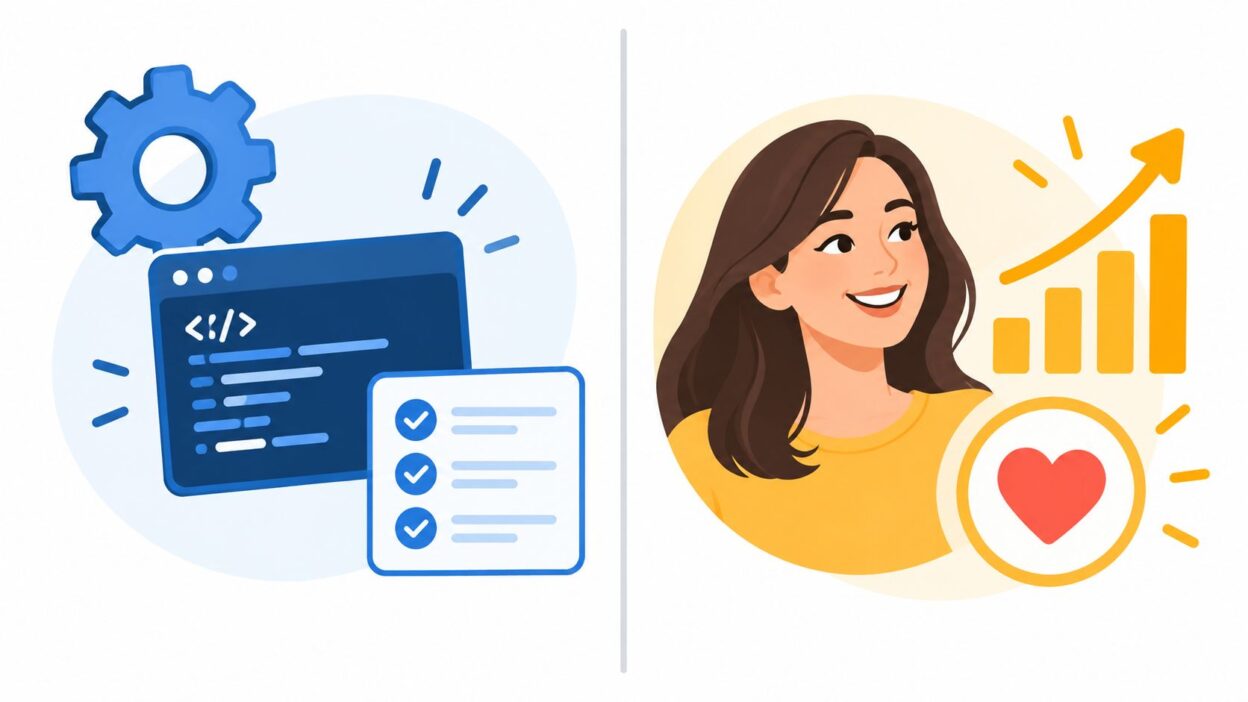
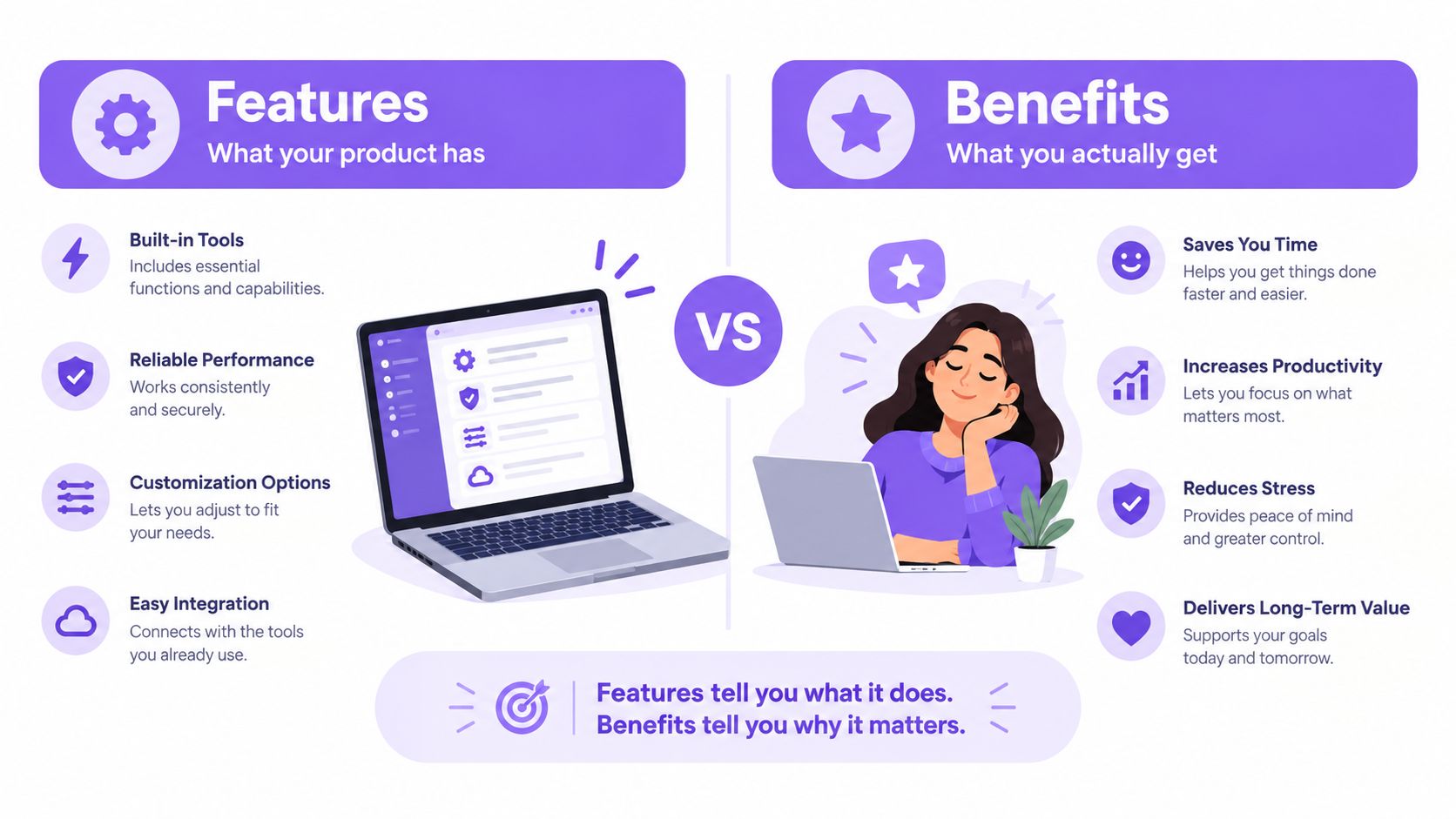
A feature is a factual attribute, capability, or specification a product has. A benefit is the outcome the buyer gets because that feature exists. The easiest test is brutally simple, ask, so what does this mean for the person reading?
That's where a lot of copy breaks. “256-bit encryption” is a feature. “Your team can store files with stronger protection and less risk anxiety” is a benefit framing. “AI-powered search” is a feature. “Find the right answer without digging through folders” is closer to a benefit because it points to the result the buyer feels.
The problem isn't that teams mention features. The problem is that they often stop at vague benefit words like powerful, easy, or uninterrupted. Those words sound positive, but they don't tell the buyer what changes in their day, their workflow, or their risk profile. If the line could sit on any product in the category, it's probably too soft.
A clean way to separate the two
Use this distinction in briefs and reviews:
- Feature: what the product has or does.
- Benefit: why that matters to the buyer.
A product page for a review-display platform might say “50+ review sources”, which is a feature statement. The benefit is “one place to keep social proof current without manual upkeep.” That second line connects the capability to the buyer's workload and reduces the mental effort required to see value.
If a line doesn't answer the reader's real question, it's just decoration.
The strongest copy usually moves from attribute to consequence in one sentence, not three. A good test is whether someone outside your team could explain the value back to you without restating your product jargon. If they can't, the line is still trapped on the feature side of the aisle.
The Feature to Advantage to Benefit Ladder
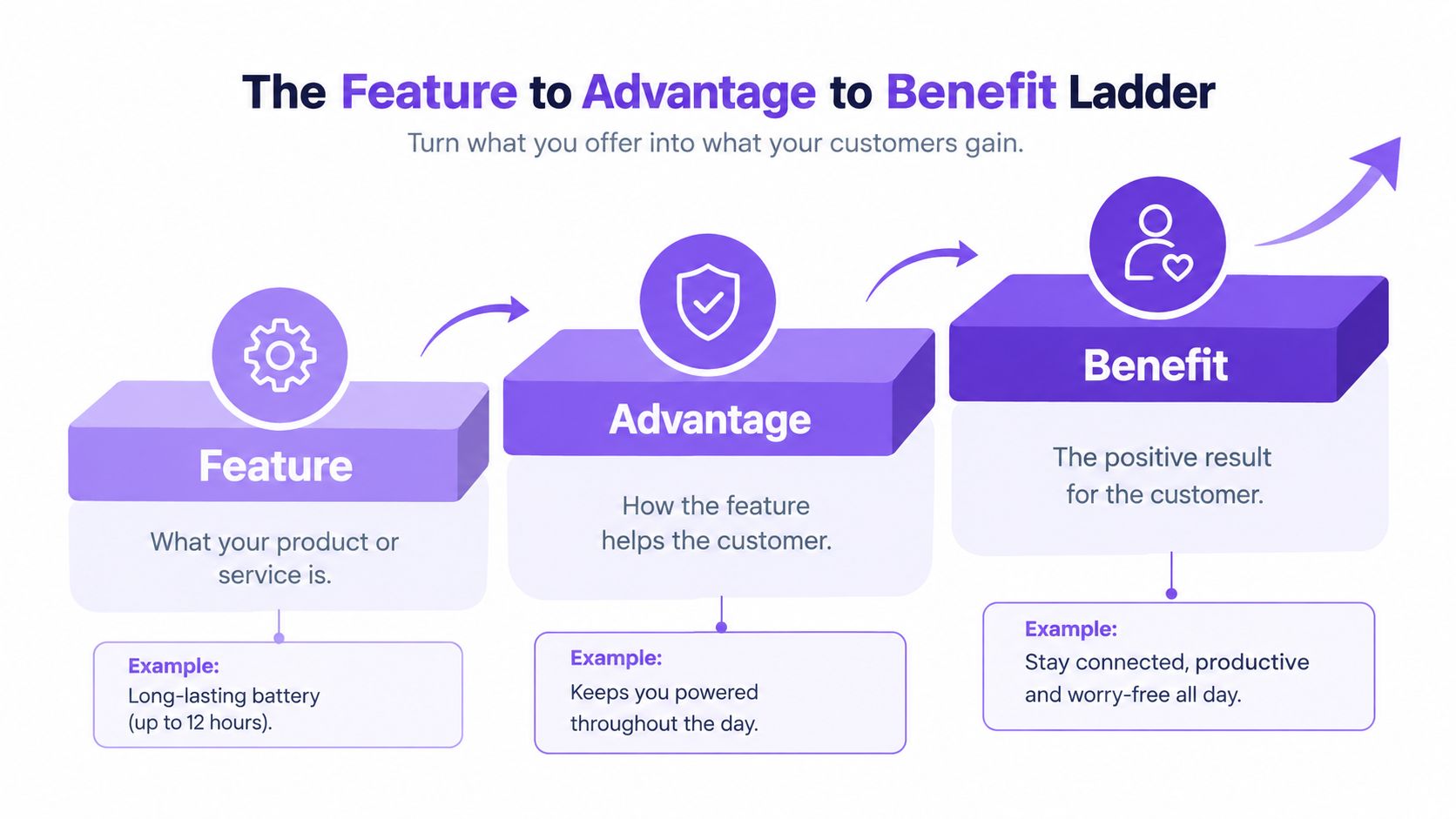
Most guides stop at “feature” and “benefit,” but that skips the part that makes the message believable. The missing middle layer is the advantage, the thing the feature enables. It's the bridge between what the product has and why the customer should care.
The three rungs
- Feature: what the product includes.
- Advantage: what that feature lets the buyer do.
- Benefit: why that improvement matters in real life.
A shared login setup makes the ladder easy to see. The feature might be SAML 2.0 with Okta and Azure AD. The advantage is one-click login for the whole organization. The benefit is employees start work faster, and IT stops fielding password reset tickets. The last line feels persuasive because the middle line made it plausible.
This matters even more in review and social proof messaging. A testimonial usually lands on the benefit rung naturally, because customers talk about the change they felt, not the mechanism you sold them. That's why customer quotes often sound stronger than product copy. They name the result in plain language.
Why the advantage layer matters
If you jump from feature straight to benefit, the line can sound inflated. If you stop at the advantage, the line still feels product-centric. The advantage is the proof step. It shows how the capability creates the result without drowning the reader in implementation detail.
That same chain helps with headline writing too. A quote like “We stopped wasting time on manual review updates” can be reverse-engineered into “Auto-sync keeps your reviews current without the maintenance drag.” One is customer language, the other is landing-page language, but the structure is the same.
A useful shorthand is this. If the reader can agree with the feature but still not feel the point, you haven't reached the benefit yet. If they can feel the point but don't understand how the product gets there, the advantage layer is missing.
Comparing Benefit-Led and Feature-Led Messaging in Practice
The same product can read completely differently depending on the channel. A homepage hero needs to earn attention fast. A product detail page may need more proof. An email subject line lives or dies on clarity. A paid ad needs to compress the message into a glance.
That's why the channel matters as much as the wording. In direct response marketing, the job is to get a specific action, not to explain every capability at once. If you want a practical primer on that discipline, what is direct response marketing is a useful reference point for thinking about response-driven copy.
| Channel | Benefit-Led Example | Feature-Led Example | Best Use |
|---|---|---|---|
| Landing page hero | “Keep your proof current without manual work” | “Auto-sync testimonials from connected sources” | Cold traffic and first impressions |
| Email subject line | “Get social proof live faster” | “No-code review widgets for major site builders” | Quick opens and interest generation |
| Google ad headline 1 | “Trust signals that don't go stale” | “Connect 50+ review sources” | Awareness and retargeting |
| Google ad headline 2 | “Show reviews where buyers actually look” | “Carousel, grid, ribbon, and badge layouts” | Page-specific relevance |
| Google ad headline 3 | “Reduce the friction of managing testimonials” | “Tagging, analytics, and auto-sync in one place” | Mid-funnel consideration |
| PDP bullet block | “See the proof that matters without digging” | “Written reviews, mixed ratings, and source filters” | Spec-driven shoppers |
Feature-led copy isn't worse. It's just more literal. A shopper who already knows what they want may prefer the facts first, especially on product pages, comparison pages, and retargeting assets. By contrast, benefit-led copy usually works better at the top of the funnel, in paid social, and in cold outreach, where the reader needs a reason to keep going before they care about the spec sheet.
The biggest mistake is using benefit language where the buyer wants evidence, or dumping feature lists into a channel that needs a hook. That's when copy feels either fluffy or flat.
How to Translate Features Into Benefits Step by Step
A repeatable rewrite process saves time and keeps the message honest. I use the same sequence when a page is full of product language that sounds informed but doesn't persuade.
The five-step rewrite
- Name the feature. Write the exact capability.
- Identify the buyer. Who's reading this, the user, the manager, or the buyer.
- Surface the job to be done. What problem are they trying to solve.
- Convert the feature into an advantage. What does it enable.
- Land on a benefit. What changes for the reader.
For a SaaS example, start with role-based access controls. For a DTC example, start with 30-second heat-up time. The feature alone is too abstract, but the benefit becomes clear when you ask what the buyer wants.
Before and after
Weak SaaS line: “Role-based access controls for team management.”
Stronger version: “Give each teammate the access they need, so admins spend less time handling permission requests.”
Weak DTC line: “30-second heat-up time.”
Stronger version: “Have it ready fast enough to fit into a rushed morning, without waiting around for the appliance to catch up.”
Those rewrites work because they move from attribute to user impact. The benefit isn't invented, it's derived from the actual use case. That's also where customer language helps. Tools like ContentBuck social proof are useful because customer quotes often reveal the exact words buyers use when they describe the outcome, not the feature.
For teams building local proof assets, the internal Bragly description generator can help turn raw feature language into cleaner outcome copy for profiles and listings.
A quick back-translation check
If your line still contains verbs like empower, unlock, or supercharge, ask what changed in the customer's day. If you can't answer with a concrete result, the sentence is still too abstract. The strongest rewrite sounds like something a buyer would say after using the product, not something a brand would say about itself.
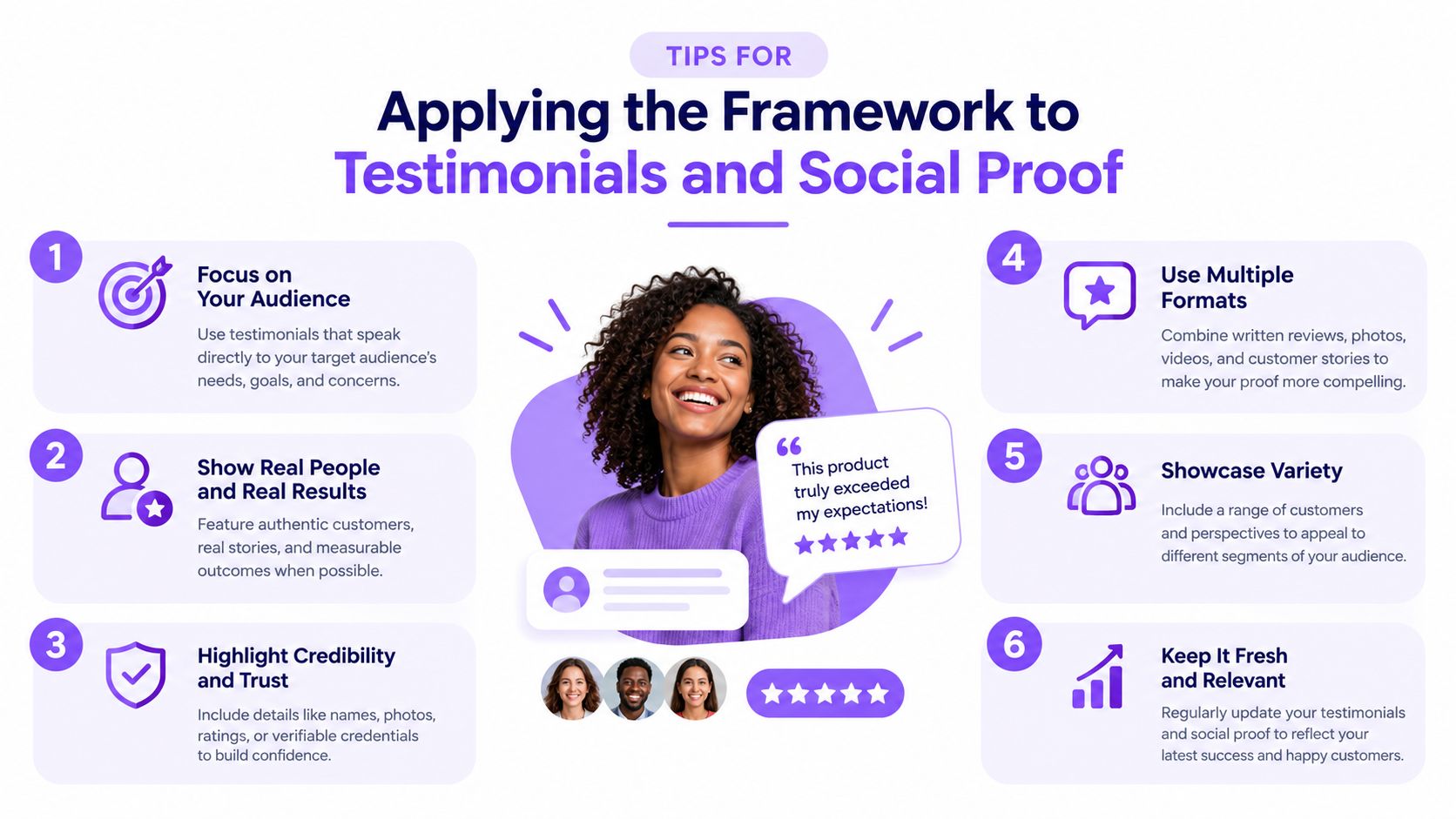
Applying the Framework to Testimonials and Social Proof
Testimonials do different work from headline copy. A headline has to persuade at speed. A testimonial has to feel earned. That means the best quotes are usually not the most polished ones, they're the ones that capture the customer's outcome in plain language.
The easiest way to find that line is to listen for the moment in an interview when a customer stops describing the product and starts describing the change. That sentence is evidence. Everything before it is setup.
Three weak quote rewrites
Weak: “We liked the widget setup and the integrations.”
Stronger: “We finally had one place to show reviews without updating five different pages.”Weak: “The analytics helped our team.”
Stronger: “We could see which reviews were driving trust, so we stopped guessing.”Weak: “It supports a lot of sources.”
Stronger: “Our social proof stays current because the reviews come in from the places customers already trust.”
That middle line is where the quote becomes useful. It shows the outcome and gives the landing page copy a matching proof point. If the headline says “Keep your reviews current without manual upkeep”, the testimonial should reinforce the same promise, not wander off into a side feature.
For teams managing review modules, Bragly testimonial widgets are one practical way to place that proof beside the relevant feature card, so the page tells one coherent story instead of two competing ones. If you want a deeper angle on why verified testimonials matter for search and discovery, how testimonials boost AI visibility is a useful read.
Prompt customers with questions that surface outcomes without steering them too hard. Ask, What changed after you started using it?, What used to take too much time?, What did this let your team stop doing?, and What surprised you most about the result? Those prompts usually pull out the benefit line you want.
When to Lead With Features Instead of Benefits
There are real moments when feature-led copy is the right call. Technical SaaS buyers want specifics when they're comparing tools. Procurement teams want details in RFPs. Developers want API limits, compatibility, and documentation clarity. Security and compliance pages need concrete signals because buyers are evaluating risk, not mood.
That matches the earlier point from the source material, benefits are the default default, but facts become decisive when the purchase is technical or high-consideration. In those situations, the feature is not filler. It's the proof.
Situations where features should lead
- Comparison pages: Buyers are already evaluating alternatives, so the spec often comes first.
- Developer tools: Integration details and limits can make or break adoption.
- Security pages: Compliance claims need concrete support, not just outcome language.
- RFP responses: The reader is checking boxes and reducing risk.
- Bottom-of-funnel pages: Buyers already know the job and want confirmation.
On the other hand, benefit-led copy still wins in cold email subject lines, paid social, ecommerce hero banners, and other surfaces where the reader hasn't committed attention yet. If they don't know why they should care, the feature won't save you.
Lead with the reader's decision, not your favorite product detail.
| Channel / Stage | Best Approach | Why It Wins | Example Asset |
|---|---|---|---|
| Homepage, top of funnel | Benefit-led | It earns attention fast | Hero headline |
| Paid social, cold traffic | Benefit-led | It creates curiosity before scrutiny | Ad creative |
| Demo follow-up | Mixed, then feature detail | The buyer wants relevance plus proof | Email body |
| Comparison page | Feature-led first | The buyer is comparing specifics | Spec table |
| Security or compliance page | Feature-led | Risk reduction depends on concrete evidence | Trust and policy section |
| Developer documentation | Feature-led | Adoption depends on implementation clarity | API overview |
The simplest filter is two questions. Who is reading? and What decision are they making? If the answer is “someone skimming for relevance,” lead with the outcome. If the answer is “someone checking whether this meets requirements,” lead with the feature and earn the benefit after.
Quick Start Checklist and Copy Audit
A fast audit catches weak copy before it ships. Take one landing page, one email, and one testimonial widget, then score every headline, subhead, and CTA on a 1 to 5 feature-to-benefit scale. A score of 1 means the line is just a spec. A score of 5 means the line clearly connects to a buyer outcome.
Fifteen-minute audit prompts
- What is the exact feature named here?
- Who is the reader, user, buyer, or evaluator?
- What job are they trying to get done?
- What advantage does the feature create?
- What benefit does the reader feel or avoid?
Then run a tiny rewrite sprint. Write three versions of the same line, one feature-led, one advantage-led, and one benefit-led. Send them into a simple test and watch which one drives the action you care about most.
For local proof assets and profile copy, the internal Bragly Google Business Profile audit can help you spot where the language is still too feature-heavy for the page it lives on.
Light test plan
- Variant A: feature-led line.
- Variant B: advantage-led line.
- Variant C: benefit-led line.
- Metric to track: CTR, demo requests, or scroll depth.
- Readout window: seven days.
Common rewrites that still feel like features in disguise include “simple and powerful”, “all-in-one”, “designed to help teams”, and “boost your workflow”. They sound positive, but they don't say what changes. Replace them with the actual outcome, or cut them.
Bragly helps teams collect, manage, and display reviews across websites, so the message on your pages can match the proof buyers need to see. If you're rewriting product pages, testimonial sections, or review widgets around clearer customer outcomes, visit Bragly and compare how your current copy reads when it's framed around benefits instead of features.