

Looking for a Shorter Overview?
AI Summary
Key Moments
Importance of Review Aggregation and Source Coverage
Aggregating reviews from multiple sources reduces manual work and helps maintain current, trustworthy evidence.First-Party Collection Enhances Testimonial Workflows
Platforms supporting collection, moderation, and tagging improve testimonial accuracy and operational control.Pricing Structures Affect Tool Suitability
Usage limits on forms, views, brands, and AI features influence the real cost and best fit for teams.Optimizing Social Proof Placement Boosts Conversion
Testing widget formats and placements can significantly increase conversions and reduce refund requests.Most “best social proof software” lists compare feature checkboxes and stop there. That's the wrong test. A review aggregator, a video testimonial collector, a UGC rights platform, and an ecommerce review engine may all display proof, but they solve different operational problems.
The useful question is whether a tool can collect or import the evidence you have, keep it current, publish it in the right format, connect to your existing stack, and remain predictable as usage grows. This comparison looks at source coverage, first-party collection, widget flexibility, integrations, analytics, pricing logic, limits, and implementation effort.
That distinction matters because reviews are already part of mainstream buying behavior. Pew Research found that 82% of U.S. adults at least sometimes read online ratings or reviews before buying something new, while 40% always or almost always do so. More recent evidence also points to a trust shift toward visible responses, recency, and authenticity rather than perfect star ratings. Teams using reviews in broader campaigns can also explore formats such as using customer reviews in video ads.


Table of Contents
- 1. Bragly
- 2. Testimonial.to
- 3. Senja
- 4. Endorsal
- 5. Trustmary
- 6. EmbedSocial
- 7. Taggbox
- 8. Elfsight
- 9. Yotpo
- 10. Stamped
- Top 10 Social Proof Software Comparison
- Choose the Platform That Fits Your Proof Stack
1. Bragly
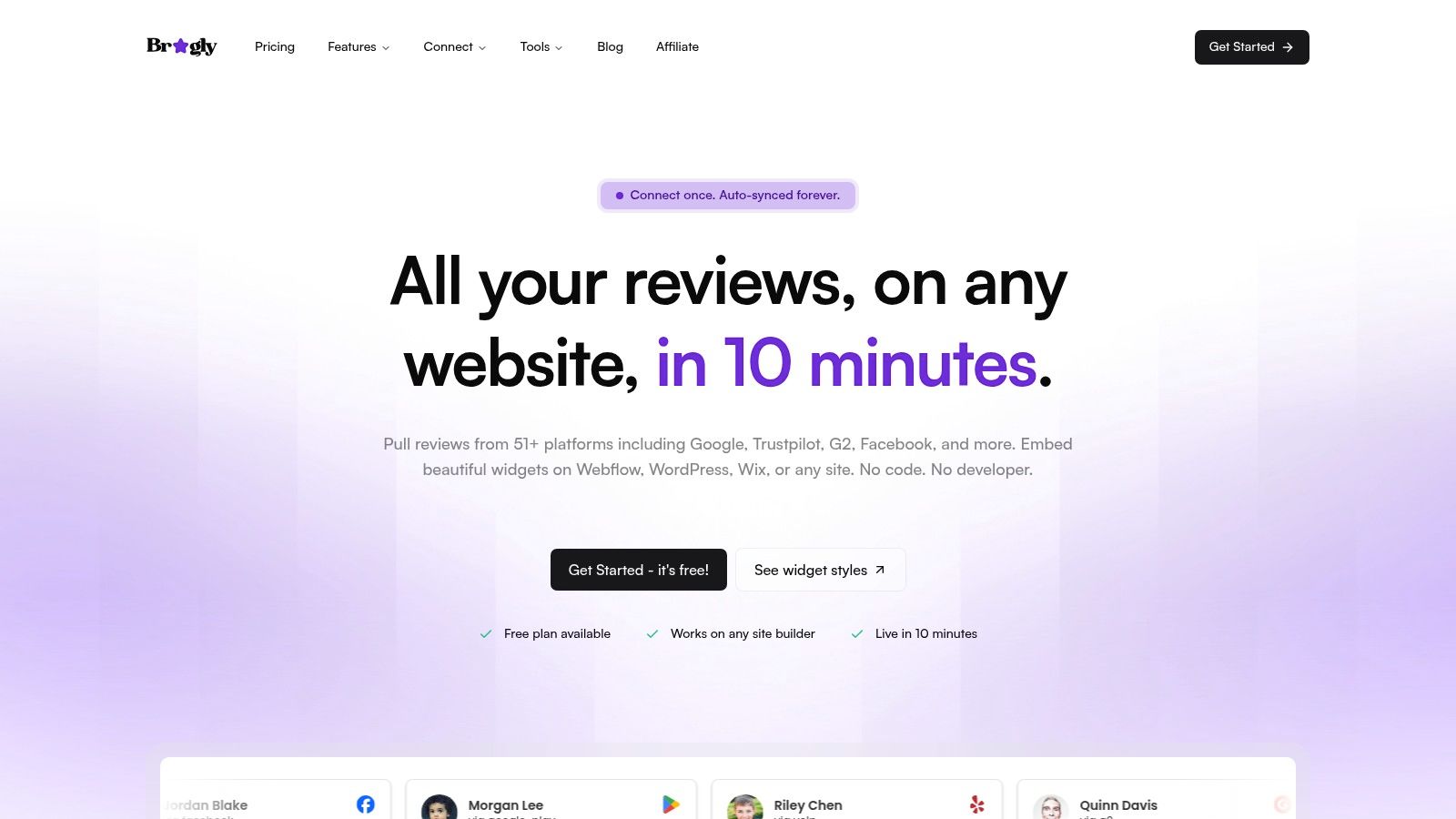
Bragly is the strongest reference point when the workflow starts with scattered third-party reviews and ends with branded website assets. It aggregates reviews from 50+ platforms, including Google, Trustpilot, G2, Facebook, Yelp, app stores, Shopify, Airbnb, Zillow, and niche sources, then publishes them through no-code widgets. That broad coverage reduces the need to copy testimonials manually from separate profiles.
The implementation is intentionally light. You choose sources, filter by rating, tag, or keyword, select a layout, match the styling to the site, and paste one div plus one script. Available formats include carousels, grids, badges, video highlights, floating badges, and other layouts suited to different page contexts. It works with Webflow, WordPress, Wix, Shopify, and HTML sites.
Where Bragly goes beyond display
Bragly also supports first-party text and video collection, moderation, tagging, manual review entry, webhooks, and AI analysis. The AI layer can summarize sentiment, identify useful phrases, and draft reply suggestions. Auto-sync keeps connected sources current, while lazy-loaded widgets and schema support help teams manage implementation and search visibility.
That matters because displaying old or overly perfect reviews can weaken trust. A 2026 survey found that 72% of consumers say suspected AI involvement lowers trust, while only 15% trust star ratings alone (Clutch consumer survey). Bragly's combination of source visibility, timestamps, filtering, moderation, and response workflows is more useful than a static testimonial wall.
Practical rule: Treat review software as a maintenance and evidence system, not just an embed generator.
Pricing logic and limitations
Bragly lists a Free starter tier, Pro at $14 per month, with a trial available, and Business at $67 per month. The important distinction is not only the headline price. Plans differ by collection-form and AI-analysis limits, including 20 review collection forms on Pro and 100 on Business. Heavy users should model brands, forms, analysis needs, and connected sources before choosing a tier.
Best fit: Small businesses, ecommerce brands, SaaS teams, agencies, and founders who need broad aggregation, fast publishing, and operational control without developer resources.
Limitations: Third-party APIs can restrict some sources or historical data, and high-scale sites should validate the performance impact of any external script.
2. Testimonial.to
Testimonial.to is built around the full testimonial journey, from requesting customer feedback to publishing text or video proof. It supports no-code Walls of Love, single-video embeds, social and review imports, brand monitoring, NPS surveys, and asynchronous case-study collection on higher tiers.
Its collection workflow is the main differentiator. The platform can use shareable forms, an email assistant with BCC-based requests, Brand Monitor, and NPS-related automation to reduce manual follow-up. Imports include sources such as X, LinkedIn, Reddit, G2, Yelp, Google, TikTok, and other review or social channels.
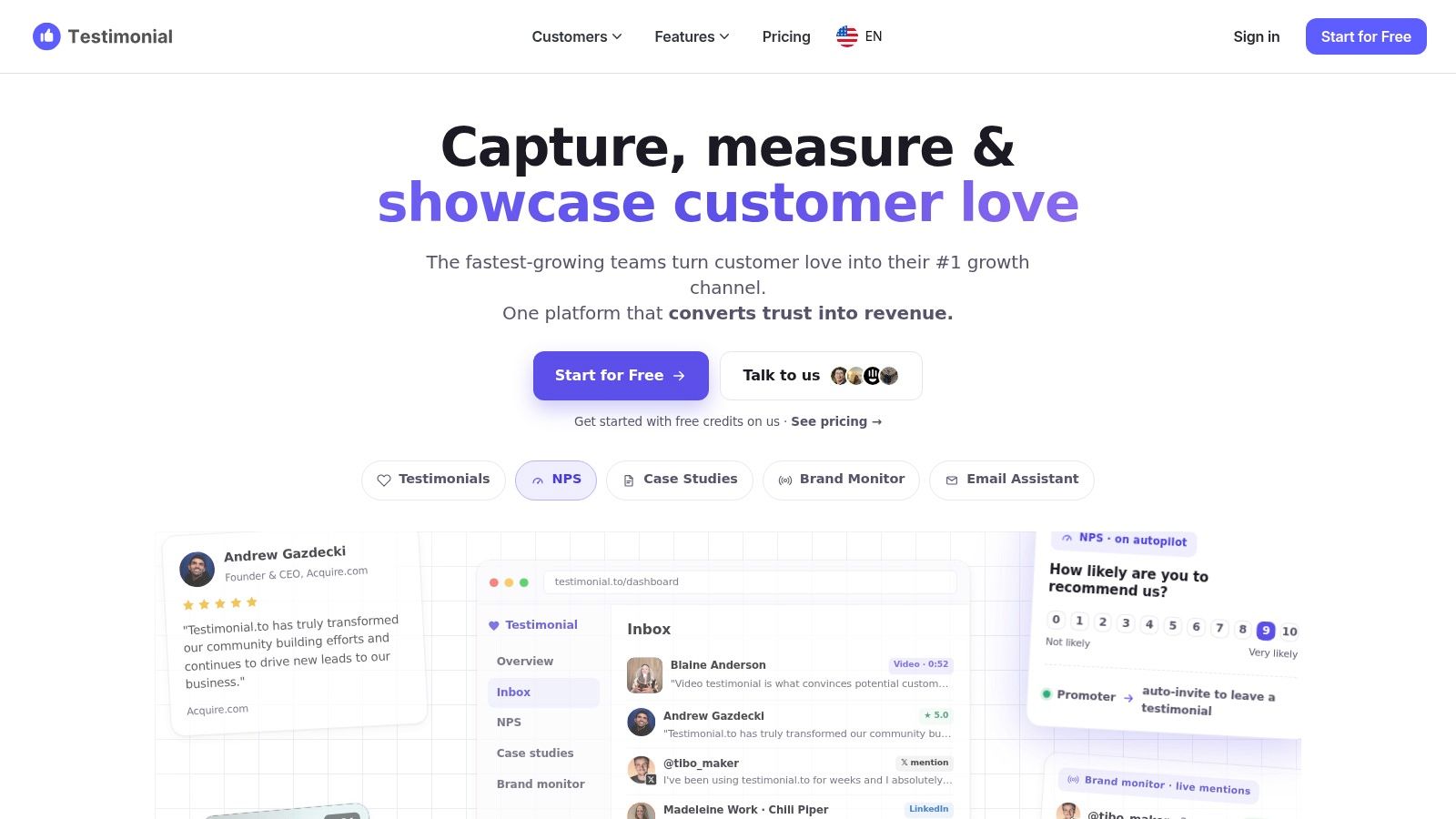
The platform suits teams that want collection, automation, analysis, and publishing in one interface. It's particularly practical for SMBs, agencies, and product teams that need video testimonials but also want NPS and case-study workflows nearby.
For a direct comparison of how its integration model differs from a broader review aggregator, see Bragly's Testimonial.to integration.
Pricing logic: Pricing is organized by space, meaning brand or workspace. That can work well for one business, but agencies and multi-brand organizations need to calculate the cost of each additional space. Unlimited video is reserved for the Ultimate tier, so video volume and plan level should be reviewed together.
Best fit: Teams prioritizing a unified collect-to-publish testimonial workflow.
Limitations: It can become expensive across multiple brands, and unlimited video requires the highest tier. It's less focused than Bragly when the primary need is aggregating a large number of external review sources into synchronized website widgets.
3. Senja
Senja takes a lighter approach. It focuses on collecting and displaying text and video testimonials through a simple dashboard, branded testimonial pages, and straightforward embeds. That narrower scope makes it approachable for solopreneurs, local businesses, creators, and early-stage SaaS teams that don't need a broader reputation or feedback suite.
The workflow is easy to understand. Create a form, send it to customers, review submissions, filter the responses, and publish selected testimonials on a branded page or embedded section. The free plan supports up to 15 testimonials, while paid tiers remove limits and add automation features.
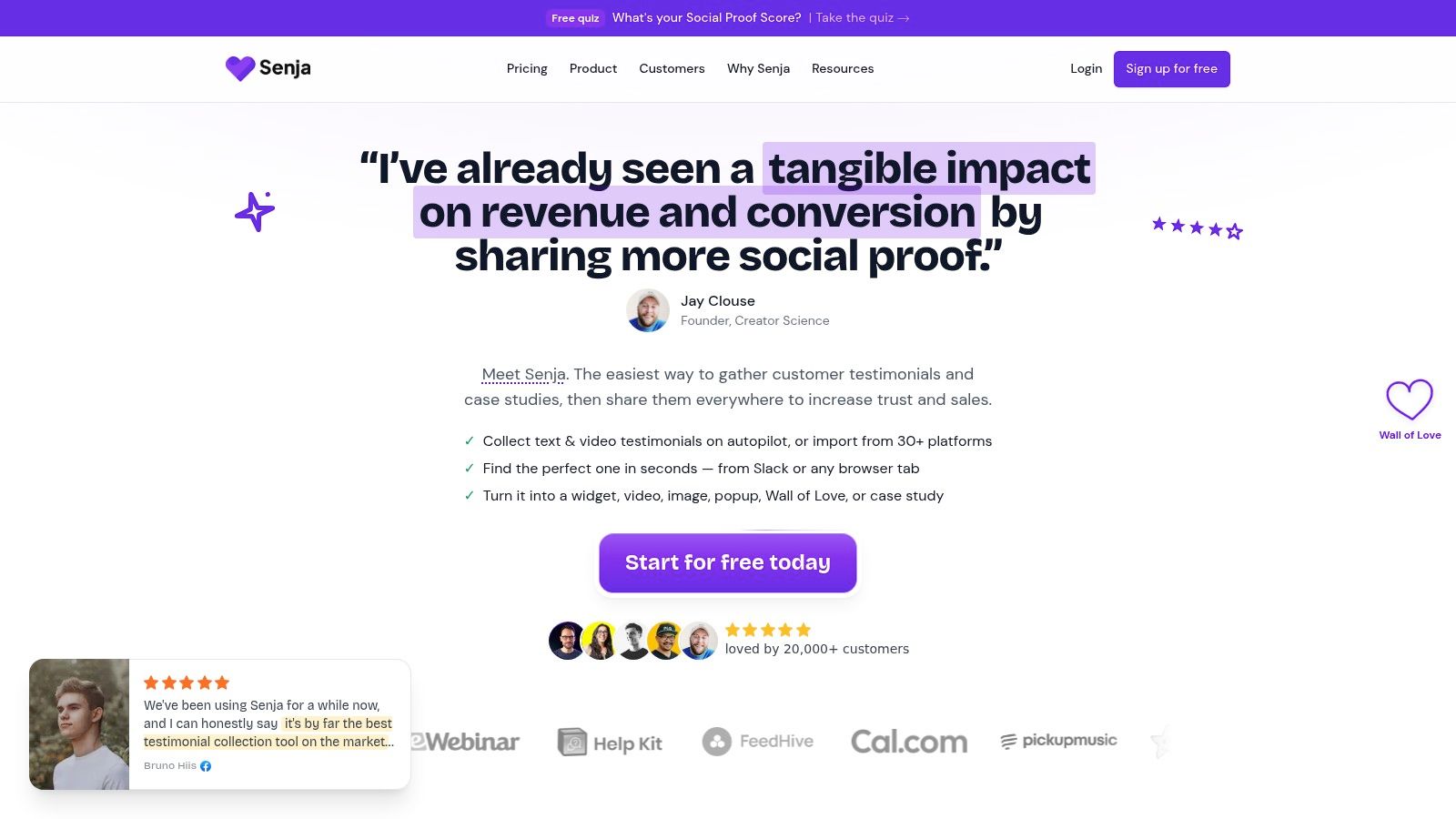
Senja is a good choice when implementation speed matters more than source breadth. A small team can get a testimonial request workflow running without configuring multiple modules, review networks, or complex ecommerce rules.
Its limits are equally clear. Senja doesn't provide built-in NPS or case-study capture, and its feature breadth is narrower than an all-in-one platform. It also isn't the natural choice for a company trying to consolidate reviews from Google, G2, Trustpilot, app stores, and local directories.
For teams comparing a lightweight collection experience with broader aggregation, Bragly's Senja integration provides a useful reference.
Pricing logic: The free tier is the entry point, while paid plans trade testimonial limits for additional automation. Model the number of testimonials and the need for automation rather than choosing only by monthly price.
Best fit: Individual operators and small teams collecting a focused library of text and video proof.
4. Endorsal
Endorsal centers its workflow on automated testimonial requests through email and SMS. That makes it particularly relevant to local and service businesses whose customers may respond more readily to a text message than to a longer email sequence.
Its AutoRequest process can request testimonials by email or SMS, while video capture is governed by tier-specific maximum lengths. The platform also supports review marketing, widgets, and an infinite-scroll Wall of Love page. Teams can automatically share selected testimonials on social channels, reducing the gap between collecting proof and reusing it in marketing.
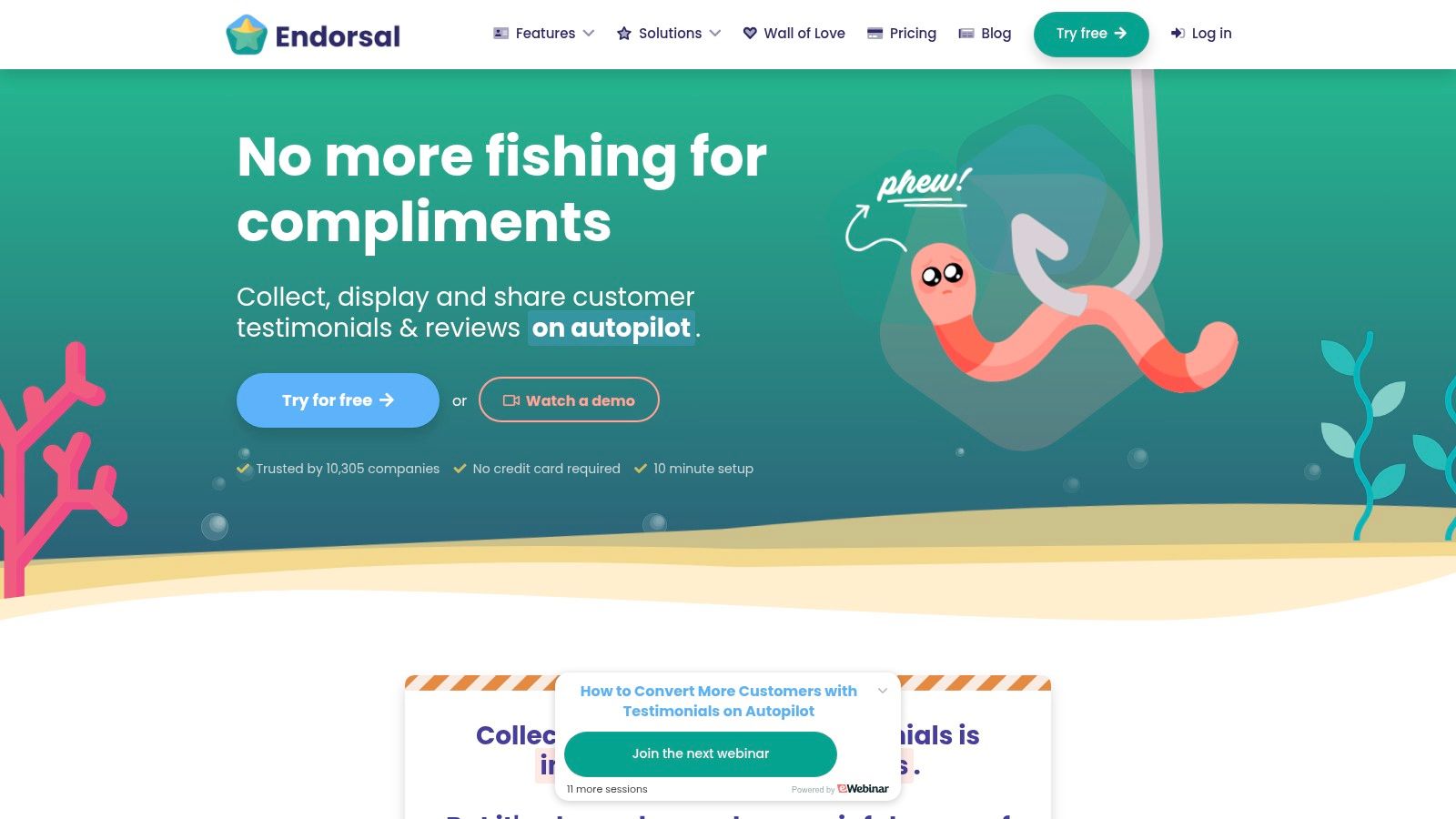
The strongest reason to choose Endorsal is channel fit. A contractor, clinic, consultant, or local agency may have an established SMS relationship with customers and need a simple way to turn that relationship into text or video feedback.
Pricing logic: SMS allowances and video length vary by tier. Those constraints are more important than the base plan label if your collection program depends on frequent SMS requests or longer customer videos.
Best fit: Service businesses that want email and SMS collection with uncomplicated publishing.
Limitations: Endorsal doesn't include built-in NPS or brand monitoring, so teams needing structured satisfaction surveys or broad reputation monitoring will need another system. It also offers fewer advanced modules than Testimonial.to or Bragly.
5. Trustmary
Trustmary is the most relevant option in this list for teams that want to connect customer feedback with conversion experimentation. Its workflow combines NPS and CSAT surveys, review requests, testimonial capture, review widgets, schema markup, and A/B testing.
The survey flow can route promoters toward review or testimonial collection. That gives marketers a practical way to separate feedback from public advocacy. Instead of asking every customer for a public review immediately, the team can first gather satisfaction data and then direct suitable respondents toward a published testimonial.
Trustmary also supports experiments for widget placements. That matters because social proof performance depends on context. Controlled testing on 1,200 UK service-business websites found that widgets above the fold on homepages produced a median 8.3% conversion lift, while placement above the primary CTA on service pages produced an 11.7% lift. Footer placement produced no measurable lift (ScoreReview placement testing).
Social proof belongs where a buyer is deciding, not wherever the template leaves empty space.
Pricing logic: Trustmary uses usage-metered pricing tied to widget views and survey responses, with add-ons for some capabilities. That structure can obscure total cost when traffic or survey volume rises. Branding removal and other options may also require paid add-ons.
Best fit: Marketing teams that need feedback collection, review acquisition, and placement testing in one workflow.
Limitations: It requires more careful forecasting than a flat subscription. Teams should estimate views, responses, experiments, and add-ons before comparing it with tools priced mainly by brand or testimonial count.
6. EmbedSocial
EmbedSocial, including EmbedReviews and EmbedFeed, is designed for teams that need both review aggregation and social feed publishing. It connects major sources such as Google, Facebook, Trustpilot, and Yelp, while also supporting social feeds and UGC displays.
The product becomes more useful when a website needs multiple types of proof. An ecommerce brand might show review snippets near product information, a social feed on a campaign page, and shoppable UGC in a gallery. Rights management, moderation, analytics, and API access are available at higher tiers.
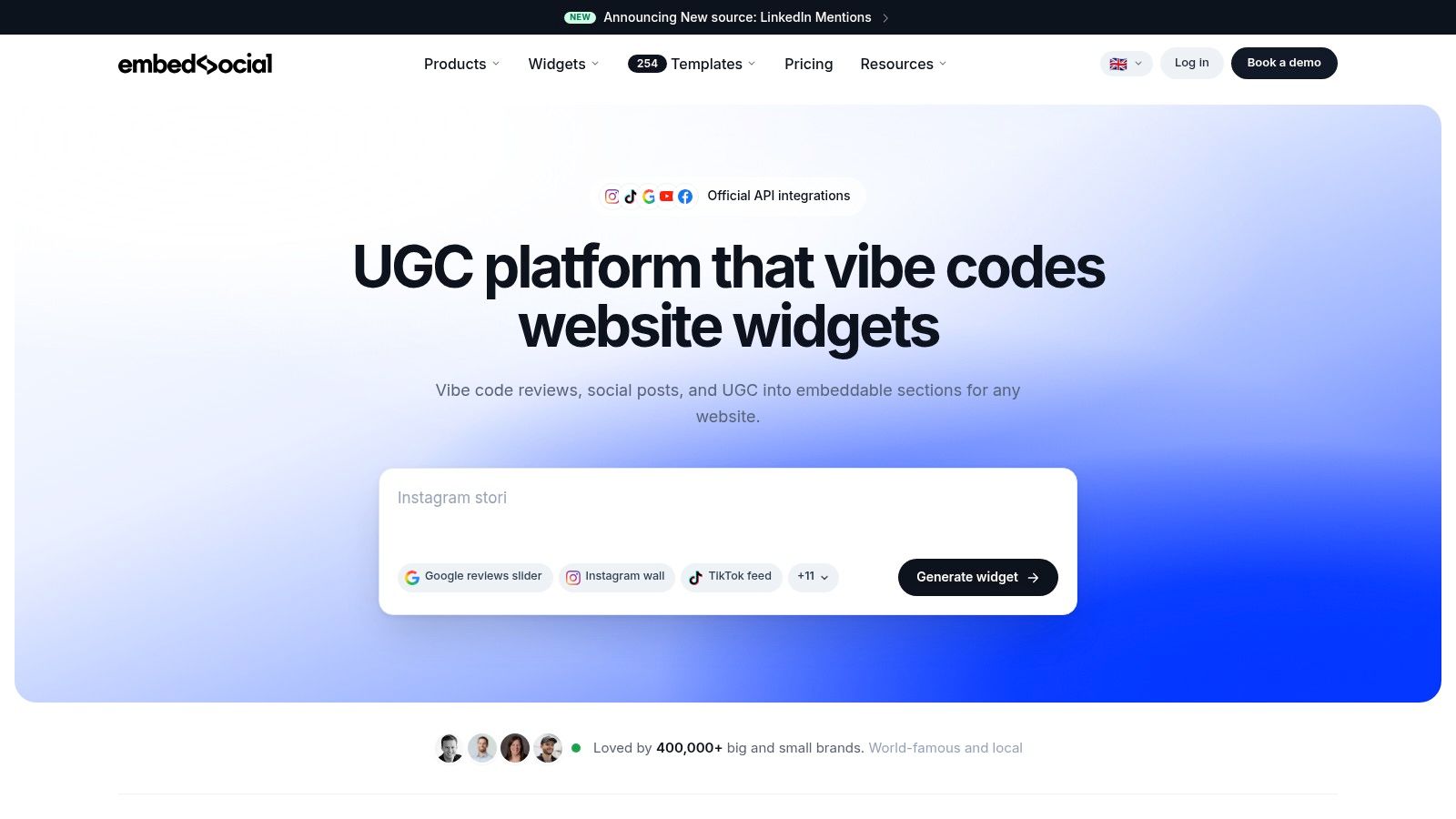
EmbedSocial advertises unlimited widgets across plans, but sources and views vary by tier. That distinction matters for multi-page sites. Unlimited widget creation doesn't necessarily mean unlimited source access, synchronization, or viewing capacity.
Its strongest fit is a marketing team that wants reviews and social content in one toolkit. It's less compelling when the team only needs a basic review widget or a first-party testimonial form.
For teams mainly evaluating layout flexibility and page publishing, compare its capabilities with Bragly's testimonial widget options.
Pricing logic: Pricing is displayed in EUR and depends on plan-specific source and view limits. Calculate the required networks, monthly views, sync expectations, and higher-tier needs before comparing the apparent subscription price.
Best fit: Ecommerce brands and agencies combining reviews, social feeds, and shoppable UGC.
Limitations: Sync intervals and source limits differ by tier, while advanced rights management, analytics, and API features may require upgrades.
7. Taggbox
Taggbox is built for curated UGC and review displays, especially when the final experience needs to be visual, shoppable, and tightly controlled. It pulls reviews from sources such as Google, Facebook, Yelp, and Airbnb, and combines them with social content.
The platform's differentiation is not merely aggregation. It gives ecommerce and agency teams tools for moderation, rights management, shoppable Instagram galleries, and branded presentation. That makes it useful when marketing needs to select content carefully before putting it on a storefront or campaign page.
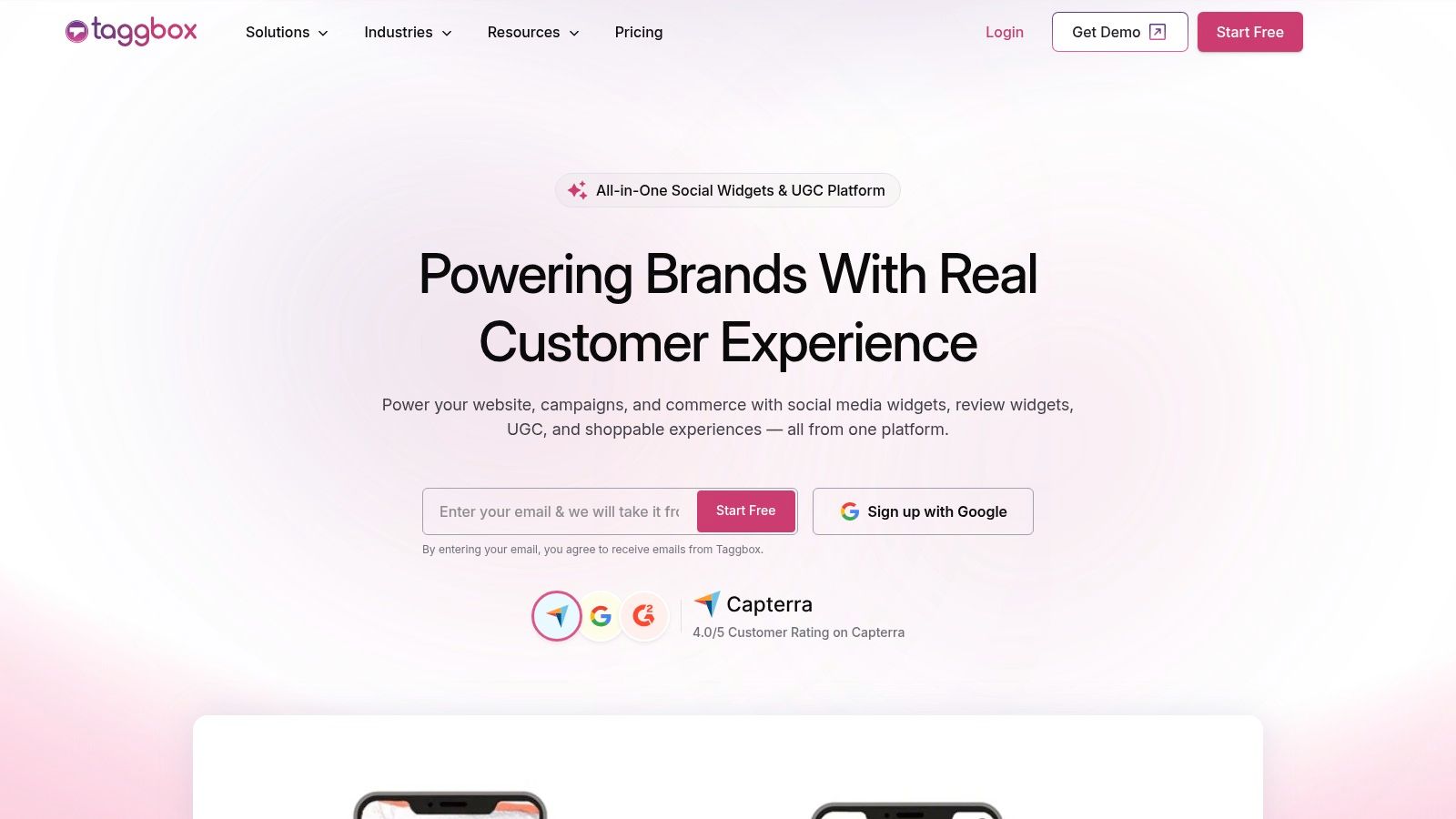
Rights management is particularly important for UGC. A team needs permission and a repeatable approval process, not just an attractive gallery. Taggbox's moderation workflow addresses that operational requirement more directly than lightweight testimonial tools.
Pricing logic: Plans are tiered by features and usage. Advanced options and branding removal may require higher plans, so agencies should include client-specific presentation needs in the estimate.
Best fit: Ecommerce brands and agencies that need curated, shoppable, on-brand UGC.
Limitations: It can require upgrades for advanced capabilities, and it isn't the most direct choice for teams whose priority is first-party text and video collection rather than visual content management.
8. Elfsight
Elfsight is a widget library rather than a dedicated review operations platform. Its Google Reviews app and All-in-One Reviews app let teams launch review displays quickly, while a wider catalog supports other website widgets.
That makes Elfsight useful for a narrow implementation. If a business needs one Google Reviews widget on a local service site, the dedicated app can be easier to deploy than a broader system. Templates and no-code configuration reduce the technical burden for teams working in common site builders.
The tradeoff appears when requirements expand. Pricing is organized per app, with view limits and widget counts influencing the plan. An organization that needs reviews, social feeds, and multiple widget types may find an all-app bundle more suitable than stacking individual subscriptions.
Paid plans also offer AI review translation, while the broader bundle is intended for teams using several widget categories. That can be valuable for multilingual audiences, but it isn't the same as built-in review collection, moderation, tagging, or AI sentiment analysis.
Pricing logic: Assess each app, monthly view cap, and number of widgets. A single-network review need may remain simple, while a multi-format setup can become less economical.
Best fit: Small businesses that need a fast, focused widget, especially for Google Reviews.
Limitations: App-by-app pricing can become inefficient as requirements grow. Elfsight also offers less review lifecycle management than Bragly, Testimonial.to, or Trustmary.
9. Yotpo
Yotpo is the enterprise-leaning ecommerce choice in this comparison. It combines product and site reviews with imports, email and SMS review requests, on-site displays, and integrations with Shopify, BigCommerce, and Salesforce Commerce Cloud.
Its value comes from stack depth. A DTC brand can connect review collection with a broader suite that includes loyalty, SMS, email, and subscriptions. That can reduce the number of separate vendors, but only if the business intends to adopt those adjacent systems.
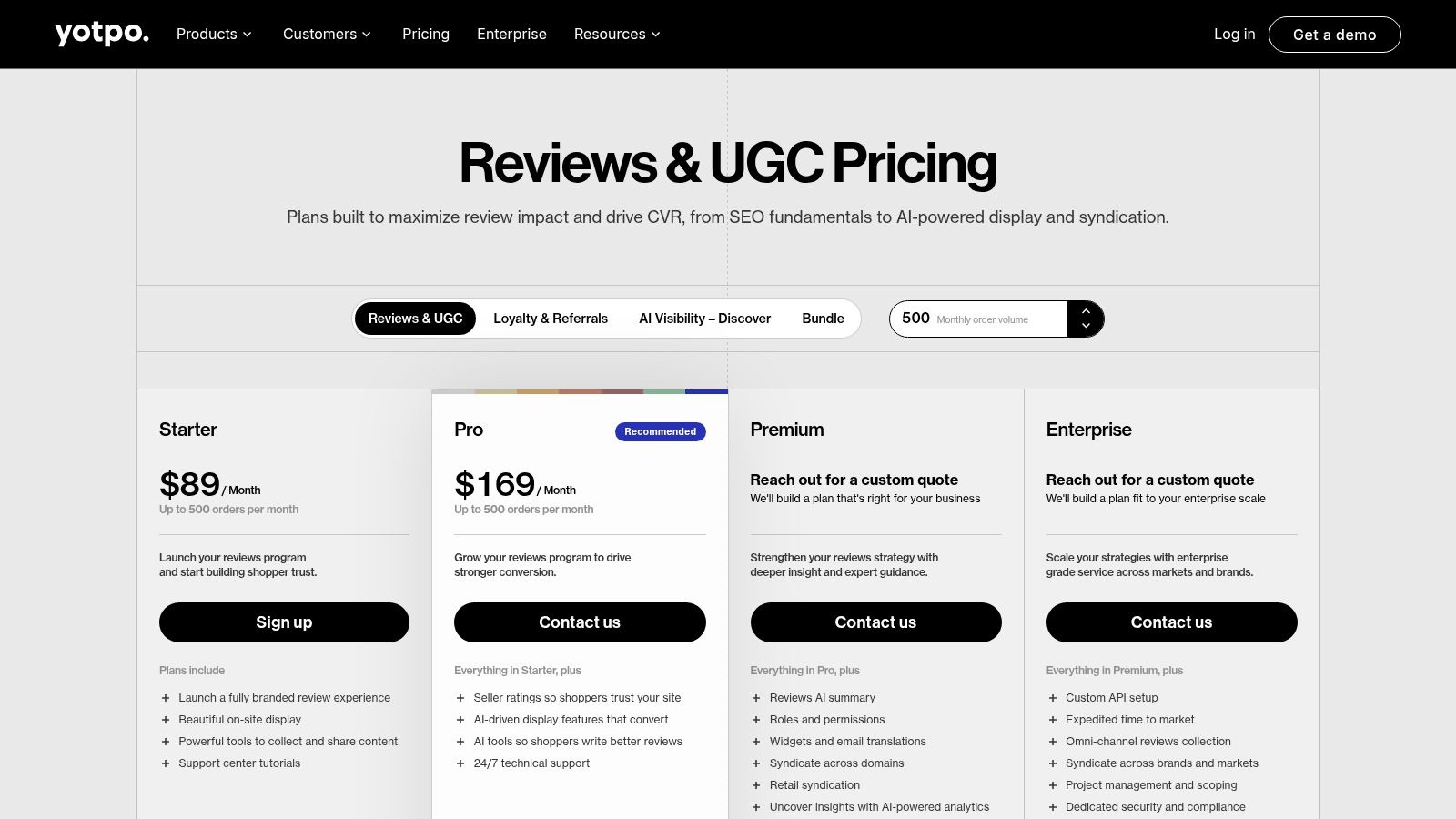
Yotpo also supports review widgets and SEO-oriented review visibility. Its ecommerce integrations are the reason to consider it, not the presence of a carousel or star display. Large catalogs, structured request automation, and order-linked workflows require more infrastructure than a basic website testimonial block.
Pricing logic: Plans scale with monthly order volume, and premium or enterprise integrations are custom quoted. Costs can become complex when order volume, add-on products, and overage structures interact.
Best fit: DTC brands at scale that need reviews integrated with retention and ecommerce operations.
Limitations: Implementation and pricing may be excessive for a small service company, SaaS site, or founder-led business that mainly needs broad aggregation and no-code publishing.
10. Stamped
Stamped targets ecommerce brands that have outgrown a basic review app but don't want the full complexity of an enterprise stack. It supports email and SMS review requests, customizable forms, product and site displays, imports, social sharing, and integrations across major ecommerce platforms.
The collection workflow is practical for stores that want to request reviews after orders and capture richer responses through customizable forms. Social sharing extends the useful life of collected content, while optional loyalty and subscription modules let a brand expand beyond reviews.
Stamped's position is between a basic Shopify app and an enterprise review suite. That can make setup more approachable, but the decision still depends on ecommerce platform, order volume, selected products, contract term, and whether loyalty or subscriptions are included.
Pricing logic: Costs depend on the chosen products and term. Advanced bundles can approach enterprise-level pricing, so buyers should model review requests, orders, integrations, and add-on modules together.
Best fit: Ecommerce brands needing automated review collection and stronger integrations than a basic app provides.
Limitations: Feature and volume pricing scales with the business. A company that only needs imported reviews and a small website widget may be paying for capabilities it won't use.
Top 10 Social Proof Software Comparison
| Product | Core features | UX & Quality | Value / Pricing | Best for | Unique selling point |
|---|---|---|---|---|---|
| Bragly 🏆 | Aggregates 50+ sources; auto‑sync; no‑code widgets; AI analysis; collection forms | ★★★★★; fast no‑code setup; lazy‑load & schema | 💰 Free / Pro $14/mo / Business $67/mo (limits vary) | 👥 SMBs, DTC, SaaS, agencies, founders | ✨ 50+ sources, AI summaries, multi‑brand Walls, webhooks |
| Testimonial.to | Text & video capture; imports; Wall of Love; NPS | ★★★★; unified collect→publish flow | 💰 Tiered; per‑space pricing (can add up) | 👥 SMBs, agencies, product teams | ✨ Brand Monitor, async case‑study capture |
| Senja | Video & text forms; branded pages; easy embeds | ★★★★; very approachable UI | 💰 Generous free tier (up to 15), affordable paid plans | 👥 Solopreneurs, local businesses, early‑stage SaaS | ✨ Simple on‑ramp and clean workflow |
| Endorsal | Email & SMS AutoRequest; video capture; Wall of Love | ★★★★; straightforward setup & docs | 💰 Tiered; SMS & video length limits by plan | 👥 SMBs, local/service businesses | ✨ SMS requests to boost response rates |
| Trustmary | NPS/CSAT routing to reviews; widgets; A/B testing | ★★★★; testing & feedback focused | 💰 Usage‑metered (views/responses); add‑ons | 👥 Marketers, conversion teams | ✨ Built‑in A/B testing + schema for SEO |
| EmbedSocial | Aggregates reviews & social feeds; shoppable UGC; API | ★★★★; scalable widget usage | 💰 EUR pricing; unlimited widgets on plans (source limits vary) | 👥 Ecommerce brands, multi‑page sites | ✨ Unlimited widgets + shoppable UGC |
| Taggbox | Reviews + UGC; shoppable galleries; rights mgmt | ★★★★; strong creative controls | 💰 Tiered; advanced features require higher plans | 👥 Ecommerce brands & agencies | ✨ Rights management + highly customizable displays |
| Elfsight | Large no‑code widget library; Google Reviews app; bundles | ★★★★; very fast to launch | 💰 Per‑app pricing by view caps; free tiers for some apps | 👥 Small teams needing single widgets | ✨ App‑by‑app flexibility and many templates |
| Yotpo | Ecommerce reviews + UGC; automations; loyalty stack | ★★★★; enterprise‑grade | 💰 Volume/order‑based pricing; enterprise quotes | 👥 DTC brands at scale | ✨ Deep ecommerce integrations & extensible retention tools |
| Stamped | Review request automations; social syndication; add‑ons | ★★★★; approachable for growing brands | 💰 Product/feature‑based pricing; scales with usage | 👥 Growing ecommerce brands | ✨ Balanced feature set between Shopify apps and enterprise |
Choose the Platform That Fits Your Proof Stack
Start with the evidence you already have. Inventory every review source, including Google, Trustpilot, G2, Facebook, Yelp, app stores, ecommerce platforms, local directories, and internal customer feedback. If reviews are fragmented across several networks, source coverage and synchronization matter more than the size of a widget library.
Next, decide whether you need first-party collection. A review aggregator can publish existing evidence, but it won't necessarily help you request new text or video testimonials, route survey responses, manage permissions, or create a repeatable follow-up process. Choose Testimonial.to, Senja, Endorsal, or Trustmary when collection is central. Choose Bragly when collection needs to sit alongside broad third-party aggregation, tagging, moderation, webhooks, and publishing.
Then map proof formats to page types. Product pages may need review summaries, photo UGC, and structured product ratings. Service pages may benefit from a reply beneath a review, a verified badge, or proof near the primary CTA. Controlled tests reported an average 4.1% conversion increase from a visible Verified badge, a 6% increase from photo reviews over text-only reviews, and a 14% reduction in refund-request rate when a business reply appeared beneath the review (ScoreReview conversion testing). Those findings support testing format and placement rather than installing one widget everywhere.
Model the real cost
Separate listed pricing from usage limits. Compare:
- Sources and sync: Which networks are included, and how current can displayed reviews remain?
- Views and traffic: Does the plan meter widget views or page impressions?
- Orders: Does ecommerce pricing scale with monthly order volume?
- Forms and submissions: Are collection forms or testimonial counts capped?
- Brands and spaces: Will each client, domain, or brand require another paid unit?
- AI and advanced features: Are analysis, translation, API access, schema, or branding removal restricted?
Before committing, test implementation speed, moderation controls, page performance, analytics usefulness, and the exact behavior at plan limits. Review software should make evidence easier to maintain, not create a new manual process.
Bragly is the relevant option when the priority is broad review aggregation, no-code publishing, automatic syncing, flexible widgets, first-party collection forms, tagging, webhooks, and AI analysis. Its Free, Pro, and Business structure gives teams a visible starting point, while the $14 Pro and $67 Business list prices make initial budgeting more direct than usage-only models. The final choice should still follow the workflow, not the feature count.
Bragly brings reviews from 50+ sources into one system, adds no-code widgets, automatic syncing, collection forms, tagging, webhooks, and AI analysis, so teams can manage social proof without constant manual updates. Visit Bragly to compare its Free, Pro, and Business plans and test whether it fits your review and testimonial workflow.