Looking for a Shorter Overview?
AI Summary
Key Moments
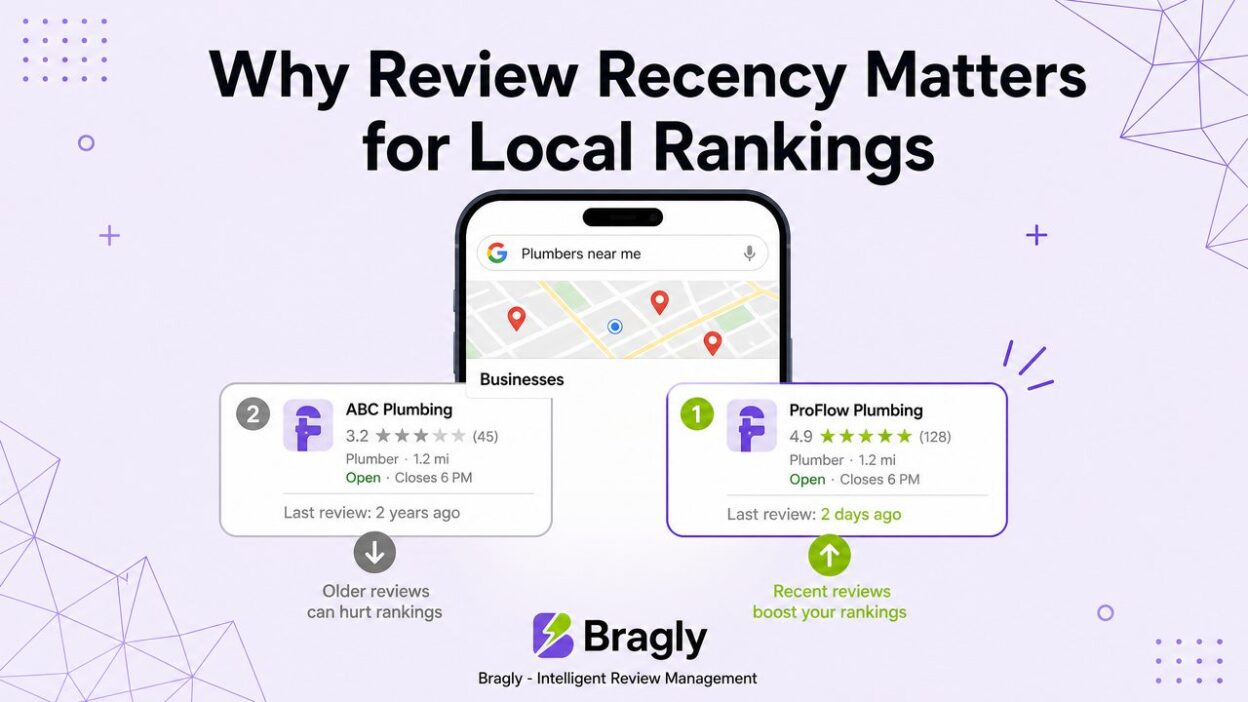
Impact of Review Recency on Rankings
Google uses review recency as a prominence signal influencing local search rankings.Consumer Trust Decays Over Time
73% of consumers find reviews older than three months irrelevant, hurting conversions.Review Velocity Matters
Consistent review accrual over time builds stronger ranking signals than bursts of reviews.Avoid Review Burst Risks
Sudden large influxes of reviews can trigger Google’s spam filters, harming ranking and visibility.A 4.8-star rating built over three years can quietly lose its power. Not because your service has changed, but because your reviews have gone stale. Google’s local algorithm and the customers reading your listing both respond to the same signal: how recently people have been talking about your business.
Key Takeaways
- Review recency refers to how recently your business has received new customer reviews, and it directly affects your position in Google’s local results.
- Google treats a steady flow of new reviews as a sign that your business is active and relevant, not just historically popular.
- 73% of consumers consider reviews older than three months irrelevant, meaning old reviews hurt conversion even when they do not hurt rankings.
- Review velocity (the rate at which you earn reviews) matters as much as recency. A burst of 50 reviews at once is less valuable than two reviews per month over a year.
- The most reliable way to maintain review recency is to build a consistent ask into your customer journey, not to run occasional review campaigns.
What Is Review Recency?
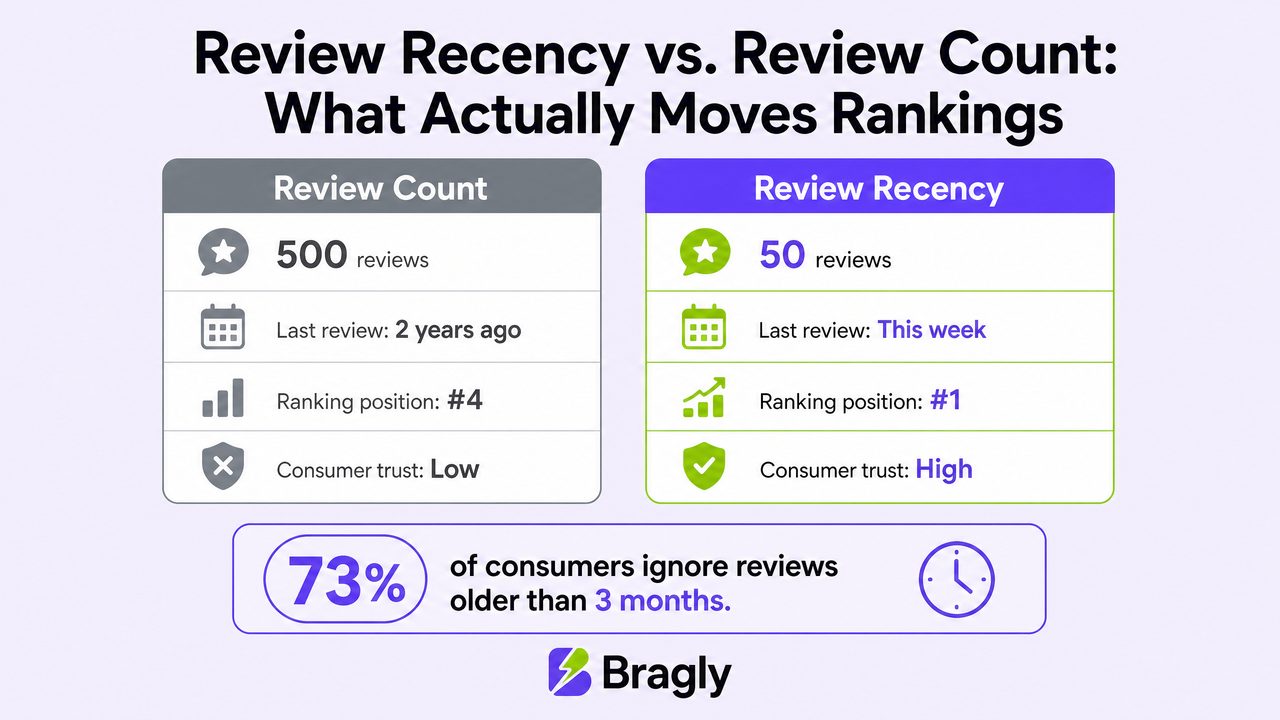
Review recency is simply how recently your customers have left reviews on your Google Business Profile. It is distinct from your total review count and your average star rating. A business can have 500 reviews and a 4.9-star average and still suffer from poor recency if those reviews were all collected two years ago and nothing new has come in since.
The concept matters because both Google and potential customers use review timestamps as a proxy for current business quality. A review from 2022 tells someone what your business was like in 2022. A review from last week tells them what it is like right now.

How Google Uses Review Recency in Local Rankings
Google’s local ranking algorithm evaluates businesses across three core dimensions: proximity (how close you are to the searcher), relevance (how well your profile matches the search query), and prominence (how well-known and trusted your business is). Reviews affect prominence, and within that dimension, recency is one of the signals Google uses to assess whether a business is still actively serving customers.
The practical effect of this is visible in real-world data. Joy Hawkins of Sterling Sky documented a case where a client with one of the highest review counts in their area saw rankings decline after their steady flow of new reviews stopped. When the client restarted their review collection process, rankings recovered. Hawkins noted she had seen the same pattern repeatedly, including a client who had not received a new review in over three years and had been filtered out of rankings for keywords they had historically dominated.
Google has not published a formal specification for how it weights review recency, but the pattern is consistent enough across independent observations that treating it as a real ranking signal is the practical approach. For a broader look at how Google’s review rules affect what gets published, the Google review policy update for 2026 covers the latest changes in detail.
The Consumer Trust Decay Problem
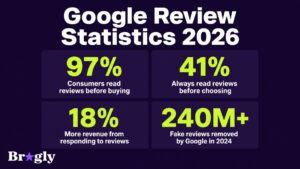
Even if review recency had no effect on rankings at all, it would still matter for conversion. Research shows that 73% of consumers consider reviews older than three months irrelevant, a figure that aligns with the broader data covered in our Google review statistics guide. That means a business with a strong historical rating but no recent activity is effectively invisible to a large portion of its potential customers, even when it appears in search results.
The psychology behind this is easy to follow. When someone sees a review from 18 months ago, they have no way of knowing whether the business has changed since then. Staff turnover, ownership changes, quality shifts, and service updates all happen within 18 months. A recent review removes that uncertainty. It tells the reader that someone with a current experience found the business worth commenting on.
This creates a compounding problem for businesses that stop collecting reviews. Rankings may hold for a while on the strength of historical signals, but click-through rates and conversion rates start to decline as the review timestamps age. Over time, the ranking drop follows.
Review Velocity vs. Review Recency
These two terms are related but not identical, and understanding the difference helps you build a better strategy.
Review recency refers to the age of your most recent reviews. A business that got 50 reviews last month has excellent recency today. A business that got 50 reviews two years ago has poor recency today, regardless of the total count.
Review velocity refers to the rate at which you earn new reviews over time. A business earning two reviews per month consistently has strong velocity. A business that earns 50 reviews in a single week and then nothing for six months has poor velocity, even though its recency was briefly excellent.
| Signal | What It Measures | Why It Matters |
|---|---|---|
| Review recency | Age of your most recent reviews | Signals current business activity to Google and consumers |
| Review velocity | Rate of new reviews over time | Signals sustained engagement; harder for competitors to replicate quickly |
| Review count | Total number of reviews | Baseline trust signal; less dynamic than recency or velocity |
| Average rating | Mean star score | Affects click-through rate; less sensitive to time |
Both recency and velocity matter, but velocity is the more durable long-term position. A competitor can run a review campaign and match your recency in a week. They cannot easily match two years of consistent monthly review collection.
How Often Do You Actually Need New Reviews?
The honest answer is: it depends on your competition. The right cadence for a plumber in a small town is different from the right cadence for a restaurant in a major city.
The practical approach is to look at the businesses ranking above you in your category and location. Check when their most recent reviews were posted and how frequently new ones appear. That gives you a competitive benchmark. If the top-ranked business in your category is getting new reviews every week, matching that frequency should be your target. If the market is less competitive and the top businesses are getting reviews once or twice a month, that pace may be sufficient.
What is clear from both research and practitioner experience is that the floor is higher than most business owners assume. Letting three or more months pass without a new review puts you at risk of both ranking decline and consumer trust erosion. One new review per month is a reasonable minimum for most local businesses. More competitive markets require more.
The Review Burst Risk
One response to learning about review recency is to run a review campaign, asking every customer from the past year to leave a review at the same time. This approach carries a real risk that is worth understanding before you try it.
Google’s spam detection system monitors for unusual patterns in review activity. A sudden influx of reviews from accounts that have never reviewed a business before, all arriving within a short window, can trigger the filter. Reviews get held, delayed, or removed entirely. The business ends up with fewer published reviews than it started with, and the ones that do appear may be flagged as suspicious. If you want to understand why reviews sometimes disappear after a burst, the article on why Google reviews disappear explains the specific causes in detail.
This does not mean you should never ask multiple customers at once. It means the goal should be a consistent, ongoing process rather than periodic bursts. The Reddit r/localseo community, which includes experienced local SEO practitioners, has observed this pattern consistently: two reviews a month for a year will outperform a burst of fifty once in a while.
How to Build a Consistent Review Cadence
The most effective review systems share one characteristic: they are built into the customer journey at a specific, repeatable moment rather than treated as a separate marketing task.
The first step is identifying the right moment to ask. This is typically the point immediately after a positive interaction, when the customer’s experience is fresh and their satisfaction is highest. For a service business, that might be right after a job is completed. For a retail business, it could be at the point of checkout or delivery confirmation. For a professional services firm, it might be after a project milestone.
Once you have identified that moment, the ask should happen every time, for every customer, without exception. Consistency is what builds velocity. A business that asks 30% of its customers for reviews will always underperform a business that asks 100% of its customers, even if the 30% business has a higher average rating.
The practical challenge is that asking consistently requires either a disciplined manual process or an automated system. Manual processes depend on individual staff members remembering to ask, which creates inconsistency. Automated review request tools, like Bragly’s review collection feature, send the request at the right moment in the customer journey without relying on anyone to remember. This is how businesses maintain a steady review cadence even during busy periods when staff attention is focused elsewhere.
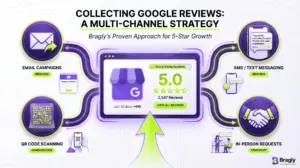
If you want to understand how review notifications and alerts fit into this system, the article on Google review notifications covers the setup process in detail. And if you are just getting started, the step-by-step guide to collecting more Google reviews walks through the full process from first ask to published review.
Final Thoughts
Review recency is not a one-time problem with a one-time fix. It is an ongoing signal that requires an ongoing process. The businesses that rank consistently in local search are not the ones that ran the best review campaign two years ago. They are the ones that have been collecting reviews steadily, month after month, because they built the ask into how they operate.
If your review timestamps are aging, the solution is not a burst of new requests. It is a system that makes asking a natural part of every customer interaction. Start with one consistent moment in your customer journey, make it a habit, and the recency problem takes care of itself.
Frequently Asked Questions
Does review recency affect Google Maps rankings?
Yes. Google’s local algorithm uses review recency as part of the prominence signal that determines where your business appears in Google Maps and the Local 3-Pack. Businesses that stop receiving new reviews can see rankings decline over time, even if their total review count and average rating remain high.
How often should I get new Google reviews for local SEO?
The right frequency depends on your competitive market. As a baseline, at least one new review per month is recommended for most local businesses. In competitive markets, weekly new reviews may be necessary to keep pace with top-ranked competitors. The best approach is to check how frequently the businesses ranking above you are receiving new reviews and match that cadence.
What is review velocity and why does it matter?
Review velocity is the rate at which your business earns new reviews over time. It differs from review recency in that it measures consistency rather than just freshness. A business with strong velocity earns reviews at a steady, predictable rate and is harder for competitors to displace than one that earns reviews in occasional bursts.
Can getting too many reviews at once hurt my ranking?
Yes. A sudden, large influx of reviews can trigger Google’s spam detection filter, causing reviews to be held, delayed, or removed. This is why periodic review campaigns are less effective than a consistent, ongoing process of asking every customer at the right moment.
Do old reviews still count for local SEO?
Old reviews still contribute to your total review count and average star rating, both of which are ranking signals. However, their contribution to the recency signal diminishes over time. A business with 200 reviews from three years ago and no recent activity will be outranked by a competitor with 50 reviews but a consistent monthly cadence, all else being equal.