Looking for a Shorter Overview?
AI Summary
Key Moments
Dual Policy Changes in April 2026
Google implemented two distinct updates within 48 hours, focusing on both external protection tools and internal review solicitation restrictions.New Bans on Review Quotas and Specific Content Requests
Staff-directed review quotas and asking customers to mention specific employees or content in reviews are now explicit policy violations.Importance and Enforcement of Review Gating Ban
Review gating remains banned; businesses must send review requests to all customers equally to avoid violations.Best Practices for Compliant Review Collection
Businesses should ask all customers open-ended review requests, avoid on-premises solicitations, remove incentives and quotas, and never prompt specific content.In April 2026, Google made two separate changes to its review policies within 48 hours. Most businesses only heard about one of them. If you collect Google reviews, through email requests, staff training, or any kind of review program, at least one of these changes probably affects your current process.
This article covers exactly what changed, when it happened, what is now banned, and what a compliant review strategy looks like from here.
Key Takeaways
- Google made two policy changes on April 16 and April 17, 2026. Most coverage only addresses one.
- Staff review quotas are now an explicit violation under the Rating Manipulation policy.
- Asking customers to mention specific employees or include specific content in their review is now banned.
- Google removed 292 million policy-violating reviews in 2025. Enforcement is automated and runs before reviews go live.
- Review gating, on-premises pressure, and incentivized reviews remain banned and are actively enforced.
- Compliant review collection is still possible. The rules change how you ask, not whether you can ask.
The 48-Hour Policy Shift: What Happened on April 16 and 17
Two separate events happened in less than 48 hours. Most coverage treats them as one event or misses the second entirely.
April 16: Three New Protections for Business Owners
On April 16, Google published its 2025 Trust and Safety Report alongside three new defensive measures for Maps. These are about protecting businesses from external abuse:
- Upgraded pre-publication scam detection: Google now identifies coordinated fake review campaigns and review extortion scams before posts go live, not after.
- Gemini-powered edit moderation: Google’s Gemini models now catch policy-violating edits to business profiles before they publish across Android, iOS, and desktop globally.
- Proactive email alerts: Verified Business Profile owners now receive email notifications before important suggested edits go live, giving them a chance to approve or reject changes.
These are defensive tools. They protect your profile from bad actors. The April 17 update is different. It restricts what your own business can do.
April 17: Two New Bans Added to the Rating Manipulation Policy
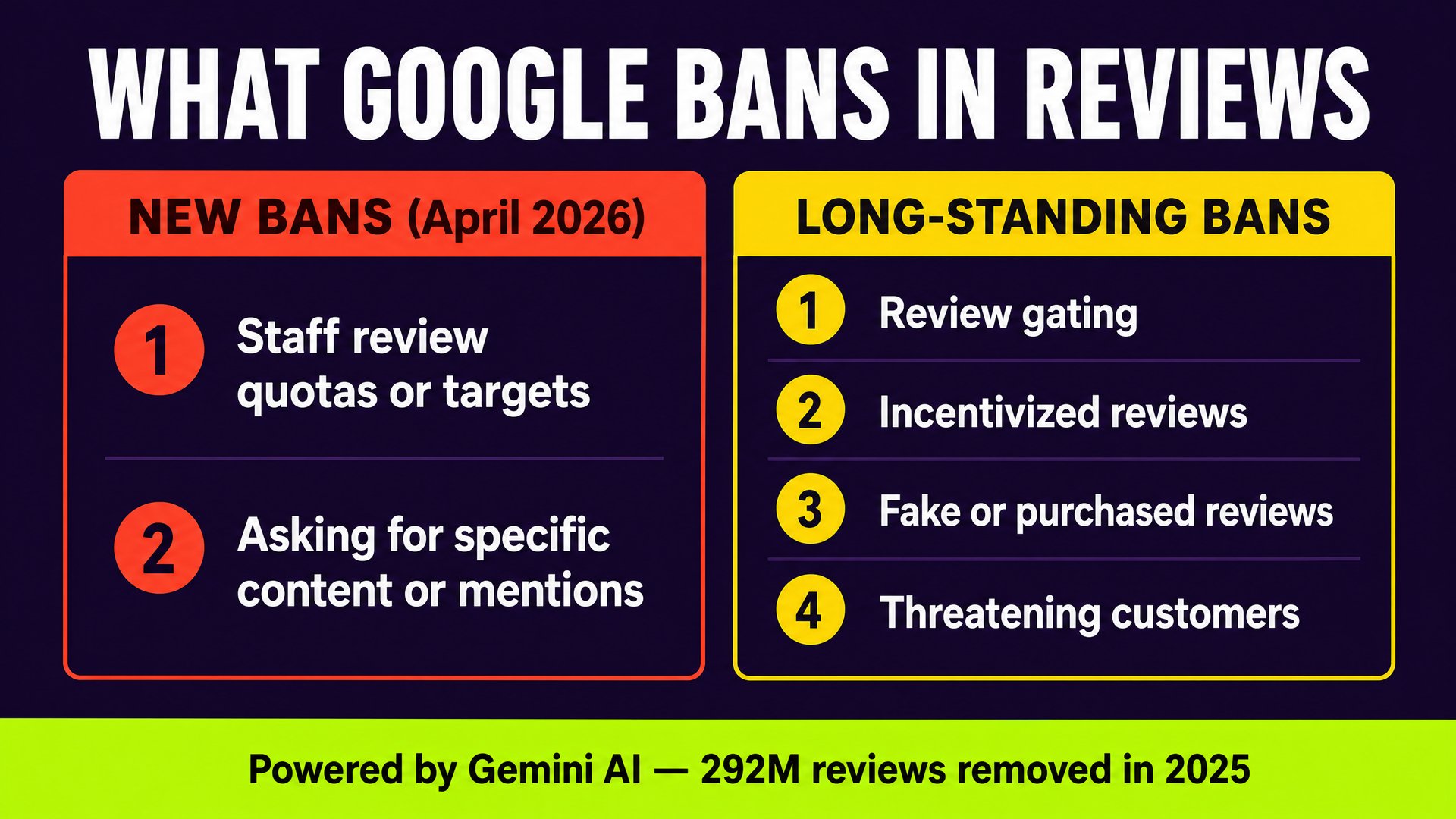
The following day, Google quietly added two new clauses to the Maps User Generated Content Policy under the Rating Manipulation section. The policy now prohibits merchants from:
- Directing staff to solicit a specific number of reviews (review quotas)
- Directing staff to request reviews that include specific content, including content that names a staff member
Both were common practices. Many businesses ran monthly staff contests tied to review counts, or trained teams to ask customers to mention a specific employee by name. Both are now violations.
One thing worth noting: the phrase “reviews that include specific content” is broader than it first appears. Until Google clarifies the exact scope, keep every review request completely open-ended. Do not prompt customers to mention a product, service, or any specific detail.
The Full List of What Is Now Banned
Here is the full list of prohibited practices under the Rating Manipulation and Fake Engagement policies:
| Prohibited Practice | Status |
|---|---|
| Offering any incentive for a review (payment, discounts, free goods, services) | Long-standing ban |
| Discouraging or prohibiting negative reviews | Long-standing ban |
| Review gating (only asking customers expected to leave positive feedback) | Long-standing ban, actively enforced |
| Requiring or pressuring customers to leave a review while on premises | Added in 2025, reinforced 2026 |
| Directing staff to hit a specific number of reviews in a given period | New (April 17, 2026) |
| Asking customers to mention a staff member by name or include specific content | New (April 17, 2026) |
| Posting reviews from multiple accounts at one person’s direction | Long-standing ban |
| Posting reviews using shared devices, emulators, or modified operating systems | Long-standing ban |
| Reviews from employees, vendors, contractors, or family members | Long-standing ban |
The Review Gating Problem Most Businesses Don’t Realise They Have
Review gating is one of the most common violations and one of the least understood. Most businesses assume they are fine as long as they ask politely. The violation is not in how you ask. It is in who you ask.
Sending review requests only to customers you expect to respond positively, while skipping customers who had a poor experience, is gating. The practice itself is the problem, no matter how politely you phrase the request. Google requires that review requests go to all customers equally.
There is a practical reason to stop gating too: 96% of consumers look for negative reviews before making a purchase decision. A profile with nothing but five-star reviews often looks suspicious before any enforcement ever happens.
How Google Detects Violations Now
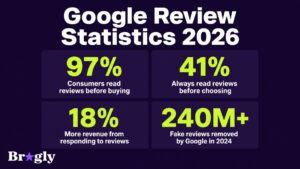
Google’s enforcement is no longer primarily reactive. The 2025 Trust and Safety Report shows Google blocked or removed over 292 million policy-violating reviews in 2025, out of more than 1 billion reviews submitted in total. That is roughly 22% of all review activity flagged as a violation.
Gemini-powered systems now catch fake content, coordinated posting patterns, and policy-violating edits before they reach the public. Google monitors patterns continuously: review volume spikes, shared device signatures, IP clustering, account activity history, and content similarity across submissions.
Most businesses assume review enforcement works like a manual complaint process. It does not. By the time you notice reviews disappearing, the system has already flagged your profile.
Who Is Most Affected by the April 2026 Changes
The new bans hit specific industries harder than others. Car dealerships have historically trained sales staff to ask customers to mention their name in reviews, often tied to performance bonuses. Healthcare and medical practices have used on-premises kiosks to collect reviews right after appointments. Home services businesses have run monthly review contests with prizes for the employee who collected the most.
All three are now explicit violations. If your business falls into one of these categories, retrain staff and remove any quota or incentive structure tied to review collection before your profile gets flagged.
What a Compliant Review Strategy Looks Like Now
The April 2026 update does not stop you from collecting reviews. It changes how you ask. Here is what compliant collection looks like in practice:
- Ask all customers, not just happy ones. Send review requests to everyone equally, regardless of whether you expect a positive response.
- Keep requests open-ended. Do not prompt customers to mention a specific person, product, service, or any particular detail. Ask for honest feedback and nothing more.
- Do not ask on premises. Customers should leave reviews on their own time and their own device, not while standing in your store or waiting room.
- Remove staff quotas and incentives. No performance bonuses, contests, or targets tied to review volume or content.
- Do not offer anything in return. No discounts, free products, or any other incentive in exchange for a review.
A tool like Bragly’s review collection forms lets you send review requests automatically after a transaction, to all customers equally, with no prompting or content direction built in. That is the kind of workflow that holds up as Google’s enforcement tightens.
What to Do Right Now
If you manage a Google Business Profile, run through this checklist against your current process:
- Check whether any staff member has a review target or quota. Remove it.
- Check whether your review request scripts ask customers to mention a name or specific detail. Rewrite them to be open-ended.
- Check whether you are sending review requests to all customers or only selected ones. If selected, switch to all.
- Check whether you have any on-premises review stations or kiosks. Remove them.
- Check whether any incentive is attached to leaving a review. Remove it.
- Check whether employees, contractors, or family members have left reviews. Flag them for removal.
If you manage reviews across multiple platforms, keeping track of what is compliant on each one is easier with a centralized review dashboard that shows all your reviews in one place. You can also use AI-assisted response drafts to respond to reviews faster without sacrificing quality.
Final Thoughts
Google’s April 2026 update is not a reason to stop collecting reviews. It is a reason to clean up how you collect them. The businesses that get hurt are the ones running quota programs, scripted requests, and gated funnels. The ones that benefit are the ones that have been doing it right all along.
If you want to understand the broader picture of how reviews affect your business, the Google review statistics every business should know are a useful read alongside this policy update. Then audit your collection process against the checklist above.
Frequently Asked Questions
What changed in Google’s review policy in April 2026?
Google made two separate changes in April 2026. On April 16, Google published its 2025 Trust and Safety Report and introduced three new defensive tools including Gemini-powered moderation. On April 17, Google added two new bans to the Rating Manipulation policy: staff review quotas are now prohibited, and asking customers to mention specific employees or include specific content in their review is now banned.
Can I still ask customers for Google reviews?
Yes. The policy update does not stop you from asking for reviews. It restricts how you ask. You can still send review requests to customers after a transaction. The request must be open-ended, go to all customers equally, and must not prompt any specific content or mention any specific person.
What is review gating and is it still banned?
Review gating is the practice of sending review requests only to customers you expect to leave positive feedback, while skipping customers who had a poor experience. It has been banned under Google’s policies for years and continues to be actively enforced. All customers must receive review requests equally.
Can I ask customers to mention my employees in their Google reviews?
No. As of April 17, 2026, asking customers to include specific content in their review, including the name of a staff member, is an explicit violation of Google’s Rating Manipulation policy. This was common practice in car dealerships and service businesses, but it is now banned.
Can I offer a discount or reward in exchange for a Google review?
No. Incentivized reviews have been banned under Google’s policies for years. Offering any reward, whether payment, discounts, free goods, or services, in exchange for a review is a violation and can result in those reviews being removed.
What happens if my business violates Google’s review policy?
Google’s automated systems can remove reviews that violate the policy. Repeated or serious violations can result in a warning banner on your Business Profile, reduced visibility in search results, and in serious cases, suspension of your profile. Google blocked or removed 292 million policy-violating reviews in 2025 alone.
Does the April 2026 update apply to all businesses globally?
Yes. Google’s Business Profile review policies apply globally to all businesses using Google Maps and Google Search. The April 2026 changes apply to any business collecting reviews through Google Business Profile, regardless of location or industry.