

Looking for a Shorter Overview?
AI Summary
Key Moments
Start with syndication
If retail network distribution is essential, Bazaarvoice remains the leader to consider.Bragly suits multi-source website proof
Ideal for teams consolidating customer reviews and testimonials from multiple platforms on their own sites.REVIEWS.io offers a clear syndication path
Closest alternative with named partnerships for review distribution including Bazaarvoice.Shopify brands choose Yotpo, Okendo, or Stamped
These platforms combine reviews with loyalty and retention features tailored for Shopify and DTC models.Bazaarvoice earns its place in a serious ecommerce stack. It gives brands and retailers a way to collect product ratings, reviews, photos, questions, and other shopper content, then distribute it across retail partners. That last part matters. It is the difference between a review app for one storefront and a program designed to put product proof where people shop.
Still, a team can outgrow the way it uses Bazaarvoice without outgrowing customer reviews. Some only use the on-site review tools and do not send content to retail partners. Some need product reviews to feed a loyalty program or a Shopify retention plan. Others have a different need altogether: show proof from Google, G2, Trustpilot, video testimonials, and customer stories across an owned website.
That is why I would not start this decision by asking which platform has the longest feature list. Start with the part of Bazaarvoice you would actually miss. If retail-network distribution is the answer, keep it in the evaluation. If it is not, the field opens up quickly.


The five alternatives below take different paths after review collection. One focuses on public proof across your own site. One offers product and company reviews with a stated Bazaarvoice distribution route. The others treat reviews as one part of a wider DTC retention or Shopify operating system.
Quick comparison
| Tool | Best for | What changes from Bazaarvoice |
|---|---|---|
| Bragly | Multi-source proof and website display | Moves the focus from retailer distribution to collecting and showing customer proof across owned sites. |
| REVIEWS.io | Product reviews with a stated syndication route | Combines product and company reviews, visual UGC, public plans, and a stated Bazaarvoice distribution option. |
| Yotpo | DTC retention with reviews at the core | Brings reviews together with loyalty, referrals, and a larger commerce-marketing program. |
| Okendo | Shopify customer marketing | Connects reviews with loyalty, quizzes, referrals, and surveys for Shopify brands. |
| Stamped | Shopify reviews plus lifecycle and loyalty | Starts with review collection, then adds lifecycle automation and loyalty when those jobs belong in one stack. |
Key Takeaways
- Start with syndication. Bazaarvoice is hard to replace if retailer-network distribution, sampling, or enterprise UGC operations are still the main job. If those are not in use, do not pay for them by habit.
- Choose Bragly for owned-site proof. It fits teams that want to bring customer voices from many sources into one place and make them visible across their website.
- Choose REVIEWS.io for a stated distribution route. It is the closest fit here for product and company reviews, visual UGC, public plans, and an official path to Bazaarvoice syndication.
- Choose Yotpo or Okendo for DTC customer marketing. These platforms make more sense when reviews need to work alongside loyalty, referrals, and other shopper-engagement tools.
- Choose Stamped for a Shopify retention stack. It is a useful fit when review collection, loyalty, and lifecycle messaging should be bought and managed together.
1. Bragly: Best for multi-source proof and website display
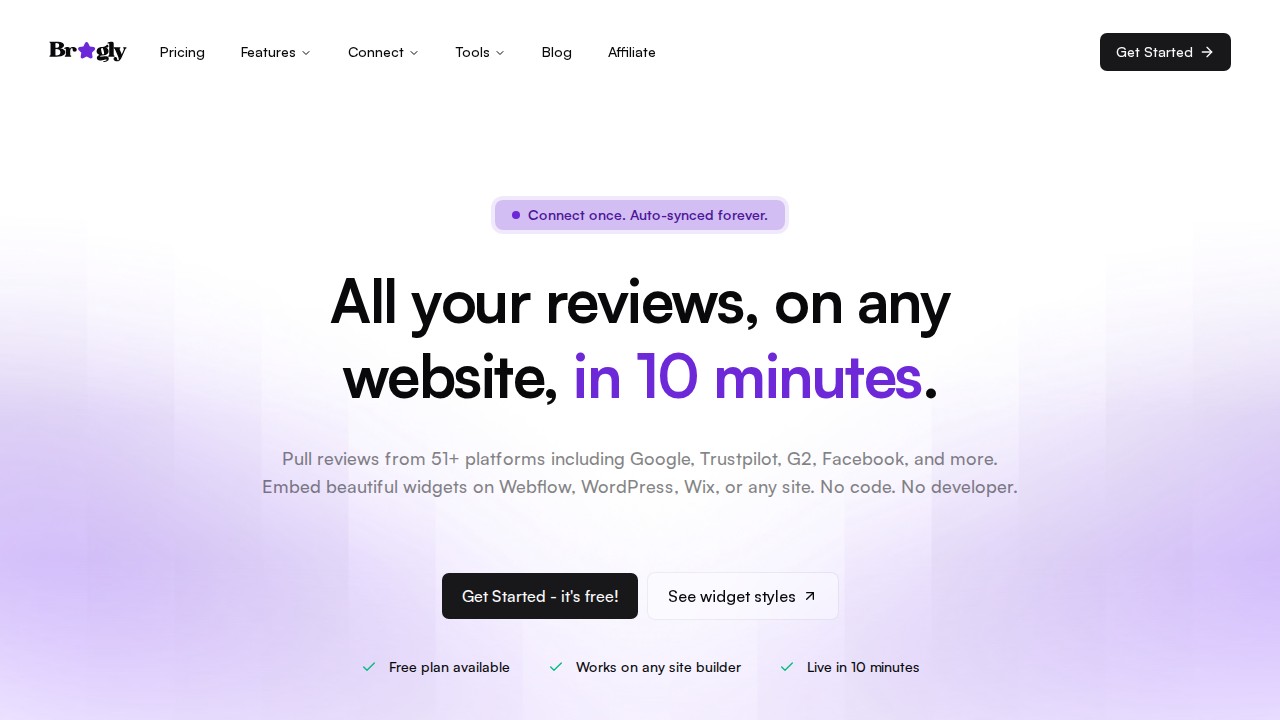
Bragly is the right alternative when the question is not “How do I get reviews onto retailer product pages?” but “How do I make the proof we already have work harder across our own website?” It collects, manages, and displays reviews and testimonials from 47+ platforms, then lets a team put that proof on landing pages, homepages, case-study pages, pricing pages, and product pages.
That is a different operating model from Bazaarvoice. Bazaarvoice is designed for product content, retailer relationships, and distributed commerce. Bragly is built around the trust layer of an owned website. A SaaS company can pull in feedback from G2 and Capterra. A local company can bring in Google reviews. An agency can organize proof for a group of clients. An ecommerce brand can blend product feedback with broader customer stories rather than keeping every proof asset inside its catalog.
The collection side is intentionally flexible. Teams can bring in reviews from supported platforms, use collection forms for new written or video testimonials, and sync customer reviews into one dashboard. From there, they can choose from 10 testimonial widget styles, filter the stories they want to show, and publish them where a visitor needs a reason to trust the business. This makes more sense for a company with many proof sources than for a brand whose only destination is a retailer PDP.
Pricing is also easier to inspect. Bragly has a free plan for up to 10 reviews, Pro at $14 per month, and Business at $67 per month. The difference is not simply price. It is the fact that the platform is solving a different problem. It will not replace Bazaarvoice’s retail network. It can replace the work of copying reviews between sources, collecting scattered testimonials, and leaving valuable proof unused on an owned site.
Choose Bragly if your next project is building a stronger proof system for your website, your client portfolio, or a set of landing pages. Its teams and agencies workspace also suits client access and handoffs. Keep Bazaarvoice in the conversation if your commercial plan still depends on retail distribution.
2. REVIEWS.io: Best for product reviews with a stated syndication route
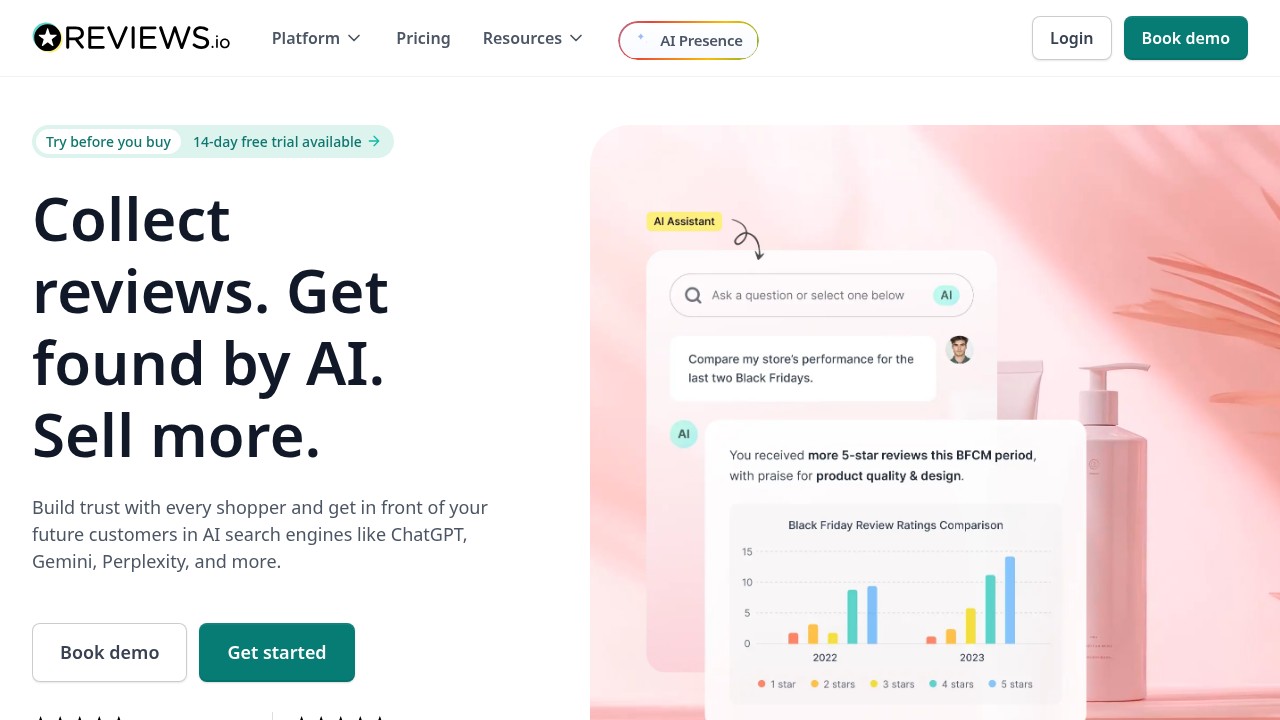
REVIEWS.io is the closest alternative in this list for a team that still needs product reviews, visual UGC, and a named route toward retail distribution. Its product supports company and product reviews, automated requests, photo and video collection, review widgets, Google-oriented proof such as star-rating schema, surveys, review management, and shoppable UGC galleries. It also publishes a review-syndication page that names partnerships with Google, Walmart, and Bazaarvoice.
That last point is important. Do not assume that every product-review platform can put content into the same retail channels. REVIEWS.io describes a Bazaarvoice distribution option on its own materials, which gives a buyer a specific question to take into a demo: which retailer destinations, product matches, contract terms, and migration steps apply to our account? Asking that question early is better than finding out after a platform switch that the retail path was the actual requirement.
REVIEWS.io also has a more visible pricing posture than Bazaarvoice. Its public annual-billing page lists Essentials at $29 AUD per month for up to 300 review invites, Start-Up at $99 AUD for up to 1,500, Grow at $299 AUD for up to 5,000, and Plus at $499 AUD for up to 10,000. The company also lists a 14-day trial. Invitation volume, domains, SMS, and premium features still deserve a careful review, but a team gets a clearer starting point than a demo-only price discussion.
The trade-off is scope. Bazaarvoice is still the deeper enterprise UGC platform if you need its own retailer network, managed sampling programs, global moderation operations, or the full Source, Display, and Amplify product range. REVIEWS.io is a better bet for a team that wants a review program with public plans, product and company proof, visual content, and an explicit answer to the syndication question.
3. Yotpo: Best for DTC retention with reviews at the core

Yotpo is a better Bazaarvoice alternative when customer reviews are part of a DTC retention plan. Its current product positioning centers on Reviews and UGC, Loyalty and Referrals, and AI visibility. That changes the buying question from “How do we distribute product proof to retailer sites?” to “How do reviews, rewards, and referrals help us build repeat purchase behavior?”
For a brand selling mainly through its own store, that can be the more useful frame. A review request can feed review content into a product page, surface common themes for shoppers, and encourage a high-rated customer to join a loyalty or referral workflow. The best case for Yotpo is a team that wants these systems to share customer signals instead of buying each one as a separate point solution.
Yotpo’s review materials also point to customizable displays, galleries, AI-supported summaries, multi-language review experiences, and integrations with the rest of a commerce stack. Its site names more than 180 integrations, while its pricing path is demo-led. That means the platform can suit a growing brand with a larger stack, but buyers should get written clarity on which modules, order volumes, service levels, and migration work are included.
There is a useful boundary here. Yotpo may be an upgrade for a DTC team that barely uses Bazaarvoice syndication and wants to connect reviews to retention. It is not an automatic replacement for a manufacturer that relies on retailer review coverage across an established distribution network. Match the product to the channel where most of your revenue is actually won.
4. Okendo: Best for Shopify customer marketing

Okendo is for Shopify teams that want reviews to sit inside a wider customer-marketing program. Its platform brings together Reviews, Loyalty, Quizzes, Referrals, and Surveys. The reviews product includes product and site reviews, photo and video content, capture forms, onsite widgets, imports, moderation, replies, analytics, and selected commerce connections.
The advantage is not that every team needs five products. It is that a team can use the same customer events in more than one place. A post-purchase request can collect review content. A positive reviewer can receive a loyalty prompt or a referral invitation. A quiz response or survey answer can add context to the customer record. This is an appealing setup for a brand that wants its review program to feed a broader Shopify growth plan.
Okendo’s pricing is tied to monthly order volume. Its public pages show individual products, bundles, custom platform plans, order bands, support options, and add-ons, rather than a single fixed starting price that works for every store. That is normal for a platform that covers more than reviews, but it makes the implementation conversation more important. Ask which product is required, what happens when order limits are reached, what needs an add-on, and how existing reviews will move across.
The limitation is channel focus. Okendo is strongest for Shopify commerce. It does not try to be a broad retailer-network replacement for Bazaarvoice. It fits a DTC brand with an owned Shopify store and a desire to combine social proof with loyalty, referrals, quizzes, or surveys.
5. Stamped: Best for Shopify reviews plus lifecycle and loyalty
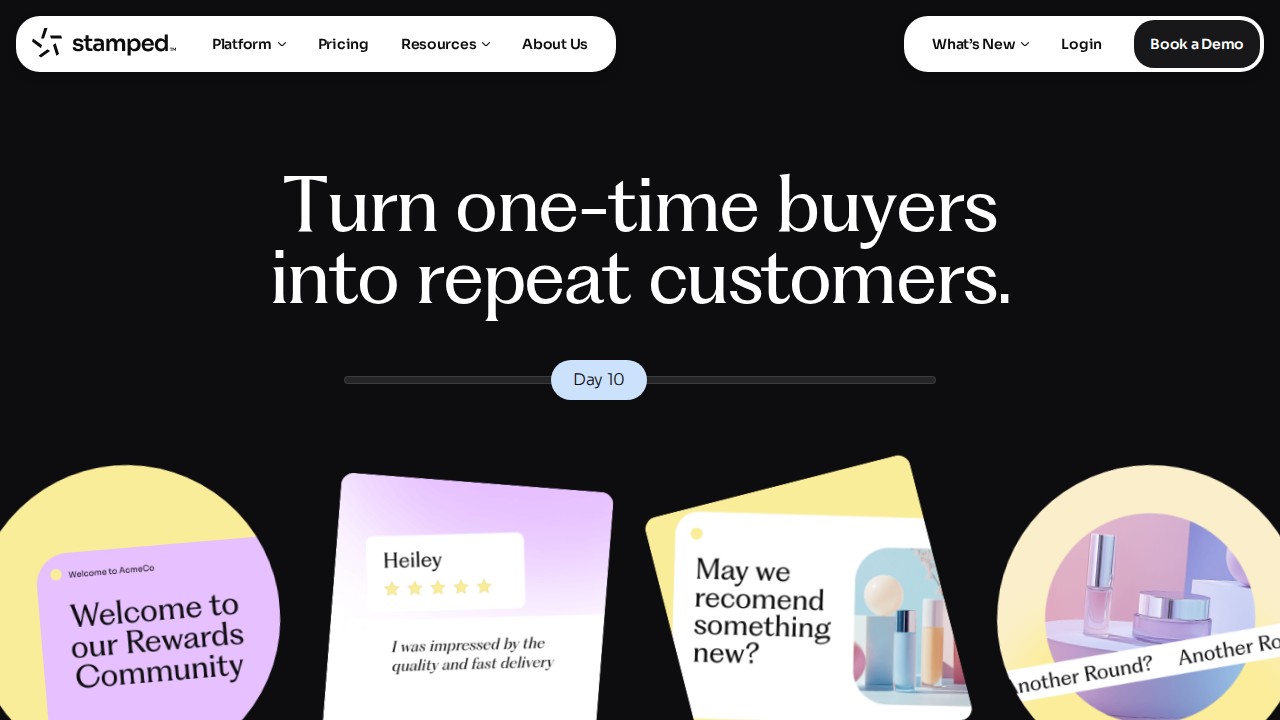
Stamped takes a related but more retention-oriented route. The current platform is organized around Reviews, Loyalty, and Lifecycle. Its Reviews product includes in-email collection, configurable onsite widgets, photo and video UGC, questions and answers, review imports, smart sentiment analysis, review displays, visual galleries, and Google-oriented capabilities. The Lifecycle product then addresses post-purchase, replenishment, and win-back programs.
That makes Stamped a sensible choice for a Shopify brand that wants reviews to influence what happens after the first order. A customer can leave a review, receive loyalty value, and later see a replenishment or win-back message. A team does not have to buy all three products, but the option is there when those workflows belong together.
Its public pricing is easier to use as a starting point than most enterprise review platforms. Stamped lists Reviews at $199 per month, Loyalty at $299 per month, and Lifecycle at $499 per month, with price changes based on order volume and the selected products. It also notes that the platform is built for Shopify and Shopify Plus. Treat those figures as a starting discussion, not a promise that every account will pay the same amount.
Choose Stamped when the current Bazaarvoice setup feels too centered on retailer distribution and your real plan is a Shopify retention stack. Skip it if the main need is multi-source proof outside ecommerce or broad retail syndication. In those cases, Bragly or a more direct syndication option will make more sense.
How to choose a Bazaarvoice alternative
The fastest way to make a bad decision is to compare every feature without first naming the job you need to keep. Start with these four questions.
| If this statement is true | Start your evaluation with |
|---|---|
| “Retail partners need our product reviews where they sell our products.” | Keep Bazaarvoice in the evaluation and ask REVIEWS.io about its stated distribution route and the exact destinations that apply. |
| “We sell mainly through our own Shopify store and want reviews to feed retention.” | Yotpo, Okendo, and Stamped. Decide whether loyalty, referrals, quizzes, surveys, or lifecycle programs need to be in the same stack. |
| “Our strongest proof lives across several review sites, testimonials, and customer stories.” | Bragly. Check how you will collect, organize, and display those sources throughout the website. |
| “We only use a slice of our current platform and need a clearer pricing model.” | REVIEWS.io, Bragly, or a focused Shopify option, depending on where proof must appear. |
Next, do a channel audit. List every place your reviews appear today: your site, retailer PDPs, Google surfaces, email, paid landing pages, sales decks, and client sites. Use this guide to displaying reviews on a website if you need a placement checklist. Then mark the places that influence revenue or lead quality. A platform can look cheaper until you discover that a critical channel is missing from the migration plan.
Ask about ownership and export before signing. You need to know how review text, rating data, photos, video, dates, product identifiers, and metadata leave the old account and enter the new one. For product reviews, verify the mapping of variants, parent products, SKUs, and store domains. For retailer distribution, get the destination list in writing. For website proof, confirm widget performance, search visibility, filtering, and design control.
Finally, migrate with a small proof plan rather than a vague launch plan. Choose ten priority pages or product groups. Identify the review source for each one, the display format, the owner, and the success measure. That gives the new platform a clear first job and exposes missing data or display gaps early. If the wider need is a review platform rather than a retailer-distribution system, the best review management software comparison gives a useful second shortlist.
Final Thoughts
The right Bazaarvoice alternative depends on a decision that often gets buried in software demos: do you need a retail distribution system, a DTC retention stack, or a better way to show customer proof on your own website?
Keep Bazaarvoice close if its retailer network and enterprise UGC program are active parts of your sales model. Look at REVIEWS.io if you want product and company reviews with a public pricing path and an explicit distribution conversation. Pick Yotpo, Okendo, or Stamped if your main goal is to connect reviews with loyalty and Shopify customer marketing. Choose Bragly if the work ahead is collecting proof from many places and putting it to use where prospects make decisions on your site.
The platform name matters less than the route your reviews need to take after they are collected. Get that answer clear, and the shortlist becomes much easier to use.
What is Bazaarvoice used for?
Bazaarvoice is a UGC platform for brands and retailers. It supports product ratings and reviews, photos and videos, questions and answers, moderation, review responses, consumer insight, sampling, social content, and retail syndication. Its Enterprise package includes retail syndication through the Bazaarvoice Network.
Is there a free Bazaarvoice plan?
Bazaarvoice’s public pricing page describes Essentials, Advanced, and Enterprise packages, but it does not list a fixed public monthly price. Its Shopify app is free to install, but the listing says that Bazaarvoice can charge separately. Treat it as a sales-led product rather than a free plan.
What is the closest Bazaarvoice alternative for review syndication?
REVIEWS.io is the closest option in this list for a team that still needs a stated syndication route. Its public materials describe review distribution partnerships with Google, Walmart, and Bazaarvoice. Confirm the exact retailer destinations, product matching, contract terms, and migration path for your account before replacing Bazaarvoice.
Which Bazaarvoice alternative is best for Shopify brands?
Okendo and Stamped are strong Shopify-focused options. Okendo fits brands that want reviews linked to loyalty, referrals, quizzes, and surveys. Stamped fits brands that want Reviews, Loyalty, and Lifecycle in the same platform. Yotpo is another DTC option for reviews paired with loyalty and referrals.
Can a Bazaarvoice alternative help display reviews outside product pages?
Yes. Bragly is designed for teams that need to gather and display customer proof from many sources across an owned website. Its widgets can support homepages, pricing pages, landing pages, service pages, case studies, and other locations where visitors need reassurance before they act.