

Looking for a Shorter Overview?
AI Summary
Key Moments
Tailor your choice to the specific review task
Identify whether you need flat pricing, public proof aggregation, retention tools, or reputation management to narrow alternatives.Bragly excels at public-source review aggregation
It consolidates reviews from over 47 public platforms, adding direct feedback for use across multiple websites.Judge.me offers straightforward flat pricing for Shopify reviews
Ideal for Shopify stores wanting unlimited review collection without order-based price growth.Migration requires careful data verification
Export samples first and check mappings, media, and verification statuses before full migration.Okendo is a serious customer marketing platform for Shopify brands. Its Reviews product sits beside loyalty, referrals, surveys, and quizzes, so a store can connect more of the customer journey. That is a good fit when a team wants the whole program.
The question changes when only one piece needs replacing. Some brands want fixed-price product reviews. Some need customer proof from Google, G2, marketplaces, and direct submissions in one place. Others want a different retention stack or commercial model.
I would not switch from Okendo because another product lists more features. First name the job: review collection, order-based pricing, public-source proof, company reputation, loyalty, or a broader DTC program. That answer narrows the field quickly.


The five tools below cover those distinct jobs. Bragly is my top pick when proof lives beyond a Shopify catalog. Judge.me is the fixed-price Shopify option. Stamped and Yotpo keep the retention focus, while REVIEWS.io handles product and company reviews, UGC, surveys, and reputation work.
Quick comparison
| Tool | Best for | Pricing posture | Choose it when |
|---|---|---|---|
| Bragly | Public reviews and customer proof across owned web properties | Free up to 100 reviews; paid from $14/month | Your proof is spread across public platforms, direct feedback, and more than one web page. |
| Judge.me | Flat-price Shopify review collection | Free or $15/month | You want unlimited product and store review collection without order-based plan growth. |
| Stamped | Reviews connected to lifecycle and loyalty | Reviews from $199/month in its main plan builder | Retention programs need to work with reviews and customer insights. |
| REVIEWS.io | Reviews, UGC, surveys, and reputation operations | Free tier and invite-based paid plans | Product and company reviews need to work together with Google and survey data. |
| Yotpo | Large DTC reviews and loyalty stack | Demo-led public pricing | Your team wants reviews, loyalty, referrals, and a broad integration ecosystem. |
Key takeaways
- Pick Bragly when customer proof is already spread across public sources, direct feedback, and your own web properties rather than one Shopify catalog.
- Pick Judge.me when flat Shopify review pricing and unlimited collection matter more than a wider customer marketing suite.
- Pick Stamped when you want reviews, loyalty, and lifecycle programs to inform each other.
- Pick REVIEWS.io when product and company reviews, UGC, surveys, Google outputs, and reputation work belong in the same workflow.
- Pick Yotpo when a larger DTC reviews and loyalty stack fits the way your team already runs retention.
1. Bragly: Best for public reviews and website proof beyond Shopify
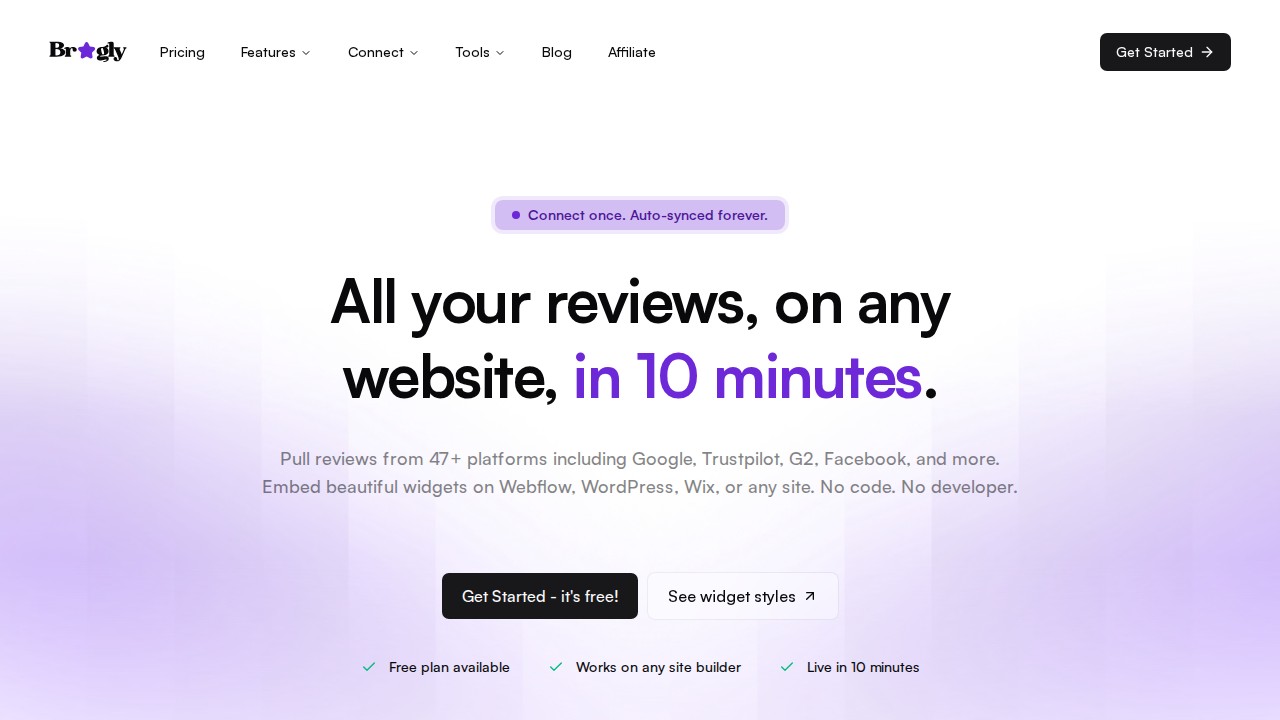
Bragly is the best Okendo alternative for a team whose strongest customer proof does not begin and end on a Shopify product page. It brings reviews from more than 47 public platforms into one workspace, then lets a team collect new text and video feedback through forms, QR codes, and campaigns. That mix matters when reviews are already on Google, G2, Capterra, Facebook, app stores, marketplaces, and direct customer channels. For a wider view of this category, see our guide to review management software.
This is a different job from Okendo. Okendo is designed to connect Shopify review data with loyalty, referrals, surveys, and quizzes. Bragly is for building a usable proof library from scattered public sources and new submissions, then showing that proof on the pages a company owns. A team can sync customer reviews in one dashboard and choose a relevant review for a service page, pricing page, home page, client site, or campaign without copying quotes by hand.
For agencies, that distinction is especially useful. One workspace can hold customer proof during a build, and the project can move to the client when the work is complete. Bragly’s teams and agency workflow supports that handoff. For SaaS companies, local businesses, e-commerce brands, and larger teams, the same idea applies: the review source may be wider than a single checkout flow.
| Consideration | Bragly fit |
|---|---|
| Best for | Combining public reviews, direct feedback, and testimonials for use across owned web properties. |
| Collection | Text and video forms, campaigns, QR codes, and post-purchase requests. |
| Display | More than 30 website display layouts, embeds, Wall of Love pages, and custom-domain options. |
| Pricing | Free plan for up to 100 reviews; paid plans begin at $14/month. |
| Choose another tool if | You need a Shopify-native loyalty, quizzes, referrals, and surveys suite in the same product. |
Bragly also includes moderation, AI reply suggestions, webhooks, and shared workspaces. That helps when proof needs to be collected and published across multiple locations, products, clients, or business lines. It is not meant to replace every retention product. It makes customer proof easier to find, manage, and publish.
2. Judge.me: Best for flat-price Shopify reviews
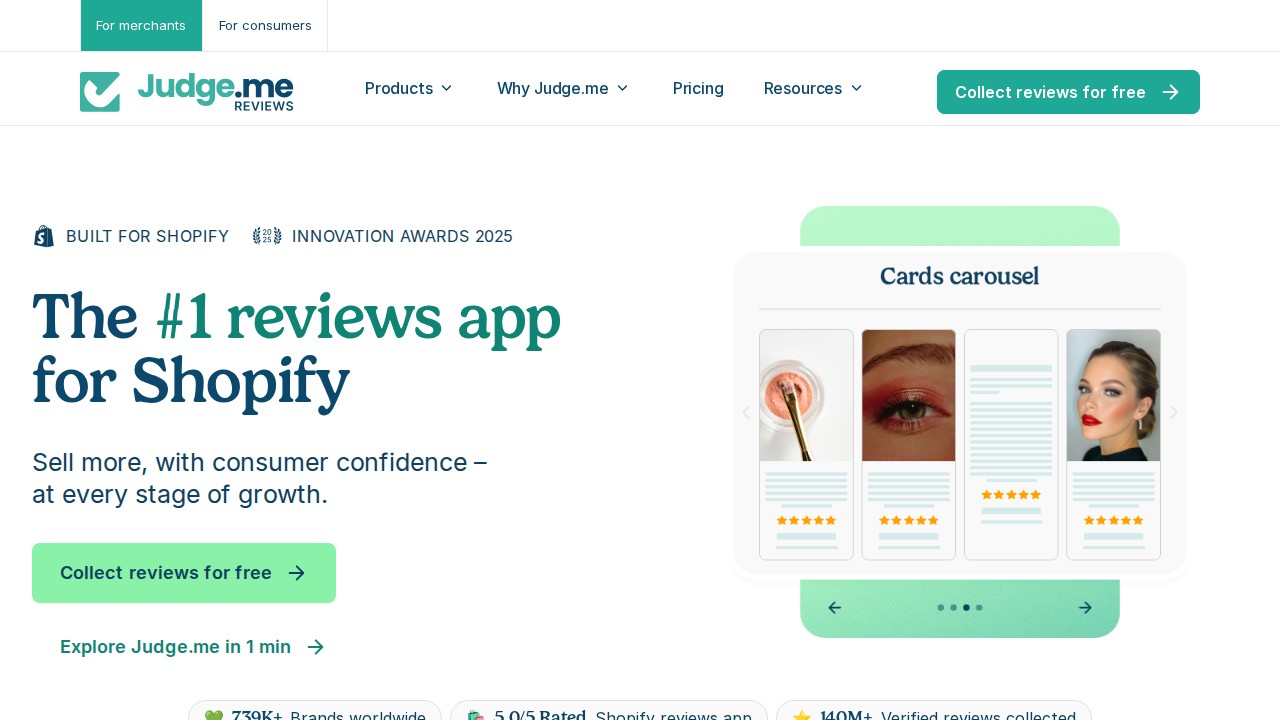
Judge.me is the cleanest answer for a Shopify store that wants product and store reviews without tying the review plan to growing order volume. Its public offer is simple: a free plan or an Awesome plan at $15 per month, with unlimited collection, widgets, photo and video reviews, AI review features, and broad Shopify-oriented syndication.
That pricing model is the main reason it belongs on an Okendo alternatives list. Okendo Reviews has plans based on monthly order volume. A brand with unpredictable promotions, seasonal spikes, or steady order growth may prefer to know exactly what the review product will cost each month. A fixed price does not make Judge.me better in every way. It simply makes the trade-off easier to understand.
Judge.me also has a documented path for moving from Okendo. The process starts with an Okendo export and a CSV import. A buyer should still test a small set before moving everything. Imported reviews do not automatically gain Judge.me verification status, may not qualify for Google Shopping Product Ratings, and video reviews need separate attention.
| Consideration | Judge.me fit |
|---|---|
| Best for | Shopify brands that want product and store reviews with a fixed monthly cost. |
| Collection | Unlimited review collection, automated requests, imports, and review rewards. |
| Display | Product and store widgets, photo and video galleries, summaries, and star ratings. |
| Pricing | Free plan or $15/month for the full paid plan, with no order caps. |
| Choose another tool if | You need public-source aggregation or a connected loyalty, quiz, referral, and survey program. |
I would choose Judge.me when the review program itself is the project. It stays focused on getting ratings and visual feedback onto Shopify product pages. That focus suits a lean commerce team, but can be a limit when reviews must feed a larger retention model or company-reputation work.
3. Stamped: Best for connected reviews, lifecycle, and loyalty
Stamped is the closest match here for a brand that likes the idea of reviews sitting beside retention tools, but wants a different product family from Okendo. It combines Reviews, Loyalty, and Lifecycle. Its message is less about a single review widget and more about turning customer behavior into follow-up actions that lead to another order.
The Reviews product includes in-email collection, on-site displays, photo and video UGC, Q&A, review grouping, Google options, sentiment analysis, and imports. Its Lifecycle product focuses on post-purchase, replenishment, and win-back automation. Loyalty covers points, rewards, VIP structures, referrals, and customer communication. The overlap with Okendo is real, which makes this comparison useful rather than forced.
Its published main pricing builder lists Reviews from $199 per month, Loyalty from $299 per month, and Lifecycle from $499 per month, with pricing that changes by product choices and order volume. Stamped also points smaller or newer Shopify brands toward its self-serve app plans. That means a buyer should look at the exact path they plan to take, not just a headline price.
| Consideration | Stamped fit |
|---|---|
| Best for | Shopify teams that want reviews, loyalty, and lifecycle marketing to share customer signals. |
| Collection | In-email requests, photo and video UGC, Q&A, review grouping, and imports. |
| Retention layer | Replenishment, win-back, loyalty rewards, referrals, and customer timing. |
| Pricing | Main Reviews plan builder starts at $199/month; smaller self-serve plans are also available. |
| Choose another tool if | You only need review collection at a low fixed price or public-source proof outside Shopify. |
Stamped deserves a serious demo when lifecycle timing is central to the decision. Reviews can inform replenishment prompts, loyalty offers, and repeat-purchase campaigns. The trade-off is scope: if you only need review collection, a three-product retention program may be more than the team needs.
4. REVIEWS.io: Best for reviews, UGC, surveys, and reputation operations
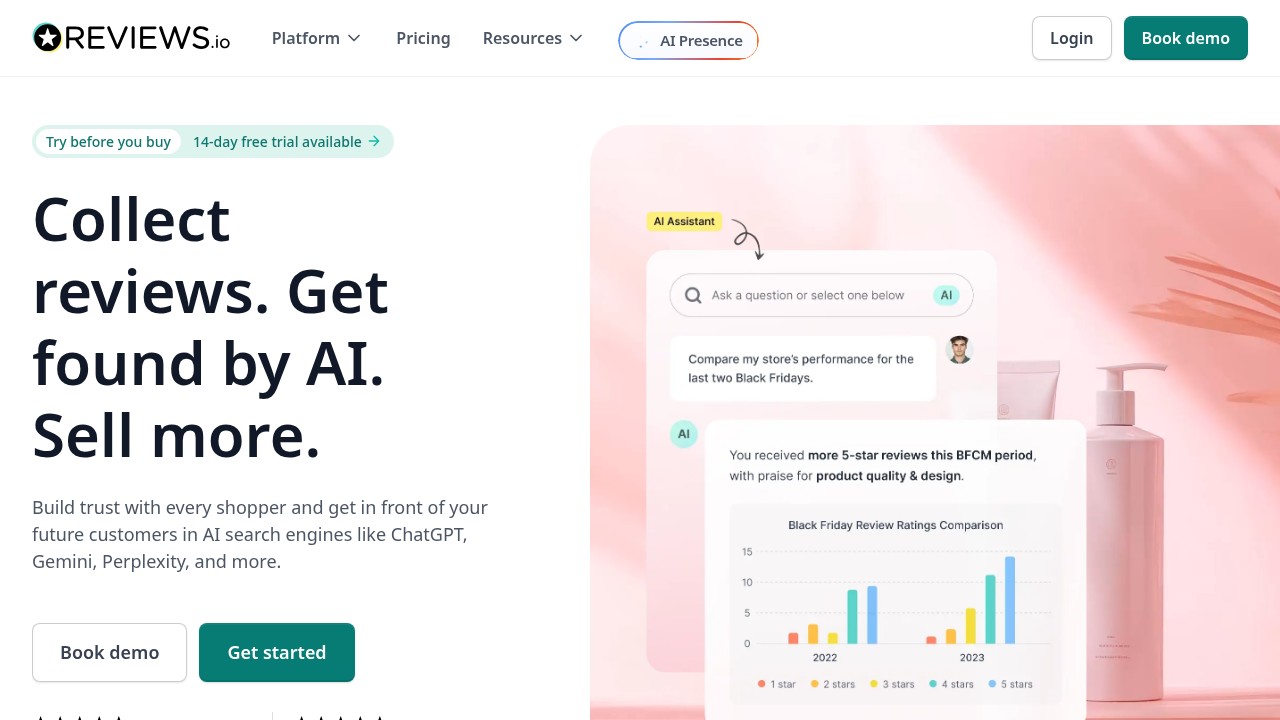
REVIEWS.io is the best option here for a company that wants product reviews, company reviews, UGC, surveys, and reputation work to live closer together. That is a different center of gravity from Okendo’s Shopify-first customer marketing suite. It can suit a business that needs to understand how the company is perceived beyond individual product pages, including customer feedback around service, delivery, support, or retail locations.
Its product range includes product and company review collection, photo and video reviews, review invitations, on-site widgets, shoppable UGC galleries, Google Seller Ratings, AI review replies, reputation management, surveys, NPS, and feedback analytics. Its Reputation Manager is worth noting for a team that wants to monitor review activity across channels rather than focus only on shopper-submitted product feedback.
The pricing page shows a free tier and invite-based paid plans. Its Essentials plan is listed from $29 per month billed annually, with higher plans that add third-party collection, review importing, Google outputs, reputation features, survey allowance, and advanced tools. Confirm the currency and current plan terms for your market before comparing the total cost with Okendo.
| Consideration | REVIEWS.io fit |
|---|---|
| Best for | Product and company reviews, UGC, surveys, Google outputs, and wider reputation work. |
| Collection | Product, company, photo, video, third-party, and survey-driven collection paths. |
| Reputation layer | Google Seller Ratings, company review workflows, reputation monitoring, and branches. |
| Pricing | Free tier plus invite-based paid plans, with Essentials listed from $29/month billed annually. |
| Choose another tool if | You want one native Shopify suite for reviews, loyalty, referrals, quizzes, and surveys. |
This is relevant for a brand that may leave Shopify or run a custom or headless store. It can also add capabilities a store does not need, so review the invite limits, domains, survey allowance, and plan features before moving. If placement is the immediate concern, our guide to displaying customer reviews across a website is a useful companion.
5. Yotpo: Best for a large DTC reviews and loyalty stack
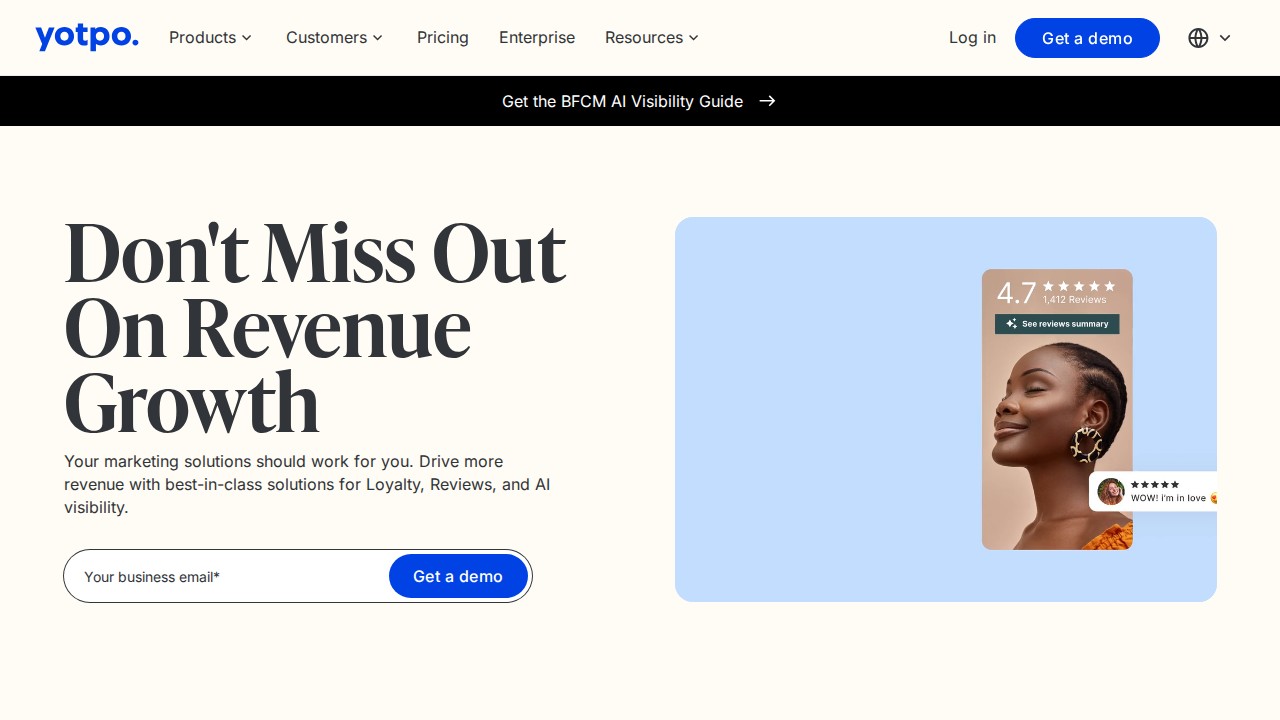
Yotpo is a credible alternative for a DTC brand that wants reviews and loyalty to remain part of a larger marketing stack. Its current platform message focuses on Reviews and UGC, Loyalty and Referrals, AI visibility, and a wide integration network. That puts it in the same broad conversation as Okendo for teams that want customer feedback to influence repeat purchase, referral, and retention activity.
The Reviews product covers collection, displays, review themes, language support, and AI summaries. The Loyalty product adds rewards and advocacy mechanics. A team with a mature commerce operation may find the integration range and DTC orientation attractive, especially when review data needs to travel into other marketing tools.
The big caveat is pricing visibility. Yotpo’s public pricing page is built around booking a demo rather than showing a clear entry price. That does not make it a poor option, but it changes the buying process. Ask for the plan structure, contract length, migration assistance, implementation expectations, included modules, and the price at your current and expected order volume before treating it as a direct cost comparison.
| Consideration | Yotpo fit |
|---|---|
| Best for | DTC brands that want reviews and loyalty inside a broad marketing and integration ecosystem. |
| Collection | Reviews, UGC, AI-supported displays, and shopper feedback workflows. |
| Retention layer | Loyalty, referrals, rewards, and connections to many marketing tools. |
| Pricing | Demo-led public pricing; request a written quote and commercial terms. |
| Choose another tool if | You need transparent self-serve pricing, public-source aggregation, or a small review-only product. |
Yotpo is not the automatic upgrade from Okendo, and Okendo is not automatically cheaper. The better platform depends on the modules your team will activate, the implementation help you want, and what your retention team already uses. A smaller Shopify store may not need that much system.
How to choose an Okendo alternative
Start with the part of Okendo you are replacing. That is more useful than comparing feature-count checklists. A platform can look strong in a table and still be a poor fit if it solves a different business problem.
| If you are replacing… | Start with | Why |
|---|---|---|
| Reviews only, with predictable cost | Judge.me | The free and $15/month options make the commercial model easy to understand. |
| Public-source proof and testimonials beyond Shopify | Bragly | It pulls together public reviews and new feedback for use across owned websites. |
| Reviews plus lifecycle and loyalty | Stamped | Its product family is built around reviews, repeat orders, and customer timing. |
| Reviews plus company reputation, surveys, and UGC | REVIEWS.io | It connects product and company feedback with surveys, Seller Ratings, and reputation work. |
| A large DTC reviews and loyalty stack | Yotpo | It pairs reviews with loyalty and referrals across a broad marketing ecosystem. |
Then compare the commercial model. Okendo’s public review plans move with monthly order volume; Judge.me’s core paid plan does not. REVIEWS.io uses invites, Stamped changes by product choice and order volume, and Yotpo requires a quote. That affects forecasting and plan changes during promotions.
Migration deserves its own workstream. Export a sample from Okendo before canceling. Check ratings, dates, authors, product mapping, media, replies, verification status, and every destination channel. Imported data can behave differently in Google, TikTok, product ratings, and review widgets.
Finally, ask where the proof needs to appear. A Shopify product page is one answer. A company home page, local landing page, software comparison page, partner site, campaign page, or client build is another. The platform should match the places where customers make decisions, not just the source where a review was collected. Bragly’s testimonial widgets make it possible to tailor the format to that page.
Final thoughts
Okendo remains a good choice for a Shopify brand that wants reviews connected to loyalty, quizzes, referrals, and surveys. The best alternative depends on why that bundle no longer fits. Changing platforms can make sense when pricing needs to be flatter, public proof needs a wider home, company reputation needs attention, or another retention stack matches the team’s day-to-day work better.
If the job is to collect and show customer proof from many sources across your own websites, start with Bragly. If the job is a Shopify review program at a fixed price, start with Judge.me. Keep Stamped, REVIEWS.io, and Yotpo in the conversation when the decision reaches deeper into retention, reputation, surveys, or a broader DTC marketing system. The better choice is the one your team will actually set up, maintain, and use after the migration is complete.
Frequently asked questions
What is the best Okendo alternative overall?
Bragly is the strongest overall choice for teams that want to collect public reviews from many sources, add fresh text and video feedback, and display that proof across their own websites. The better answer can change if the main job is Shopify review collection, a connected retention suite, or company reputation work.
Is there a free alternative to Okendo?
Yes. Okendo has a free plan up to 50 monthly orders. Bragly has a free plan up to 100 reviews, and Judge.me has a free Shopify plan. Compare the collection limits, display needs, and source coverage before choosing a free tier.
Which Okendo alternative is best for Shopify review collection?
Judge.me is a strong fit for Shopify stores that want unlimited product and store review collection at a flat monthly price. Stamped, REVIEWS.io, and Yotpo are worth comparing when the review program needs to connect more closely with retention, UGC, loyalty, or a wider marketing stack.
Can I migrate reviews from Okendo to another platform?
Yes, most major review platforms support an import path. Export a sample from Okendo first, then verify ratings, product mappings, dates, author data, photos, videos, replies, verification status, and destination-channel eligibility before moving the full archive.
Which alternative is best for reviews from many public sources?
Bragly is built for that situation. It brings reviews from more than 47 public sources into one workspace, then combines them with fresh text and video feedback for use across websites, client projects, and campaign pages.