

Looking for a Shorter Overview?
AI Summary
Key Moments
Meter choice impacts pricing and usage
Pricing varies by unique visitors, notifications, or impressions, so pick based on your campaign consumption.Bragly excels at lasting, detailed proof
Best for teams needing imported reviews and customer stories visible beyond short popups.ProveSource is best for live activity notifications
A natural replacement for TrustPulse when keeping live visitor notifications is key.WiserNotify suits teams focused on testing and experimentation
Ideal for campaigns requiring A/B testing, goal tracking, and a broad range of notification templates.TrustPulse is a good fit when you want a visitor to see recent activity while they are deciding. Its campaigns can show purchases, signups, popular activity, and action messages without asking the visitor to leave the page.
The reason to look elsewhere is usually more specific than wanting a different social-proof tool. You may hit a monthly unique visitor limit before traffic feels substantial, need a pricing model based on notifications or impressions instead, want stock and delivery prompts beside your proof, or need a review that remains visible after a popup has gone away.
That distinction changes the shortlist. A live purchase notice, a time-window activity counter, and a review widget may all build trust, but they do different jobs. Treating them as interchangeable is how teams end up paying for a familiar interface that does not solve the page-level problem.


I compared the alternatives by starting with the meter, then the visitor cue, then the shelf life of the proof. The five tools below cover those different jobs. Bragly is my first choice when customer proof needs a lasting place on the website. ProveSource, Fomo, Nudgify, and WiserNotify are closer matches when notification campaigns are the main requirement.
Quick comparison
| Tool | Best for | What changes from TrustPulse | Pricing posture | Choose it when |
|---|---|---|---|---|
| Bragly | Reviews and customer stories that remain on the page | Replaces short activity notices with imported reviews, collection, moderation, and many page-level displays | Free up to 100 reviews; Pro from $14/month | A visitor needs proof they can read on a homepage, product page, pricing page, or customer-stories page. |
| ProveSource | A close notification-first replacement | Adds a forever-free starting point, broader notification formats, review notices, and visitor-based usage | Free option; paid plans follow monthly traffic | You want to stay close to live activity campaigns but want more notification choices. |
| Fomo | Notification-based usage and optional inline proof | Uses a notification-send meter, with API access and inline proof on higher plans | From $25/month for 8,000 notifications | Notification volume is easier for your team to estimate than monthly visitors. |
| Nudgify | E-commerce behavior nudges | Adds stock, delivery, discount, urgency, and friction prompts beside social proof | From $9/month for 10,000 impressions | A store needs a decision cue that goes beyond recent purchases or signups. |
| WiserNotify | Templates, tests, and broad event inputs | Adds wider template choice, A/B tests, goal tracking, and inline messages on higher tiers | Basic from $59/year; Pro from $16/month | You need campaign variation and experimentation more than a compact notification builder. |
Key takeaways
- Start with the meter. Monthly unique visitors, notification sends, and impressions are different limits. Compare the one your site will actually consume.
- Choose Bragly for proof that stays. It is the stronger fit for imported reviews, fresh customer stories, and flexible displays that keep working after a visitor dismisses a popup.
- Choose ProveSource for a close visitor-based replacement. It is a natural next option when live activity is still the main job and a free starting point matters.
- Choose Fomo or Nudgify for a different delivery model. Fomo fits notification-led usage, while Nudgify connects proof to stock, delivery, discount, and checkout behavior.
- Choose WiserNotify for breadth and testing. It fits teams that need more campaign forms, broad event inputs, goal tracking, and experiments.
1. Bragly
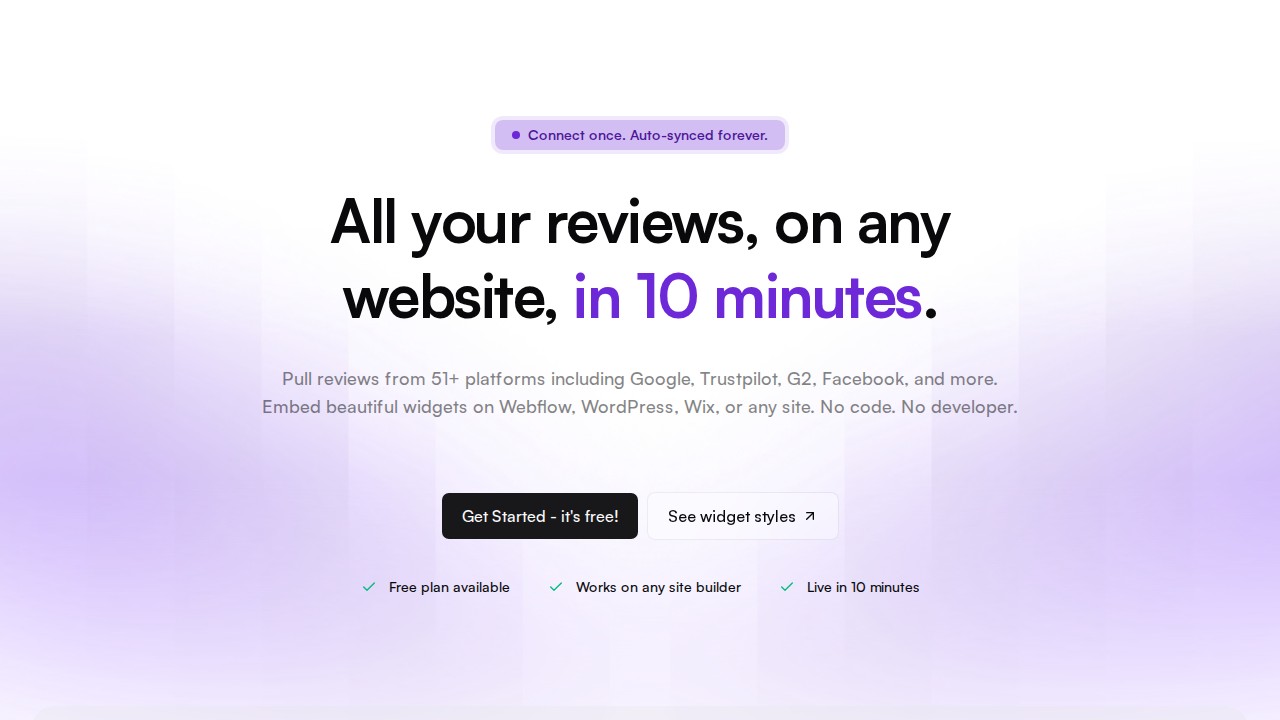
Bragly is the TrustPulse alternative I would start with when the issue is not a lack of activity popups. It is a lack of customer proof that a visitor can inspect at their own pace. TrustPulse can show a recent event well. Bragly handles the reviews, testimonials, collection, moderation, and page placement that should still be useful after that event disappears.
That matters when feedback is spread across public sources. A SaaS team may have G2 and Capterra reviews. An e-commerce brand may have Shopify, marketplace, Google, and Trustpilot reviews. An agency may own proof across several client sites. A rotating notification gives a momentary signal, but it does not give visitors much context. A page-level display lets them see the pattern for themselves.
Bragly connects to 47+ review platforms and supports fresh text and video collection, moderation, tags, highlights, analytics, AI-assisted review responses, Wall of Love pages, and 30+ widget layouts. Its free plan supports up to 100 reviews, while Pro starts at $14 per month. It is not a one-for-one replacement for a current-purchase notice, but it is a practical fit for teams that want imported proof and new customer stories in the same workspace.
| Where Bragly fits | What it gives you | Where TrustPulse may still fit better |
|---|---|---|
| Reviews are scattered across public sources | 47+ source connections, moderation, tags, filters, and page-ready displays | You only need a live message from one current event feed. |
| A visitor needs proof that remains visible | 30+ layouts, Wall of Love pages, and widgets filtered by source, rating, keyword, or tag | A short activity notice is the entire campaign. |
| Teams own customer proof together | Shared work across reviews, widgets, forms, and analytics | Your account is only for notification campaigns. |
A testimonial widget can sit beside a CTA, on a product page, near a pricing explanation, or in a dedicated customer-stories area. That gives visitors enough time to read the evidence. You can show only reviews relevant to that page instead of placing every event into one rotating format.
Bragly also fits when review work continues after display. Teams can use AI-assisted review responses to draft replies, review the text before sending, and keep source material organized. For agencies and internal teams, teams and agency workflows support collaborators, client handoffs, and separate ownership rather than shared logins.
2. ProveSource

ProveSource is the closest substitute here if live activity remains the center of your campaign. Its public product materials describe streams for individual actions, combinations that aggregate activity over a selected period, live-visitor counters, review notices, informational messages, and social counters. That gives it a wider set of notification forms than a simple recent-purchase popup.
The billing conversation is easier because it stays close to the visitor model that TrustPulse uses. ProveSource advertises a forever-free plan and lists traffic-based paid options. It also describes timing and display rules, auto tracking, webhooks, page-visit activity, and integrations for common commerce and marketing tools.
This is the sensible switch when you like the basic TrustPulse workflow but need more ways to frame the activity. It is less compelling when the visitor needs a fuller review rather than a small notice. In that case, a popup that says someone left feedback may be less useful than the feedback itself.
| Where ProveSource fits | What it gives you | Where TrustPulse may still fit better |
|---|---|---|
| You want to keep live activity front and center | Streams, combos, live visitors, reviews, informational messages, and counters | You prefer TrustPulse’s compact campaign categories and current annual entry pricing. |
| A free starting point is useful | A vendor-advertised forever-free plan | You already know your traffic and need only a small paid campaign setup. |
| Activity arrives from several sources | Auto tracking, webhooks, and a broad integration list | Your event capture is already working cleanly through TrustPulse. |
ProveSource is a notification system first. Choose it when that is exactly what you want, not because a free plan makes every kind of customer proof interchangeable.
3. Fomo

Fomo is the better TrustPulse alternative when notification sends are the unit you want to budget around. Its Starter plan is listed at $25 per month for 8,000 notifications and one website. Higher plans raise the notification allowance, add unlimited websites, and make inline proof available.
That is a material change from a visitor-based limit. A site with steady traffic but a modest number of notification opportunities may find the math easier. A site that creates many events per visitor may reach its allowance quickly. The point is not that one meter is cheaper. The point is that it makes a different assumption about how your campaign is used.
Fomo also lists active-visitor counters, custom page rules, roundup notifications, API access, and 30+ configurable settings. It is a good option when notification design and delivery are the focus and you want the option to place proof within a page, not only in a corner popup.
| Where Fomo fits | What it gives you | Where TrustPulse may still fit better |
|---|---|---|
| You estimate campaign use by sends | A notification-based allowance rather than a visitor cap | A monthly unique visitor meter better matches your traffic pattern. |
| You need programmatic or page-specific control | API access, custom page rules, and configured roundups | You want a smaller set of campaign controls at a lower annual entry point. |
| Inline proof matters | Inline availability on higher plans | You only need floating activity notices. |
Fomo earns a place on this list because the pricing model changes the buying decision. Before switching, estimate how many notices you actually plan to show rather than comparing the first price you see.
4. Nudgify
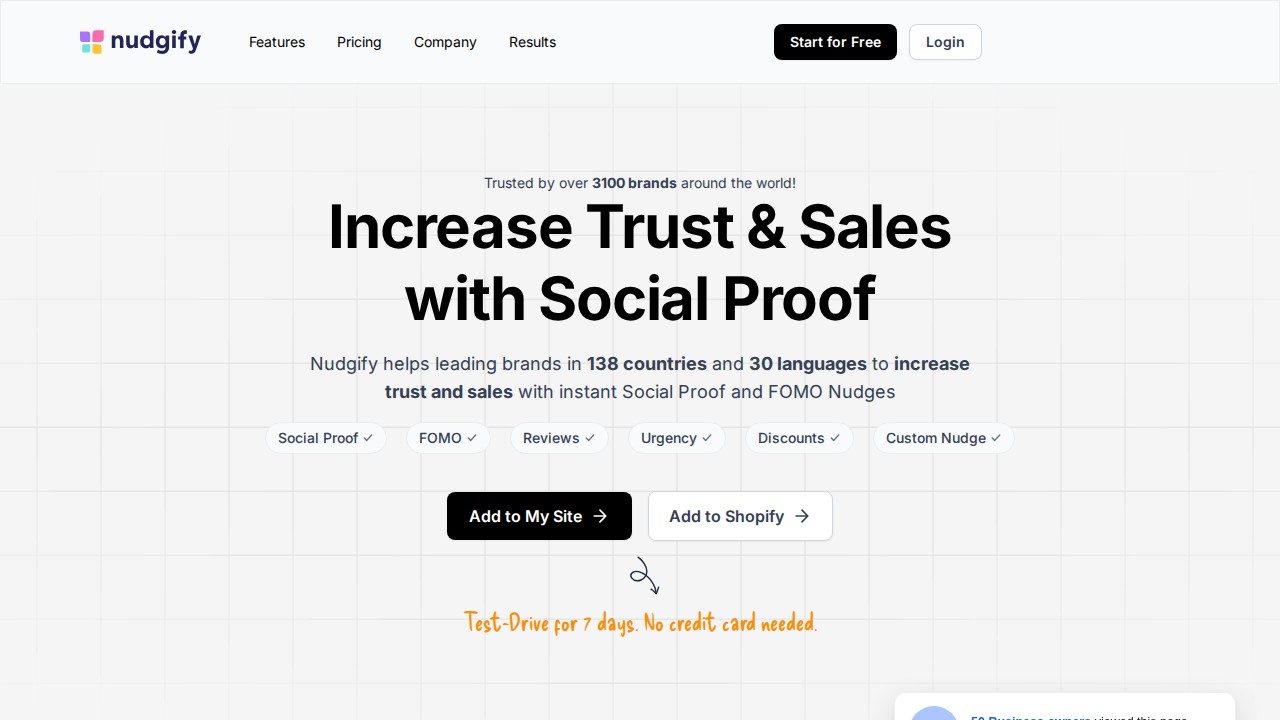
Nudgify is the TrustPulse alternative for teams that want visitor proof to influence a specific shopping decision. Recent purchase notices are only part of its catalog. Its product materials also cover stock levels, delivery information, discounts, form submissions, reviews, and other urgency or friction prompts.
That makes Nudgify especially relevant to e-commerce brands, but the use case is broader than a cart popup. A SaaS team can show signups or review cues. A service business can show inquiries. A seller with a physical product can use stock and delivery context at the point where it matters.
The basic Lite plan is listed at $9 per month for 10,000 impressions, unlimited websites, unlimited nudges, and three reviews. An impression meter is another distinct model. It counts the times a nudge is seen, so it needs its own forecast rather than a direct conversion from visitor traffic or notification sends.
| Where Nudgify fits | What it gives you | Where TrustPulse may still fit better |
|---|---|---|
| A store needs more than activity notices | Stock, delivery, discount, urgency, friction, review, and purchase cues | Simple purchase or signup activity is all you need. |
| The page needs a decision-specific prompt | Nudges tied to checkout and product context | A compact notification campaign is preferable. |
| Usage should be measured by exposure | An impressions-based plan model | You want to estimate usage by unique visitors instead. |
Choose Nudgify when the moment of persuasion matters as much as the evidence. If you only need an authentic activity notification, it may be more product than you need.
5. WiserNotify
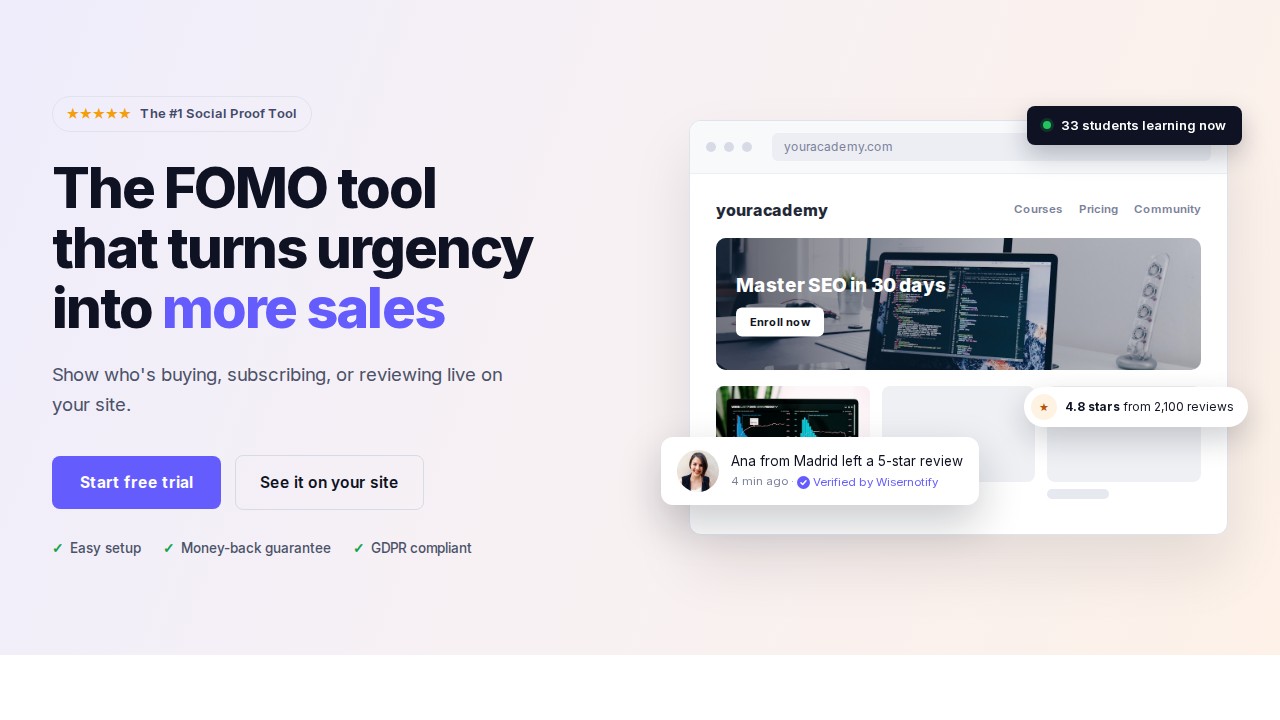
WiserNotify is the choice for teams that want a wider notification toolkit with experimentation built in. Its pricing and feature material calls out social-proof and urgency widgets, many templates, 200+ integrations, timing and data controls, reports, A/B testing, and goal tracking. Higher plans add inline social-proof messaging.
That creates a different relationship with campaign building. TrustPulse is useful when you want to create a clean campaign and put it live. WiserNotify is more suitable when your team expects to test messages, formats, and page behavior over time.
Its Basic plan is listed at $59 per year for 5,000 monthly visitors. Pro begins at $16 per month and adds premium templates, branding control, A/B testing, goal tracking, custom CSS, and a teammate. Growth adds inline messaging and larger visitor allowances.
| Where WiserNotify fits | What it gives you | Where TrustPulse may still fit better |
|---|---|---|
| You need more formats to test | Broad template choice, widget forms, and campaign variation | You want fewer options and a faster campaign setup. |
| Measurement must guide iteration | A/B testing, goal tracking, reports, and engagement data | You only need basic activity proof. |
| Proof should appear inline as well as in popups | Inline messages on Growth | A floating notification handles the use case. |
WiserNotify is not automatically the better choice because it has more settings. It is the better choice when your team has a real testing plan and enough traffic to learn from those experiments.
How to choose a TrustPulse alternative
Choose by the unit that is constrained first. TrustPulse’s introductory annual plans are tied to monthly unique visitors. ProveSource also uses traffic as a central pricing input. Fomo focuses on notification sends. Nudgify focuses on impressions. WiserNotify uses visitor tiers. A lower starting figure can be misleading when the meter is not the same.
Next, choose the visitor cue. A recent purchase, signup, live-visitor counter, time-window aggregate, low-stock prompt, delivery message, review, and inline trust message are not interchangeable. Make a short list of the three situations where your page loses confidence today. Then choose the product that can show an honest cue at those moments.
Finally, decide whether a notification is enough. If your page needs people to read actual customer feedback, compare a review management software workflow rather than only another popup platform. A single review dashboard and a page-level display can give the visitor a fuller reason to trust the business.
Final thoughts
TrustPulse remains a sensible option for simple real-time activity campaigns with visitor-based pricing. Switch only when the meter, campaign type, or proof format does not match the job your page needs to do.
ProveSource is the closest live-notification replacement. Fomo makes more sense when notification volume is the useful unit. Nudgify is the better fit for decision-specific e-commerce nudges. WiserNotify is the stronger option for template range and testing. Bragly is the answer when the real need is proof that stays visible, gives context, and can be managed as a long-term customer asset.
If your visitors need more than a passing cue, start with how you want to display reviews on your website. That decision often makes the right category clear before you ever compare plans.
Frequently asked questions
What is the best TrustPulse alternative for proof that stays on a website?
Bragly is the better fit when the goal is to show imported reviews, new customer stories, and filtered widgets that a visitor can read at their own pace. It is built for lasting page-level proof rather than only short activity messages.
Is ProveSource a free TrustPulse alternative?
ProveSource advertises a forever-free plan. It is a close fit when you still want live activity notifications, visitor-based usage, and a broader range of notification formats. Check the current plan conditions before choosing a tier.
Is Fomo cheaper than TrustPulse?
The plans use different meters, so the displayed starting price is not the whole answer. TrustPulse uses monthly unique visitors on its current pricing page, while Fomo lists notification allowances. Estimate the visitor traffic and sends your campaign will create before comparing cost.
Is Nudgify better than TrustPulse for an online store?
Nudgify is a stronger fit when an online store needs stock, delivery, discount, urgency, and friction prompts beside social proof. TrustPulse is still a sensible option when simple activity campaigns are enough.
Which TrustPulse alternative is best for testing notification campaigns?
WiserNotify is the more suitable choice when A/B tests, goal tracking, broader templates, and inline proof are part of an ongoing campaign plan. Its extra controls are most useful when the team has enough traffic and a clear test to run.