

Looking for a Shorter Overview?
AI Summary
Key Moments
Understand each alternative's unique focus
Each Loox alternative addresses different business needs beyond product reviews, including loyalty, retention, and public review aggregation.Pricing and plan structure matter
Judge.me offers fixed pricing, unlike Loox which has order-based plans affecting cost.Integration of reviews with customer marketing
Platforms like Okendo and Stamped connect reviews with loyalty, referrals, quizzes, and lifecycle messaging.Test migration before full switch
Export and verify a small review sample to ensure data integrity before moving to a new platform.Loox is a good product. It is built for Shopify stores that want buyer photos and videos to do more selling on product pages, in email, and across social channels. The focus is clear: ask for visual reviews, reward the customer for sharing them, then show that proof in polished widgets.
That does not mean every store should use it. A brand may have reviews spread across Google, marketplaces, G2, and direct feedback forms. Another may want unlimited review collection at a fixed price. A third may be past the point where reviews stand alone and now needs loyalty, referrals, lifecycle messages, or customer surveys in the same program.
The alternatives below are not interchangeable. Judge.me is a close Shopify review-app comparison. Okendo and Stamped move into customer marketing and retention. REVIEWS.io brings product and company reviews, UGC, surveys, and reputation work together. Bragly takes a different path: it helps teams bring public reviews and fresh customer stories together, then publish them wherever their own website needs proof.


I would also check how the plan changes as order volume grows. Loox has a free tier for lower-volume stores, then paid plans that add functions and may tie usage to orders.
Quick comparison
| Tool | Best for | Starting point | Choose it when |
|---|---|---|---|
| Bragly | Public reviews and customer stories across your own web properties | Free up to 100 reviews; paid from $14/month | Reviews already live on several public platforms or need to appear beyond a Shopify storefront. |
| Judge.me | Flat-price Shopify product and store reviews | Free or $15/month | You want unlimited collection without order-based plan growth. |
| Okendo | DTC customer marketing around reviews | From $19/month | Reviews must work with loyalty, quizzes, referrals, and surveys. |
| Stamped | Reviews connected to lifecycle and retention programs | Demo-led evaluation | Retention campaigns and repeat purchase behavior are part of the review plan. |
| REVIEWS.io | Reviews, UGC, Seller Ratings, surveys, and reputation work | 14-day trial with published plans | Product and company reviews need to work alongside third-party collection, surveys, and conversion tools. |
Key takeaways
- Pick Bragly when your proof is spread across public platforms, direct feedback, and client or marketing sites rather than one Shopify catalog.
- Pick Judge.me when predictable Shopify review pricing matters more than a visual-review specialty.
- Pick Okendo when reviews need to feed loyalty, referrals, quizzes, and surveys.
- Pick Stamped when review collection belongs inside a retention and lifecycle program.
- Pick REVIEWS.io when reviews, UGC, Seller Ratings, surveys, and reputation work need to live in one platform.
1. Bragly: Best for public reviews and website proof beyond Shopify
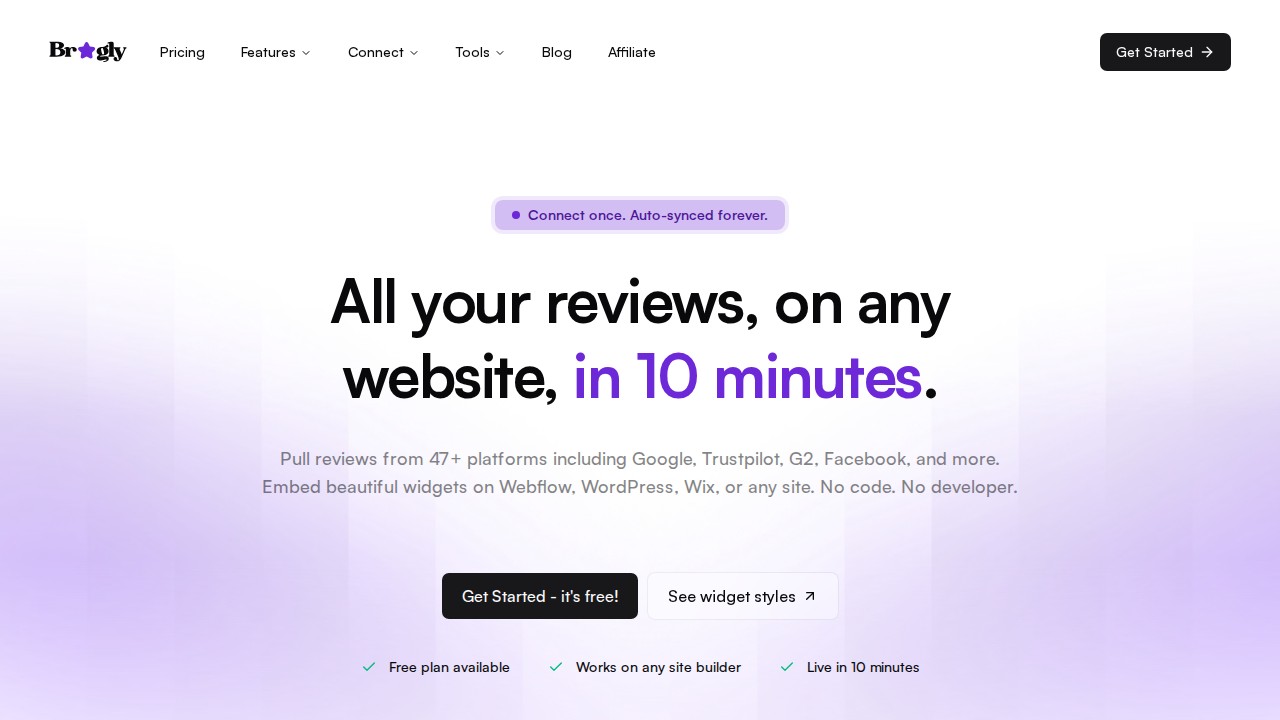
Bragly is the best Loox alternative for a team whose strongest customer proof does not begin and end on a product page. It brings reviews from more than 47 public platforms into one workspace and lets teams collect fresh text and video feedback through direct forms. That makes it useful when a brand has reviews on Google, G2, Capterra, Facebook, app stores, marketplaces, and its own customer channels.
This is a different job from Loox. Loox is purpose-built for visual reviews in Shopify. Bragly is for turning a scattered collection of public review sources and new submissions into a usable proof library for your own website. A team can select the right review for a home page, service page, case-study page, campaign page, or client handoff without copying quotes by hand. If the broader task is monitoring and responding to reviews, our guide to review management software gives more context.
The free plan supports up to 100 reviews, while paid plans start at $14 monthly. Teams can use text and video forms, QR codes, email campaigns, moderation, AI response suggestions, custom Wall of Love pages, webhooks, and more than 30 display layouts. That mix fits agencies managing client proof, SaaS teams with review-site feedback, local businesses with Google reviews, e-commerce brands, and larger teams that need a single source of truth.
| What Bragly adds | Why it may suit a Loox user |
|---|---|
| 47+ public review platforms | Keep customer proof from sources that already matter to your buyers. |
| Text and video collection forms | Add new feedback without limiting collection to post-purchase Shopify flows. |
| 30+ display layouts | Use a grid, carousel, badge, strip, or single quote where each page needs credibility. |
| AI reply suggestions and moderation | Draft a response, review the tone, and decide what proof is ready to publish. |
| Custom domains, webhooks, and agency transfer | Build branded proof pages, connect activity to other systems, and hand a project to a client. |
Choose Bragly if the problem is fragmented proof and flexible website display. It is less suited to a store that only wants visual reviews attached to a Shopify product catalog. In that case, Loox, Judge.me, or a larger Shopify review suite may be a closer fit.
2. Judge.me: Best for flat-price Shopify reviews
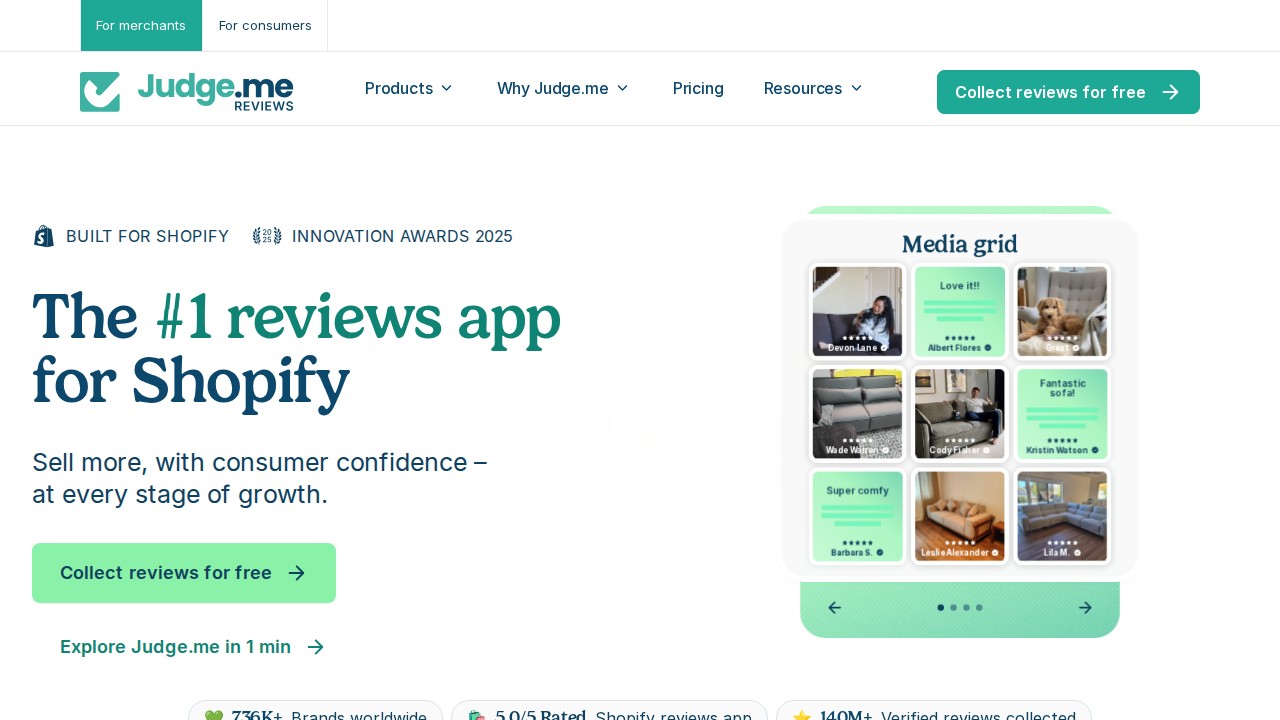
Judge.me is the alternative I would look at first when the main concern is pricing that stays easy to predict. Its Free plan and $15 monthly Awesome plan support unlimited product and store reviews, with no order caps or usage fees. That differs from Loox’s paid tiers, where plan needs can change with volume and access to advanced visual-review features.
It is still a full Shopify review product, not a stripped-back free tool. Judge.me supports automated requests, imports, text, photo, and video reviews, 16+ widgets, Google Shopping and other syndication routes, AI summaries, reply suggestions, translations, referrals, and coupons. The product is strongest when the store needs reviews to do their job reliably without turning app pricing into a separate planning exercise.
Judge.me gives a Shopify team a broader general review toolkit at a simple price. A fashion, beauty, food, or home-goods brand that depends heavily on customer imagery may prefer Loox’s visual approach. A store that wants unlimited collection and a lower, fixed cost may find Judge.me easier to live with.
| What Judge.me adds | Why it may suit a Loox user |
|---|---|
| Free or $15 monthly pricing | Keep plan cost steady as order volume changes. |
| Unlimited product and store reviews | Collect as much feedback as the store can earn. |
| 16+ widgets | Choose among standard product-page, gallery, and review-display formats. |
| Google, Meta, TikTok, and Shop App routes | Put ratings where shoppers discover products. |
| AI summaries, replies, and translations | Help shoppers read through more review content and help teams respond. |
Choose Judge.me when pricing certainty and unlimited Shopify review collection are the deciding factors. It is not the right choice if the work extends beyond Shopify or if the store wants reviews to sit inside a wider retention platform.
3. Okendo: Best for DTC customer marketing around reviews
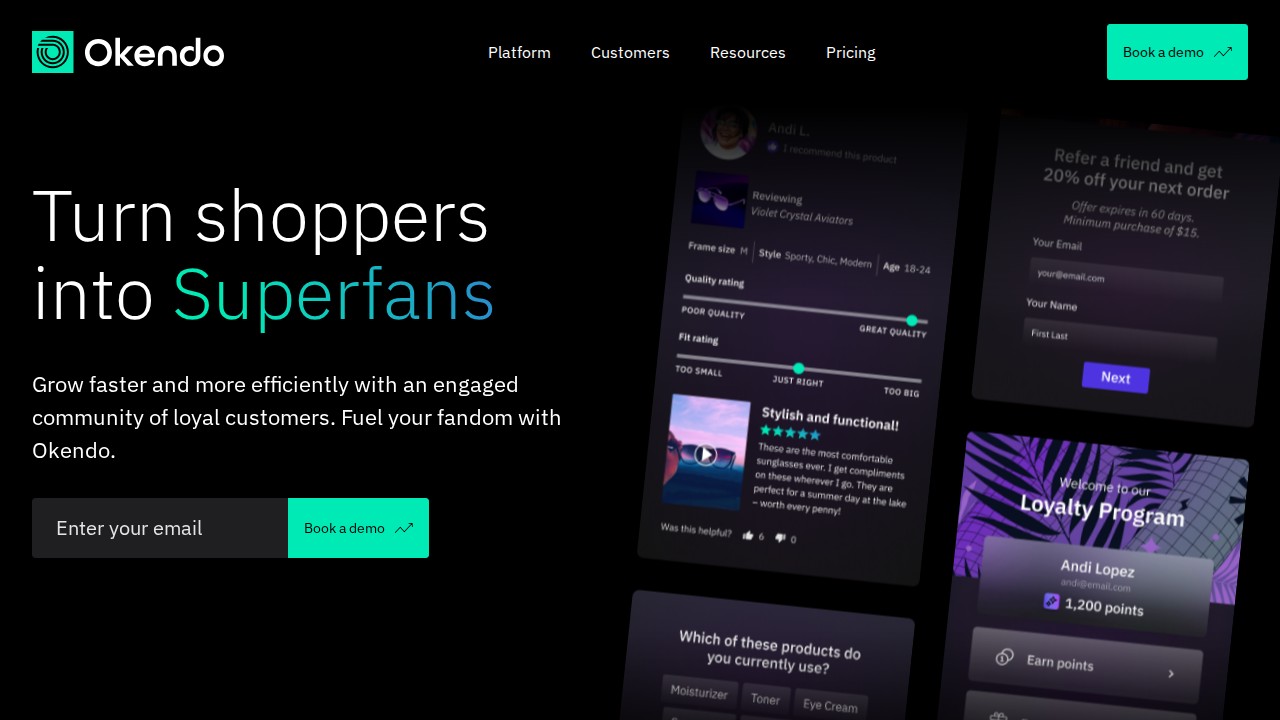
Okendo belongs on this list because it treats reviews as one part of a larger customer-marketing system. Its platform brings together reviews, loyalty, quizzes, referrals, and surveys. That can change the buying decision for a DTC brand that is trying to connect feedback with repeat purchase behavior, customer segmentation, and community-building rather than simply add a review widget to product pages.
Loox can be a better choice when visual reviews are the core project. Okendo becomes attractive when the team has already decided that reviews must share customer data and triggers with other programs. A review can inform a reward, a quiz can change how a shopper is segmented, and a referral can give the brand another way to activate a happy customer. It is a wider operating model, which means it asks for more planning than a focused review app.
Okendo says plans start at $19 monthly, but a serious evaluation should go beyond the opening price. Ask which products are needed, how review volume affects the plan, which integrations are included, and whether the team will actually use loyalty, quizzes, or surveys. Paying for a combined platform makes sense only if those connected programs have an owner and a clear job.
| What Okendo adds | Why it may suit a Loox user |
|---|---|
| Reviews, loyalty, quizzes, referrals, and surveys | Keep several customer programs connected rather than separate. |
| Customer-marketing focus | Use review content as input for follow-up activity and retention work. |
| Google, TikTok Shop, and broader integration options | Extend social proof and customer data into other channels. |
| Shopify-focused platform | Keep the evaluation centered on a Shopify commerce workflow. |
| Demo-led product exploration | Assess the whole program rather than selecting a widget in isolation. |
Choose Okendo when the store is ready to run a connected customer-marketing program. It is likely more system than a team needs when the immediate goal is affordable visual review collection.
4. Stamped: Best for reviews tied to loyalty and lifecycle
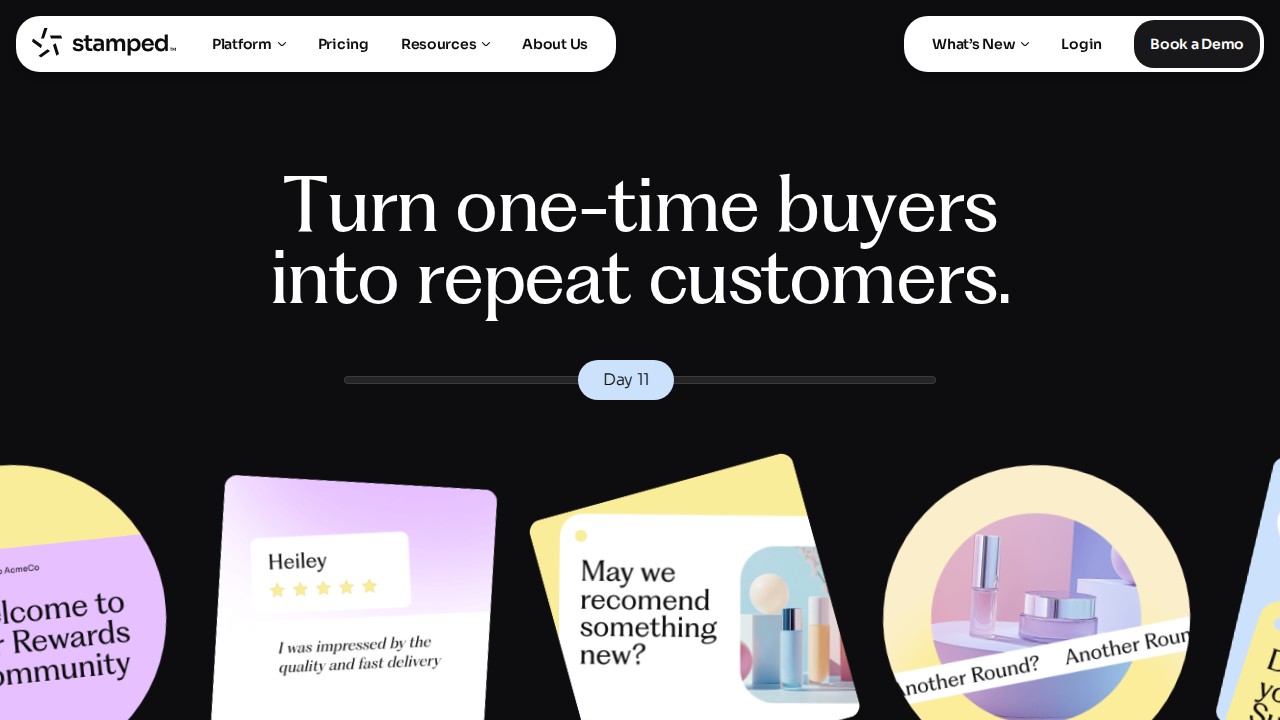
Stamped is a better Loox alternative for a retention-minded Shopify brand. Its current positioning connects Reviews, Loyalty, and Lifecycle. The idea is not only to ask for a review after a purchase. It is to use customer behavior and feedback to decide what message, reward, or reminder should happen next.
That is useful for brands with replenishment cycles, repeat-purchase products, an active loyalty program, or a marketing team that already runs post-purchase and win-back flows. Review collection can still include photo and video content, but the broader question becomes how that content fits into customer retention. A shopper who writes a positive review could earn a reward, receive a referral prompt, or enter a more thoughtful follow-up sequence.
It also introduces a different level of setup. A simple Loox replacement can be installed and configured around product reviews. Stamped requires a team to decide how reviews, points, lifecycle messages, and customer data should work together. The platform is worth comparing when that coordination is a real priority, not when a brand simply wants a less expensive photo-review widget.
| What Stamped adds | Why it may suit a Loox user |
|---|---|
| Connected Reviews, Loyalty, and Lifecycle products | Put review collection inside a larger repeat-purchase plan. |
| Lifecycle automation | Trigger messages around reorder timing, win-back, and other customer moments. |
| Loyalty and referral programs | Give happy customers an incentive to return or bring someone new. |
| Review-driven customer insight | Turn feedback into material for retention decisions. |
| Shopify-oriented setup | Keep reviews and retention close to the commerce operation. |
Choose Stamped when review collection has to feed a real retention workflow. It may be a poor fit when the brand does not need lifecycle automation or wants a low-effort review app with a simple plan.
5. REVIEWS.io: Best for reviews, UGC, and wider feedback operations
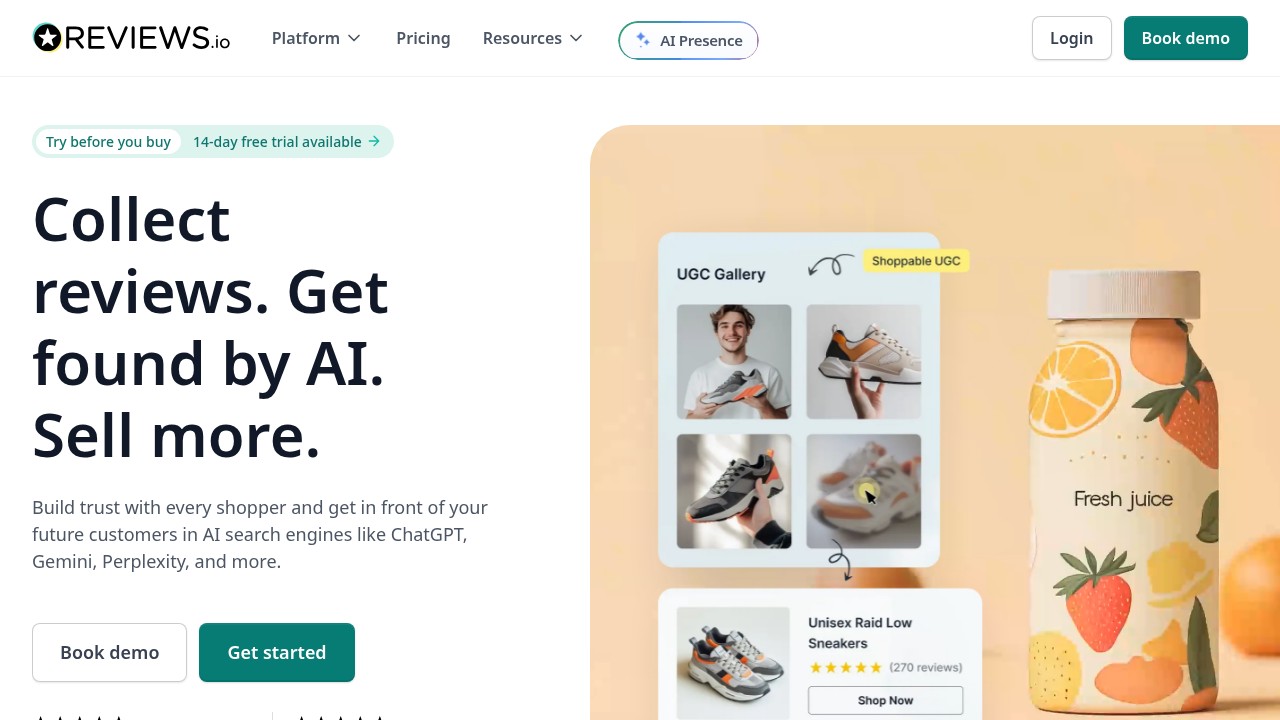
REVIEWS.io is the alternative to consider when a visual Shopify review app needs to become a broader feedback operation. It combines product and company reviews with photo and video collection, review invitations, on-site widgets, review importing, third-party review collection, Google Seller Ratings, surveys, and reputation features. That gives a team more routes to collect and use proof than a product-review workflow alone.
This can suit a brand that needs company-level credibility as well as product-page reviews. A shopper may see a product review on a storefront, while a prospective buyer, wholesale partner, or ad visitor needs proof about the company itself. Teams can also use survey and NPS tools to collect feedback at more points in the customer journey, then use the patterns they find to improve the experience.
Its public plans include a 14-day trial and scale by monthly review invites. That makes invite volume, channels, and feature needs worth checking before a move. A brand that only needs a photo-review gallery may find the extra functions unnecessary. A team that needs company reviews, Seller Ratings, surveys, importing, and review management in one place may find the broader scope worthwhile.
| What REVIEWS.io adds | Why it may suit a Loox user |
|---|---|
| Product and company reviews | Cover storefront proof and brand-level feedback in one platform. |
| Photo, video, and shoppable UGC | Put customer content to work on product and discovery pages. |
| Google Seller Ratings and review importing | Carry existing proof into search and simplify a migration. |
| Surveys, NPS, and reputation tools | Gather feedback beyond a product-review request. |
| Published trial and invite-based plans | Match the plan discussion to expected collection volume. |
Choose REVIEWS.io when product reviews need to work with company proof, third-party collection, surveys, and reputation activity. It is not the default alternative for a merchant who only needs simple visual review collection.
How to choose the right Loox alternative
The fastest way to make this choice is to start with the proof you already have. If it mostly comes from product buyers and needs to live on Shopify product pages, compare Loox and Judge.me first. If your review program should trigger loyalty, referrals, surveys, or quizzes, look at Okendo. If repeat purchase and lifecycle messaging are the main commercial goals, look at Stamped. If product reviews need to live alongside company reviews, Seller Ratings, surveys, and reputation work, add REVIEWS.io to the evaluation.
Bragly is the different answer when the proof is already spread across public review sites, marketplaces, direct customer feedback, and multiple web properties. In that situation, the priority is not only getting another product-review tool. It is creating a manageable library of customer voices, then choosing the right way to display reviews across your website wherever a buyer needs reassurance.
Use a short pilot before moving everything. Export a sample of existing reviews and check whether ratings, customer details, dates, product associations, photos, videos, replies, and translations arrive correctly. Build one product-page widget and one non-product display before committing the full history. If an agency manages several brands, verify permissions and project transfer early; team and agency handoffs can matter as much as the review widget.
| If this is your main need | Start with |
|---|---|
| Public reviews, direct feedback, and proof across any website | Bragly |
| Unlimited Shopify reviews at a stable cost | Judge.me |
| Reviews plus loyalty, quizzes, referrals, and surveys | Okendo |
| Reviews as part of repeat-purchase and lifecycle work | Stamped |
| Product and company reviews plus surveys and Seller Ratings | REVIEWS.io |
Final thoughts
Loox remains a strong choice when visual reviews are central to how a Shopify product sells. You do not need to move just because another app has a longer feature list.
Move when the model no longer matches the work. That might mean reviews from too many public sources, a pricing structure that no longer feels sensible, a need for flat Shopify review pricing, or a retention program that needs more than visual proof. Pick the platform that matches the job you actually need done next, then test the migration with a small, representative set of reviews before making a final call.
Frequently asked questions
What is the best Loox alternative overall?
Bragly is the strongest overall choice for teams that need to collect public reviews from many sources, add fresh text and video feedback, and display proof across their own website. The better choice can change if your work is Shopify-only, retention-led, or part of a larger customer-marketing program.
Is there a free alternative to Loox?
Yes. Bragly has a free plan up to 100 reviews, and Judge.me has a free Shopify plan with unlimited review collection. Loox also has a free tier for lower-volume stores. The right free option depends on where your reviews come from and where you need to show them.
Which Loox alternative is best for Shopify stores?
Judge.me is a good fit for Shopify stores that want unlimited product and store review collection at a fixed price. Okendo is a better fit when Shopify reviews need to connect with loyalty, quizzes, referrals, and surveys.
Can I migrate my Loox reviews to another platform?
Most review platforms support imports, but the fields that arrive can vary. Test a small export first and verify ratings, dates, authors, product links, photos, videos, replies, and translations before moving the full history.
Which Loox alternative is best when reviews come from several public sources?
Bragly is built for this situation. It brings reviews from more than 47 public sources into one workspace, then combines them with fresh text and video feedback so a team can choose the right proof for each page.